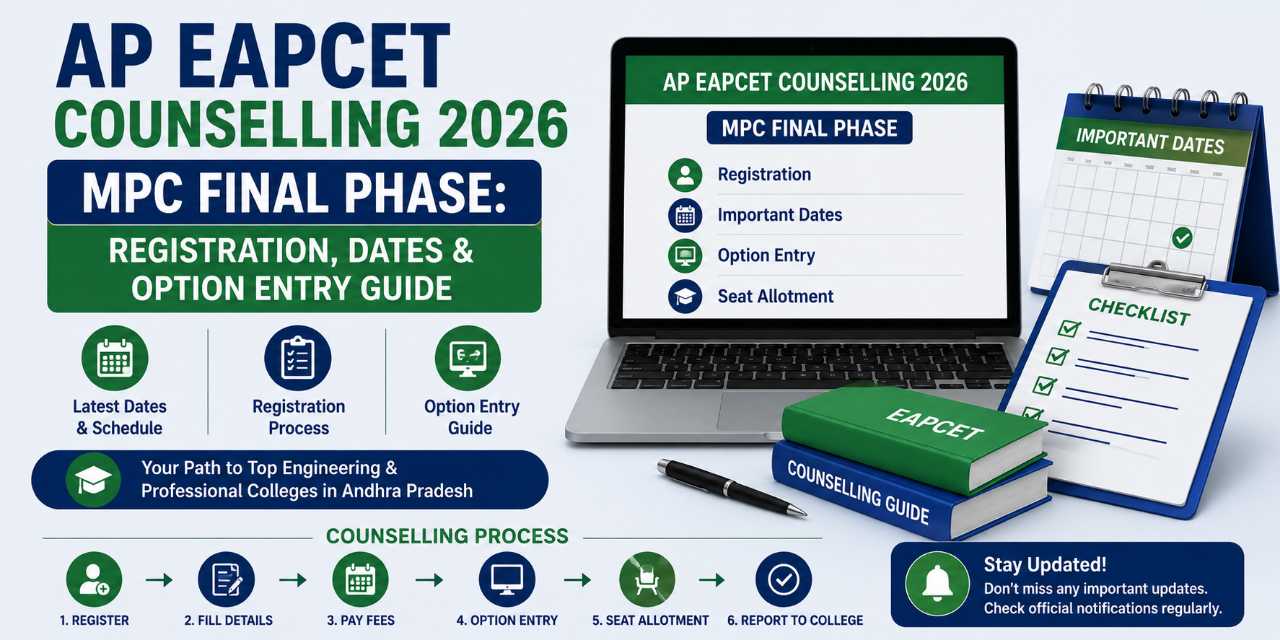

The Andhra Pradesh State Council of Higher Education (APSCHE) has started the AP EAPCET Counselling 2026 MPC final phase for Mathematics–Physics–Chemistry (MPC) stream candidates. Registration, processing fee payment, and web option entry are live on the official Centralised Admission Process (CAP) portal at cap.apcfss.in. If you appeared for AP EAPCET 2026 with an MPC rank and still need an engineering or pharmacy seat in Andhra Pradesh, this is your last structured counselling round before spot admissions begin.
This article explains the complete final phase schedule, who can participate, fee structure, documents required, and practical tips to fill college options wisely. Whether you are a first-time registrant or a candidate upgrading from an earlier allotment, the deadlines are tight — missing even one step can remove you from seat allotment on August 26, 2026.
What Is AP EAPCET MPC Final Phase Counselling?
AP EAPCET (Engineering, Agriculture and Pharmacy Common Entrance Test) is Andhra Pradesh’s state-level entrance exam for professional degree admissions. The MPC stream covers B.Tech, B.Pharm, and related programmes offered by government, aided, and private colleges affiliated with APSCHE and Jawaharlal Nehru Technological University (JNTU) campuses.
Counselling happens in multiple phases. Earlier rounds allocate seats to high-ranking candidates and those who registered on time. The final phase is the last centralised round where remaining vacant seats across engineering and pharmacy branches are offered to eligible rank holders. After this phase, only spot or institutional-level admissions may remain for unfilled seats.
For students comparing state-level engineering admissions across India, processes like MHT CET counselling in Maharashtra or IPU CET seat allotment in Delhi follow similar patterns — registration, document verification, preference filling, and allotment — though dates and fee rules differ by state.
AP EAPCET 2026 MPC Final Phase Schedule
APSCHE has published fixed date windows for each counselling activity. Complete every step within its window; the portal will not accept late submissions once a deadline passes.
| Counselling Activity | Date |
|---|---|
| Registration and Processing Fee Payment | August 17 to 20, 2026 |
| Online Certificate Verification | August 17 to 21, 2026 |
| Web Option Entry | August 17 to 22, 2026 |
| Freezing of Options | August 23, 2026 |
| Seat Allotment Result | August 26, 2026 |
| Self Reporting and Reporting at College | August 27 to 31, 2026 |
Key Dates You Must Not Miss
- August 20, 2026: Last day for registration and fee payment.
- August 21, 2026: Last day for online certificate verification.
- August 22, 2026: Last day to enter or modify web options.
- August 23, 2026: Options are frozen automatically — no further changes.
- August 26, 2026: Seat allotment result published on the CAP portal.
- August 27–31, 2026: Self-reporting online and physical reporting at the allotted college.
Candidates should treat August 17–20 as the critical registration window. Do not wait until the last evening of August 20; server load and payment gateway delays are common on deadline days.
Who Is Eligible for the Final Phase?
The final phase is open to MPC stream candidates holding a valid AP EAPCET 2026 rank. Several candidate categories can participate:
- Fresh registrants who did not take part in any earlier counselling phase.
- Candidates without allotment who registered previously but did not receive a seat.
- Candidates seeking upgradation who already hold a seat from an earlier phase and want a better college or branch.
Important Rule for Candidates With an Existing Allotment
If you already have a seat from a previous counselling round and you enter fresh options in the final phase, your earlier allotment will be cancelled once you submit new preferences. Only participate for upgradation if you are genuinely willing to risk your current seat for a better option. If your current allotment is acceptable, freezing without re-entry may be safer.
Candidates must meet eligibility criteria set at the time of AP EAPCET application — including age, educational qualification (typically passed or appearing in Intermediate with MPC), and domicile or local/non-local status as defined by APSCHE rules.
AP EAPCET 2026 Counselling Processing Fee
Participation in the final phase requires a non-refundable processing fee paid online through the CAP portal. Accepted payment modes include net banking, debit card, credit card, and UPI.
| Category | Processing Fee |
|---|---|
| OC (Open Category) and BC (Backward Classes) | Rs 1,200 |
| SC (Scheduled Caste) and ST (Scheduled Tribe) | Rs 600 |
Keep the payment receipt or transaction reference number saved. You may need it during certificate verification or if a payment discrepancy appears on your dashboard.
Documents Required for Online Certificate Verification
Certificate verification in AP EAPCET counselling is conducted online. Keep clear scanned copies (PDF or image format as specified on the portal) of the following documents ready before you begin:
- AP EAPCET 2026 rank card and hall ticket
- Class 10 (SSC) marks memo
- Class 12 (Intermediate) marks memo
- Transfer certificate (TC)
- Study certificates from Class 9 through Class 12
- Aadhaar card
- Income certificate (for fee reimbursement or scholarship categories, if applicable)
- Caste certificate (for BC, SC, ST, or other reserved categories)
- Residence or local status certificate of the candidate or parent, as applicable
- Minority or special category certificates, if claimed during application
Document Verification Tips
Upload documents in the correct order and ensure names, dates of birth, and category details match your EAPCET application exactly. Mismatches are a leading cause of verification rejection. If a certificate is rejected, use the correction window before August 21, 2026, to re-upload corrected documents.
Pharmacy aspirants targeting institutions under health sciences universities — such as programmes linked to Dr NTR University of Health Sciences, Vijayawada — should verify whether additional eligibility proofs apply to their chosen branch or category.
How Web Option Entry Works in Final Phase Counselling
Web option entry is the stage where you rank your preferred college–branch combinations. The CAP software allotts seats based on your EAPCET rank, category, local area status, and the order of preferences you submit.
Understanding Option Priority
Your first preference is attempted first. If that seat is unavailable at your rank, the system moves to your second preference, and so on. Therefore, list options in true order of preference — not randomly or alphabetically.
A practical strategy for final phase counselling:
- Place 2–3 dream choices at the top if your rank has a realistic chance.
- Add 5–8 moderate choices where your rank historically fits based on previous year cutoffs.
- Include 5–10 safe options you would genuinely attend rather than leaving seats blank.
- Mix government, university, and reputable private colleges across districts.
- For pharmacy, include both standalone B.Pharm colleges and university-affiliated options.
College and Branch Selection in Andhra Pradesh
Engineering seats are spread across JNTU Anantapur, JNTU Kakinada, JNTU Gurajada Vizianagaram, and numerous private engineering colleges in districts like NTR, Krishna, Guntur, and Visakhapatnam. Exploring colleges in NTR district can help you discover strong regional options beyond the most popular city campuses.
When researching branches, consider accreditation status, placement records, faculty strength, and commute or hostel feasibility — not just college brand name. National private institutions such as SRM Institute of Science and Technology, Chennai or Galgotias College of Engineering and Technology follow separate admission routes, but comparing their programmes can help you judge the value of branches you list within Andhra Pradesh.
Seat Allotment Result and Reporting Process
On August 26, 2026, APSCHE will release the final phase seat allotment result on cap.apcfss.in. Log in with your credentials to check whether a seat has been allotted, and note the allotted college, branch, and category of seat (such as convener quota or management quota, if applicable).
Self Reporting (Online)
After allotment, candidates must complete self-reporting on the CAP portal within the prescribed schedule. Self-reporting confirms that you accept the allotted seat and intend to join the institution. Failure to self-report can lead to cancellation of the allotment.
Reporting at the Allotted College
Physical reporting at the college campus is mandatory between August 27 and 31, 2026. Carry original documents and photocopies as listed in the allotment memo. Pay the prescribed tuition or admission fee to confirm your seat.
At reporting, verify:
- Allotment letter and fee payment receipt
- Original certificates for final verification by college officials
- Hostel application deadlines, if you need accommodation
- Branch change or sliding rules — usually not available after final reporting in this phase
Why the Final Phase Matters for MPC Candidates
The final phase is often the last opportunity to secure a seat through the centralised convener quota before colleges move to spot admissions for remaining vacancies. Vacant seats in popular branches — Computer Science, Electronics and Communication, Artificial Intelligence and Data Science, and Civil Engineering — may become available as candidates fail to report or withdraw.
This round also benefits candidates who improved their strategy after observing earlier cutoff trends. If you underestimated safe options in phase one or two, the final phase lets you recalibrate with realistic preferences based on actual seat movement data published on the portal.
Pharmacy candidates should note that B.Pharm seats sometimes remain open longer than top engineering branches, especially in district-level colleges. Listing pharmacy options alongside engineering alternatives — if you are eligible for both — can increase your chances of securing any professional seat in this cycle.
Common Mistakes to Avoid During Final Phase Counselling
- Missing the fee payment deadline — registration alone is incomplete without fee payment.
- Uploading blurry or incorrect documents — leads to verification failure and loss of allotment eligibility.
- Entering too few options — if all listed choices fill before your rank, you receive no seat.
- Listing unrealistic top preferences only — balance ambition with safe backups.
- Ignoring local/non-local status rules — some seats are reserved for local candidates in specific areas.
- Re-entering options without understanding cancellation rules — existing allotments are cancelled when fresh options are submitted.
- Not freezing options by August 23 — unfrozen or incomplete option lists may not be considered.
- Skipping self-reporting after allotment — the seat may be forfeited and given to the next candidate.
Action Plan: Week-by-Week Checklist for Candidates
Use this checklist to stay on track during the final phase window:
- Day 1 (August 17): Visit cap.apcfss.in, start registration, pay processing fee, and begin document uploads.
- By August 20: Complete registration and payment; resolve any payment failures immediately.
- By August 21: Finish certificate verification; fix rejected documents the same day.
- August 21–22: Research cutoffs, shortlist colleges, and enter web options in priority order.
- August 22 evening: Review your full preference list with a parent, teacher, or counsellor.
- August 23: Confirm options are frozen; download confirmation receipt.
- August 26: Check allotment result immediately after release; note reporting instructions.
- August 27–31: Complete self-reporting and join the allotted college with originals in hand.
What Happens After August 31, 2026?
Once the reporting window closes, colleges may conduct spot admissions or notify candidates on waiting lists for any seats that remain vacant. Monitor the CAP portal and individual college websites for spot admission notifications. Spot rounds typically require immediate payment and document submission, so keep scanned copies and fee arrangements ready.
If you do not receive a seat in the final phase, explore alternative pathways: management quota seats (where permitted and at additional cost), other state counselling exams if you hold multiple entrance ranks, or preparing for AP EAPCET 2027 as a repeat candidate.
Reservation, Quota, and Local Area Rules in AP EAPCET Counselling
Seat allotment in AP EAPCET counselling is not based on rank alone. APSCHE applies reservation for Scheduled Castes, Scheduled Tribes, Backward Classes, Economically Weaker Sections, and other categories as per Andhra Pradesh government policy. Your category certificate must be uploaded and verified before allotment; uncategorised or unverified claims default to Open Category treatment.
Local and non-local status also affects seat availability. Andhra Pradesh divides institutions into local areas — typically linked to districts or university regions. A candidate classified as local to a particular area receives priority for seats reserved under the local quota in colleges within that zone. Non-local candidates compete for remaining seats. Check your local area mapping on the rank card or counselling notification before filling options.
Convener Quota vs Management Quota
Most seats filled through cap.apcfss.in fall under the convener quota, where fees follow government-approved structures. Management quota or category-B seats in private colleges operate under separate rules and higher fee slabs. During web option entry, confirm which quota each listed seat belongs to so you are not surprised by fee differences after allotment.
How to Use Previous Cutoff Data for Smarter Option Entry
Final phase counselling moves quickly, but cutoff data from earlier 2026 phases and previous academic years remains your best planning tool. APSCHE and counselling help desks often publish phase-wise cutoff ranks by college and branch. Compare your current rank against these cutoffs with a buffer of 500 to 1,000 ranks for popular branches, since final phase movement can be unpredictable.
When reviewing cutoffs, focus on branch-level data rather than college-level averages. A college may show a moderate cutoff for Mechanical Engineering but a very competitive cutoff for Computer Science and Engineering in the same year. Institutions like Krishna Institute of Engineering and Technology and other regional engineering colleges illustrate how branch demand varies widely even within a single campus.
Create a spreadsheet with three columns — college-branch name, last allotted rank in your category, and your priority order — before logging into the portal. This reduces panic filling on the last day and helps parents and students agree on a realistic list in advance.
Engineering vs Pharmacy: Choosing the Right Path in Final Phase
MPC candidates may be eligible for both B.Tech and B.Pharm programmes depending on their intermediate subjects and the specific eligibility criteria listed in the AP EAPCET information bulletin. If you qualify for both streams, decide your primary career goal before option entry rather than mixing preferences without a plan.
Engineering pathways lead to roles in software, core manufacturing, infrastructure, and emerging technology sectors. Pharmacy pathways open doors in pharmaceutical companies, clinical research, hospital pharmacy, regulatory affairs, and entrepreneurship in drug retail. Health sciences universities play a central role in pharmacy education across the state, and candidates interested in medical-adjacent fields may also explore design or allied entrance routes such as NID DAT for future design education planning — though that is a separate admission track from EAPCET.
In the final phase, pharmacy seats sometimes remain available at ranks where top engineering branches have long closed. Listing at least two to three pharmacy options among your lower preferences can be a practical safety net if your primary goal is any professional degree in the current academic year.
Official Sources and Where to Check Updates
Rely only on official channels for schedule changes, document requirements, and fee updates. The primary sources are the CAP portal at cap.apcfss.in, notifications issued by APSCHE, and announcements on the AP EAPCET website. Avoid acting on unverified social media posts that may cite outdated dates from previous years.
Bookmark the notifications page on the CAP portal and check it at least twice daily during the final phase window. Colleges also post reporting instructions, fee structures, and hostel details on their official websites after allotment — visit your allotted institution’s site immediately after August 26 to confirm campus-specific deadlines that may fall before the general reporting window ends.
Conclusion
The AP EAPCET Counselling 2026 MPC final phase is the decisive last centralised round for engineering and pharmacy admissions in Andhra Pradesh. With registration and fee payment open until August 20, 2026, certificate verification until August 21, and web option entry until August 22, candidates have a narrow but clear window to secure a seat. Seat allotment results on August 26 will be followed by self-reporting and college reporting through August 31.
Act early, verify documents carefully, build a balanced preference list, and complete every step on cap.apcfss.in before deadlines pass. Whether you are registering for the first time or upgrading an existing allotment, disciplined preparation in this final phase can still place you in a strong engineering or pharmacy programme across Andhra Pradesh.