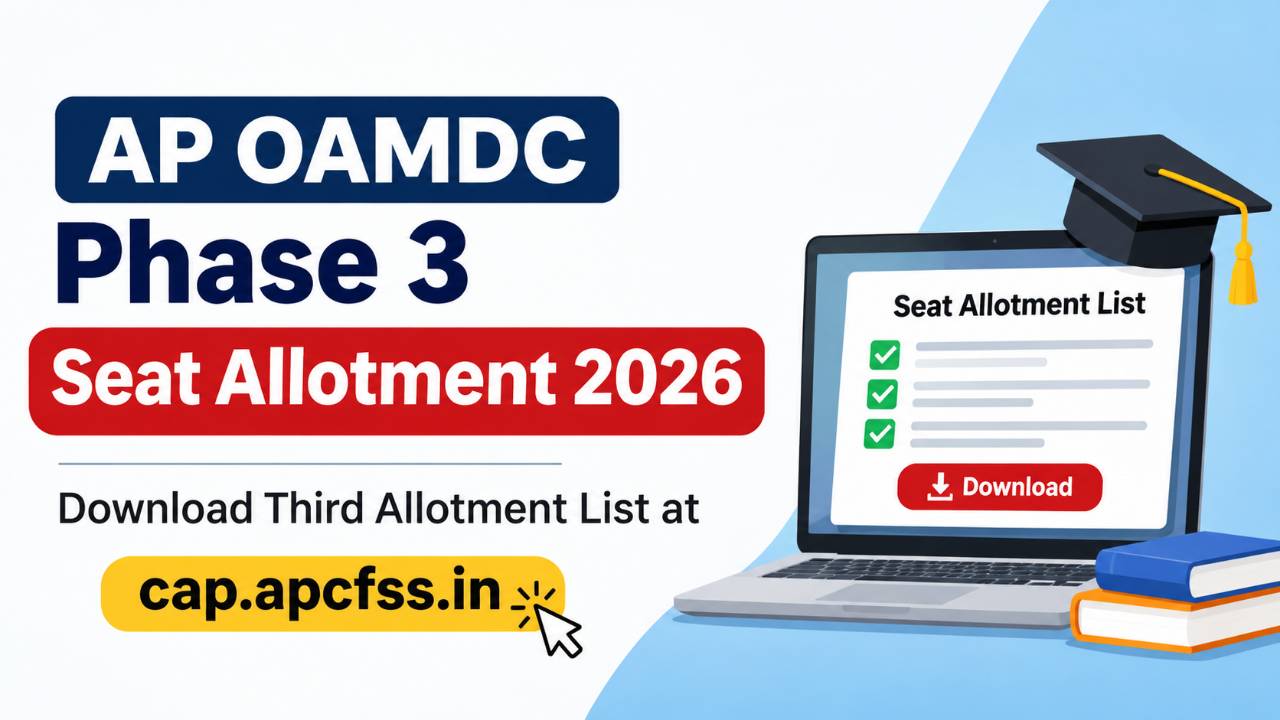
The Andhra Pradesh Online Admission Module for Degree Colleges (OAMDC) is the state-wide gateway for undergraduate admissions into arts, science, commerce, management, vocational, and select integrated programmes at government, aided, and private colleges. When Phase 3 seat allotment 2026 is declared, thousands of Class 12 pass students discover which college and course they have received in the third counselling round. Results are not sent by post or SMS aloneyou must log in on the official portal, verify every field on the allotment list, and complete reporting within the deadline published by the Andhra Pradesh State Council of Higher Education (APSCHE).
If you are tracking OAMDC third allotment list 2026, the primary access point is cap.apcfss.in, managed through Andhra Pradesh Comprehensive Financial Services System (APCFSS) infrastructure. Phase 3 typically follows earlier phases that consumed high-demand seats in popular government colleges and university constituencies. This round matters for students who revised web options, were upgraded from a waiting status, or joined counselling late after certificate corrections. Treat Phase 3 as a decisive milestone: either you freeze a seat you are happy with, or you prepare for the spot round while protecting your current allotment rules as announced in the official brochure.
What Is AP OAMDC and Who Runs Phase 3 Allotment?
OAMDC centralises merit-based seat distribution for roughly 1,400 participating colleges affiliated to state universities such as Andhra University (Visakhapatnam), Sri Venkateswara University (Tirupati), Nagarjuna University (Guntur), Krishna University (Machilipatnam), and Rayalaseema University (Kurnool). The platform excludes engineering and pharmacy admissions, which follow separate counselling channels. Programmes commonly covered include B.A., B.Sc., B.Com., BBA, B.Voc., B.F.A., and certain five-year integrated postgraduate tracks as listed in the current academic year notification.
Phase 3 allotment uses the same core principle as earlier phases: merit rank, reservation rules, local area eligibility, and your submitted web options determine the best available seat at the time of processing. APSCHE releases allotments in batches; each phase has its own reporting window, fee payment instructions, and instructions for exercising Freeze, Float, or Withdraw choices where applicable. Always read the notification PDF on the OAMDC portal before acting, because a small date change can affect hostel reporting or fee deadlines.
How Phase 3 Fits Into the 2026 Counselling Calendar
While exact timestamps are updated every academic cycle, the third phase generally lands in November 2026, close to the spot round and ratification activities. The table below summarises the usual sequencecross-check live dates on cap.apcfss.in or the OAMDC microsite.
| Event | Typical timeline (2026 cycle) |
|---|---|
| Phase 1 seat allotment and college reporting | September 2026 |
| Phase 2 allotment and reporting | September–October 2026 |
| Phase 3 seat allotment | November 2026 |
| Self-reporting and physical reporting to allotted college | November 2026 (as per notification) |
| Spot round allotment and admissions closure | November 2026 |
| Ratification fee, portal upload, and proceedings | November 2026 |
Students who miss a reporting deadline in an earlier phase sometimes re-enter through subsequent options or spot admission, subject to vacancy and rules. Phase 3 is often the last structured merit round before vacant seats move to spot counselling.
AP OAMDC Phase 3 Seat Allotment 2026: Key Highlights
When the third allotment list goes live, the portal displays whether you received a provisional seat, remained unallotted, or were upgraded compared with Phase 2. Key outcomes include:
- Fresh allotment: First-time seat assignment in Phase 3 based on revised rank position and available vacancies.
- Upgrade: Movement to a higher-preference college or course if seats opened due to withdrawals or floaters.
- No change / not allotted: You may need to wait for spot round or revise strategy if web options are still open.
The allotment list typically shows your name, application number, rank, category, courses opted, and allotted college. Download multiple printouts and save a PDFyou need these for document verification at the college and for parent reference during fee payment.
Official Websites You Should Bookmark
- Seat allotment and CAP services: https://cap.apcfss.in
- Allotment order download (alternate/APSCHE link): https://oamdc-apsche.aptonline.in
- OAMDC information hub: https://www.oamdc.ap.gov.in
Phishing pages mimic government portals during peak admission season. Confirm the URL, use only HTTPS links from APSCHE notices, and never share OTPs or passwords on unofficial Telegram channels.
How to Check and Download the Third Allotment List
Checking your result is a short process, but login failures spike when results first release. Use a stable connection, disable autofill if it inserts an old password, and complete checking within the first few hours so you still have time to arrange travel for reporting.
Login Credentials You Need
- OAMDC application number (from your registration)
- Password created during counselling registration
- Security PIN / captcha shown on the login screen
If you forgot your password, use the portal’s “Forgot Password” flow immediatelyhelpline queues grow on allotment day.
What Appears on the Allotment Screen
Beyond basic identity fields, verify:
- Correct course name and branch (especially for B.Sc. combinations and vocational programmes).
- College name and districtconfirm it matches your web option priority, not a similarly named institution.
- Reporting dates mentioned in the allotment letter or linked notification.
- Fee or self-reporting instructions before physical verification.
After Phase 3 Allotment: Reporting, Freeze, and Fees
Allotment is provisional until the college verifies documents and you pay prescribed fees. APSCHE’s workflow generally expects candidates to download the allotment order, complete any online self-reporting step, visit the allotted college within the schedule, submit originals and photocopies, and then freeze the seat if they intend to join.
Documents Commonly Required at College Verification
- SSC / 10th memo and certificates from Class 6 to 12 as specified in the brochure
- Intermediate or equivalent mark sheet and pass certificate
- Transfer certificate (if applicable)
- Income certificate or ration card where required for fee concession
- Caste/category certificate and PH certificate if applicable
- Passport-size photographs
- Payment receipt or demand draft proof for counselling or college fees
Carry both originals and sets of photocopies. Colleges may insist on matching spellings across certificatesresolve discrepancies through board procedures before reporting if possible.
Freeze, Float, and Withdraw: Decision Tips
Freeze when you are satisfiedyou accept the seat and usually will not participate in further upgrades. Float (if offered in your round) keeps you eligible for a better seat in a later phase while temporarily holding the current one, subject to rules. Withdraw only when you are sure you will not join; improper withdrawal can affect spot round eligibility. Discuss float risk with parents: a prized government seat once declined may not return in the next phase.
OAMDC Courses and Duration in Andhra Pradesh
Most general degrees under OAMDCB.A., B.Sc., B.Com.are three-year programmes under the state university framework. Four-year models apply to specific professional degrees outside OAMDC (for example, engineering). Vocational and integrated programmes may have different durations; the allotment letter states the course tenure.
OAMDC does not allocate MBBS/BDS seats. Students aiming for medicine must qualify NEET and attend national or state medical counselling. For context on premier medical institutes elsewhere in India Which many Andhra students target alongside state degree plansexplore profiles such as All India Institute of Medical Sciences Mangalagiri (serving the Andhra region), AIIMS Delhi, AIIMS Bhubaneswar, AIIMS Patna, and AIIMS Nagpur on CollegeDwar. If your Phase 3 seat is a B.Sc. (Life Sciences) stepping stone while you prepare for NEET, align your annual plan so degree attendance and entrance prep do not conflict.
Participating Universities and Choosing Wisely in Phase 3
Vacancies in Phase 3 often concentrate in private and self-financed colleges, though government seats still appear when candidates withdraw. Previous-year statistics showed substantial allotments in government, private, aided, and university college categories combineddemand is uneven by district and subject.
Major OAMDC-Affiliated State Universities
- Andhra University, Visakhapatnam
- Krishna University, Machilipatnam
- Adikavi Nannaya University, Rajahmundry
- Sri Krishnadevaraya University, Anantapur
- Nagarjuna University, Guntur
- Dr. B.R. Ambedkar University, Srikakulam
- Yogi Vemana University, Kadapa
- Vikrama Simhapuri University, Nellore
- Rayalaseema University, Kurnool
- Sri Venkateswara University, Tirupati
Before locking a Phase 3 seat, research college accreditation status, fee structure, hostel availability, and bus connectivity. A lower-ranked preference that is closer to home may outweigh a distant “brand” name if you need to assist with family responsibilities.
Spot Round After Phase 3
When structured phases end, OAMDC spot admission fills residual vacancies. Spot rules may allow offline or online participation depending on the year’s notification. Candidates who did not freeze a seat, or those willing to pay spot fees, should monitor vacancy lists and carry documents ready for instant verification. Ratification by the competent authority and issuance of proceedings typically follow; admissions are considered final only after they appear in ratified lists and the college uploads data to the portal.
Previous Year Allotment Trends (Context for 2026)
Historical Phase 1 data illustrated the scale of OAMDC: tens of thousands of government college seats, with even larger capacity in private institutions. Phase 3 and spot rounds absorb students who missed earlier deadlines, sought upgrades, or listed conservative options first. Use past trends as context, not as a guarantee of your own rank-cutoffeach year’s withdrawals and option patterns shift closing ranks.
| Institution type (illustrative) | Seats allotted (Phase 1 snapshot) | Total seats (snapshot) |
|---|---|---|
| Government colleges | 27,348 (~39% filled in phase cited) | 70,005 |
| Private colleges | 94,015 | 2,81,940 |
| Aided colleges | 6,931 | 24,699 |
| University colleges | 1,551 | 3,933 |
Common Mistakes to Avoid in Phase 3
- Waiting until the last hour to log in and missing the reporting window.
- Assuming allotment SMS forwards are enough without downloading the official allotment order.
- Listing web options randomly; Phase 3 seats may be distant or costly programmes.
- Ignoring local area or minority institution rules that affect eligibility.
- Paying fees to intermediaries instead of official college or portal channels.
- Not carrying income or category certificates that affect fee reimbursement schemes.
Helpline and Technical Support
For counselling queries, candidates often use the OAMDC helpline 9154970351. Technical login issues may be directed to support numbers such as 9154072137 and 8008250472 as published in official brochuresconfirm the latest numbers on the portal before calling. Keep your application number, rank card, and screenshots of errors ready to speed up troubleshooting.
Planning Parallel Pathways: Degree Admissions and National Institutes
Many families treat OAMDC Phase 3 as one branch of a wider higher-education plan. If you also applied to universities outside Andhra Pradesh, compare deadlines so you do not forfeit a seat elsewhere while floating in OAMDC. Degree students interested in healthcare careers may later compete for postgraduate clinical seats; knowing flagship hospitals helps long-term planninginstitutions such as AIIMS Raipur, AIIMS Gorakhpur, AIIMS Jammu, and AIIMS Jodhpur illustrate the national network beyond state universities. OAMDC remains the right platform for mainstream undergraduate study within Andhra Pradesh’s public and private college ecosystem.
Eligibility, Merit Rank, and Web Options Before Phase 3
Only candidates who completed OAMDC counselling registration, paid the prescribed processing or counselling fee where applicable, and exercised web options before the phase-specific deadline are considered for Phase 3 processing. Your merit position may derive from Intermediate marks, board normalization rules, or other criteria announced in the yearly information bulletin. Reservation categoriesSC, ST, BC, EWS, PH, and other notified groupsapply only when valid certificates are uploaded and verified.
Web options are not merely a wish list; the software allots the highest preference for which a seat is still free when your rank is processed. In Phase 3, many students reorder options after seeing Phase 2 outcomes. Practical tips include mixing ambitious and realistic choices, listing at least one nearby college to reduce dropout risk, and avoiding duplicate or experimental picks you would never attend. If the portal opens option entry between phases, use that window immediately; late edits may not reflect in the allotment run you expect.
Self-Reporting Versus Physical Reporting
Recent OAMDC cycles emphasise self-reporting online as a declaration step before you visit the campus. Self-reporting confirms that you acknowledge the allotment and intend to join within the schedule. Skipping self-reporting has, in some years, led to colleges refusing verification even when you travelled with documents. After self-reporting, attend physical verification during working hours listed by the principal’s office or admission cell. Bring a parent or guardian if the college requires an undertaking for minor students or hostel admission.
Understanding Your Allotment Letter in Detail
The OAMDC allotment order is the legal-looking summary the college stamps during admission. Beyond college and course names, it often mentions:
- Duration of the programme (three years for most degrees, longer for integrated tracks).
- Tuition and admission fee break-up or references to the fee approved by the government for aided seats.
- Instructions to produce originals and consequences of false certificates.
- Dates for fee payment and cancellation if dues are not cleared.
Compare the allotment letter course code with the handbook entry for your university. Mix-ups between B.Com. Computer Applications and general B.Com., or between MPC and BiPC B.Sc. groups, are rare but serious. Resolve them at the admission help desk before signing undertakings.
Fee Payment, Scholarships, and Reimbursement
Government degree colleges charge relatively lower fees; private colleges may collect higher tuition, development, and transport fees. Students from eligible economic backgrounds should submit income certificates within deadlines so fee reimbursement or scholarship portals can accept their data. Payment modes often include challan at designated banks, online UPI or card payment on the college site, or CAP-integrated payment where enabled. Retain every receipt; you need them for reimbursement audits and for future hostel deposits.
If you received an upgrade in Phase 3 from a private to a government seat, verify whether earlier counseling payments transfer or whether fresh challans are required. Accounting desks get crowded near reporting deadlinesvisit early in the morning with digital and printed payment proofs.
Who Should Still Wait for Upgrades After Phase 3?
Candidates floating with a reasonable Phase 3 seat may gamble for a spot or rare vacancy upgrade. This suits students whose rank improved after recounting, who added options late, or who expect withdrawals from candidates joining other states. It is a poor strategy if your current allotment is your last affordable option near home. Model the worst case: if no upgrade arrives, will you still join the frozen college before classes begin? Academic calendars at constituent colleges rarely wait for individual indecision.
Conclusion
AP OAMDC Phase 3 seat allotment 2026 delivers the third merit-based allocation for degree admissions across the state. Log in at cap.apcfss.in, confirm your allotted college and course, download the allotment order from the authorised link, and complete reporting and fee steps before the published deadline. Use Freeze or Float choices carefully, prepare documents for verification, and track spot round notices if you still seek a better fit. Authoritative dates and rule changes always appear on APSCHE and OAMDC official pagesrely on them for every decision that affects your admission.