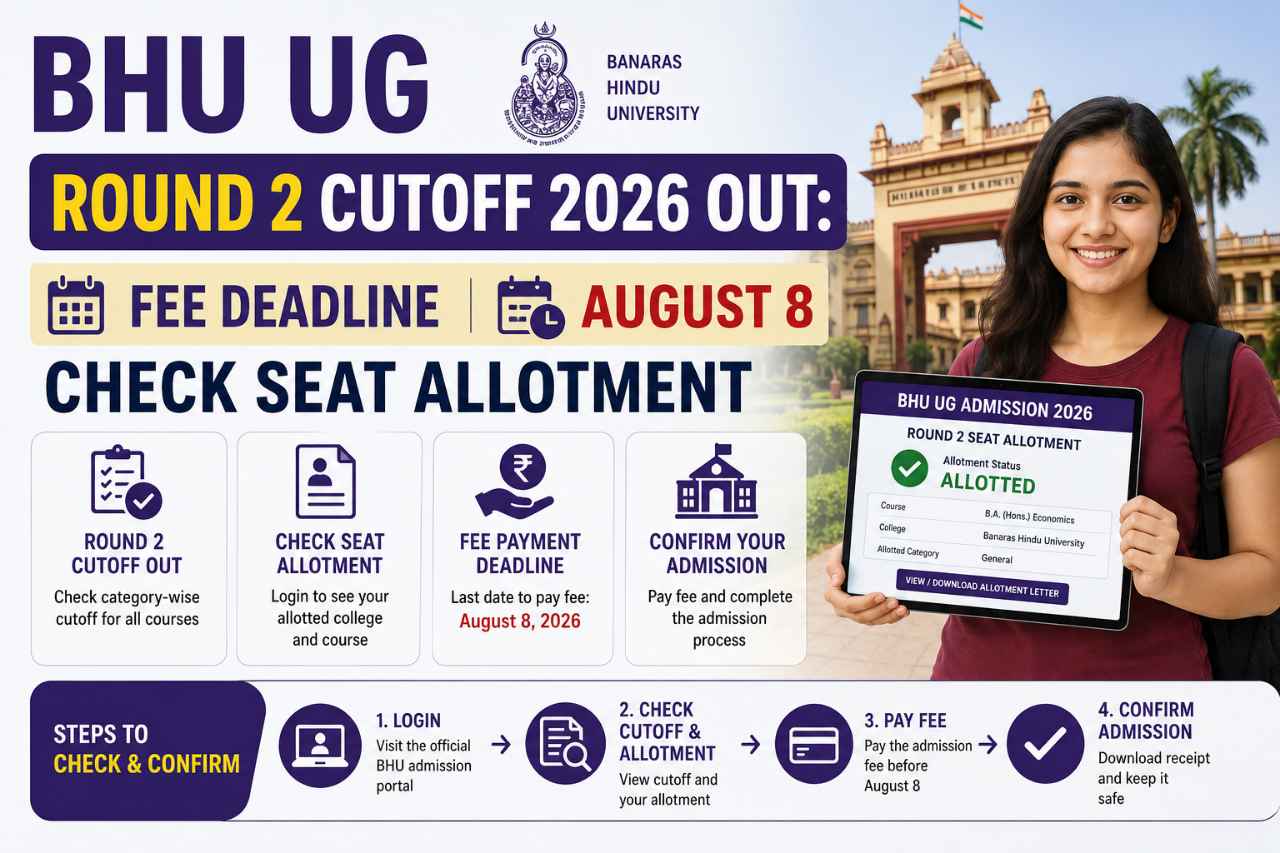

Banaras Hindu University (BHU) has released the Undergraduate (UG) Round 2 cutoff and seat allotment results for the 2026-27 academic session under the Central Admission Portal Undergraduate (CAP-UG) framework. Candidates who appeared in CUET UG 2026 and registered for BHU counselling can now check programme-wise closing scores on the official admission portal and view their individual allotment by logging into the Samarth dashboard. If you have been allotted a seat, the most urgent task is to pay the admission fee by August 8, 2026, before 11:59 PM and choose between the Freeze or Upgrade options.
This guide explains what the Round 2 cutoff means, how to check your result, what scores were observed across faculties, and the step-by-step actions you must take before the deadline. Whether you are a first-time CAP applicant or a candidate moving up from Round 1, this article covers timelines, documents, and common mistakes to avoid during BHU UG admissions 2026.
What Is BHU UG Round 2 Cutoff 2026?
The BHU UG Round 2 cutoff 2026 represents the closing CUET score at which the last seat in a given programme, faculty, category, and gender combination was filled during the second round of CAP-UG counselling. Unlike a traditional entrance exam cutoff published as a single number for all students, BHU releases programme-wise and category-wise closing scores that reflect seat availability after Round 1 withdrawals, upgrades, and fresh allotments.
Round 2 is particularly important for candidates who did not receive their preferred programme in Round 1, those who opted for Upgrade, and fresh applicants whose ranks improved as higher-scoring students moved to other institutions. Because BHU admits entirely through CUET UG scores under NEP-aligned centralised testing, your normalized CUET marks directly determine eligibility at each counselling stage.
Key Difference: Cutoff Page vs Seat Allotment
Many students confuse two separate resources on BHU's admission ecosystem:
- Cutoff page (admission.bhu.ac.in): Shows closing scores by programme, category, and gender for Round 2. This is a reference tool to understand competition levels.
- Samarth Portal (bhucuet.samarth.edu.in): Shows your personal seat allotment, payment link, and Freeze/Upgrade choice. This is where you take action.
BHU is not publishing a Round 2 merit list PDF this year. Your allotment exists only inside your candidate login. Skipping the dashboard check is one of the most common and costliest mistakes in CAP counselling.
BHU UG Round 2 2026: Important Dates and Timeline
The CAP-UG calendar for 2026 is running on a compressed schedule. Missing even one deadline can remove you from subsequent regular rounds for the same programme.
| Activity | Date and Time |
|---|---|
| Round 1 seat allotment and fee window | August 1–3, 2026 |
| Round 2 cutoff and allotment release | August 6, 2026 (evening) |
| Last date to pay Round 2 admission fee | August 8, 2026 (11:59 PM) |
| Round 3 allotment (expected) | Around August 12, 2026 |
| Round 4 allotment (expected) | Around August 17, 2026 |
| Spot round | To be announced if seats remain |
Because Round 2 followed Round 1 within days, candidates should treat every notification from admission.bhu.ac.in as time-sensitive. Enable portal alerts, bookmark both the admission site and Samarth login, and complete fee payment well before the final hour to avoid payment gateway delays.
Programme-Wise Round 2 Closing Scores: Highlights
The Round 2 cutoff data published on the official portal shows how competition varies sharply across BHU's constituent units. Closing scores depend on programme demand, seat matrix, category (General, OBC, EWS, SC, ST, PwBD), gender (where applicable), and whether the course is a regular or paid-fee variant.
Faculty of Social Sciences
Programmes under the Faculty of Social Sciences recorded some of the highest closing scores in Round 2. Representative closing scores included entries around 368.38, 365.74, 336.71, 325.26, and 322.73, with at least one programme closing near 224.73 depending on category and subject combination. The paid-fee course variant in this faculty closed around 361.31, indicating sustained demand even at higher fee structures.
Mahila Maha Vidyalaya (Maintained by BHU)
As a women's college maintained by BHU, Mahila Maha Vidyalaya attracts strong applicants in arts and science streams. Round 2 closing scores in this unit ranged from approximately 335.28 and 325.69 at the higher end to around 291.78 and 317.42 for other programme-category combinations. The paid-fee course track closed near 331.99.
Vasant Kanya Mahavidyalaya
Another prominent BHU-maintained institution for women, Vasant Kanya Mahavidyalaya, showed closing scores between roughly 280.13 and 202.39 across programmes in Round 2. These numbers confirm that even within the same university system, cutoff trends differ by campus unit and course.
Actionable tip: Always filter the cutoff page by your exact programme code, category, and gender. A score that qualifies for BA Economics at one faculty may not suffice for BSc Mathematics at another.
How BHU CAP-UG Counselling Works Through CUET UG
BHU undergraduate admissions are entirely routed through CUET UG 2026 scores. After taking the national test conducted by the NTA, candidates apply separately on the BHU CAP portal, fill programme preferences, and participate in multiple allotment rounds.
The Multi-Round CAP Framework
CAP-UG operates on a sequential round system:
- Round 1: Initial seat allocation based on preferences and merit.
- Round 2: Re-allocation after Round 1 upgrades, freezes, and seat vacancies.
- Round 3 and Round 4: Further iterations for remaining seats and upgraded candidates.
- Spot Round: Final mop-up for vacant seats, typically with stricter rules on option changes.
At each stage, allotted candidates must pay the admission fee within the prescribed window. Non-payment leads to automatic seat cancellation and exclusion from further regular rounds for that programme.
Freeze vs Upgrade: Which Should You Choose?
After Round 2 allotment, every candidate with a seat must decide:
- Freeze: Accept the allotted programme and lock your seat. You proceed toward document verification and reporting. Choose Freeze if this programme is your genuine first preference or if you do not want to risk losing the seat in later rounds.
- Upgrade: Keep the current seat provisionally but remain eligible for a higher preference in Round 3 or Round 4 if seats open up. Choose Upgrade only if a better programme on your preference list is realistically within reach based on cutoff trends.
Upgrade is not a guarantee of a better seat it is a strategic bet. Review Round 1 and Round 2 cutoff movement before selecting Upgrade. If your score is far below the closing mark of your dream programme, Freeze may be the safer choice.
How to Check BHU UG Round 2 Cutoff and Seat Allotment
Checking your result requires two parallel steps: verifying general cutoff data and confirming your personal allotment. Follow both to make an informed decision.
Step 1: View Programme-Wise Cutoff on the Admission Portal
- Visit the official cutoff page at admission.bhu.ac.in/en/cutoff/UG/2026.
- Select your programme, category, and gender from the dropdown filters.
- Locate the Round 2 closing score for your combination.
- Compare your CUET normalized score against the closing mark to assess competitiveness for future rounds.
Step 2: Check Personal Allotment on the Samarth Portal
- Open bhucuet.samarth.edu.in.
- Log in using your CUET UG application number and password.
- Navigate to the candidate dashboard and locate the Round 2 allotment section.
- Review the allotted faculty, programme, quota, and category details carefully.
- Download and save the provisional allotment letter and any payment instructions.
If your dashboard shows "Not Allotted," do not panic immediately. Check whether you are eligible for Round 3, revise preferences if the portal allows, and monitor cutoff trends for programmes where your score exceeds the Round 2 closing mark.
Admission Fee Payment: Deadline, Mode, and Consequences
The admission fee payment is the binding step that converts a provisional allotment into a confirmed seat. For Round 2, the deadline is August 8, 2026, at 11:59 PM.
Payment Process
- Fee payment is completed online through the Samarth Portal payment gateway on your dashboard.
- Keep your debit card, credit card, UPI, or net banking details ready before starting the transaction.
- After successful payment, download the receipt immediately and store it with your allotment letter.
- Complete Freeze or Upgrade selection as prompted before or alongside payment, depending on portal workflow.
What Happens If You Miss the Deadline?
Failure to pay within the window results in:
- Automatic cancellation of the allotted seat.
- Removal from further regular allotment rounds for the same programme.
- Loss of any provisional claim on that seat, which is then offered to waitlisted or next-round candidates.
Payment gateway failures in the final hours are a recurring issue every counselling season. Pay at least 24 hours before the deadline to avoid technical glitches, bank timeouts, or server overload.
Documents and Reporting: What Comes After Fee Payment
Paying the fee is not the final step in BHU UG admission. Physical or online document verification and reporting schedules will follow in subsequent notifications. Prepare the following in advance:
- CUET UG 2026 scorecard and admit card
- Class 10 and Class 12 mark sheets and certificates
- Category certificate (if applicable) issued by competent authority
- EWS, PwBD, or other quota certificates as claimed during application
- Photo ID (Aadhaar, passport, or driving licence)
- Passport-size photographs
- Allotment letter and fee payment receipt
- Transfer or migration certificate (may be submitted later as per BHU rules)
Keep both original documents and self-attested photocopies organized in a single folder. Discrepancies between uploaded CAP data and physical certificates are a leading cause of admission cancellation at reporting stage.
Strategic Advice for Round 3 and Beyond
Candidates who were not allotted a seat in Round 2, or those who chose Upgrade, should prepare for Round 3 (expected around August 12, 2026) and Round 4 (expected around August 17, 2026).
For Candidates Without a Seat
- Re-evaluate your preference list. Lower-preference programmes at BHU may still be achievable if cutoffs drop in later rounds.
- Track closing score movement between Round 1 and Round 2 to identify programmes with declining cutoffs.
- Ensure your CAP registration remains active and all eligibility criteria are met.
For Candidates Exploring Alternatives
Not every student will secure a BHU seat, and that does not mean your academic journey ends. India offers diverse pathways through state universities, private colleges, and specialised entrance exams. Students interested in design careers can explore exams like NID DAT, while those seeking engineering programmes may consider institutions such as DMI College of Engineering Chennai. For quality undergraduate options in Rajasthan, colleges like MD Mission College Kota offer accessible pathways while you continue monitoring central university counselling results.
Parallel applications and backup plans are not signs of weakness they are standard practice in India's multi-exam, multi-round admission landscape.
Understanding Cutoff Trends: Why Scores Vary So Much
BHU UG cutoffs are reported as precise decimal values (for example, 368.3843537) because they reflect the exact CUET normalized score of the last admitted candidate in that seat matrix cell. Several factors drive variation:
- Programme popularity: Economics, psychology, and core science programmes typically close higher than newer or niche combinations.
- Seat intake: Programmes with fewer seats see sharper cutoff spikes.
- Category and gender: Separate matrices for General, OBC, EWS, SC, ST, and PwBD candidates produce different closing scores.
- Constituent college: Main campus faculties, Mahila Maha Vidyalaya, and Vasant Kanya Mahavidyalaya each have independent matrices.
- Paid-fee vs regular courses: Paid-fee variants sometimes close at scores comparable to or higher than regular seats due to demand-supply dynamics.
- Round-to-round movement: Candidates freezing seats in Round 1 reduce availability; those upgrading create new vacancies.
Use cutoff data as a trend indicator, not a guarantee. A programme that closed at 320 in Round 2 may rise or fall in Round 3 depending on how many candidates freeze or leave for other universities like DU, JNU, or state institutions.
Common Mistakes to Avoid During BHU UG Round 2
- Checking only the cutoff page and not the Samarth login: Cutoff data does not tell you whether you personally received a seat.
- Waiting until the last hour to pay: Server congestion and payment failures peak near deadlines.
- Choosing Upgrade without analysing cutoff gaps: You may lose a good seat without gaining a better one.
- Ignoring category or gender filters on the cutoff page: Comparing your score against the wrong matrix leads to false hope or unnecessary panic.
- Assuming non-payment only delays admission: It permanently cancels your Round 2 seat for that programme.
- Uploading incorrect documents during CAP registration: Reporting-stage verification can invalidate even a paid seat.
- Not downloading the allotment letter and receipt: These are mandatory for reporting and future correspondence.
BHU UG Round 2 vs Other Central University Counselling
BHU's CAP-UG process shares similarities with other CUET-linked admissions but has distinct features. JNU, DU, and other central universities run their own portals and round schedules. BHU's emphasis on constituent colleges (including women's colleges), paid-fee programmes, and Samarth-based payment makes its cutoff landscape uniquely granular.
Students counselling at multiple institutions should maintain a calendar with each university's fee deadline. A BHU Round 2 seat and a DU CSAS allotment may have overlapping payment windows prioritize based on your confirmed preference order and financial readiness.
Who Should Take Immediate Action After Round 2 Allotment?
Not every CUET UG candidate needs the same response after Round 2 results. Understanding your category helps you prioritize correctly.
Candidates Allotted a Seat
If your Samarth dashboard shows a programme allotment, treat August 8, 2026, as a hard deadline. Confirm the faculty name, course title, and campus unit match your expectations before paying. Some programmes are offered at main campus faculties while others are at Mahila Maha Vidyalaya or Vasant Kanya Mahavidyalaya each has a distinct academic environment even though all fall under the BHU umbrella.
Candidates Who Chose Upgrade in Round 1
If you previously selected Upgrade and received a new allotment in Round 2, compare it against your Round 1 offer. A higher-preference programme may now be yours, or you may have moved to a different faculty. Re-evaluate whether to Freeze the Round 2 seat or continue upgrading for Round 3 based on updated cutoff data.
Candidates Not Allotted Any Seat
Absence of an allotment in Round 2 does not end your CAP-UG journey. Seats often become available in Round 3 and Round 4 as candidates leave for DU, JNU, state universities, or private institutions. Maintain active portal access, keep financial arrangements ready for a sudden fee deadline, and build backup plans through other admission routes while waiting.
Quick Reference: BHU UG Round 2 at a Glance
For students searching for a fast summary before diving into details, here is the Round 2 snapshot:
- Cutoff portal: admission.bhu.ac.in/en/cutoff/UG/2026
- Allotment portal: bhucuet.samarth.edu.in
- Login: CUET UG application number and password
- Fee deadline: August 8, 2026, 11:59 PM
- Options after allotment: Freeze or Upgrade
- Payment mode: Online via Samarth Portal
- Merit list PDF: Not released; check individual login only
Conclusion
The BHU UG Round 2 cutoff 2026 and seat allotment results mark a critical juncture in the CAP-UG counselling cycle. Allotted candidates must log in to bhucuet.samarth.edu.in, verify their programme details, select Freeze or Upgrade thoughtfully, and pay the admission fee by August 8, 2026, before 11:59 PM. Use the official cutoff page at admission.bhu.ac.in to benchmark scores and plan for Round 3 if needed.
Whether you secure a seat at the Faculty of Social Sciences, Mahila Maha Vidyalaya, Vasant Kanya Mahavidyalaya, or another BHU unit, timely action on the Samarth Portal is non-negotiable. For those still waiting, upcoming rounds and the spot round offer additional chances and exploring parallel options through exams and colleges across India keeps your higher education plans on track. Stay updated on the official portal, act early, and treat every CAP deadline with the seriousness it deserves.