Every year, lakhs of Indian graduates set their sights on the CAT (Common Admission Test) as the gateway to IIMs and hundreds of other MBA colleges. It is a smart choice CAT remains the most widely accepted management entrance exam in India. But limiting yourself to a single exam can also limit your admission options, especially when one difficult section or a single bad day can affect your entire season.
That is where SNAP 2026 (Symbiosis National Aptitude Test) becomes a valuable second pathway. SNAP opens admission to prestigious Symbiosis institutes such as SIBM Pune, SCMHRD Pune, and SIIB Pune. The best part for CAT aspirants: roughly 70–80% of your existing preparation transfers directly. You are not building two separate skill sets you are adapting one strong foundation to a faster, differently structured paper.
This article breaks down CAT vs SNAP 2026 in plain language syllabus overlap, format differences, the newly introduced Ethics, Morality and Values section, and a week-by-week plan to manage both exams without burnout. Whether you are a final-year student or a working professional targeting MBA admission in 2027, this guide gives you actionable steps you can start today.
Understanding CAT and SNAP 2026 at a Glance
Before diving into preparation strategy, it helps to understand what each exam actually tests and where your score takes you.
What Is CAT 2026?
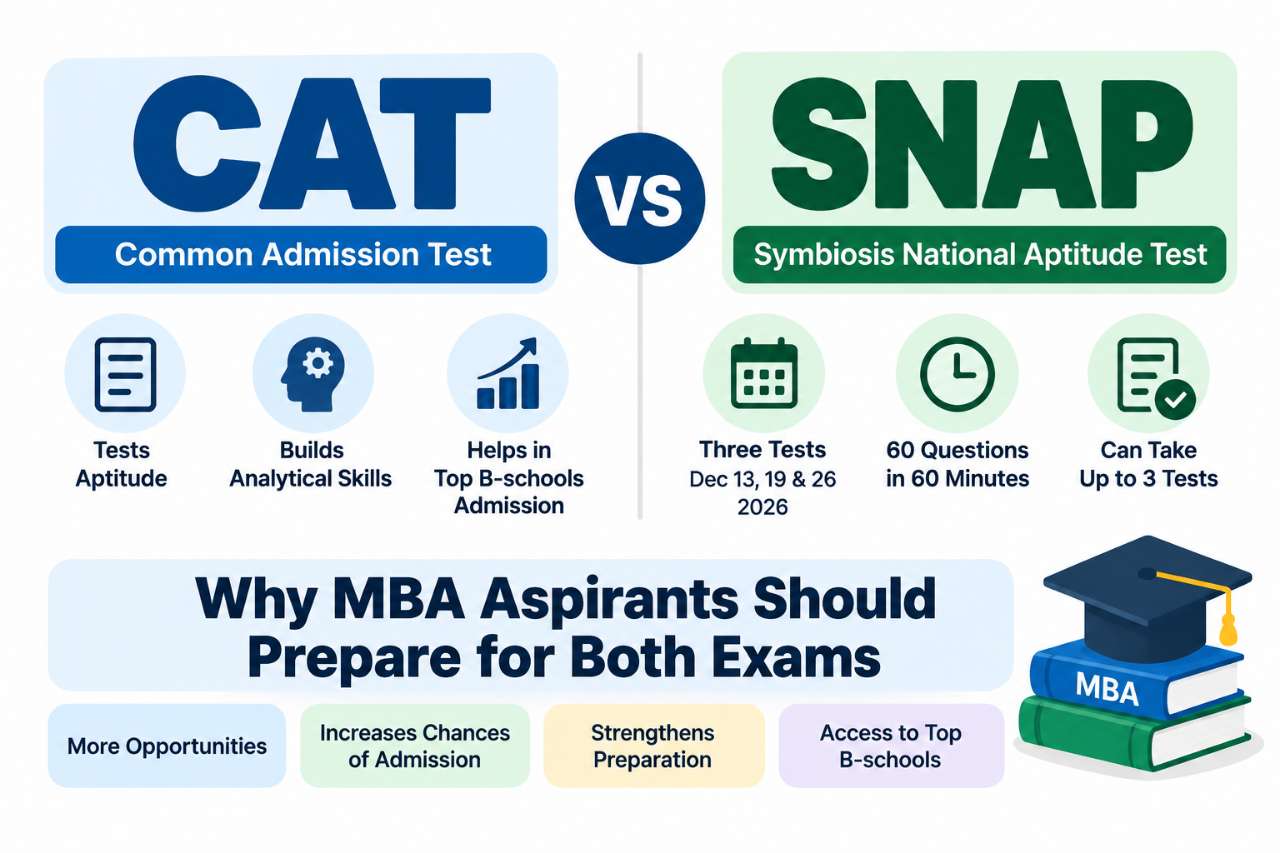
CAT is conducted by the IIMs on a rotational basis and is accepted by 20 IIMs plus over 1,000 B-schools across india. CAT 2026 is expected to follow the established pattern: 68 questions across three timed sections Verbal Ability and Reading Comprehension (VARC), Data Interpretation and Logical Reasoning (DILR), and Quantitative Aptitude (QA) within a total duration of 120 minutes. Each section has its own time limit, which means you cannot borrow time from one section to compensate in another.
CAT rewards deep conceptual understanding, patience with complex DILR sets, and the ability to handle lengthy reading comprehension passages. Scoring in the 95+ percentile opens IIM shortlist doors; even 85–90 percentile can secure strong private B-school admits depending on your profile.
What Is SNAP 2026?
SNAP is the official entrance exam for MBA and related programmes at Symbiosis International (Deemed University) and its participating institutes. SNAP 2026 features 60 questions to be solved in 60 minutes an average of one minute per question. Unlike CAT, SNAP allows candidates to attempt sections in any order they choose, giving greater flexibility in time allocation.
SNAP 2026 has four sections: General English; Analytical and Logical Reasoning; Quantitative Aptitude, Data Interpretation and Data Sufficiency; and the newly added Ethics, Morality and Values (EMV) section worth 10 marks. Candidates can appear for up to three SNAP tests in a single admission cycle, and only the highest score is considered a significant advantage if exam-day nerves affect your first attempt.
Side-by-Side Comparison: CAT vs SNAP 2026
| Feature | CAT 2026 | SNAP 2026 |
|---|---|---|
| Conducting body | IIMs (rotational) | Symbiosis International University |
| Total duration | 120 minutes | 60 minutes |
| Total questions | 68 | 60 |
| Sections | VARC, DILR, QA (section-timed) | General English, A&LR, QA-DI-DS, EMV (flexible order) |
| Negative marking | Varies by question type | 25% of marks per wrong answer |
| Attempts allowed | One per year | Up to three per cycle |
| Primary institutes | IIMs and 1,000+ B-schools | Symbiosis group institutes |
| Core challenge | Sectional time management and depth | Speed, question selection, and accuracy |
Why CAT Aspirants Should Also Register for SNAP 2026
If you are already investing months in CAT preparation, adding SNAP is less about doing more work and more about protecting your admission chances. Here are the strongest reasons to register.
Access to Top Symbiosis MBA Programmes
SNAP is the only route to Symbiosis flagship institutes. SIBM Pune consistently ranks among India;s top 20 B-schools with strong placement records in consulting, banking, and FMCG. SCMHRD Pune is renowned for HR and operations programmes. SIIB Pune specialises in international business. For aspirants who want Pune-based premium MBA options alongside IIM dreams, SNAP is essential not optional.
High Syllabus Overlap Means Minimal Extra Study
Quantitative topics like arithmetic, algebra, geometry, number systems, and modern mathematics appear in both exams. Logical reasoning fundamentals arrangements, blood relations, coding-decoding, directions, series, and syllogisms transfer directly. English preparation covering vocabulary, grammar, verbal ability, and reading comprehension serves both papers. Your CAT foundation is not wasted; it is the base upon which SNAP-specific speed practice is layered.
Three Attempts Reduce Exam-Day Risk
CAT offers one shot per year. A stomach bug, a unexpectedly tough DILR set, or simple time mismanagement can cost an entire admission cycle. SNAP's three-attempt policy lets you treat your first test as a live mock, refine your strategy, and peak on attempt two or three. For risk-averse planners, this alone justifies the registration fee.
SNAP Functions as a Backup Without a Backup Plan
Many aspirants say they will "prepare for XAT or SNAP later if CAT goes badly." In reality, starting fresh preparation in December after a disappointing CAT is exhausting and often ineffective. By registering for SNAP early and doing light parallel practice, you arrive at the post-CAT period with momentum rather than starting from zero.
SNAP Practice Actually Improves CAT Performance
The speed drills required for SNAP quick calculations, rapid question triage, and decision-making under pressure sharpen skills that help in CAT's QA and VARC sections too. Candidates who solve SNAP-style timed sets often report better pacing in CAT mocks. The two exams are complementary, not competing.
How Much of Your CAT Preparation Carries Over to SNAP?
Understanding exactly what transfers saves you from redundant study hours. Here is a section-wise breakdown.
Quantitative Aptitude: Strong Overlap, Different Execution
Every major quant topic you study for CAT percentages, profit and loss, time-speed-distance, ratios, linear equations, quadratic equations, circles, triangles, permutations, and probability appears in SNAP. You do not need new textbooks. What changes is execution speed. SNAP quant questions tend to be more direct and calculation-oriented rather than multi-layered puzzles. Practice solving standard quant problems in under 60 seconds each.
Actionable tip: Maintain a "speed quant" notebook. Each day, solve 20 medium-difficulty quant questions with a strict 45-minute timer. Track which question types slow you down and drill those specifically.
Logical Reasoning: Same Concepts, Different Question Mix
CAT DILR emphasises complex interconnected sets that may take 10–15 minutes to crack. SNAP's Analytical and Logical Reasoning section includes more standalone questions single puzzles you can attempt or skip within seconds. Blood relations, seating arrangements, input-output, and coding-decoding appear in both, but SNAP rewards breadth across question types rather than depth within one set.
Actionable tip: After each CAT DILR mock, spend 15 minutes solving 10 standalone SNAP-style reasoning questions from past papers. This builds the mental flexibility SNAP demands.
General English: CAT VARC Builds the Foundation
CAT's VARC section is reading-comprehension heavy, with long passages and inference-based questions. SNAP General English includes more direct vocabulary questions (synonyms, antonyms, analogies), grammar-based items (sentence correction, fill in the blanks), and shorter verbal ability problems. Your CAT reading habit improves comprehension speed, but you must add targeted vocabulary and grammar drills that CAT preparation alone may not emphasise.
Actionable tip: Dedicate 20 minutes daily to Norman Lewis Word Power Made Easy or an equivalent vocabulary resource, plus 10 grammar questions from SNAP previous-year papers.
Data Interpretation and Data Sufficiency: Needs Focused SNAP Practice
CAT includes DI within the DILR section, often as part of larger sets. SNAP treats DI and Data Sufficiency as distinct question types within the quant section. Data Sufficiency determining whether given statements are sufficient to answer a question is particularly important for SNAP and less emphasised in CAT preparation. Include regular DS practice in your SNAP routine.
Ethics, Morality and Values: The One Truly New Section
SNAP 2026 introduces an EMV section carrying 10 marks a topic area absent from CAT entirely. Questions may cover ethical dilemmas in business, corporate social responsibility, moral reasoning, values in leadership, and situational judgement. This section is not about mathematical formulas; it tests awareness and reasoning about ethical scenarios.
Actionable tip: Read short case studies on business ethics, skim the SIU SNAP preparation material for EMV guidance, and practice 5–10 EMV questions weekly starting two months before SNAP. This section is low-effort, high-return for well-prepared candidates.
Key Differences That Change Your Preparation Approach
Beyond syllabus overlap, the structural differences between CAT and SNAP demand distinct exam-day strategies.
Time Management Philosophy
CAT forces sectional discipline you must perform in all three sections within fixed windows. SNAP gives you 60 minutes total and lets you choose section order. Successful SNAP candidates often start with their strongest section to build confidence and bank easy marks, then tackle harder areas. Experiment with different section orders in SNAP mocks to find your optimal sequence.
Question Selection Is Everything in SNAP
With only one minute per question on average, you cannot afford to spend five minutes on a single puzzle. Develop a triage system: scan a question for 10 seconds, attempt if confident, mark for review if uncertain, skip immediately if it looks time-consuming. In CAT, attempting most questions in a section is often viable. In SNAP, selective attempting with high accuracy beats blind rushing.
Negative Marking Requires Discipline
SNAP deducts 25% of the marks assigned to a question for every wrong answer. With three marks per question in most sections, each error costs 0.75 marks. Attempt only when you can eliminate at least one option or have strong reasoning. A score of 30 accurate attempts often beats 45 attempts with 15 wrong answers.
Preparation Style Comparison
| Preparation Area | CAT Approach | SNAP Adaptation |
|---|---|---|
| Concept building | Deep, thorough coverage | Reuse CAT concepts; no re-learning needed |
| Quant practice | Difficult, multi-step problems | Speed-oriented, calculation-light methods |
| Reasoning | Set-based, 10–15 min blocks | Standalone questions, 1–2 min each |
| English | Long RC passages | Vocabulary, grammar, short verbal items |
| Mock tests | Full 120-min sectional mocks | 60-min full-length SNAP mocks |
| Question selection | Important | Critical defines your score |
How Much Extra Preparation Does SNAP 2026 Actually Need?
Honest answer: not a second full syllabus. Most CAT aspirants need four to six weeks of SNAP-specific practice layered onto existing preparation. Here is what "extra" actually means in hours.
- EMV section preparation: 5–8 hours total over the preparation cycle
- SNAP-style verbal and reasoning drills: 30 minutes, three times per week
- Data Sufficiency practice: 20 minutes, twice per week
- SNAP full-length mocks: 6–10 mocks with thorough analysis
- Speed quant drills: 20 minutes daily in the final four weeks
If you are studying 4–5 hours daily for CAT, adding 45–60 minutes of SNAP-specific work three days per week is sufficient for most aspirants. Increase frequency only after CAT exam day.
CAT + SNAP 2026: A Practical Month-by-Month Preparation Plan
Timing matters. Here is a phased approach assuming CAT 2026 is held in late November and SNAP tests fall in December.
Phase 1: June to August CAT Foundation (SNAP on Pause)
Focus entirely on building CAT concepts. Cover quant fundamentals, develop DILR set-solving ability, and build reading speed for VARC. No SNAP-specific work needed yet beyond registering for SNAP when applications open. Ensure your CAT syllabus coverage is at least 60% complete before introducing SNAP elements.
Phase 2: September to October Light SNAP Integration
Continue CAT as the primary focus. Add two SNAP-specific activities weekly: a 30-minute vocabulary and grammar drill, and one 60-minute SNAP mini-mock (20 questions timed). Begin EMV reading short articles on business ethics and corporate governance. Solve 5–10 standalone reasoning questions per week from SNAP past papers.
Phase 3: November (Pre-CAT) Maintain Dual Awareness
Do not let SNAP distract from CAT peaking. Continue CAT mocks at full intensity. Sneak in one SNAP mock every ten days if energy permits. Review SNAP exam pattern and section order strategy mentally, but keep 90% of effort on CAT.
Phase 4: Post-CAT to SNAP Sprint Mode
Once CAT is done, shift gears immediately. Take one SNAP mock within 48 hours of CAT to assess baseline. Increase to three SNAP mocks per week. Analyse every mock for time per section, accuracy rate, and negative marks lost. Revise EMV topics. Fine-tune section order based on mock performance. Peak on your second or third SNAP attempt if possible.
SNAP 2026 Mock Test Analysis: What to Track
Taking mocks without analysis is wasted effort. After every SNAP mock, record these metrics in a spreadsheet:
- Total attempts vs accuracy: Aim for 35–42 attempts with 80%+ accuracy rather than 50 attempts at 60%.
- Time per section: Identify which section consistently exceeds 15 minutes.
- Negative marks lost: If negatives exceed 5 marks, reduce attempt count.
- Unattempted easy questions: Flag questions you skipped that were solvable in under a minute these are scoring leaks.
- EMV performance: Track separately; this section should be a mark booster, not a liability.
Which Exam Should You Prioritise?
CAT must remain your primary focus if IIM admission is the goal. Its preparation depth, competition level, and institutional reach are unmatched. SNAP is the strategic complement not the replacement. Think of it this way: CAT is your main battle; SNAP is your insurance policy and your pathway to Symbiosis excellence.
Candidates who benefit most from the dual-exam approach include: aspirants targeting both IIMs and Symbiosis institutes; candidates in their second or third CAT attempt who want a safety net; working professionals with limited study hours who can leverage overlap efficiently; and anyone who performs better under speed-based formats than depth-based ones.
Common Mistakes CAT Aspirants Make with SNAP
- Ignoring SNAP until after CAT: Starting cold in December leaves insufficient mock analysis time.
- Using only CAT mocks for SNAP prep: Section timing and question distribution are too different.
- Over-attempting in SNAP: Chasing attempt count instead of accuracy destroys scores through negative marking.
- Skipping EMV preparation: Ten marks can shift your percentile significantly in a 60-question paper.
- Not using all three SNAP attempts: Register and plan for at least two tests to maximise your highest score.
Conclusion
Preparing for CAT and SNAP 2026 together is one of the smartest moves an MBA aspirant can make in India. The syllabus overlap is substantial, the additional effort is manageable, and the reward access to both IIMs and premier Symbiosis institutes significantly widens your admission net. Start with a strong CAT preparation foundation, layer in SNAP-specific speed practice and EMV preparation from September onward, and sprint with SNAP mocks after CAT exam day.
Do not treat SNAP as a distant backup plan you will figure out later. Register when applications open, schedule your three attempts strategically, and walk into each test with a clear section order and question selection strategy. In India's competitive MBA landscape, the aspirants who secure the best admits are often those who planned for multiple pathways not those who bet everything on a single exam day.
Final Checklist Before SNAP 2026 Exam Day
Use this quick checklist in the week leading up to your SNAP attempt:
- Confirm your SNAP admit card, test centre location, and reporting time.
- Decide your section attempt order based on your best mock performance.
- Revise EMV case studies and key vocabulary lists.
- Prepare your exam-day kit: photo ID, admit card, water bottle, and watch.
- Get adequate sleep SNAP rewards alert, fast decision-making over last-minute cramming.
With consistent preparation and smart exam strategy, CAT aspirants are well positioned to excel in SNAP 2026 and secure admission to India's leading Symbiosis MBA programmes.