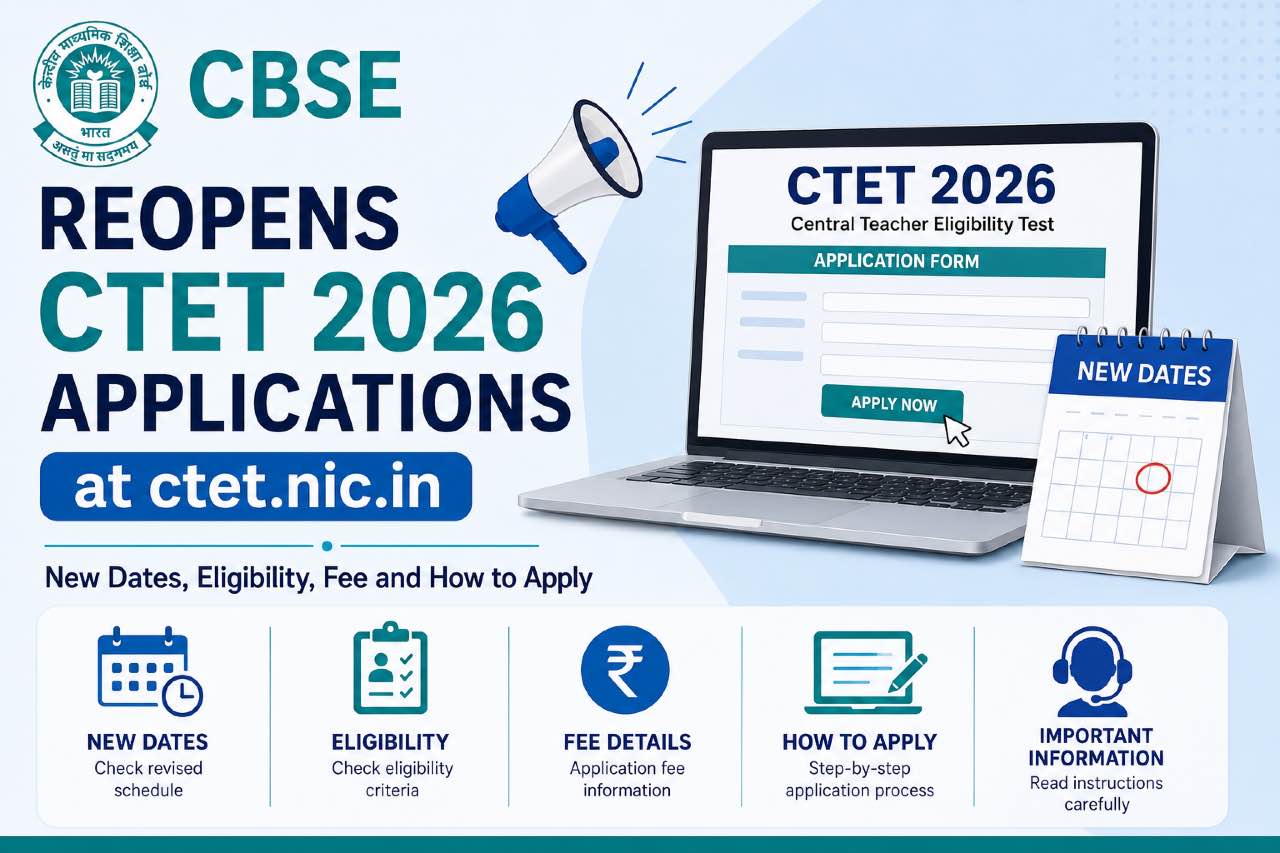
The Central Board of Secondary Education (CBSE) has reopened the online application window for the 21st Central Teacher Eligibility Test (CTET) September 2026 session. Candidates who missed the earlier registration period can now apply at the official portal ctet.nic.in between 25 August 2026 and 1 September 2026. This move follows requests from a large number of eligible aspirants and aligns with directions from the Hon'ble Supreme Court on ensuring teachers get a reasonable opportunity to meet statutory TET requirements.
For lakhs of graduates and diploma holders across India, CTET remains the gateway to teaching jobs in central government schools such as Kendriya Vidyalayas (KVS), Navodaya Vidyalayas (NVS), and schools under the administrative control of central government bodies. If you are planning a career in school teaching, this reopened window is your second chance—do not wait until the last day.
Why Has CBSE Reopened the CTET 2026 Application Window?
The first CTET 2026 application period ran from 11 May to 6 June 2026. Despite this window, CBSE received representations from many eligible candidates who could not complete registration due to document issues, payment failures, technical glitches, or lack of awareness about deadlines.
In its official notice, CBSE cited the Hon'ble Supreme Court's observation that eligible teachers must be given a reasonable opportunity to comply with the statutory requirement of acquiring the prescribed Teacher Eligibility Test (TET) qualification. Teaching appointments in many government and aided institutions are governed by the Right of Children to Free and Compulsory Education (RTE) Act, 2009, which makes TET qualification mandatory for recruitment.
Accordingly, CBSE decided to reopen the portal from 25.08.2026 to 01.09.2026 in the larger interest of candidates. Importantly, candidates who have already successfully submitted their applications need not apply again. Only those who could not register or complete payment during the first window should use this opportunity.
What About the CTET September 2026 Exam Date?
The CTET September 2026 examination was originally scheduled on 6 September 2026 in two shifts. With the application window extended, CBSE has confirmed that the revised exam date for the 22nd edition of CTET will be announced after 1 September 2026. Candidates should monitor ctet.nic.in regularly for the updated schedule, city intimation slip, and admit card release.
What Is CTET and Why Does It Matter for Indian Teachers?
The Central Teacher Eligibility Test (CTET) is a national-level eligibility examination conducted by CBSE twice a year (usually in July and December sessions). Clearing CTET does not guarantee a job by itself, but it certifies that a candidate meets the minimum standards prescribed by the National Council for Teacher Education (NCTE) to teach at primary (Classes 1–5) and upper primary (Classes 6–8) levels.
A valid CTET certificate is widely accepted for recruitment in:
- Kendriya Vidyalaya Sangathan (KVS) teacher recruitment
- Navodaya Vidyalaya Samiti (NVS) posts
- Central Tibetan Schools Administration (CTSA)
- Andaman and Nicobar, Lakshadweep, Daman and Diu, Dadra and Nagar Haveli school systems
- Many state government and private schools that recognise CTET scores
Unlike entrance exams for professional degrees—such as the CAT for management or the NIFT entrance exam for design—CTET is an eligibility test, not a rank-based admission exam. Your goal is to score at or above the qualifying marks, not to beat other candidates on a merit list.
CTET 2026 Application Dates at a Glance
Use this quick reference table to track the reopened CTET 2026 timeline:
| Event | Date / Status |
|---|---|
| First application window | 11 May – 6 June 2026 (closed) |
| Reopened application window | 25 August – 1 September 2026 |
| Original exam date | 6 September 2026 (postponed) |
| Revised exam date | To be announced after 1 September 2026 |
| Official website | ctet.nic.in |
Action tip: Complete registration at least two days before 1 September 2026 to avoid last-minute server load or payment gateway issues.
CTET 2026 Eligibility Criteria: Paper 1 and Paper 2
CTET has two papers. You may appear for Paper 1, Paper 2, or both depending on the class level you wish to teach.
CTET Paper 1 Eligibility (Classes 1 to 5 – Primary Level)
As per NCTE norms, candidates must satisfy any one of the following conditions for Paper 1:
- Senior Secondary (Class 12) with at least 50% marks and a 2-year Diploma in Elementary Education (D.El.Ed), or appearing in the final year of D.El.Ed
- Senior Secondary with 50% marks and a 4-year Bachelor of Elementary Education (B.El.Ed), or appearing in the final year
- Senior Secondary with 50% marks and a 2-year Diploma in Education (Special Education), or appearing in the final year
- Graduation and a 2-year Diploma in Elementary Education (D.El.Ed), or appearing in the final year
Many candidates complete D.El.Ed or B.El.Ed through regular colleges or through open universities. Institutions such as the Indira Gandhi National Open University, Vardhman Mahaveer Open University Kota, Nalanda Open University Patna, and UP Rajarshi Tandon Open University Allahabad offer flexible teacher-education pathways for working aspirants and those in smaller towns.
CTET Paper 2 Eligibility (Classes 6 to 8 – Upper Primary Level)
For Paper 2, candidates must meet any one of these qualifications:
- Graduation and passed or appearing in final year of 2-year D.El.Ed
- Graduation with at least 50% marks and passed or appearing in B.Ed (1-year or 2-year as applicable)
- Graduation with at least 45% marks and passed or appearing in B.Ed (as per NCTE regulations)
- Senior Secondary with 50% marks and passed or appearing in 4-year B.El.Ed
- Senior Secondary with 50% marks and passed or appearing in B.A. Ed / B.Sc. Ed (4-year integrated programme)
- Graduation with 50% marks and passed or appearing in 1-year B.Ed (special education)
If you are currently pursuing B.Ed from a government or private institution—such as colleges in Rajasthan like SK Government Post Graduate College Sikar, SNKP Government Post Graduate College Sikar, or Shekhawati Post Graduate Mahavidyalaya Sikar—you may still be eligible to apply if you are in the final year, subject to producing proof at the time of appointment.
Can You Apply for Both Papers?
Yes. Candidates who wish to teach both primary (Classes 1–5) and upper primary (Classes 6–8) must appear in both Paper 1 and Paper 2. You can register for both papers in a single application during this reopened window and pay the combined fee.
Age Limit for CTET 2026
There is no upper age limit prescribed by CBSE for CTET. The minimum age is generally 18 years. This makes CTET a strong option for career changers, homemakers returning to work, and graduates from diverse backgrounds—including those who initially pursued other fields such as Computer Applications or a Bachelor of Computer Application (BCA)—who later decide to enter the teaching profession after completing B.Ed or D.El.Ed.
CTET 2026 Application Fee Structure
Fee payment is mandatory to complete registration. The CTET 2026 fee details are:
| Category | One Paper | Both Papers |
|---|---|---|
| General / OBC (Non-Creamy Layer) | Rs 1,000 | Rs 1,200 |
| SC / ST / PwD | Rs 500 | Rs 600 |
Payment is accepted online through debit card, credit card, net banking, or UPI as available on the portal. Always save the payment receipt and confirmation page. If payment is deducted but the application status does not update, note the transaction reference number and contact CBSE CTET helpdesk immediately—do not submit a duplicate application.
How to Apply for CTET 2026 at ctet.nic.in (Step-by-Step)
Follow these steps carefully during the reopened window (25 August – 1 September 2026):
- Visit the official website at ctet.nic.in. Use only the official portal; avoid third-party websites that claim to fill forms on your behalf.
- Click on "Apply Online" for CTET September 2026 and read the information bulletin carefully.
- Complete registration by entering basic details such as name, date of birth, mobile number, and email ID. You will receive login credentials.
- Fill the application form with personal details, category, disability status (if applicable), educational qualifications, and paper selection (Paper 1, Paper 2, or both).
- Choose exam cities in order of preference. CTET is conducted across multiple cities nationwide.
- Upload scanned documents—recent passport-size photograph and signature—as per the prescribed format and file size.
- Pay the application fee online and verify that the payment status shows as successful.
- Submit the application and download the confirmation page. Take at least two or three printouts for your records.
Keep your Class 10 certificate, graduation marksheets, diploma/B.Ed certificates, category certificate (if applicable), and PwD certificate ready before you begin. Having documents scanned in advance reduces errors and saves time.
CTET 2026 Exam Pattern and Marking Scheme
Understanding the exam pattern helps you plan preparation during the extended time before the revised exam date is announced.
Mode, Duration, and Language
- Exam mode: Offline (OMR-based pen-and-paper test)
- Duration: 2 hours 30 minutes (150 minutes) per paper
- Question type: Multiple Choice Questions (MCQs)
- Total questions: 150 per paper
- Total marks: 150 per paper
- Negative marking: None—no marks are deducted for wrong answers
- Medium: Hindi, English , and multiple other languages for language papers
CTET Paper 1 Pattern (Classes 1–5)
| Section | Questions | Marks |
|---|---|---|
| Child Development and Pedagogy | 30 | 30 |
| Language I (compulsory) | 30 | 30 |
| Language II (compulsory) | 30 | 30 |
| Mathematics | 30 | 30 |
| Environmental Studies | 30 | 30 |
| Total | 150 | 150 |
CTET Paper 2 Pattern (Classes 6–8)
| Section | Questions | Marks |
|---|---|---|
| Child Development and Pedagogy | 30 | 30 |
| Language I (compulsory) | 30 | 30 |
| Language II (compulsory) | 30 | 30 |
| Mathematics and Science OR Social Studies/Social Science | 60 | 60 |
| Total | 150 | 150 |
In Paper 2, candidates choose either the Mathematics and Science combination (for science/maths teachers) or Social Studies/Social Science (for social science teachers).
Qualifying Marks for CTET 2026
- General category: 60% — 90 marks out of 150
- Reserved categories (SC/ST/OBC/PwD): 55% — 82 marks out of 150 (as per CBSE norms)
There is no sectional cut-off; your overall score determines qualification. Because there is no negative marking, attempt all questions—educated guessing can improve your score.
CTET 2026 Syllabus Overview
Child Development and Pedagogy (Both Papers)
This section tests understanding of how children learn and develop. Topics include theories of Piaget, Vygotsky, and Kohlberg; inclusive education; learning differences; assessment techniques; and pedagogical approaches for diverse learners. For Paper 1, focus is on children aged 6–11 years; for Paper 2, on adolescents aged 11–14 years.
Language I and Language II
Language I is usually the medium of instruction or regional language; Language II is a different language. Questions cover reading comprehension, grammar, pedagogy of language development, and principles of language teaching. Choose languages you are comfortable teaching in.
Mathematics (Paper 1) / Mathematics and Science (Paper 2)
Paper 1 mathematics covers number system, geometry, measurements, and data handling at primary level. Paper 2 includes advanced topics in algebra, geometry, mensuration, and science concepts from NCERT upper primary syllabus—food, materials, living world, motion, natural phenomena, and natural resources—with emphasis on pedagogical issues.
Environmental Studies (Paper 1 Only)
EVS questions relate to family, food, shelter, water, travel, and environmental conservation, aligned with NCERT themes for Classes 3–5.
Social Studies (Paper 2 Option)
Covers history, geography, social and political life, and pedagogical issues based on upper primary NCERT content.
Preparation Strategy After the Exam Date Postponement
The postponement of the 6 September 2026 exam date gives reopened-window applicants extra preparation time. Use it wisely:
- Study NCERT textbooks for Classes 1–8 thoroughly—most CTET questions are application-based on school-level content.
- Solve previous year papers and timed mock tests to build speed for 150 questions in 150 minutes.
- Focus on Child Development and Pedagogy—it carries 30 marks in both papers and is often the differentiator.
- Revise language grammar rules and practice comprehension passages daily.
- Join short revision groups or use standard CTET guidebooks from recognised publishers.
Candidates from states with strong open-learning ecosystems—such as those studying through Dr Babasaheb Ambedkar Open University Ahmedabad, Karnataka State Open University Mysore, Tamil Nadu Open University Chennai, or Yashwantrao Chavan Maharashtra Open University—should ensure their degree/diploma documents are attested and ready for verification during future recruitment.
What Happens After You Clear CTET?
After results are declared, qualified candidates receive a digital marksheet and eligibility certificate from CBSE. The CTET certificate is valid for lifetime (as per current CBSE policy), unlike earlier norms that limited validity to seven years.
With a valid CTET score, you can apply for:
- KVS and NVS recruitment notifications
- State TET-coupled vacancies where CTET is accepted
- Private school teaching positions that list CTET as preferred or mandatory qualification
Remember: CTET qualifies you to apply; final selection depends on the recruitment exam, interview, and document verification of the hiring body.
Common Mistakes to Avoid During Reopened Registration
- Reapplying when already registered: If your earlier application was successful, do not submit again—it may cause confusion.
- Name mismatch: Enter your name exactly as on Class 10 certificate.
- Wrong paper selection: Choose Paper 1, 2, or both based on your qualifications and career goal.
- Blurry photograph or signature: Upload clear scans within size limits specified on the portal.
- Ignoring confirmation page: Always download and save proof of submission and fee payment.
- Waiting until 1 September night: Server traffic peaks on deadline day; apply early.
CTET vs State TET: Quick Comparison
| Feature | CTET | State TET (e.g., REET, UPTET) |
|---|---|---|
| Conducting body | CBSE | Respective state authorities |
| Acceptance | Central schools + many states | Primarily state government schools |
| Frequency | Twice a year | Varies by state |
| Validity | Lifetime (current policy) | As per state rules |
Many candidates appear for both CTET and their state TET to maximise job options. If you are based in Rajasthan, for instance, preparing for CTET alongside state-level tests while studying at institutions like Mahatma Gandhi Post Graduate Mahavidyalaya Sikar or Seth GR Chamria Post Graduate College Sikar can strengthen your profile for both central and state postings.
Documents Required for CTET 2026 Application
Keep the following ready in scanned format (JPG/JPEG as specified):
- Recent passport-size colour photograph (white/light background)
- Clear signature on white paper
- Valid email ID and mobile number (for OTP and updates)
- Educational qualification details and roll numbers
- Category certificate (SC/ST/OBC-NCL) if applicable
- PwD certificate with correct percentage of disability if applicable
- Photo ID proof details (Aadhaar, PAN, passport, etc.)
Conclusion
The reopening of the CTET September 2026 application window from 25 August to 1 September 2026 is a significant relief for eligible teacher aspirants who missed the May–June registration period. Driven by candidate requests and the Supreme Court's emphasis on fair access to TET qualification, this second chance allows thousands of graduates and diploma holders to register at ctet.nic.in.
The original exam date of 6 September 2026 stands postponed, and CBSE will announce the revised schedule after 1 September 2026. If you qualify on eligibility and have not yet applied, complete your registration immediately, pay the fee (Rs 1,000/Rs 1,200 for General/OBC or Rs 500/Rs 600 for SC/ST/PwD), and begin structured preparation using NCERT books and previous papers.
Teaching remains one of India's most stable and purpose-driven career paths. A CTET certificate opens doors to respected institutions nationwide—from KVS and NVS to state and private schools. Use this reopened window wisely, stay updated on official notifications, and treat every day before the new exam date as an opportunity to strengthen your pedagogy knowledge and subject fundamentals.