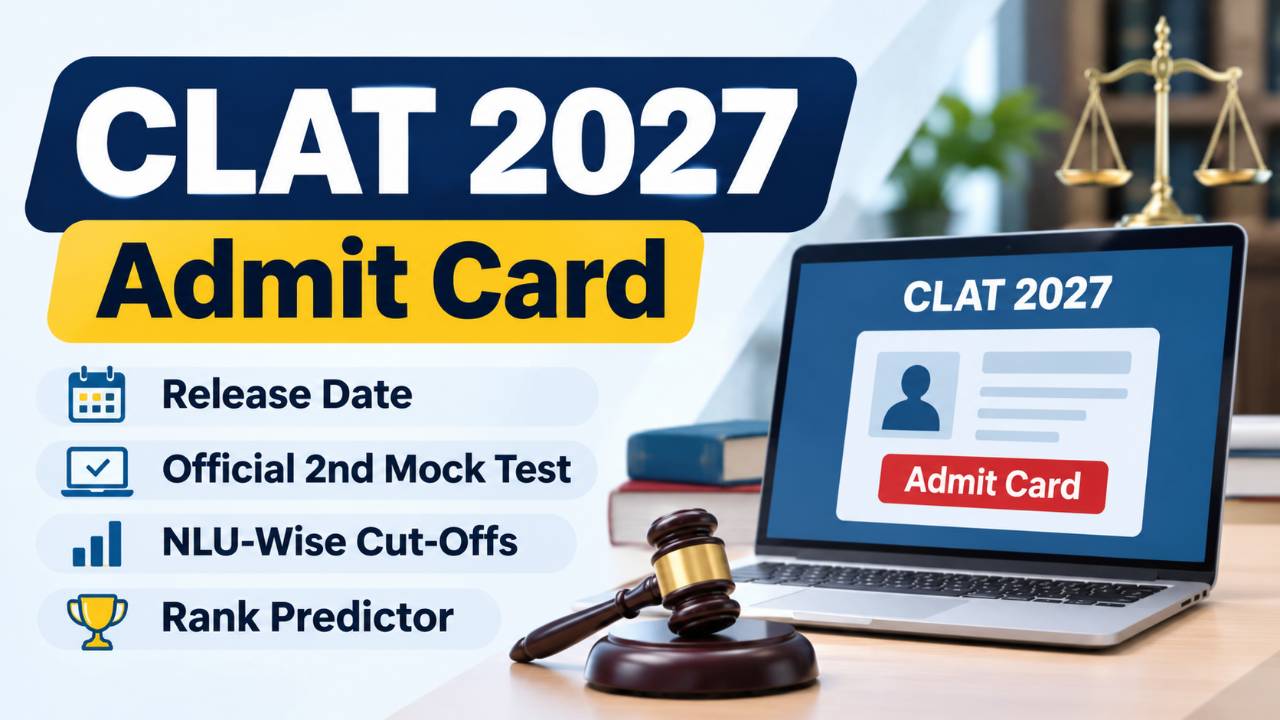
As CLAT 2027 approaches, thousands of law aspirants across India are tracking two urgent updates from the Consortium of National Law Universities: the CLAT 2027 admit card and the second official mock test on 20 November 2026. The National law entrance exam is scheduled for 6 December 2026, which means hall tickets are expected roughly two weeks before test day typically by the weekend following 18 November 2026.
This CollegeDwar guide explains what candidates should do right now: how to download the admit card, how to use consortium mock tests wisely, what NLU-wise closing ranks mean for your target college, and how rank predictors fit into a realistic preparation plan. Whether you are targeting NLSIU Bengaluru, NALSAR Hyderabad, or a strong regional NLU, clear timelines and verified official steps matter more than social-media rumours.
For a full overview of eligibility, syllabus, and participating colleges, start with our dedicated CLAT exam page. Postgraduate aspirants should also bookmark PG CLAT for LLM-specific dates and admit-card access on the same consortium portal.
The next few days are decisive: attempting mock test 2 with full seriousness, downloading the admit card the day it goes live, and aligning mock analytics with NLU cut-off trends will shape both confidence and college strategy. Use this page as a living checklist and refresh consortium alerts daily.
CLAT 2027 at a Glance: Key Dates and What Is Live Now
The Consortium conducts CLAT once a year for admission to integrated BA LLB, BBA LLB, and LLM programmes at member NLUs and affiliated institutions. In the 2027 cycle, the first official online mock test was held on 10 November 2026, with detailed solutions released afterward. The second and final official CLAT 2027 mock test is set for 20 November 2026. Registered candidates log in at consortiumofnlus.ac.in to attempt it.
Admit cards for both UG and PG are expected by the end of the week of 18 November 2026, in line with the consortium’s practice of releasing hall tickets about 15 days before the exam. Until the download link goes live, only application confirmation and mock-test access prove registration so keep your mobile number and password handy.
CLAT 2027 Important Dates (Quick Reference)
| Event | Date / Status |
|---|---|
| First official CLAT 2027 mock test | 10 November 2026 (solutions available) |
| Exam centre preference correction | Closed on 10 November 2026 |
| Second official CLAT 2027 mock test | 20 November 2026 |
| CLAT 2027 admit card | Expected by end of week (mid/late November 2026) |
| CLAT 2027 exam day | 6 December 2026 |
CLAT 2027 Admit Card Release Date: What We Know Officially
As of 18 November 2026, the CLAT 2027 admit card had not yet been published on the consortium portal, though media queries indicated candidates could expect hall tickets soon on the official website. This timing aligns with past years: download windows usually open close to the 15-day mark before 6 December.
Both CLAT UG and CLAT PG admit cards are released on the same day. You need the mobile number and password created during CLAT registration. The download link stays active until exam day, but experts advise printing your hall ticket immediately after release to avoid server rush or last-minute printer issues.
Details to Verify on Your CLAT 2027 Hall Ticket
- Candidate name, date of birth, and parent or guardian name
- Photograph and signature (as uploaded during application)
- Examination centre name and complete address
- Exam date, reporting time, and instructions
Your final centre is fixed now that the centre change facility closed on 10 November 2026. Any mismatch in name, photo, or centre must be raised through the consortium’s official communication channels do not rely on informal Telegram or WhatsApp “support” groups.
Security Alert: Ignore Paper-Leak Scams
In November 2026 the consortium issued a public notice warning candidates against fraudulent claims on social media and messaging apps offering CLAT question papers for money. Such offers are illegal and false. Report suspicious activity with evidence to the consortium. Your safest preparation path remains official mock tests, previous-year papers, and structured revision not paid “leaks.”
Second Official CLAT 2027 Mock Test (20 November 2026)
The consortium’s second CLAT 2027 official mock test is the last sample paper released directly by the exam authority before 6 December. It is taken online through your registered account; a PDF and solutions typically follow, similar to the first mock on 10 November.
Important: the consortium states that mock format, question types, structure, and difficulty are indicative only. Treat the mock as a dress rehearsal for interface, timing, and stamina not as a leaked final paper. You may retake the official mock as many times as you wish; after each attempt, study solutions instead of chasing score alone.
Mock Test Rules (Same as Exam Pattern)
- Duration: 2 hours in one sitting
- Questions: 120 MCQs, largely passage-based
- Marking: +1 per correct answer, −0.25 per wrong answer, no penalty for unattempted questions
- Stable internet and use on-screen navigation to move between sections
What Is a “Good” CLAT 2027 Mock Score?
Official mocks are often harder than the actual CLAT. Aspirants targeting top NLUs should aim high on tough papers and treat easier mocks as confidence builders. Illustrative section-wise targets on a 120-question paper (before negative marking adjustments) include:
| Section | Max Marks | Strong Mock Range |
|---|---|---|
| English | 25 | 21–23 |
| Current Affairs / GK | 30 | 24–27 |
| Legal Reasoning | 30 | 26–28 |
| Logical Reasoning | 25 | 21–23 |
| Quantitative Techniques | 10 | 8–10 |
| Total | 120 | About 100–111 raw |
For NLSIU Bengaluru, recent general-category counselling closed around AIR 108 in round 1 (CLAT 2026 data), with marks often discussed in the 100–105 band. On a deliberately hard mock, a target of 75–85 may still be competitive prep; on an easier mock, push toward 110+. NALSAR Hyderabad closed near AIR 168 in a later round similar mark bands apply, with slightly more rank buffer.
Last-Minute Prep Before Mock 2
- Revise high-yield current affairs from the last 6–12 months.
- Practise timed legal reasoning passages; note trap options.
- Redo logical reasoning sets you got wrong in mock 1.
- Brush up basic maths and data interpretation.
- Analyse every incorrect answer from the first official mock.
NLU-Wise CLAT Cut-Offs: How to Read Closing Ranks
CLAT cut-offs are expressed as All India Ranks (AIR) after centralised counselling, not as “college-specific percentiles” in isolation. Tier-1 NLUs NLSIU, NALSAR, WBNUJS, NLU Jodhpur, and others typically close under roughly AIR 400 for general category in early rounds. A score above 100 marks is widely cited as a practical tier-1 target, though each year’s difficulty shifts the mark–rank curve.
CLAT 2026 General Category Closing Ranks (Illustrative BA LLB, Round 1)
| NLU | Round 1 Closing Rank (General) |
|---|---|
| NLSIU Bengaluru | 108 |
| NALSAR Hyderabad | 148 |
| WBNUJS Kolkata | 284 |
| NLU Jodhpur | 310 |
| GNLU Gandhinagar | 372 |
| NLIU Bhopal | 431 |
| MNLU Mumbai | 481 |
| RMLNLU Lucknow | 747 |
| NLUO Cuttack | 800 |
| CNLU Patna | 1141 |
Later counselling rounds sometimes improve closing ranks slightly as seats move. Use these numbers as planning benchmarks, not guarantees for CLAT 2027. Category, domicile, and newly added NLU rules can change effective cut-offs.
Beyond NLUs, many private universities accept CLAT scores or run their own law entrances. Students comparing pathways may look at the Amity Entrance Test alongside CLAT-based admission at Amity and similar institutions listed on CollegeDwar.
CLAT 2027 Rank Predictor: Smart Use, Not Crystal Ball
Rank predictors estimate probable AIR from expected marks using past cut-off trends and exam difficulty assumptions. They help you answer: “If I score X, which NLU round might open?” Pair predictor output with the table above and your mock trend line not a single good day on an easy test series.
Actionable tip: Enter a conservative, a realistic, and a stretch score. Map each to three NLU lists (dream, target, safe). This mirrors how centralised counselling actually works preferences matter as much as rank.
Exam Day Readiness After Admit Card Download
Once your CLAT 2027 admit card is live, build a one-page checklist:
- Print at least two colour copies (backup)
- Carry government photo ID matching application details
- Reach the centre early; know address and transit time
- Follow item restrictions listed on the hall ticket
- Keep consortium helpline and email handy for centre issues
Law is one path in a broad higher-education landscape. Chennai students weighing technical or interdisciplinary options alongside law might explore campus profiles such as MIT Anna University Chennai or DMI College of Engineering Chennai while keeping CLAT as the primary NLU route. Maharashtra-based learners can compare institutions like Dr Vishwanath Karad MIT World Peace University, MIT Art Design and Technology University Pune, and MIT Vishwaprayag University for allied programmes, while Rajasthan aspirants may review skill-focused campuses such as Team Lease Skills University or hospitality training at Frankfinn Institute of Air Hostess Training Sikar if they want parallel career exploration. Design entrants often track NID DAT separately useful if you are juggling multiple entrance calendars in December.
Preparation Strategy for the Final Three Weeks
With the exam on 6 December 2026, shift from content hoarding to execution:
- Week 1 (mock 2 week): Full official mock under exam conditions; error log by section.
- Week 2 (admit card week): Download hall ticket; two timed sectional tests; revise GK notes daily.
- Week 3 (exam week): One full test every alternate day; light revision only on the last 48 hours.
Previous-year CLAT papers (2016–2026) remain the best free resource after consortium mocks. Analyse how legal passages blend current issues with static principles that pattern repeats.
Who Should Download the CLAT 2027 Admit Card Immediately?
Every candidate who completed CLAT 2027 registration and fee payment must download the hall ticket even if you only need to confirm centre city or reporting time. First-time national exam takers should read prohibited-item rules and reporting gates on the admit card; centres enforce consortium instructions uniformly.
If you registered separately for integrated UG law and LLM, track both programmes on the consortium portal. Our PG CLAT page summarises PG-specific counselling context while UG aspirants stay focused on BA LLB preferences.
Common Admit Card Problems and Quick Fixes
- Forgotten password: Use OTP-based reset on the login page with your registered mobile number.
- Blurry print: Re-download the PDF; never alter the photo digitally escalate to the consortium if the source image is faulty.
- Name spelling issues: Report with application proof before 6 December; carry matching government ID on exam day.
- Centre distance shock: Plan travel now correction closed on 10 November 2026.
CLAT 2027 Exam Pattern Reminder for Mock Practice
CLAT UG is a single-session, two-hour computer test with 120 passage-based MCQs and 0.25 negative marks per wrong answer. Unattempted questions carry no penalty. Official mocks mirror navigation and marking; private test series may use different toughness, so prioritize consortium performance trends in the last 15 days.
Many rankers use a flexible sectional clock: Legal Reasoning 25–28 minutes, English 20–22, GK 22–25, Logical Reasoning 22–25, Quant 8–10, plus five minutes to revisit flagged questions. Tune this split using errors from mock 1 and mock 2.
NLU Counselling and Safe Preference Lists
Centralised counselling ranks candidates nationally, then allocates seats by locked NLU order. Round-1 closing ranks are not the final word later rounds absorb slips and withdrawals. Build a preference list you can honour financially and geographically: two aspirational NLUs, four competitive choices, and six realistic backups.
Domicile or institutional quotas at select NLUs change effective cut-offs. Read each university’s admission brochure alongside historical AIR data. CollegeDwar’s CLAT section helps map likely ranks to accepting colleges across states.
Documents to Carry Along With CLAT 2027 Admit Card
On exam day, the admit card is mandatory but not sufficient by itself. Carry at least one original government photo ID (Aadhaar, PAN, passport, or school/college ID with photo) whose details align with your application. Some centres may ask for a passport-size photograph identical to the one on the hall ticket keep two spare prints in your folder.
Arrive at least 45–60 minutes before reporting time to complete frisking and seating. Mobile phones, smartwatches, calculators, and study notes are not allowed inside the lab unless the hall ticket explicitly permits a specific item. When in doubt, leave valuables at home.
How Parents and Mentors Can Support CLAT Aspirants Now
Family support in November should focus on logistics: stable internet for the 20 November mock, quiet study hours, nutritious meals, and reduced chore load during the final week. Avoid comparing your child’s mock score with coaching-centre toppers on Instagram official mocks and actual CLAT difficulty vary year to year.
Mentors can help build a rank-to-college spreadsheet using last year’s closing ranks, then update it after CLAT 2027 results. That exercise turns anxiety into a concrete Plan A and Plan B before counselling opens.
After CLAT 2027: Results, Answer Key, and Counselling
Post-exam, the consortium releases an answer key, objections window, and final results. Counselling registrations open with NLU preference locking and seat allotment rounds. Keep scanned copies of admit card, scorecard, and category certificates organised in one folder counselling moves quickly.
PG candidates follow the same portal ecosystem described on our PG CLAT resource. UG and PG timelines often overlap; set separate calendar reminders.
Section-Wise CLAT 2027 Revision Priorities Before 6 December
English Language: Focus on inference-based reading comprehension, tone, and vocabulary in context rather than isolated word lists. Practice eliminating options that exaggerate or contradict the passage.
Current Affairs and General Knowledge: Consolidate national and international events from the last year, major Supreme Court judgments, constitutional amendments, and awards. Link news stories to static polity and history basics so legal passages feel familiar on exam day.
Legal Reasoning: Train for principle-fact questions and argument evaluation. You are not expected to cite bare acts from memory; you are expected to apply given rules consistently.
Logical Reasoning: Strengthen puzzles, syllogisms, and analytical sets with a timer. Mark lengthy sets for a second pass instead of burning twenty minutes on one question cluster.
Quantitative Techniques: Revisit percentages, ratios, averages, and elementary statistics. This section has fewer questions but offers high accuracy when fundamentals are sharp.
CLAT 2027 Eligibility Snapshot for Last-Minute Applicants
Most integrated UG law programmes through CLAT require candidates to have passed or be appearing in the Class 12 examination with the minimum percentage prescribed by the consortium and individual NLUs. LLM applicants need an undergraduate law degree with required marks. If you are unsure whether your board percentage meets the bar, re-read the official information bulletin rather than third-party summaries.
Candidates exploring non-law backups while awaiting results may compare entrance routes side by side law through CLAT, design through NID DAT, and private-university tests such as the Amity Entrance Test but keep CLAT revision the priority until 6 December 2026.
Conclusion
CLAT 2027 admit cards are expected imminently on consortiumofnlus.ac.in, with the second official mock test on 20 November 2026 serving as your last authority-led rehearsal before the 6 December 2026 exam. Verify every detail on your hall ticket, ignore paper-leak fraud, and translate mock scores into rank-aware college lists using proven NLU closing trends. For ongoing updates, eligibility, and college options, keep our CLAT hub bookmarked and approach rank tools as planning aids, not promises. Consistent revision, official practice material, and calm exam-day discipline remain the strongest predictors of where you will study law next year.