The Central Teacher Eligibility Test (CTET) 2026 is one of the most important national-level exams for aspiring school teachers in India. Conducted by the Central Board of Secondary Education (CBSE), CTET determines whether a candidate meets the minimum qualifications to teach at primary and upper-primary levels in central government schools such as KVS, NVS, and schools under the administrative control of UT of Chandigarh, Lakshadweep, and the Andaman and Nicobar Islands.
CBSE has officially announced that the 22nd edition of CTET will be held on December 12 and 13, 2026. The exam was originally scheduled for September 6, 2026, but was postponed after the application window was reopened. For lakhs of B.Ed, D.El.Ed, and teacher-training graduates across India, these revised dates provide a clear timeline to plan revision, mock tests, and travel to exam centres.
This guide covers everything CTET applicants need for December 2026: confirmed exam dates, city intimation slip timeline, admit card release schedule, documents to carry, preparation tips, and post-exam career pathways. Whether you are a first-time applicant from Rajasthan, Delhi, Karnataka, or Tamil Nadu, use this page as your single reference point before exam day.
What Is CTET and Who Should Apply?
CTET is a qualifying examination mandated under the Right of Children to Free and Compulsory Education (RTE) Act, 2009. It assesses whether a candidate possesses the essential aptitude and knowledge to teach children at the elementary stage. Clearing CTET does not guarantee a job, but it is a mandatory eligibility criterion for recruitment in many central and state government teaching posts.
CTET Paper I vs Paper II
Understanding which paper to attempt is the first step in your preparation journey:
- Paper I (Classes 1 to 5): For candidates who wish to become primary teachers. Subjects include Child Development and Pedagogy, Language I, Language II, Mathematics, and Environmental Studies.
- Paper II (Classes 6 to 8): For candidates targeting upper-primary teaching roles. It includes Child Development and Pedagogy, Language I, Language II, and either Mathematics and Science or Social Studies/Social Science, depending on the candidate's chosen subject.
- Both Papers: Candidates who want flexibility to teach across Classes 1 to 8 may appear for both papers on the scheduled dates.
Candidates who have completed or are in the final year of a recognised teacher education programme such as B.Ed, B.El.Ed, D.El.Ed, or BA/B.Sc with B.Ed are generally eligible. Always cross-check the latest eligibility criteria on the official CTET notification before applying.
CTET 2026 Exam Dates: Complete Schedule
CBSE has confirmed the revised CTET 2026 examination dates. Candidates who applied during the reopened registration window should note the following timeline. Dates may be updated through an official corrigendum, so bookmark the CTET portal and check it weekly as December approaches.
| Event | Expected Timeline |
|---|---|
| CTET 2026 Exam | December 12 and 13, 2026 |
| Original Scheduled Date (Postponed) | September 6, 2026 |
| Exam City Intimation Slip | At least 15 days before the exam |
| Admit Card Release | Two days before the exam |
| Result Declaration | Usually within 4–6 weeks after the exam (official date TBA) |
CBSE may conduct CTET in more than one shift on both days. Your exact paper (I or II), shift timing, reporting time, and centre address will appear only on the admit card. Set a calendar reminder for the city slip and admit card release windows so you are not dependent on last-minute WhatsApp forwards or unofficial Telegram channels.
Why Was CTET 2026 Postponed?
The September 6, 2026 date was deferred after CBSE reopened the CTET application window, allowing additional candidates to register or make corrections. Postponements in national exams are not uncommon when registration timelines shift. The December schedule gives both new and existing applicants roughly three extra months to strengthen weak subjects, complete syllabus coverage, and attempt full-length mock tests under timed conditions.
Rather than viewing the delay as lost time, treat it as a structured revision window. Candidates from teacher-training hubs whether enrolled at a District Institute of Education and Training in Sikar, a B.Ed programme at Pink City College of Education Jaipur, or a Delhi-based institution like Jesus and Mary College Delhi can use this period for peer study groups and supervised mock drills.
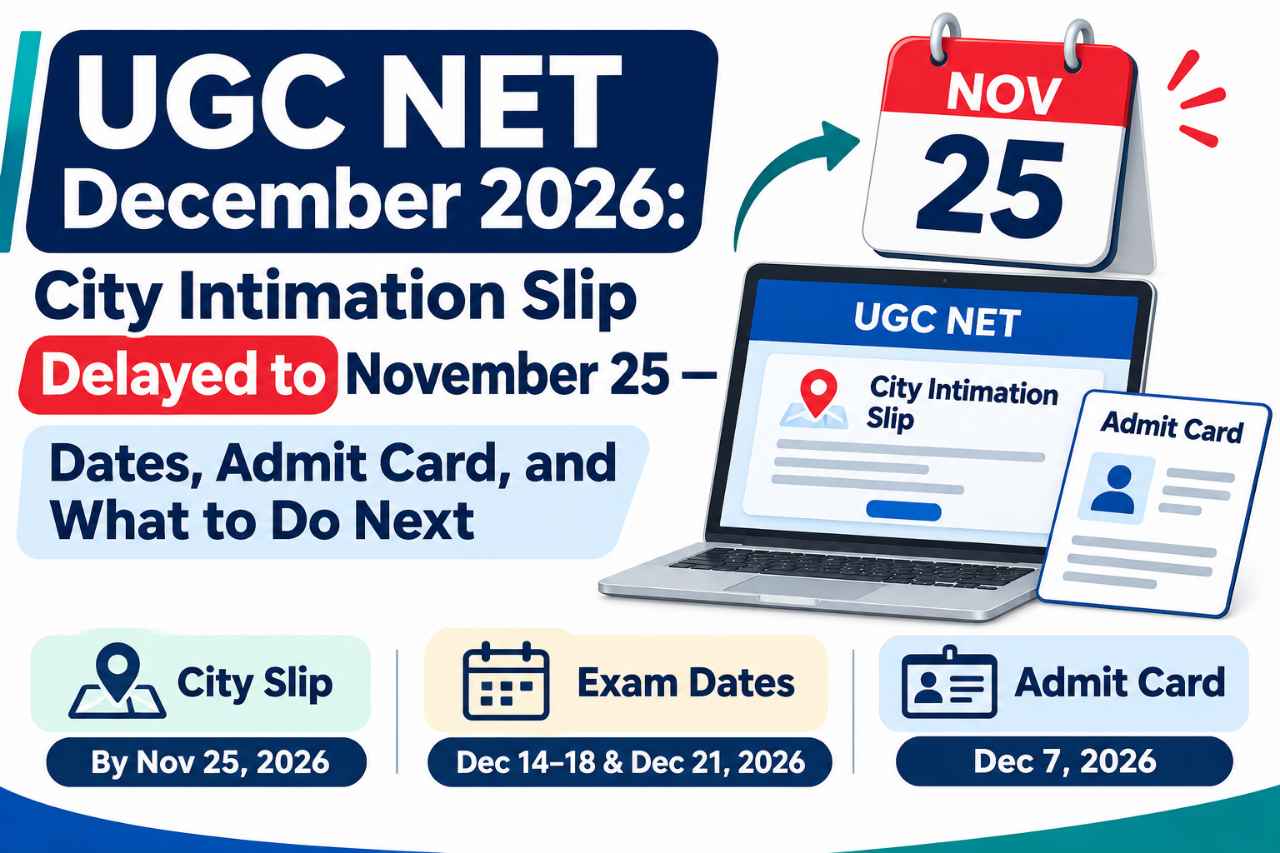
CTET Exam City Intimation Slip 2026: What It Is and How to Download
The exam city intimation slip (also called the city slip) is an advance notice that tells you which city CBSE has allotted for your examination centre. It is not the admit card and does not contain the full centre address, gate number, or reporting time.
Why the City Slip Matters
India's CTET centres span hundreds of cities from metro hubs to tier-2 towns. Knowing your exam city at least 15 days in advance helps you:
- Book train, bus, or flight tickets at reasonable fares
- Arrange accommodation if the centre city differs from your home town
- Inform your employer or college about travel dates
- Reduce last-minute panic when the admit card is released just two days before the test
How to Download the CTET City Intimation Slip
- Visit the official CTET website at ctet.nic.in (verify the URL carefully use only the .nic.in domain).
- Click on the Candidate Login or Download City Intimation Slip link on the homepage.
- Enter your application number, password, and security pin (or date of birth, depending on the login format for that session).
- The city slip will display your allotted exam city. Download and save a PDF copy.
- Do not share your login credentials on third-party websites or "help" groups.
If the allotted city is far from your preferred choice, CBSE generally does not accept change requests after allotment. Plan travel accordingly. Candidates based in southern states who may be allotted centres near institutions such as Bengaluru City University or SRM Institute of Science and Technology Chennai should scout local transport options early.
CTET Admit Card 2026: Release Date and Download Steps
CBSE releases the CTET admit card two days before the examination. This is a tight window, which is why the city slip and advance preparation are critical. Without a valid admit card and photo ID, you will not be permitted to enter the exam hall.
Details to Verify on Your Admit Card
After downloading, check every field carefully:
- Candidate name (must match your ID proof)
- Photograph and signature
- Application number and roll number
- Paper (I, II, or both) and subject combination
- Exam date and shift
- Reporting time and gate closing time
- Complete exam centre name and address
- Instructions regarding allowed and prohibited items
If you spot an error such as a misspelled name or wrong photograph contact the CTET helpdesk immediately through the official website. Corrections close once the exam begins, and discrepancies can lead to entry denial despite a valid application.
Admit Card Download Checklist
- Keep your application number, password, and registration confirmation page in a secure folder (physical and digital).
- On the release day, log in early servers often slow down due to heavy traffic.
- Print at least two colour copies of the admit card on A4 paper.
- Save a PDF backup on your phone, but note that a printed copy is usually mandatory.
- Read the complete instruction sheet on the back or second page of the admit card.
Documents Required on CTET Exam Day
Reporting to the centre without the correct documents is one of the most avoidable reasons for disqualification. Carry the following:
- Printed CTET admit card with a clear photograph
- Valid photo identity proof (original): Aadhaar card, PAN card, passport, driving licence, voter ID, or any ID listed in the official instructions
- Passport-size photograph (same as uploaded in the application, if instructed)
Prohibited items typically include mobile phones, smartwatches, calculators, bags, study material, and electronic gadgets. Exam centres provide rough sheets; you only need a ballpoint pen in most sessions. Reach the venue at least 60–90 minutes before reporting time to account for security checks and seating allocation.
CTET 2026 Exam Pattern at a Glance
CTET is conducted in offline (pen-and-paper) mode unless CBSE announces a mode change in the official notification. Each paper consists of multiple-choice questions (MCQs) with four options and no negative marking a significant advantage for candidates who can attempt all questions strategically.
| Feature | Paper I | Paper II |
|---|---|---|
| Duration | 2.5 hours (150 minutes) | 2.5 hours (150 minutes) |
| Total Questions | 150 MCQs | 150 MCQs |
| Total Marks | 150 | 150 |
| Negative Marking | None | None |
| Qualifying Marks | 60% (General/OBC); 55% (SC/ST/PwD) | 60% (General/OBC); 55% (SC/ST/PwD) |
Section-Wise Focus Areas
Child Development and Pedagogy (30 marks in each paper): Questions on Piaget, Vygotsky, inclusive education, learning theories, and classroom management appear every year. Use concise notes rather than bulky textbooks.
Language Sections: Comprehension passages, grammar, and pedagogy of language learning. Practice unseen passages daily.
Mathematics / Environmental Studies (Paper I): NCERT-based conceptual questions dominate. Revise Classes 1–5 NCERT maths and EVS textbooks.
Mathematics & Science or Social Science (Paper II): Choose your subject combination at application time and stick to NCERT content for Classes 6–8.
Preparation Strategy for the Revised December 2026 Schedule
The postponement from September to December gives candidates an extended but finite preparation runway. A structured plan beats random chapter reading every time.
8-Week Action Plan Before CTET 2026
- Weeks 8–7: Complete syllabus coverage. Identify weak topics in pedagogy and content subjects.
- Weeks 6–5: Solve the last 5–7 years of CTET question papers. Note recurring themes.
- Weeks 4–3: Attempt full-length mock tests every 3–4 days. Analyse every incorrect answer.
- Weeks 2–1: Rapid revision using short notes. Focus on formulas, teaching methods, and important thinkers.
- Final 3 days: Light revision only. Fix sleep schedule. Arrange documents and travel.
Smart Study Tips That Actually Work
- Revise NCERT first: CTET questions are strongly rooted in NCERT content for Classes 1–8.
- Practise time control: 150 questions in 150 minutes sounds generous, but pedagogy passages can consume time. Do not spend more than 90 seconds on a single question initially.
- Use section-wise tests: Isolate Child Development, Language, and content subjects to find score leaks.
- Build a formula and fact sheet: One-page summaries for mathematics and EVS save hours during final revision.
- Join a reliable test series: Free and paid mock platforms help simulate exam pressure.
- Discuss pedagogy cases: Study groups at your college whether at Jagran Lakecity University Bhopal or a Rajasthan-based B.Ed institute can clarify tricky classroom scenarios.
Aspirants who also explore other career paths alongside teaching such as design entrances like the NIFT Entrance Exam or NID DAT should still prioritise CTET if school teaching is their primary goal. CTET scores remain valid for a lifetime as per the Ministry of Education's 2023 policy update, removing the earlier seven-year validity limit.
Important Instructions and Common Mistakes to Avoid
National exams attract misinformation. Protect yourself by following only official CBSE communications.
Do's
- Use only ctet.nic.in for application status, city slips, admit cards, and answer keys.
- Save copies of your application form, fee payment receipt, and confirmation page.
- Visit your exam centre a day early if you are unfamiliar with the city.
- Carry transparent water bottles and follow the dress code if specified.
- Check CTET notices every week from November 2026 onward.
Don'ts
- Do not pay anyone claiming to "change your exam city" or "guarantee qualification."
- Do not click unknown links shared on social media pretending to be admit card downloads.
- Do not bring prohibited electronic devices these can lead to immediate disqualification.
- Do not rely solely on coaching notes; NCERT remains the primary source.
- Do not skip mock tests; they build stamina for a 2.5-hour exam.
After CTET: Career Pathways for Qualified Teachers
Qualifying CTET opens doors to recruitment in KVS, NVS, ERDO, and state-level teacher eligibility lists. Many states accept CTET scores for their own TET-exempt recruitments or as a benchmark during DSSSB, REET-aligned processes, and UT-level hiring.
While awaiting results, candidates can strengthen their profiles through:
- Applying for state Teacher Eligibility Tests (TET) where CTET is not accepted
- Completing internships and classroom practice hours at local schools
- Pursuing postgraduate qualifications such as M.Ed for senior roles
- Exploring allied education programmes at institutions like Garden City University or management of education courses at Pink City Institute of Management Jaipur
Teacher recruitment is competitive, but CTET qualification is the foundation. Candidates from engineering or other streams who pivot to teaching should ensure their B.Ed or equivalent is from a recognised NCTE-approved institution similar to how technical aspirants verify AICTE approval at colleges such as Galgotias College of Engineering and Technology or Krishna Institute of Engineering and Technology.
CTET 2026 Key Takeaways
The CTET December 2026 cycle is confirmed for 12 and 13 December 2026, following a postponement from the earlier September date. Your preparation timeline, travel planning, and document readiness should align with two critical release windows: the city intimation slip at least 15 days before the exam and the admit card two days before the exam.
Success in CTET requires consistent NCERT-based study, timed mock tests, and careful attention to official announcements. Mark your calendar, secure your login credentials today, and use the extra months wisely. A calm, well-prepared candidate who reaches the centre on time with the correct documents is already ahead of thousands of others.
Stay updated through the official CTET portal, plan your journey as soon as the city slip appears, and treat every mock test as a rehearsal for 12–13 December 2026. Good luck with your preparation.