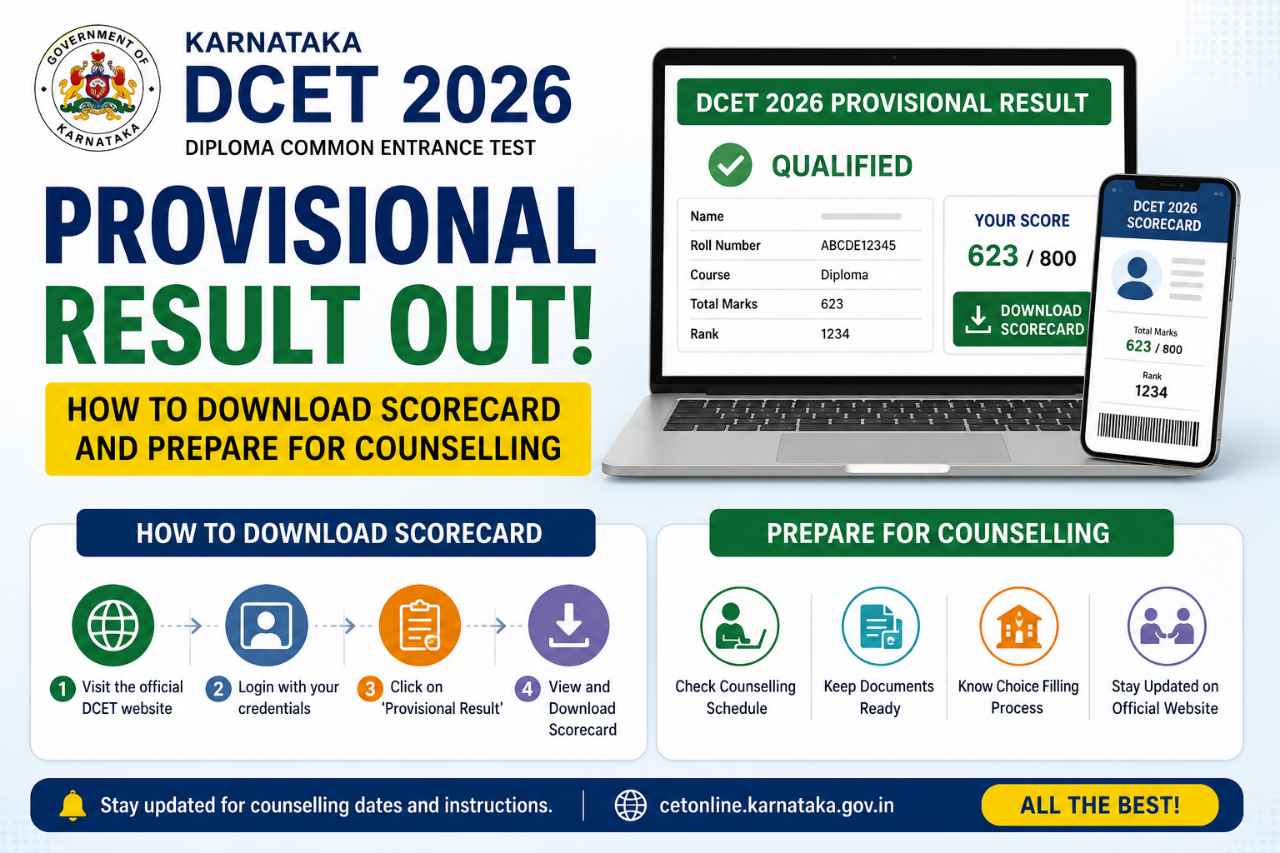
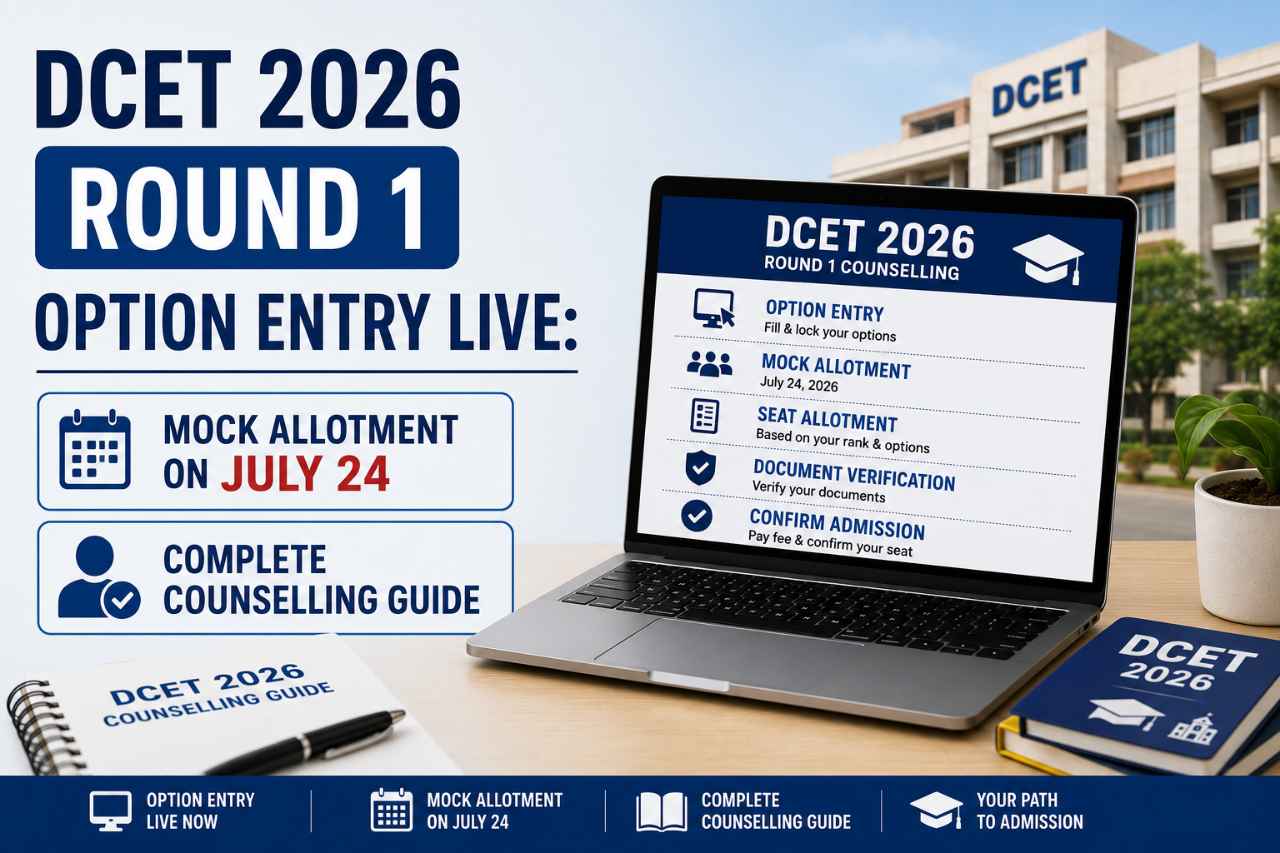

The Karnataka Examinations Authority (KEA) has opened DCET 2026 Round 1 option entry for diploma holders and working professionals seeking lateral entry into BE, BTech, and BArch programmes across Karnataka. If you cleared the Diploma Common Entrance Test and completed document verification, this is the stage where your rank, preferences, and seat matrix come together to decide your engineering college.
Option entry began on July 21, 2026, and the first window closes on July 24, 2026. On the same evening, KEA will release the mock seat allotment result at 6 PM a preview that helps you understand where you stand before the real Round 1 allotment on July 27. This guide explains the full counselling timeline, how mock allotment works, smart choice-filling strategies, and what to do after you receive a seat.
What Is DCET and Who Can Participate in Round 1 Counselling?
DCET (Diploma Common Entrance Test) is Karnataka's state-level entrance exam for lateral entry admissions. Unlike first-year engineering admissions through KCET, DCET is designed for candidates who already hold a diploma in engineering or a related field and wish to join the second year (third semester) of a BE or BTech programme directly.
Round 1 counselling is open to candidates who:
- Appeared for DCET 2026 and obtained a valid rank
- Completed document verification at the allotted KEA centre or online slot
- Downloaded the verification slip from the official portal
- Meet eligibility criteria for the specific branch and college they wish to choose
Working professionals with relevant experience may have a separate verification schedule, but the option entry process on cetonline.karnataka.gov.in follows the same preference-based allotment logic for all eligible candidates.
Lateral entry counselling is fundamentally different from undergraduate medical or general UG admissions. For instance, premier institutes like All India Institute of Medical Sciences Delhi (AIIMS Delhi) follow NEET-based MBBS counselling, while DCET follows a diploma-to-degree pathway specific to Karnataka's technical education system. Understanding this distinction helps candidates set realistic expectations about colleges, branches, and cutoffs.
Document Verification: The Step Before Option Entry
Before Round 1 option entry opened, KEA completed document verification for eligible DCET candidates. Those who successfully verified their diplomas, category certificates, and identity documents received a verification slip downloadable from July 18, 2026. Without a verified status on the portal, the option entry tab may remain inactive.
During verification, KEA checks whether your diploma discipline matches the branches you intend to choose. For example, a diploma in Computer Science Engineering typically allows lateral entry into CSE, Information Science, or related IT branches, but may not qualify you for every core branch at every institution. Always cross-check branch eligibility in the official notification before locking preferences.
Working Professionals: Separate Schedule, Same Allotment Logic
Karnataka reserves a portion of lateral entry seats for working professionals who meet minimum experience requirements. These candidates follow a separate document verification schedule but enter options on the same KEA portal using the same preference-based allotment system. Working professionals should pay special attention to seat codes marked for their category in the seat matrix, as choosing ineligible options wastes valuable preference slots.
DCET 2026 Round 1 Counselling Schedule: Key Dates You Must Not Miss
KEA has compressed Round 1 into a fast-paced one-week window in 2026. Missing even a single deadline can cost you a seat. Below is the official timeline candidates should bookmark immediately.
| Event | Date and Time |
|---|---|
| Verification slip download | July 18, 2026 |
| Seat matrix and fee details published | July 20, 2026 (4 PM) |
| Round 1 option entry opens | July 21, 2026 (11 AM) |
| Round 1 option entry closes (first window) | July 24, 2026 (11 AM) |
| Mock seat allotment result | July 24, 2026 (6 PM) |
| Choice modification window | July 24 to July 27, 2026 (till 11 AM) |
| Round 1 final seat allotment | July 27, 2026 (after 6 PM) |
| Choice selection (Choice 1 to Choice 4) | July 28 to July 31, 2026 |
| Challan download (Choice 1 and 2) | July 28 to August 1, 2026 |
| Last date for fee payment | August 3, 2026 |
| Reporting at allotted college | August 4, 2026 |
How 2026 Differs from DCET 2025
Compared to last year, the 2026 schedule has shifted later in the calendar. In 2025, Round 1 option entry started on June 3 and final allotment was declared on July 9. This year, option entry began on July 21 and final allotment is scheduled for July 27. Candidates who prepared using last year's dates should rely only on the 2026 notification to avoid confusion.
Reservation Categories and Seat Matrix Reading Tips
The seat matrix published on July 20, 2026, breaks down availability by GM (General Merit), SC, ST, Category-I, 2A, 2B, 3A, 3B, and other applicable reservation groups. When filling options, ensure you are selecting seats under the category for which you verified documents. A common error is entering GM seats when your verified category is 2A this can lead to allotment failure even with a good rank.
Also note district-wise and Kannada-medium quotas where applicable. Some colleges offer seats under special categories with separate cutoffs. Reading the matrix column by column rather than scanning college names alone gives you a clearer picture of genuine seat availability for your profile.
Understanding Mock Seat Allotment: Why It Matters
The mock seat allotment on July 24, 2026, is one of the most useful tools KEA provides during engineering counselling yet many students ignore it or misinterpret it. Here is what you need to know.
What Mock Allotment Shows
Mock allotment is a simulated result based on:
- Your current DCET rank and category
- The colleges and branches you have already entered as preferences
- The published seat matrix and reservation rules
- Choices submitted by other candidates up to that point
It gives you a realistic preview of which college and branch you are likely to receive if you do not change your preference list before the final allotment.
What Mock Allotment Does NOT Guarantee
Mock allotment is not binding. It does not reserve a seat, confirm admission, or reflect the final outcome. Other candidates may revise their choices between July 24 and July 27, which can shift cutoffs and change your final allotment. Treat mock results as guidance, not a guarantee.
Actionable Tips After Mock Allotment
- If you are happy with the mock result: Still review your preference order. Ensure no lower-priority college is placed above a college you genuinely prefer.
- If mock shows a branch you dislike: Reorder choices immediately during the modification window. Add safer options lower in the list and move preferred branches higher.
- If mock shows no allotment: Expand your list. Include more colleges, consider allied branches, and check whether category or region-specific seats apply to you.
- Compare with previous cutoffs: Cross-check mock results against last year's closing ranks for similar categories to validate whether your list is too ambitious or too conservative.
How to Fill DCET 2026 Round 1 Options Smartly
Option entry is not about listing your dream college alone. It is a strategic exercise in balancing ambition, safety, and branch preference. Counselling systems used in exams like MHT CET in Maharashtra and IPU CET in Delhi also follow preference-based allotment, and the same core principle applies here: order matters more than the number of choices.
Step 1: Download and Study the Seat Matrix
Before logging in, download the official seat matrix published on July 20, 2026. This document lists every participating college, available branches, seat count by category, and fee structure. Filter colleges by district, university affiliation, accreditation status, and branch availability relevant to your diploma discipline.
Step 2: Build a Tiered Preference List
Organise choices into three tiers:
- Reach choices (top 5–10): Colleges where your rank is near or slightly above last year's closing rank
- Realistic choices (middle 10–15): Colleges where your rank comfortably falls within expected cutoffs
- Safe choices (bottom 5–10): Colleges where admission is highly likely even if cutoffs rise
Place your most preferred college–branch combination at the top, even if it is a reach option. KEA allots the highest preference you qualify for not the lowest.
Step 3: Prioritise Branch Over Brand When Needed
If you are passionate about a specific branch Computer Science, Electronics, Mechanical, Civil, or others place that branch at multiple colleges above a prestigious college offering a branch you do not want. Many candidates regret choosing a famous college name over a branch that aligns with their career goals.
Step 4: Save, Review, and Lock Before Deadline
After entering choices, save the list and verify the order carefully. During the first window, complete entry before July 24, 2026 (11 AM) to participate in the mock allotment preview. Use the modification window from July 24 (6 PM) to July 27 (11 AM) for final adjustments.
Branch Mapping: Matching Your Diploma to BE or BTech Programmes
Not every diploma branch maps equally to every degree branch. KEA publishes branch-wise eligibility rules that define which diploma disciplines qualify for which engineering programmes. Before filling options, confirm that your diploma specialisation is accepted for the branches you want.
Popular lateral entry pathways include:
- Diploma in Computer Science or IT → CSE, ISE, AIML, or Data Science branches
- Diploma in Electronics → ECE, EEE, or Telecommunication branches
- Diploma in Mechanical → Mechanical, Automobile, or Mechatronics branches
- Diploma in Civil → Civil Engineering or Construction Technology branches
If your preferred branch is unavailable at a top college, consider related branches that share similar career outcomes. Many graduates successfully transition across allied disciplines through certifications and internships during the remaining degree years.
How DCET Counselling Compares with Other State Entrance Exams
Students familiar with state-level counselling will notice strong parallels between DCET and other preference-based systems. Maharashtra's MHT CET CAP rounds and Delhi's IPU CET counselling also require candidates to rank colleges and courses in strict priority order, with allotment based on the highest available preference. The skills you develop for DCET reading seat matrices, building tiered lists, and using trial allotments transfer directly to these processes if you apply elsewhere in future admission cycles.
Round 1 Final Seat Allotment and Post-Allotment Choices
On July 27, 2026, after 6 PM, KEA will publish the real Round 1 seat allotment result. Unlike mock allotment, this result is official and requires action from your side.
Understanding Choice 1, Choice 2, Choice 3, and Choice 4
After allotment, candidates must select one of four options between July 28 and July 31, 2026:
- Choice 1: Accept the allotted seat and proceed with admission. You will download the challan, pay fees, and report to the college by August 4, 2026.
- Choice 2: Accept the seat but remain eligible for the next round upgrade. Use this only if you want a better seat in Round 2 while holding your current allotment temporarily.
- Choice 3: Reject the seat and participate in the next counselling round without retaining the current seat.
- Choice 4: Exit counselling entirely if you do not wish to continue in further rounds.
Read KEA's latest notification carefully before selecting Choice 2 or 3, as rules about seat retention and upgrade eligibility can affect your admission status in subsequent rounds.
Fee Payment, Challan Download, and College Reporting
Candidates who accept a seat under Choice 1 or Choice 2 must complete financial formalities within the prescribed timeline.
Challan and Fee Payment Timeline
- Challan download window: July 28 to August 1, 2026
- Fee payment deadline: August 3, 2026
- Seat confirmation slip download and college reporting: by August 4, 2026
Pay the admission fee only through the official KEA portal or designated payment mode mentioned in your allotment letter. Keep payment receipts, challan copies, and transaction screenshots safely.
Documents to Carry for College Reporting
When reporting to your allotted engineering college, carry both originals and photocopies of:
- DCET 2026 rank card and scorecard
- Diploma marks cards and provisional or final diploma certificate
- Verification slip and seat allotment order
- Category certificate (if applicable)
- Income and caste certificates (if applicable)
- Photo ID proof (Aadhaar, passport, or voter ID)
- Passport-size photographs
- KEA fee payment receipt and seat confirmation slip
Arrive at the college on or before August 4, 2026. Late reporting may result in cancellation of the allotted seat and forfeiture of fees, depending on KEA and institutional rules.
Estimated Fee Structure and Financial Planning
KEA published fee details alongside the seat matrix on July 20, 2026. Government and aided engineering colleges in Karnataka generally charge lower tuition than private unaided institutions. Before entering preferences, estimate the total cost tuition, development fees, university fees, and hostel charges if applicable so you are not surprised after allotment.
If you receive a seat at a private college with higher fees, confirm whether education loans, scholarships, or fee reimbursement schemes apply to your category. Having a financial plan ready before July 27 helps you accept or reject allotments confidently during the Choice 1 to Choice 4 window.
Common Mistakes Candidates Should Avoid During DCET Counselling
Every year, eligible candidates lose seats due to avoidable errors. Keep these pitfalls in mind:
- Entering too few choices: A short list increases the risk of no allotment. Aim for a comprehensive but well-ordered list.
- Ignoring mock allotment: Skipping the July 24 preview means missing the best window to correct your strategy.
- Placing safe colleges at the top: KEA will allot your highest eligible preference. Do not put a backup college first out of fear.
- Missing modification deadline: The window closes on July 27 at 11 AM. Set reminders for July 24 evening and July 26.
- Not checking category and reservation rules: Ensure you select seats you are actually eligible for.
- Delaying fee payment: Even after allotment, failure to pay by August 3 can cancel your seat.
- Relying on unofficial cutoff predictions: Use only KEA's seat matrix and verified previous-year data from trusted sources.
DCET 2026 Round 1 Action Plan: Week-by-Week Checklist
Use this practical checklist to stay on track through the entire Round 1 process:
- Before July 24 (11 AM): Log in, enter all preferences, save and lock choices for mock allotment participation.
- July 24 (6 PM): Check mock allotment result and note the college and branch shown.
- July 24–27: Modify, reorder, or add choices based on mock outcome and updated cutoff analysis.
- July 27 (after 6 PM): Download final Round 1 allotment result and read all instructions carefully.
- July 28–31: Select Choice 1, 2, 3, or 4 as per your admission plan.
- July 28–August 1: Download challan if accepting the seat under Choice 1 or 2.
- By August 3: Complete fee payment without delay.
- By August 4: Report to the allotted college with all required documents.
Conclusion
DCET 2026 Round 1 option entry is live, and the counselling window is moving quickly. With the first option entry phase closing on July 24 and mock seat allotment releasing the same evening at 6 PM, candidates have a brief but valuable opportunity to test and refine their preferences before the final allotment on July 27.
Success in DCET counselling depends on preparation, not luck. Study the seat matrix, build a balanced preference list, use mock allotment as a diagnostic tool, and act promptly during the modification and post-allotment phases. Whether you are aiming for a top engineering college in Bengaluru or a trusted regional institution, disciplined choice filling and timely fee payment will protect the seat you have worked hard to earn through your diploma and DCET rank.
Stay updated only through the official KEA portal at cetonline.karnataka.gov.in, and complete every step before the published deadline to secure your lateral entry admission for the 2026–27 academic session.