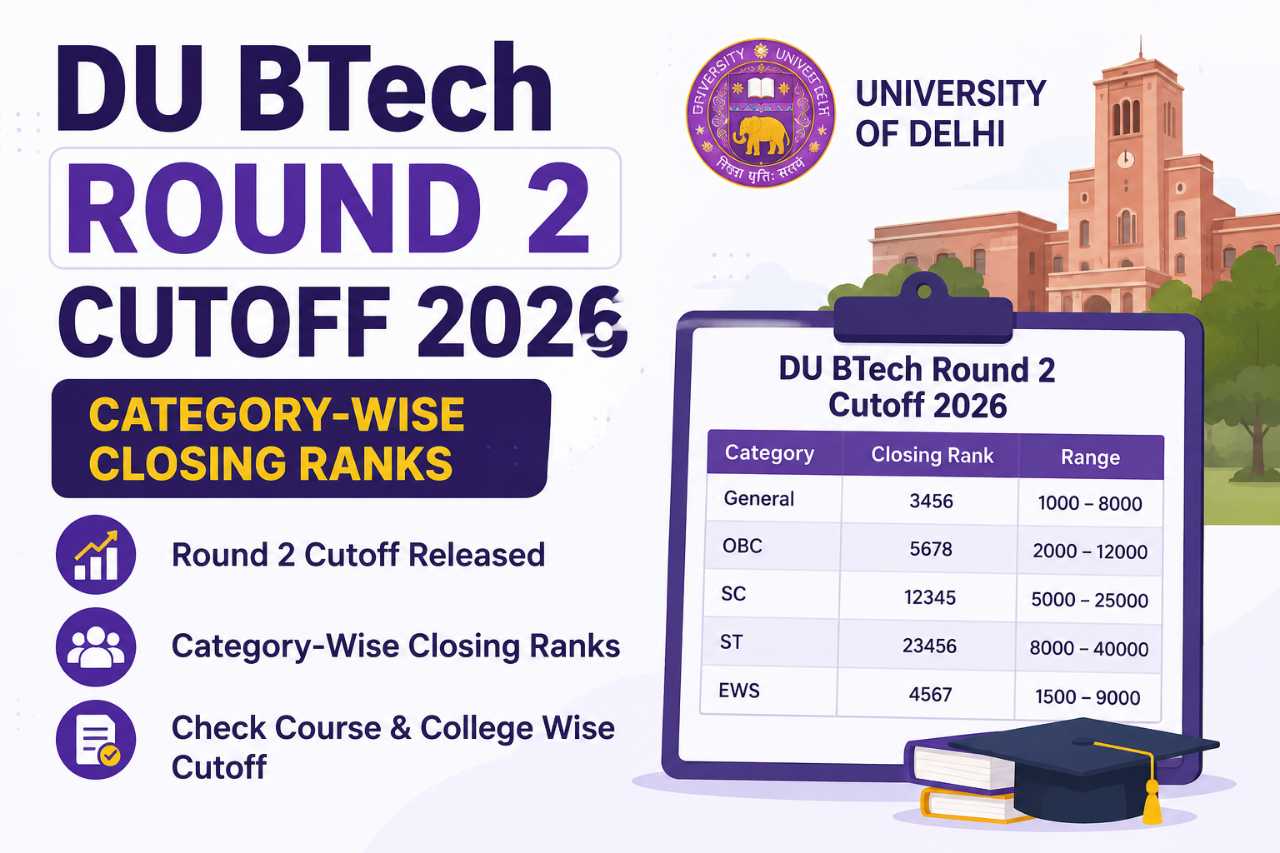
Delhi University (DU) has released the Round 2 category-wise cutoff ranks for BTech admissions 2026-27 through its Faculty of Technology. The official list, uploaded on July 5, 2026, is available on the CSAS portal at admission.uod.ac.in. If you appeared in JEE Main 2026 and registered for DU engineering seats, this round is one of the most important checkpoints in your admission journey.
Round 2 cutoffs tell you the last JEE Main rank at which a seat was allotted in each programme and reservation category. Whether you received an allotment or are still waiting, understanding these numbers helps you decide whether to accept a seat, prepare for a spot round, or explore alternatives such as CSAB special counselling or other Bachelor of Technology (BTech) colleges across India.
This article breaks down the DU BTech Round 2 cutoff 2026 in simple language, covers programme-wise and category-wise closing ranks, explains eligibility rules, and gives you a clear action plan before deadlines close.
DU BTech Round 2 Cutoff 2026: Quick Overview
The University of Delhi admits students to its three BTech programmes solely on the basis of JEE Main 2026 All India Rank (AIR). There is no separate DU entrance test for these seats. Counselling is conducted online through the Centralised Seat Allocation System (CSAS) portal.
Round 2 seat allotment results were declared on July 3, 2026, and the category-wise closing rank document followed on July 5, 2026. Candidates who received an allotment must complete seat acceptance, document verification, and fee payment within the prescribed window—or risk losing the seat.
Important Dates for Round 2
| Event | Date |
|---|---|
| Round 2 Seat Allotment Result | July 3, 2026 |
| Round 2 Category-Wise Cutoff Ranks Released | July 5, 2026 |
| Last Date to Accept Allotted Seat | July 8, 2026 |
| Last Date for Application Verification | July 9, 2026 |
| Last Date for Fee Payment | July 10, 2026 |
These dates are strict. DU does not typically extend the fee payment deadline for individual candidates. Mark them on your calendar and complete each step well before the final day to avoid last-minute portal congestion or technical issues.
Programmes Offered Under DU BTech 2026-27
The Faculty of Technology currently offers three four-year BTech programmes. All seats are filled through JEE Main ranks, and preferences are submitted during CSAS registration.
- BTech in Computer Science and Engineering (CSE) the most competitive branch; explore course details on our BTech CSE page.
- BTech in Electronics and Communication Engineering (ECE)
- BTech in Electrical Engineering (EE)
DU's BTech ecosystem has grown in visibility over recent years, especially for students who want a government university tag in Delhi at a relatively affordable fee compared with many private institutions. That said, competition remains intense particularly for CSE because only a limited number of seats are available across these three branches.
DU BTech Round 2 Category-Wise Closing Ranks 2026
Closing rank is the highest JEE Main rank (worst rank) at which a seat was allotted in a given round for a specific programme and category. If your rank is better (numerically lower) than the closing rank, you were eligible for allotment in that round, subject to seat availability and your preference order.
BTech Computer Science and Engineering (CSE)
| Category | Round 2 Closing Rank |
|---|---|
| UR (Unreserved) | 63,272 |
| OBC-NCL | 1,03,356 |
| SC | 2,71,921 |
| ST | 5,13,222 |
| EWS | 80,249 |
| PwBD | 7,93,296 |
BTech Electrical Engineering (EE)
| Category | Round 2 Closing Rank |
|---|---|
| UR (Unreserved) | 93,427 |
| OBC-NCL | 1,46,712 |
| SC | 3,47,315 |
| ST | 7,26,228 |
| EWS | 1,12,898 |
| PwBD | 12,77,335 |
BTech Electronics and Communication Engineering (ECE)
| Category | Round 2 Closing Rank |
|---|---|
| UR (Unreserved) | 76,787 |
| OBC-NCL | 1,26,146 |
| SC | 3,10,372 |
| ST | 6,53,783 |
| EWS | 99,876 |
| PwBD | 14,40,518 |
Supernumerary Category Cutoffs (Round 2)
DU also publishes closing ranks for supernumerary categories such as SGC (Single Girl Child) and KM (Kashmiri Migrants). These are separate from the main reservation matrix.
| Programme | Category | Round 2 Closing Rank |
|---|---|---|
| CSE | SGC | 68,363 |
| EE | KM | 1,89,070 |
| EE | SGC | 96,592 |
| ECE | KM | 1,22,059 |
| ECE | SGC | 77,246 |
How to read these numbers: CSE remains the toughest branch in Round 2, with the UR closing rank at 63,272. ECE sits between CSE and EE for most categories. EE generally has the highest (most relaxed) closing ranks among the three programmes, making it a practical option for candidates with moderate JEE Main scores who prioritise a DU degree.
Eligibility and Selection Criteria for DU BTech
Before you compare your rank with the cutoff list, confirm that you meet DU's academic eligibility. Admission is not granted on JEE rank alone.
JEE Main 2026 Rank Requirement
DU uses the All India Common Rank List (CRL) from JEE Main 2026 for seat allocation across all categories. Your category rank may be used for reservation benefits, but the published cutoff document reflects the closing ranks as released by the university for Round 2.
Class 12 Subject and Percentage Requirements
- Compulsory subjects: Physics and Mathematics in Class 12.
- Third subject (any one): Chemistry, Biotechnology, Biology, or Technical Vocational subject.
- Minimum aggregate: 60% in Class 12 (or equivalent qualifying examination).
Candidates who do not meet the Class 12 criteria may lose their seat during document verification even after allotment. Keep your marksheets, passing certificates, and JEE scorecard ready in both original and scanned formats.
Reservation and Category Certificates
If you applied under OBC-NCL, SC, ST, EWS, or PwBD categories, ensure your certificate is valid for the admission year and issued by the competent authority. OBC-NCL certificates must typically be dated on or after April 1 of the admission year. Uploading an incorrect or expired certificate is one of the most common reasons for verification rejection.
Why Round 2 Cutoffs Matter for Aspirants
Round 2 is not just a formality—it reshuffles the seat matrix after Round 1 upgradations, withdrawals, and new registrations. Several types of candidates should pay close attention to this list:
- Fresh allottees who received a seat for the first time in Round 2.
- Upgraded candidates who moved to a higher preference (for example, from EE to ECE or CSE).
- Unallotted candidates comparing their rank against closing ranks to estimate spot-round chances.
- Students holding other College seats deciding whether DU is worth the switch before CSAB timelines begin.
If seats remain vacant after Round 2, DU may conduct a spot round. Separately, CSAB special counselling is scheduled to open registrations on July 28, 2026, giving students another pathway to participating institutes. Candidates who miss DU deadlines should immediately research backup options, including state counselling and reputable private universities such as Vel Tech Chennai and other engineering colleges listed on CollegeDwar.
What Allotted Candidates Must Do After Round 2
Receiving a Round 2 allotment is only the beginning. DU confirms admission only after you complete three mandatory steps in sequence on the CSAS portal.
Step 1: Accept the Allotted Seat
Log in to admission.uod.ac.in and accept your seat by July 8, 2026. Seat acceptance is an explicit online confirmation. Simply viewing the allotment email or PDF is not enough.
Step 2: Complete Online Document Verification
Upload scanned copies of all required documents by July 9, 2026. The verification team checks authenticity, eligibility, and category claims. Incomplete uploads or blurry scans can delay processing.
Step 3: Pay the Admission Fee
Fee payment must be completed by July 10, 2026. Your admission is confirmed only after successful payment. Failure to pay by the deadline results in automatic cancellation of the allotted seat.
Documents Required for Verification
- Class 10 marksheet and certificate
- Class 12 marksheet and certificate
- JEE Main 2026 scorecard and admit card
- Category certificate (if applicable): OBC-NCL, EWS, SC, ST, or PwBD
- Recent passport-size photograph and signature
- Valid photo ID (Aadhaar, PAN, or Passport)
Organise these documents in a single folder on your phone and laptop before logging in. Name files clearly—for example, Class12_Marksheet.pdf—so you do not upload the wrong document under pressure.
How to Check DU BTech Round 2 Cutoff 2026 Online
The cutoff list is published as a PDF notification on the official CSAS portal. Follow these steps to access it:
- Visit admission.uod.ac.in.
- Look for the notification titled Second Round BTech Cut-off Ranks.
- Open the PDF dated July 5, 2026.
- Find your programme (CSE, ECE, or EE) and your category row.
- Note the closing rank and download the PDF for your records.
You do not need to log in to view the cutoff PDF in most cases, but you will need your CSAS login credentials to check personal allotment details and complete seat acceptance.
Comparing Round 2 Cutoffs: Practical Tips for Students
Cutoff ranks shift every round based on seat movement. Use these practical tips to make a smart decision:
Compare Your Rank, Not Just Your Percentile
JEE Main percentile and rank are related but not interchangeable across sessions. DU allotment is based on rank. Always compare your All India Rank directly with the published closing rank for your category.
Evaluate Branch vs. College Tag
A DU EE seat at rank 93,000 (UR) may appeal to students who value the university brand and Delhi location. Others with similar ranks may prefer a private BTech CSE programme if branch matters more than the institution name. There is no universal right answer—weigh fees, placement outlook, campus exposure, and your long-term career plan.
Do Not Ignore Fee and Withdrawal Rules
Before accepting, read the refund and withdrawal policy carefully. If you are waiting for IITs, NITs, or CSAB rounds, understand whether accepting a DU seat affects your participation elsewhere. Many students hold multiple counselling options simultaneously, but each system has its own locking rules.
Keep Backup Options Ready
If your rank is above the Round 2 closing rank for your preferred branch, monitor spot round announcements and CSAB registration dates. Students exploring diploma-to-degree pathways can also review BTech Lateral Entry CSE options at institutions that offer second-year entry after polytechnic.
DU BTech vs. Other Engineering Admission Routes
DU BTech is one pathway among many for engineering aspirants in India. Understanding how it fits into the larger admission landscape prevents missed opportunities.
JOSAA and CSAB Counselling
JEE Main and JEE Advanced ranks open doors to NITs, IIITs, GFTIs, and IITs through JOSAA. CSAB special counselling caters to vacant seats after regular rounds. If your DU Round 2 rank is not competitive for CSE, CSAB may still offer viable alternatives at participating institutes.
State-Level Engineering Counselling
States such as Maharashtra, Karnataka, Tamil Nadu, and Uttar Pradesh run their own counselling based on JEE Main or state exams. These processes often have separate fee structures and branch options that suit mid-rank students well.
Private Universities and Institute -Specific Exams
Many students secure strong placements through private universities without going through DU. While engineering admissions typically hinge on JEE Main, management aspirants later pursue exams like CAT for MBA showing how admission pathways evolve beyond undergraduate choices. For BTech specifically, explore college profiles, fees, and specialisations on CollegeDwar before committing.
What to Expect After Admission Confirmation
Once fee payment is complete, DU will confirm your admission status on the portal. Expect further communication regarding orientation, class commencement, hostel applications (if applicable), and document submission in physical form if required later.
New BTech students should also prepare academically—especially in Mathematics and Programming for CSE and ECE branches. Delhi's tech ecosystem offers internship and project opportunities, but students must proactively build skills beyond the classroom.
Common Mistakes to Avoid During Round 2
- Missing the acceptance deadline by assuming allotment equals confirmed admission.
- Uploading incorrect category certificates that fail verification.
- Paying fees from an unverified bank account or ignoring payment confirmation receipts.
- Not checking email and CSAS dashboard for correction notices or deficiency messages.
- Rejecting a seat without a backup plan in place for subsequent rounds.
A few hours of careful attention during this window can save months of regret. Treat Round 2 with the same seriousness as JEE Main preparation itself.
Understanding Category-Wise Cutoff Differences in Round 2
Reservation categories show wide variation in closing ranks, and Round 2 data makes those gaps clearly visible. For CSE, the UR closing rank of 63,272 contrasts sharply with the ST closing rank of 5,13,222—a reflection of both seat quota distribution and applicant pool size within each category.
OBC-NCL candidates saw a CSE closing rank of 1,03,356, roughly 40,000 ranks beyond the UR cutoff. EWS closed at 80,249 for CSE, tighter than OBC-NCL but still more relaxed than UR. PwBD candidates had the widest closing rank at 7,93,296 for CSE, underscoring the importance of applying under the correct category and submitting valid supporting documents.
For supernumerary categories, SGC cutoffs for CSE (68,363) and ECE (77,246) sit close to UR levels, which is expected given the smaller seat pool and specific eligibility conditions. Kashmiri Migrant (KM) quotas for EE and ECE closed at 1,89,070 and 1,22,059 respectively. Candidates eligible for these categories should verify their status on the portal before comparing ranks against the general matrix alone.
Will Cutoffs Change in a Spot Round?
Spot rounds typically show marginally relaxed closing ranks compared with Round 2, but the difference is unpredictable. Movement depends on how many allotted students fail to pay fees, how many withdraw for other colleges, and whether DU opens additional seats. Students within 5,000 to 10,000 ranks of the Round 2 closing rank for their category should stay alert for spot round notifications rather than assuming admission is impossible.
Strategic Advice for Candidates Not Allotted in Round 2
If your JEE Main rank falls short of the Round 2 closing rank for your preferred DU branch, you still have meaningful options. Start by reassessing your preference order—some students miss allotment because they listed only CSE without including ECE or EE as backup preferences within DU.
Next, track CSAB special counselling registration opening on July 28, 2026. Institutes participating in CSAB often absorb students in the 50,000 to 2,00,000 rank range depending on branch and category. Parallel state counselling windows may also be active; registering in multiple systems is standard practice among well-prepared aspirants.
Private and deemed universities remain a strong fallback. Platforms like CollegeDwar help you compare institutions including Vel Tech Chennai—on parameters such as accreditation, fees, placement records, and campus facilities. A timely decision in July prevents last-minute panic in August when academic sessions begin across most universities.
When to Freeze vs. Float Your DU Seat
Candidates allotted in Round 2 who are also participating in other counselling processes must understand DU's seat retention rules. If you accept and pay fees at DU, you may forfeit flexibility elsewhere depending on concurrent counselling policies. Consult the official CSAS guidelines and any JOSAA or CSAB participation rules before making a final commitment. When in doubt, speak with a school counsellor or senior who has navigated dual counselling in the same admission cycle.
Preparing for Campus Life at DU Faculty of Technology
Students who confirm their Round 2 allotment should begin practical preparations early. Delhi's cost of living varies significantly depending on whether you choose university hostel accommodation or private paying guest (PG) facilities near campus. Budget for tuition fees, study materials, a laptop for programming courses, and daily commuting expenses.
Academically, first-year BTech curricula across CSE, ECE, and EE emphasise core engineering mathematics, physics foundations, and introductory programming. Building comfort with Python or C++ before classes begin gives CSE and ECE students a measurable head start. Electrical Engineering students benefit from revisiting circuit theory and basic electronics concepts from Class 12 Physics.
Extracurricular engagement matters too. Delhi hosts hackathons, startup meetups, and internship fairs throughout the academic year. Students who engage early—through coding clubs, IEEE chapters, or departmental societies—tend to access better project and placement opportunities by the third year. Admission through Round 2 is not a lesser pathway; once enrolled, your performance and initiative define your outcomes far more than the counselling round in which you secured the seat.
Conclusion
The DU BTech Round 2 cutoff 2026 gives aspirants a transparent view of how competitive each branch and category remained after the second allotment cycle. With CSE closing at 63,272 for UR, ECE at 76,787, and EE at 93,427, the data confirms that Computer Science remains the most sought-after programme while Electrical Engineering offers relatively wider access for general category students.
If you have been allotted a seat, act immediately: accept by July 8, verify documents by July 9, and pay fees by July 10 on admission.uod.ac.in. If you were not allotted, analyse your rank against these closing numbers, watch for a possible spot round, and register for CSAB special counselling opening July 28, 2026. Use CollegeDwar to compare alternative BTech programmes and colleges so you always have an informed Plan B—and Plan C—ready.