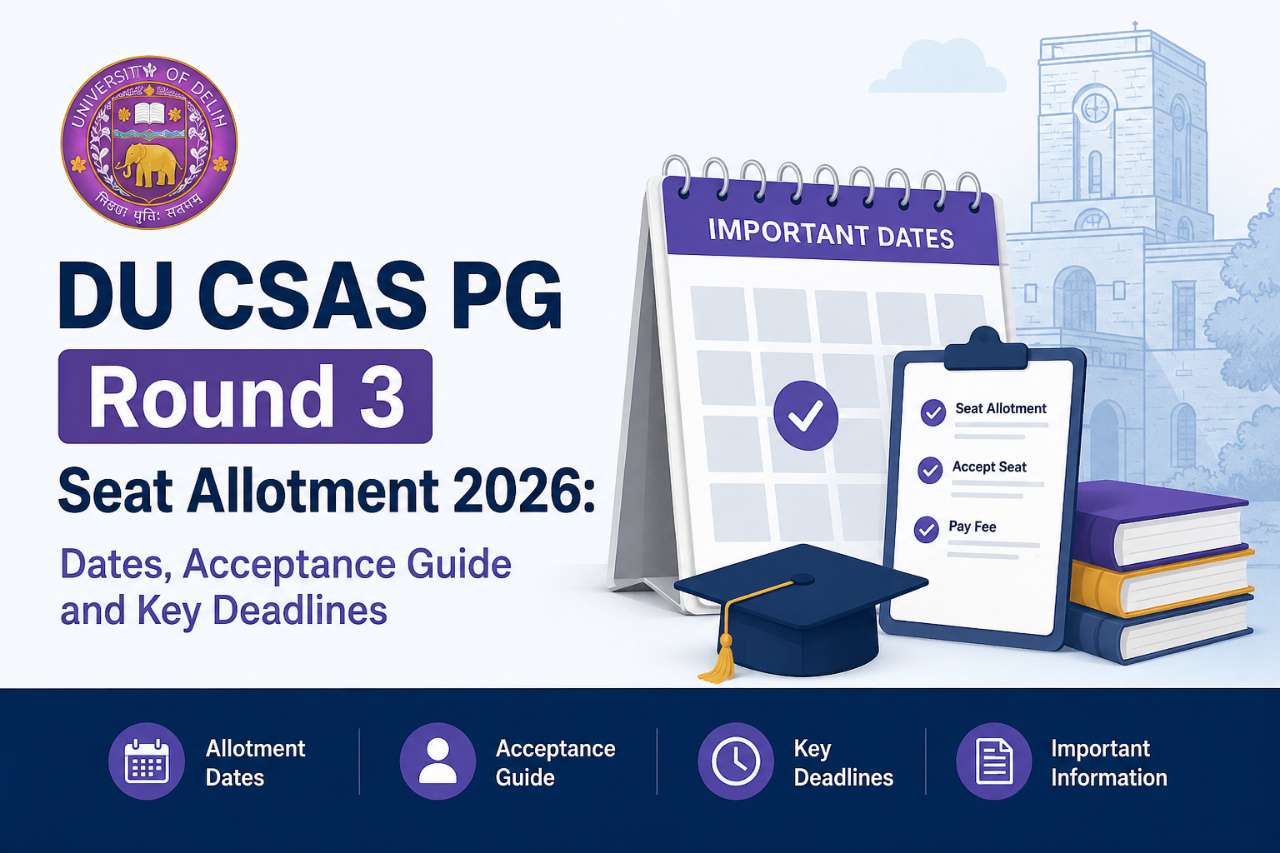

The University of Delhi has released the DU CSAS PG Round 3 seat allotment 2026 on its official admission portal at admission.uod.ac.in. For thousands of postgraduate aspirants who appeared in CUET PG 2026 and registered through the Common Seat Allocation System for Postgraduate (CSAS-PG), this third allocation round is often the last realistic chance to secure a seat in a preferred MA, MSc, MCom, or other two-year programme across DU departments, centres, and affiliated colleges.
Round 3 is not just another list on a dashboard. It follows a tightly sequenced window of upgrade choices, mid-entry applications, and application corrections. Candidates who receive an allotment must accept their seat within the prescribed deadline; missing that step can remove them from subsequent regular allocation rounds. This guide explains the full Round 3 timeline, how to check and accept your allotment, what Freeze and Upgrade mean, and what happens during department verification and fee payment — all in plain language for students and parents navigating Delhi University PG admissions 2026-27.
What Is DU CSAS PG and Why Does Round 3 Matter?
Delhi University conducts postgraduate admissions exclusively through CSAS-PG 2026, a single-window online system linked to CUET (PG) 2026 scores. Unlike earlier years when individual departments ran separate processes, every two-year PG programme — from English and Political Science to Commerce, Mathematics, and Law — is allocated centrally based on merit, category, programme preferences, and seat matrix published in the Bulletin of Information (BoI-PG).
Seat allocation happens in multiple rounds. Round 1 and Round 2 typically absorb high-rank candidates and those who confirm admissions early. By Round 3, many popular programmes still have vacant seats because some candidates declined offers, upgraded to higher preferences, or failed document verification. Round 3 therefore becomes critical for:
- Candidates who were unallocated or on waiting status in earlier rounds
- Fresh applicants entering through the mid-entry window
- Students seeking movement to a better College or department via the Upgrade option
- Aspirants under CW, Sports, and Ward supernumerary quotas
- Applicants to performance-based programmes such as MFA, MA Music, B.P.Ed., and M.P.Ed.
If you are comparing DU with institutions in other cities — for instance, students from Rajasthan often weigh DU alongside colleges like Md Mission College Kota, while Chennai-based learners may look at options such as DMI College of Engineering Chennai remember that DU's CSAS system is entirely score- and preference-driven once you meet eligibility under BoI-PG 2026.
DU CSAS PG Round 3 2026: Complete Date Schedule
According to the revised schedule announced by Delhi University, the Round 3 phase includes several linked events. Treat these as a chain: missing an earlier step can affect your eligibility for the next.
Key Dates at a Glance
| Event | Date and Time |
|---|---|
| Upgrade window (Round 1 & 2 admitted candidates) | 30 June 2026, 10:00 AM – 1 July 2026, 4:59 PM |
| Mid-entry and correction window | 2 July 2026, 10:00 AM – 4 July 2026, 4:59 PM |
| Round 3 seat allotment list release | 6 July 2026 |
| Performance-based programmes (Round 1): MFA, MA Music, B.P.Ed., M.P.Ed. | 6 July 2026 |
| CW, Sports, and Ward quota allocation | 7 July 2026 |
| Last date to accept allotted seat | 9 July 2026, 4:59 PM |
| Department/college verification of applications | Up to 10 July 2026 |
| Last date for online admission fee payment | 11 July 2026, 4:59 PM |
Actionable tip: Do not wait until 9 July evening to accept your seat. Portal traffic spikes before every CSAS deadline, and technical delays are not accepted as valid excuses under university rules.
How to Check DU CSAS PG Round 3 Seat Allotment Result
Once DU publishes the allocation list, follow these steps to view your status:
- Visit the official portal: admission.uod.ac.in or the CSAS application portal at pgadmission.uod.ac.in.
- Log in with your registered CSAS-PG credentials (email ID and password used during application).
- Open your candidate dashboard and navigate to the seat allocation or allotment section.
- Check the programme name, department/centre/college, category, and round number displayed.
- Download or screenshot the allotment details for your records.
If your dashboard shows "Not Allocated", monitor official notifications. DU has indicated that additional allocation rounds may be announced if seats remain vacant after Round 3. Also check your registered email and SMS alerts, as departments sometimes raise queries during verification.
What Details Appear on the Allotment Dashboard?
Your allotment card typically includes:
- Programme and specialization (e.g., MA Economics, MSc Botany)
- Allocating unit — department, centre, or college
- Category under which the seat is offered (UR, OBC-NCL, SC, ST, EWS, etc.)
- Round number and status (Provisionally Allocated)
- Buttons to Accept or take other prescribed actions
Accepting Your Round 3 Seat: Rules You Cannot Ignore
Under CSAS-PG 2026 rules, seat acceptance is time-bound and round-specific. Once a seat is allocated in Round 3, you must click Accept on your dashboard before 4:59 PM on 9 July 2026.
Important provisions from the official CSAS-PG document:
- Inactivity equals rejection: If you take no action, the system treats it as a decline. You will not participate in subsequent regular allocation rounds.
- One seat only: If multiple seats are offered in the same round, accept only one. Confirming more than one violates allocation rules.
- Acceptance is valid only for that round: The accept button remains active only during the acceptance window for the round in which you were allocated.
After acceptance, your application moves to the admitting department, centre, or college for online eligibility and document verification. This is not a formality. Faculty committees check CUET-PG scores, qualifying degree marks, category certificates, and programme-specific requirements listed in BoI-PG 2026.
Freeze vs Upgrade: What Round 1 and Round 2 Admits Must Decide First
Before Round 3 results, candidates who already secured admission in Round 1 or Round 2 faced a crucial choice during the upgrade window (30 June – 1 July 2026).
Upgrade Option
Choosing Upgrade tells DU you want a higher preference within the same programme where you are already admitted. If a better college or department seat opens in a later round, you may be moved automatically. Key points:
- Upgrade is unavailable if you already received your first preference in that programme.
- If you upgrade and the new seat has a higher fee, you must pay the difference within the stipulated time.
- Upgrade remains available across rounds until you freeze.
Freeze Option
Freeze locks your current admission. You will not be considered for further upgrades in that programme. Select Freeze only when you are fully satisfied with your college and department. Candidates who neither upgrade nor freeze risk their existing admission being treated as inactive under university guidelines.
Example: A student admitted to MA History at a South Campus college in Round 2 may upgrade hoping for a North Campus department. If Round 3 offers that department, acceptance may be auto-processed. A student who freezes at Round 2 keeps the South Campus seat regardless of Round 3 vacancies elsewhere.
Mid-Entry and Correction Window: A Second Chance Before Round 3
DU opened the mid-entry and correction window from 2 to 4 July 2026. This served two distinct groups:
Mid-Entry Candidates
Students who missed the original CSAS-PG application or could not complete it earlier could enter by paying a non-refundable fee of ₹1,000. Mid-entry is subject to eligibility: you must have appeared in the relevant CUET-PG 2026 paper and meet BoI-PG criteria. Note that mid-entry is not permitted for performance/audition/practical-based programmes or sports quota admissions.
Correction Window for Existing Applicants
Registered candidates could correct selected fields, including eligibility-related information. Some corrections — such as one-time category changes — cannot be repeated, so review BoI-PG instructions before submitting.
Students accustomed to design entrance pathways like NID DAT should note that DU's performance programmes (MFA, MA Music) follow a separate combined evaluation of CUET-PG and practical/audition components, not a standalone design aptitude test.
Special Allocations: CW, Sports, Ward, and Performance Programmes
CW, Sports, and Ward Quotas
Supernumerary seats under Children/Widows of Armed Forces (CW), Sports, and Ward categories were allocated on 7 July 2026, one day after the general Round 3 list. Candidates in these quotas must still accept seats by 9 July and complete verification and fee payment on the same overall timeline.
Performance-Based Programmes
Round 1 allocations for MFA, MA Music, B.P.Ed., and M.P.Ed. were announced alongside Round 3 on 6 July. These programmes use combined weightage of CUET-PG and practical tests or trials. Applicants should upload all required certificates and monitor department-specific instructions on the admission website.
Delhi remains a major hub for specialised education. Alongside DU's arts and sciences faculties, institutions such as All india Institute of Medical Sciences Delhi (AIIMS Delhi) represent the city's strength in professional and research-oriented training \a useful benchmark when evaluating the depth of DU's Medical Sciences and interdisciplinary PG offerings.
Department Verification and Admission Fee Payment
After you accept a Round 3 seat, the timeline quickens:
- 9 July 2026, by 4:59 PM: Accept your provisionally allocated seat online.
- By 10 July 2026: Departments and colleges complete online verification of eligibility, CUET-PG details, and uploaded documents.
- 11 July 2026, by 4:59 PM: Pay the admission fee online if your application is approved.
During verification, a department may raise a query on your dashboard requesting clarification or additional documents. Respond promptly. Failure to reply or submit authentic documents can lead to rejection even after initial allotment.
What Documents Are Typically Verified?
- CUET-PG 2026 scorecard and application details
- Mark sheets and certificates of the qualifying bachelor's degree
- Category, EWS, PwBD, CW, or other reservation certificates from competent authorities
- Programme-specific eligibility proof (e.g., subject combinations, minimum marks)
- Identity and photograph matching Digilocker-integrated data where applicable
DU may also notify candidates for physical verification of original documents at a later stage. Admission remains provisional until all checks are complete.
Admission Fee and Financial Aid
Fee amounts vary by programme and college. Payment is made only through the CSAS-PG portal. Students facing financial constraints can explore the PM-Vidyalaxmi Scheme for collateral-free education loans at quality higher education institutions, including DU colleges and departments.
What Happens If You Miss the Deadline or Decline the Seat?
Declining or failing to accept a Round 3 allotment by 9 July has serious consequences under CSAS-PG rules:
- You forfeit participation in further regular allocation rounds.
- Your candidature for that admission cycle effectively ends unless DU announces spot admission or special rounds.
- Any earlier admitted seat you held may already be subject to upgrade/freeze decisions — review your dashboard history carefully.
Spot admission rounds, when announced, operate under different rules: upgrade and withdrawal options are typically frozen for already-admitted candidates. Vacant seats may be filled on a first-come or merit basis as per spot round notifications.
Common Mistakes to Avoid in Round 3
- Ignoring dashboard emails: Verification queries often arrive with short response windows.
- Uploading incorrect category certificates: OBC-NCL, EWS, and CW documents must meet issuing authority and validity norms.
- Assuming CUET-PG rank alone guarantees admission: Programme preferences and seat matrix limit options.
- Using mobile browsers for fee payment: DU advises completing CSAS actions on desktop/laptop for stability.
- Waiting for the last hour on 9 or 11 July: Server load and payment gateway delays have caused missed deadlines in past cycles.
- Applying mid-entry to performance programmes: This is explicitly not allowed under CSAS-PG 2026.
Who Should Stay Alert After Round 3?
Even if you are not allotted in Round 3, continue monitoring admission.uod.ac.in. DU has stated that additional rounds may be conducted if vacancies remain. Candidates on waiting lists, those who froze lower preferences, and spot-round applicants should:
- Keep documents ready in PDF and original form
- Maintain sufficient balance for instant fee payment
- Follow BoI-PG 2026 for any new programme-specific notices
- Contact the PG helpdesk at pg@admission.du.ac.in only for genuine portal issues — admissions are not processed via WhatsApp or post
Understanding CUET-PG Scores and CSAS Preference Filing
Round 3 allotment is the outcome of decisions made much earlier in the admission cycle. Every CSAS-PG applicant filed programme preferences after CUET-PG 2026 results, ranking combinations of courses and colleges. Delhi University's allocation engine matches your CUET-PG score, category, and preference order against real-time seat vacancies.
Students sometimes assume a high percentile guarantees a North Campus MA seat. In practice, seat matrix limits, category reservations, and the order of preferences matter equally. If you listed only ultra-competitive options, Round 3 may still offer a seat in a lower preference you had included — or no seat if all preferences exhausted earlier rounds.
Practical advice for future applicants: File a balanced preference list mixing dream, target, and safe programme-college combinations. Read the seat matrix on admission.uod.ac.in before locking preferences. Students preparing for other national entrances — whether NID DAT for design or CUET-PG for central universities — benefit from the same discipline: research eligibility, map preferences strategically, and never rely on a single institution.
How Merit and Tie-Breaking Work in Later Rounds
When two candidates have identical CUET-PG scores competing for the last seat in Round 3, DU applies published tie-breaking rules from CSAS-PG 2026. Factors may include higher marks in specific CUET sections, qualifying degree percentages, or age criteria as defined in the official document. Understanding this helps explain why allotment results can differ from informal rank predictors shared on social media.
Category-Wise and Quota-Specific Guidance for Round 3
Round 3 is not uniform for every applicant. Your category and quota determine both when results appear and which documents reviewers prioritise.
Reserved Category Candidates (SC, ST, OBC-NCL, EWS, PwBD)
Ensure certificates are issued by competent authorities and uploaded in the correct format. OBC-NCL certificates must typically be valid for the admission year. EWS certificates follow central government income and asset criteria. PwBD candidates should verify programme-specific disability benchmarks listed in BoI-PG 2026. A mismatch discovered during the 10 July verification window can void an allotment even after acceptance.
CW, Sports, and Ward Supernumerary Seats
These quotas follow separate timelines. CW (Children/Widows of Armed Forces personnel) applicants need valid service-related documentation. Sports quota candidates must meet DU Sports Council norms, often including trial performance and ranking. Ward quota applies to university employees' dependents under defined rules. Allocations on 7 July 2026 still require acceptance by 9 July — the shorter window makes immediate action essential.
Life After Round 3: Academic Session and NEP 2020 Framework
Admissions confirmed through Round 3 lead into the 2026-27 academic session under Delhi University's Postgraduate Curriculum Framework (PGCF) aligned with NEP 2020. New students encounter multidisciplinary components, credit-based structures, and revised examination patterns. While you focus on seat acceptance this week, also bookmark du.ac.in for academic calendars, orientation schedules, and department handbooks.
Postgraduate study at DU opens pathways to research, civil services preparation, teaching careers, and corporate roles. The city's ecosystem — from library resources on campus to specialised institutions like AIIMS Delhi for medical research aspirants — adds value beyond classroom lectures. Students from across India, whether relocating from Kota after schooling at Md Mission College Kota or from southern states comparing DU with institutes such as DMI College of Engineering Chennai, should plan housing, commute, and document attestation early once admission is confirmed.
Official Support Channels and Reliable Information Sources
Misinformation spreads quickly during allotment season. Trust only admission.uod.ac.in, notifications under BoI-PG 2026, and the CSAS-PG 2026 rulebook. For genuine technical issues, use official helpdesk channels listed on the portal, including chatbot support and pg@admission.du.ac.in. DU explicitly states that admissions, corrections, and withdrawals are not processed via post, fax, WhatsApp, or informal phone calls.
When reading third-party news coverage — including alerts on allotment releases and deadline reminders cross-check every date on the official site. Schedules can be revised, and the university reserves the right to amend CSAS rules with portal updates.
Conclusion
The DU CSAS PG Round 3 seat allotment 2026 marks a decisive phase for postgraduate admission at Delhi University. With the allotment list live on admission.uod.ac.in, candidates must quickly accept their seats by 9 July 2026 (4:59 PM), cooperate with department verification by 10 July, and complete fee payment by 11 July 2026 (4:59 PM). Whether you entered through the original application, mid-entry window, or supernumerary quota, the same principle applies: proactive dashboard monitoring and timely action secure your seat.
Delhi University's CSAS-PG system rewards prepared candidates who understand Freeze and Upgrade logic, respect deadlines, and keep eligibility documents accurate. Use only the official portal for every step, double-check BoI-PG 2026 programme rules, and treat Round 3 as your structured opportunity not a formality to join one of India's most sought-after public universities for postgraduate study in the 2026-27 academic session.