

The University of Delhi has officially released the DU CSAS UG Round 3 cutoff and seat allocation results for 2026-27 on its admission portal at admission.uod.ac.in. In this round, 10,680 candidates have received seat allotments across 956 undergraduate programmes where vacancies remained after earlier rounds. If you registered for DU admissions through the Common Seat Allocation System (CSAS-UG) and participated in preference filling, this is a critical window — you must log in, review your allocation, and accept your seat before the deadline expires.
Round 3 is often the round where students who missed top colleges in Rounds 1 and 2 find meaningful options, especially in programmes where cutoffs have softened as seats opened up. Whether you are a first-time allottee or a candidate who upgraded from a previous round, understanding the cutoff logic, acceptance timeline, and fee payment process is essential to securing your admission without last-minute errors.
What Is DU CSAS UG Round 3 and Why Does It Matter?
Delhi University's undergraduate admissions for 2026-27 are conducted entirely through the Common Seat Allocation System (CSAS-UG), which replaced the older college-wise cutoff lists with a centralised, preference-based seat allocation model tied to CUET (UG) 2026 scores. After Round 1 and Round 2 seat allocations — including upgrade rounds — a significant number of seats remained vacant across DU's 70+ colleges and numerous programme-college combinations.
Round 3 addresses this gap. The university published a category-wise vacant seat list on August 3, 2026, covering Unreserved (UR), OBC-NCL, SC, ST, EWS, Sikh Quota, Christian Quota, and PwBD categories. Media tallies of that notice placed the total vacant seats at roughly 16,643, though the university notes that this figure is subject to change due to upgrades, withdrawals, cancellations, and grievance redressals.
On August 8, 2026, DU activated Round 3 allocations on candidate dashboards. Unlike the old system where a single consolidated cutoff PDF was the primary reference, CSAS now allocates seats individually based on a combination of:
- Programme-specific CUET merit — your normalised score in the subjects required for the programme
- Category — UR, OBC-NCL, SC, ST, EWS, or applicable quota
- Seat availability — vacancies in specific college-programme-category combinations
- Preference order — the sequence in which you listed programmes during Phase II preference filling
For thousands of students across india who aspired to study at DU — whether in popular courses like B.Com (Hons.), B.A. (Hons.) Economics, B.Sc. Computer Science, or newer interdisciplinary programmes — Round 3 represents one of the last major general-category allocation rounds before specialised quota rounds conclude.
DU CSAS UG Round 3 2026: Important Dates at a Glance
Missing a single deadline in the CSAS process can result in automatic cancellation of your allotted seat. Mark these dates carefully on your calendar and set reminders on your phone.
| Event | Date / Deadline |
|---|---|
| Vacant seat list for Round 3 published | August 3, 2026 |
| Mid-entry and correction window | August 3 to August 5, 2026 (till 11:59 PM) |
| Round 3 seat allocation released | August 8, 2026 |
| ECA and Sports seat allocation | August 9, 2026 |
| Ward Quota Round 2 allocation | August 10, 2026 |
| Last date to accept allotted seat (Round 3) | August 11, 2026 (till 11:59 PM) |
| College verification and approval | By August 12, 2026 (till 4:59 PM) |
| Last date for online admission fee payment | August 13, 2026 (till 11:59 PM) |
The acceptance window for Round 3 runs from August 8 to August 11, 2026. Even if you received your allocation on August 8, do not wait until the last hour on August 11 — portal traffic spikes dramatically on deadline day, and technical glitches can cost you a seat you earned through months of CUET preparation.
Parallel Quota Rounds Running Alongside Round 3
Round 3 is not the only allocation happening in early August. DU simultaneously processes admissions under several special categories:
- ECA (Extra-Curricular Activities) and Sports quota — Round 1 allocation on August 9, 2026, with the same acceptance deadline of August 11
- Ward Quota — Round 2 allocation on August 10, 2026
- Performance-based programmes — Music, BFA, Physical Education, and Home Science had separate Round 1 allocations on August 6, with acceptance open until August 11 and fee payment due by August 13
- CW (Children/Widows of Armed Forces Personnel) quota — processed on its own schedule as announced by DU
If you hold multiple allocations across categories, read DU's advisory carefully — accepting one seat may affect your status in another category.
How to Check DU CSAS UG Round 3 Cutoff and Seat Allotment
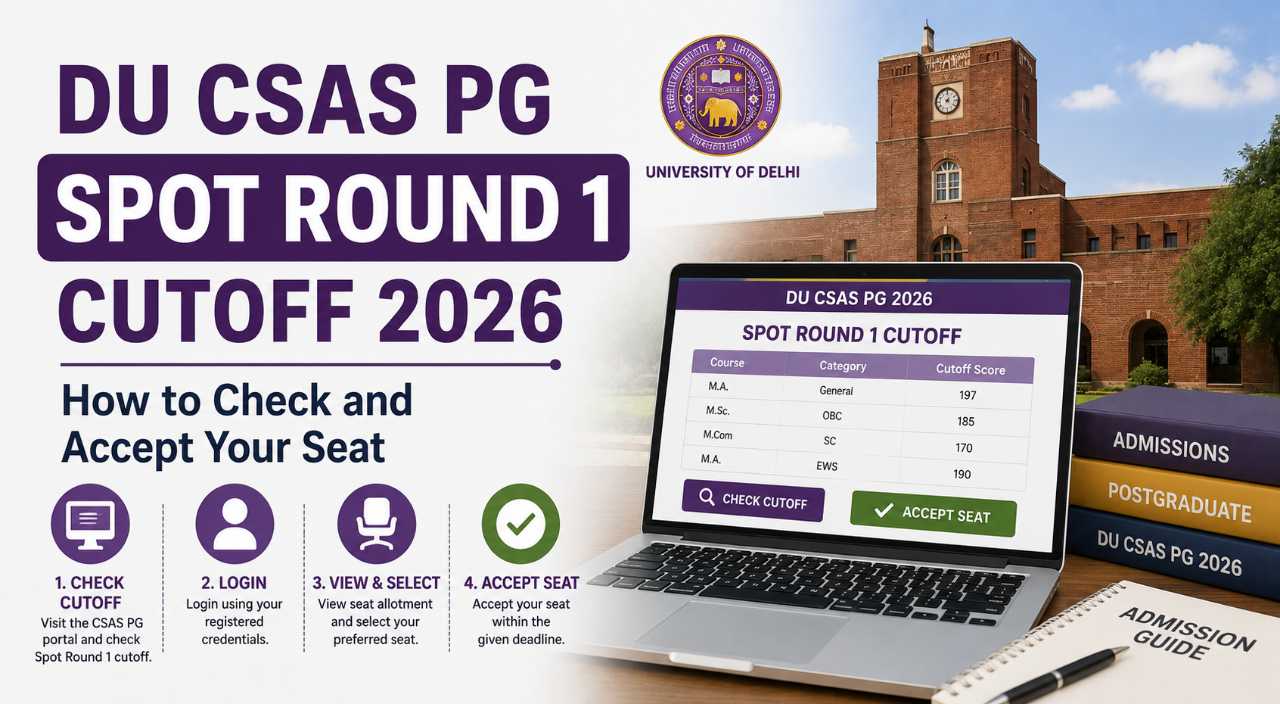
DU does not publish a single master cutoff list for all colleges and courses in Round 3 the way it once did under the old cutoff system. Instead, allocation is visible on your individual CSAS dashboard. Here is how to check your result:
- Visit the official portal at admission.uod.ac.in
- Click on the CSAS (UG) 2026 login section
- Enter your registered credentials — typically your CUET application number and password/OTP
- Navigate to the Round 3 allocation or seat status section on your dashboard
- Review the college name, programme name, category, and allocation status displayed
- Download or screenshot the allocation details for your records
- If allotted, proceed immediately to the Accept option before the August 11 deadline
To understand whether your CUET score was competitive for a particular programme, refer to the vacant seat PDF published on August 3 and any programme-wise minimum allocation score information DU releases on the portal. Category-wise cutoffs in Round 3 are typically lower than Round 1 for the same programme, especially in colleges located away from the North Campus cluster, but top programmes at sought-after colleges like SRCC, Hindu college, and Hansraj still demand strong CUET percentiles.
Understanding Round 3 Cutoffs: How DU Determines Your Seat
The term "cutoff" in the CSAS era works differently from the pre-CUET era when DU released college-wise percentage lists. Today, the effective cutoff for any programme in Round 3 is the CUET score of the last candidate allocated to that specific college-programme-category combination, given the seats available and preferences filed.
Factors That Influence Your Round 3 Allocation
1. CUET normalised scores: Your scores in the subjects mapped to your chosen programme determine your merit position. DU applies strict subject-mapping rules — you must have appeared in CUET for subjects you studied in Class XII, including at least one language paper from the approved list.
2. Preference rank: CSAS allocates seats based on your ordered preferences. If your first preference is unavailable at your merit level, the system moves to your next preference. Students who filed realistic preferences across a mix of high-demand and moderate-demand programmes often fare better in Round 3 than those who listed only top-tier combinations.
3. Category and quota: Cutoffs vary significantly across UR, OBC-NCL, SC, ST, EWS, and supernumerary quotas. A candidate in the SC category may receive an allocation at a college where an unreserved candidate with a higher absolute CUET score did not, simply because category seats were available at that merit level.
4. Seat movement from earlier rounds: When candidates upgrade to better preferences in upgrade rounds or withdraw, seats cascade into Round 3. This is why the vacant seat list published before Round 3 is an indicator but not a guarantee — actual allocations depend on who remains in the pool.
Programmes With Notable Round 3 Activity
In Round 3 2026, allocations span 956 programmes — a figure that reflects DU's extensive programme-college matrix rather than 956 distinct course types. Common programme categories seeing Round 3 activity include:
- B.Com (Hons.) and B.Com Programme — widely offered across colleges; Round 3 often opens seats at newer or off-campus colleges
- B.A. Programme and B.A. (Hons.) streams in History, Political Science, English, and Psychology
- B.Sc. (Hons.) and B.Sc. Programme in Physics, Chemistry, Mathematics, and Computer Science
- B.A. (Hons.) Economics and BBE/BMS — competitive even in Round 3 at select colleges
- Interdisciplinary and vocational programmes — including Environmental Science, Food Technology, and Applied Life Sciences at specialised centres
If your allocation is in a programme or college that was lower on your preference list, weigh your options carefully before accepting. Once you accept and pay the fee, withdrawal rules and financial implications apply. Speak with seniors, teachers, or college alumni if you are unsure whether a particular DU college-programme combination aligns with your long-term goals — Round 3 decisions made under pressure are often regretted later.
Historically, Round 3 cutoffs for popular commerce and science programmes at South Campus colleges such as ARSD, Motilal Nehru, and Dyal Singh have been noticeably lower than North Campus counterparts like SRCC and Kirori Mal, making Round 3 a practical entry point for students with mid-range CUET percentiles who still want a DU degree with strong peer networks and campus placement exposure.
How to Accept Your DU Round 3 Seat: Step-by-Step Process
Receiving an allocation is not the same as securing admission. You must complete three distinct stages — acceptance, college verification, and fee payment — within the prescribed timelines.
Stage 1: Accept the Allotted Seat (by August 11, 2026)
Log in to your CSAS dashboard and click the Accept button for your Round 3 allocation. This action confirms to DU that you intend to take the seat. If you do not accept by 11:59 PM on August 11, 2026, your allocation will be cancelled automatically and the seat will move to subsequent processing.
Important: If you received an upgraded allocation (a better programme or college than a previous round), accepting the upgrade typically releases your earlier seat. Read the on-screen instructions carefully before confirming.
Stage 2: College Verification (by August 12, 2026)
After you accept, the allotted college verifies your documents online — Class XII marksheet, category certificate (if applicable), CUET scorecard, and other required proofs. Colleges must complete verification and approval by 4:59 PM on August 12, 2026. Ensure all uploaded documents are clear, correctly categorised, and match your CSAS application details exactly. Discrepancies in name spelling, category certificate validity, or board roll number are among the most common reasons for verification delays.
Stage 3: Pay Admission Fee (by August 13, 2026)
Once the college approves your application, the fee payment option activates on your dashboard. Complete the online payment by 11:59 PM on August 13, 2026. Admission fee amounts vary by college and programme but typically range from approximately ₹5,000 to ₹25,000 for the initial payment, depending on whether the college is maintained or affiliated. Keep your payment receipt and download the admission confirmation letter once the process is complete.
Mid-Entry Window: A Second Chance for Late Applicants
DU offered a mid-entry and correction window from August 3 to August 5, 2026 for candidates who missed Phase I registration or Phase II preference filling earlier in the cycle. Mid-entry required payment of a non-refundable fee of ₹1,000 and was subject to the same eligibility rules — including valid CUET (UG) 2026 scores and correct subject mapping.
Mid-entry is not a shortcut around merit requirements. It simply allows eligible candidates to enter the allocation pool before Round 3 computation. If you entered through mid-entry and received a Round 3 allocation, the acceptance and fee payment process is identical to regular candidates.
The correction window during the same period also allowed existing candidates to modify preferences or update application details, which could directly affect Round 3 outcomes.
What If You Did Not Get a Seat in Round 3?
Not receiving a Round 3 allocation does not necessarily mean your DU admission journey is over. Consider these scenarios:
- Special quota rounds: If you applied under ECA, Sports, CW, or Ward quota, separate allocations may still be pending or in progress
- Spot admissions or additional rounds: DU has historically announced further rounds or spot admission processes if substantial vacancies remain — monitor admission.uod.ac.in daily
- Upgrade possibilities: If you hold a seat from an earlier round and did not receive an upgrade in Round 3, you retain your previous allocation if you accepted it within the earlier deadline
- Re-evaluation of CUET scores: If you believe your CUET result does not reflect your performance, check NTA's re-evaluation window — though this rarely aligns with admission deadlines
If DU admission does not work out, explore strong alternatives at reputable institutions across India. Many students who miss Delhi University cutoffs build excellent careers through regional universities and specialised institutes. For instance, engineering aspirants might consider institutions like DMI College of Engineering Chennai, while students in Rajasthan exploring quality degree colleges can look at options such as MD Mission College Kota, a city known for its academic ecosystem. Creative and design-oriented students, meanwhile, should prepare for entrance exams like NID DAT, which opens pathways to premier design institutes outside the DU framework.
Actionable Tips for Round 3 Candidates
Based on patterns from previous CSAS cycles and the 2026 timeline, here are practical recommendations:
- Act on Day 1: Accept your seat as soon as you verify the allocation details — do not wait for August 11
- Double-check document uploads: Blurry scans and expired category certificates are the top verification bottlenecks
- Keep financial arrangements ready: Have your payment method tested and sufficient balance available before August 13
- Join your allotted college's official communication channels: Many colleges share orientation dates, document submission requirements, and class commencement schedules via email or WhatsApp groups after fee payment
- Do not rely on unofficial cutoff PDFs: Trust only your dashboard status and documents on admission.uod.ac.in
- Understand the difference between Programme and Honours: Accepting a B.A. Programme seat at a college you desired does not equate to a B.A. (Hons.) seat — read the programme name carefully
- Contact DU helpdesk for technical issues early: If the portal shows an error, raise a ticket immediately with screenshots rather than on the last day
CBSE Compartment Students: Special Advisory
DU has issued specific advisories for CBSE compartment candidates in the 2026 admission cycle. If your Class XII result was pending at the time of initial CSAS registration, ensure your updated marksheet is uploaded and verified before the college verification deadline of August 12. Colleges may withhold final approval until compartment results are declared and confirmed. Check the official CSAS portal for the latest compartment-related circulars.
Conclusion
The DU CSAS UG Round 3 cutoff and seat allocation for 2026-27 marks a pivotal moment for over 10,680 candidates who received offers across 956 programmes. With the seat acceptance deadline set at 11:59 PM on August 11, 2026, and fee payment due by August 13, 2026, every hour counts. Log in to admission.uod.ac.in, confirm your allocation, accept your seat, and complete verification and payment without delay.
Whether your Round 3 seat is at a dream college or a stepping-stone programme, what matters most is that you make an informed decision within the deadline and begin preparing for the academic journey ahead. Collect your original documents, note your college's reporting date, and connect with fellow allottees through official channels rather than unverified social media groups that spread rumours about further rounds or cutoff changes.
Delhi University remains one of India's most respected undergraduate destinations — and for thousands of students, Round 3 is the round that makes that dream concrete. Stay alert for any official notifications on the CSAS portal regarding further allocation rounds, spot admissions, or counselling grievances, and act only on information published at admission.uod.ac.in.