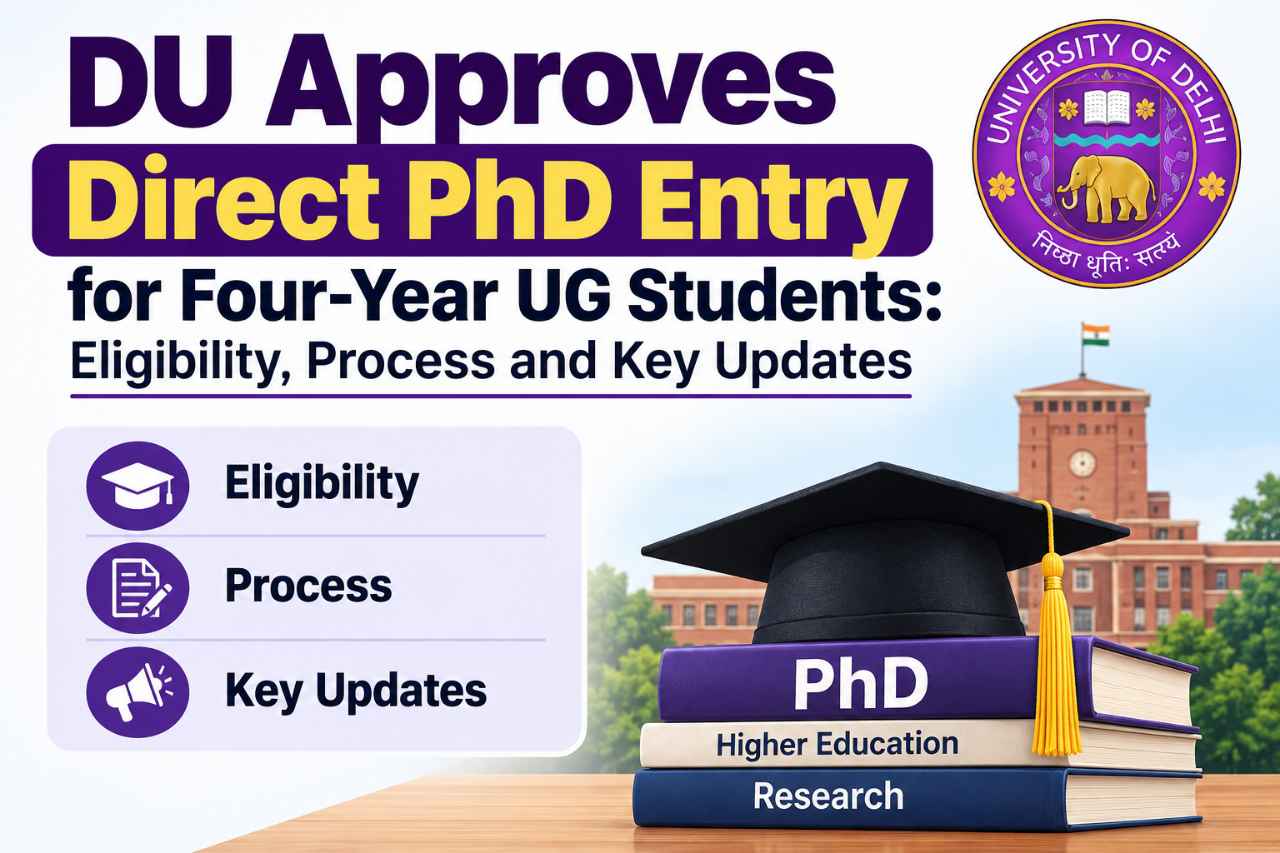
The University of Delhi has opened a major new pathway to doctoral research. On July 25, 2026, the Academic Council approved amendments to PhD Ordinance VI, allowing students who complete a four-year undergraduate degree with research components to apply directly for a PhD without first earning a master's or MPhil qualification. The decision aligns Delhi University with the University Grants Commission's 2022 PhD regulations and the research-focused vision of the National Education Policy (NEP) 2020. For thousands of FYUP graduates—many from premier DU colleges such as Lady Shri Ram College for Women and Indraprastha College for Women—this reform could shorten the journey from classroom to research lab by two or more years. This guide explains who qualifies, how to apply, what scores you need, and what debates surround the new rules.
What Changed in DU's PhD Admission Rules
Until recently, most Indian universities—including Delhi University—required a postgraduate degree as the standard entry point for doctoral programmes. The revised ordinance creates a separate eligibility track for graduates of four-year undergraduate programmes that include structured research training. Students who complete such degrees at DU or at other UGC-recognised institutions may now register for PhD admission after meeting minimum academic thresholds and clearing national eligibility tests.
The amendment was recommended by DU's Research, Innovation and Entrepreneurship Council (RIEC) and ratified by the Academic Council. Officials have stated that the change brings Ordinance VI in line with UGC norms that already permit direct doctoral entry for four-year graduates with adequate research exposure. The policy is expected to apply from the 2026-27 PhD admission cycle onward, coinciding with the expected graduation of DU's first FYUP batch, which enrolled in 2022-23.
Why Delhi University Made This Move Now
Three factors converged to make 2026 the right moment for reform. First, DU launched its Four-Year Undergraduate Programme under the Undergraduate Curriculum Framework (UGCF) 2022, embedding research methodology, dissertation work, and skill enhancement modules into the degree itself. Second, the UGC's 2022 PhD regulations explicitly recognised four-year graduates with research as eligible candidates, creating a national template that central universities were expected to adopt. Third, DU's leadership has prioritised improving research output and global rankings—the institution recently moved into the QS World University Rankings 2027 band at 322, the highest position among Indian universities in that edition.
By enabling direct PhD entry, DU signals that a well-designed undergraduate research experience can substitute for the traditional master's bridge. This is not a lowering of standards; rather, it reflects a structural shift in how Indian higher education defines research readiness.
Background: NEP 2020, FYUP, and UGC PhD Regulations
Understanding the new rule requires context on India's broader academic restructuring. The National Education Policy 2020 proposed flexible degree durations—three-year general degrees, four-year degrees with research, and integrated programmes—so that students could exit with a certificate, diploma, or full degree at different stages while accumulating credits.
Delhi University implemented the four-year model from the 2022-23 session across its constituent colleges and departments. Under UGCF 2022, students in the FYUP track complete core discipline courses, ability enhancement courses, skill enhancement courses, and a research project or dissertation in the final year. Colleges like Indraprastha College for Women and dozens of other DU affiliates now produce graduates whose academic profiles differ meaningfully from those of three-year programme alumni.
On the regulatory side, the UGC (Minimum Standards and Procedure for Award of PhD Degree) Regulations, 2022, allow universities to admit candidates who hold a four-year bachelor's degree with research, subject to minimum marks and NET qualification. Delhi University's amendment operationalises that provision within its own statute framework. Students exploring doctoral options beyond Delhi can compare pathways through resources on PhD programmes at institutions nationwide.
Eligibility Criteria for Direct PhD Entry at DU
Direct PhD admission after a four-year undergraduate degree is not automatic. Candidates must satisfy academic, examination, and procedural requirements laid down in the amended ordinance and the PhD Bulletin of Information (BOI).
Minimum Academic Requirements
For the four-year UG with research route, candidates need at least 75 percent marks or a 7.5 CGPA on a 10-point scale in their bachelor's degree. Reserved-category applicants from SC, ST, OBC-NCL, PwD, and EWS backgrounds receive a 5 percent relaxation, reducing the threshold to 70 percent or 7.0 CGPA, consistent with UGC concession norms.
The degree must be from a university recognised by the UGC or equivalent statutory body. Both DU FYUP graduates and four-year graduates from other institutions may apply, provided their programme includes the research component stipulated under NEP-aligned frameworks.
National Eligibility Test Requirement
All applicants under this route must qualify UGC-NET (including JRF or Assistant Professor eligibility) or CSIR-NET, depending on the subject. The NET requirement ensures a baseline of subject mastery and research aptitude assessed through a standardised national examination conducted by the National Testing Agency. Candidates who already hold valid NET scores from recent cycles should verify subject-code alignment with their proposed PhD discipline.
Departmental Interview
Clearing NET qualifies a candidate to appear before the respective department's selection committee. The interview evaluates research proposals, subject knowledge, and alignment with faculty expertise. Departments publish area-wise seat matrices, allied subjects, and interview schedules on their official webpages. Applicants must monitor departmental notifications in addition to central university announcements on du.ac.in.
All PhD Entry Routes at Delhi University: A Comparison
Direct entry after four-year UG is one of several pathways. The amended ordinance retains existing routes for postgraduate and MPhil holders. The table below summarises minimum qualifying marks and common requirements.
| Qualification Route | Minimum Score | Additional Requirement |
|---|---|---|
| Four-Year UG with Research | 75% or 7.5 CGPA | UGC-NET or CSIR-NET + Department Interview |
| One-Year PG after Four-Year UG | 55% or 5.5 CGPA | UGC-NET or CSIR-NET + Department Interview |
| Two-Year PG after Three-Year UG | 55% or 5.5 CGPA | UGC-NET or CSIR-NET + Department Interview |
| MPhil Degree | 55% or 5.5 CGPA | UGC-NET or CSIR-NET + Department Interview |
The higher mark threshold for four-year direct-entry candidates reflects the expectation that research training embedded in the UG programme compensates for the absence of a standalone master's degree. Students who completed a four-year degree but fall below the 75 percent cutoff may still pursue a one-year postgraduate programme and then apply through the 55 percent PG route.
Science and technology aspirants targeting engineering or applied science departments should review discipline-specific criteria listed in the BOI and explore specialised listings such as PhD in Engineering for comparative guidance across institutions.
How to Apply for PhD Admission at Delhi University
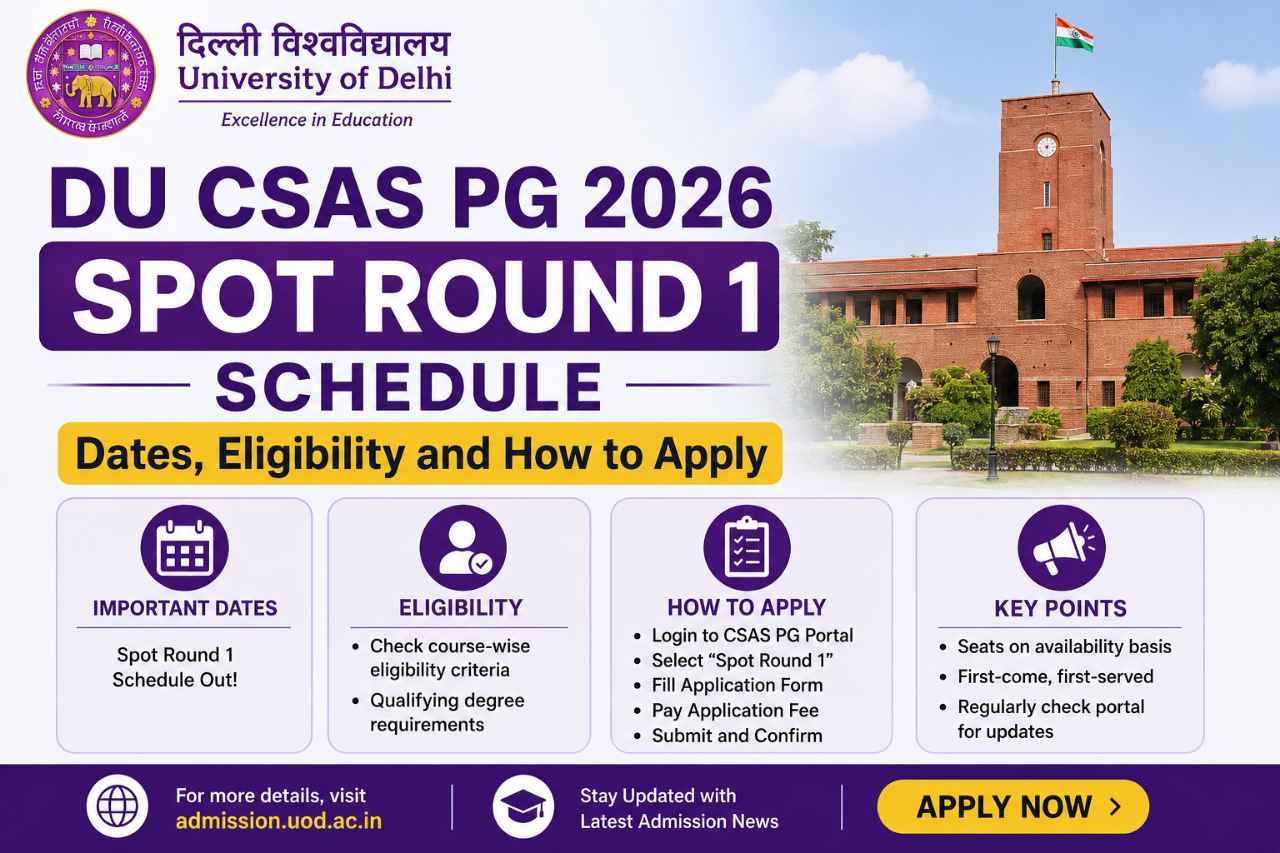
PhD admissions at DU are conducted online through the university portal. The PhD BOI for each cycle specifies registration dates, fee structure, document requirements, and department-wise research areas. For the 2025-26 cycle, registration commenced on October 18, 2025, through phd2025.uod.ac.in, with subsequent phases and fee payment schedules announced via public notices.
Registration Fee Structure
- General, EWS, and OBC-NCL candidates: Rs 750 per programme
- SC, ST, and PwBD candidates: Rs 300 per programme
The fee is non-refundable. Candidates may apply to multiple departments by paying separate registration charges per programme, subject to eligibility in each case.
Documents Typically Required
- Degree certificate and mark sheets (four-year UG with research)
- UGC-NET or CSIR-NET scorecard
- Category certificate (if applicable)
- Research proposal, where mandated by the department
- Photo identity proof and passport-size photograph
- Migration certificate, if applicable
Candidates whose certificates are not in English or Hindi must submit certified translations. All original documents are verified at the departmental level before final admission is confirmed.
Department Selection Process and Research Proposal Tips
Each faculty department at DU autonomously defines research areas, allied subjects, entrance test requirements, and interview weightages within the framework of Ordinance VI. Some departments allow NET-qualified candidates to proceed directly to interview, while others conduct written entrance tests for certain fellowship categories.
A strong research proposal can distinguish direct-entry UG applicants from postgraduate candidates with similar NET scores. Effective proposals typically include:
- A clearly defined research problem grounded in recent literature
- Alignment with at least one faculty member's ongoing work
- Feasible methodology given available departmental resources
- A realistic timeline linked to UGC-mandated PhD duration norms
Students who completed undergraduate dissertations should build on that work rather than proposing entirely unrelated topics—continuity demonstrates genuine research interest. Reach out to potential supervisors before the interview; an informed conversation about their publications shows preparation that committees notice.
Timeline: From FYUP Launch to Direct PhD Entry
Mapping the policy timeline helps candidates plan their academic journey with clarity. Delhi University introduced the Four-Year Undergraduate Programme in 2022-23 under the UGCF framework mandated by NEP 2020. Students who enrolled in that inaugural batch will complete their degrees in 2026, making them the first cohort eligible to test the direct PhD pathway in the 2026-27 admission cycle.
The UGC revised national PhD regulations in 2022 to recognise four-year graduates with embedded research, but each university must amend its own ordinances before the provision takes effect locally. DU's RIEC reviewed international practices—where bachelor's-to-PhD pipelines exist in countries such as the United States and the United Kingdom—and recommended statutory changes suited to Indian quality safeguards, including mandatory NET qualification and higher minimum marks than the postgraduate route.
Candidates currently in the second or third year of FYUP should treat their undergraduate dissertation as a foundation for future doctoral work. Strong performance in research methodology courses, consistent academic scores above the 75 percent benchmark, and early NET preparation can position students to apply immediately upon graduation rather than spending additional years in a master's programme they may no longer need.
Who Should Consider Direct PhD Entry Versus a Master's Degree?
Direct PhD entry is ideal for students who are confident about a research career in academia, government laboratories, or industry R&D. If your undergraduate dissertation sparked sustained curiosity, you have identified potential supervisors at DU, and your marks comfortably exceed the cutoff, skipping a master's degree saves time and tuition costs.
Conversely, students who are still exploring disciplines, need to strengthen foundational knowledge, or scored between 70 and 74 percent (without category relaxation) may benefit from a one-year or two-year postgraduate programme before applying through the 55 percent PG route. A master's degree also provides an additional qualification valued by employers outside pure research roles. Evaluate your career goals, financial situation, and subject preparedness before committing to either path.
Concerns Raised Within the Academic Council
Not all council members supported the amendment without reservation. Academic Council members Maya John and Latika Gupta submitted a formal dissent note highlighting three areas of concern that applicants and policymakers should understand.
Reservation Policy Clarity
The dissent note argues that the revised ordinance does not explicitly define how horizontal and vertical reservation applies to four-year UG direct-entry candidates. Because these students are grouped alongside master's and MPhil holders in the eligibility framework, the members fear reservation provisions could be applied inconsistently across departments. The note has been forwarded for consideration by the Executive Council, and candidates from reserved categories should monitor official clarifications before assuming seat allocation rules.
Fellowship and Financial Support
Another concern relates to the cap on university-funded non-JRF fellowships—reportedly limited to 16 plus one supernumerary seat per department. Full-time PhD scholars without Junior Research Fellowship (JRF) or external project funding may face financial strain. The dissenting members requested expanded research assistance for non-JRF scholars, noting that direct-entry students may enter doctoral programmes earlier and therefore spend more years without independent funding.
Aspirants should plan finances early: explore CSIR-UGC JRF, INSPIRE, DBT, ICMR, and departmental project fellowships. Institutions such as the International Academy for Certification and Training and other research-training centres across India offer preparatory programmes, but doctoral funding ultimately depends on national fellowship schemes and supervisor-linked projects.
What Direct PhD Entry Means for FYUP Students Across India
Delhi University's decision is likely to influence other central and state universities implementing NEP-aligned four-year programmes. Students at DU colleges—including women's institutions that have historically sent large cohorts to postgraduate study—now face a strategic choice: pursue direct doctoral admission, complete a one-year master's for a lower mark threshold, or enter the workforce with a research-enhanced bachelor's degree.
The reform also holds relevance beyond Delhi. Graduates from four-year programmes at universities in Tamil Nadu, Rajasthan, and other states may eventually benefit as their home institutions amend PhD ordinances. Students at colleges such as Bharathidasan Government College for Women, SRD Modi College for Women, and Shekhawati College for Education should track whether their affiliating universities adopt similar direct-entry provisions.
Design and interdisciplinary researchers may find growing opportunities as universities expand research-linked undergraduate tracks. Institutions focused on creative and applied research, including the Centre for Design Excellence in Jaipur, represent the broader ecosystem where four-year research degrees could eventually connect to doctoral work in emerging fields.
Actionable Preparation Tips for Aspiring PhD Candidates
Whether you are a final-year FYUP student or a recent graduate, the following steps can strengthen your candidacy:
- Verify your eligibility early. Calculate your aggregate percentage or CGPA against the 75 percent benchmark (or relaxed threshold if applicable) and confirm that your programme qualifies as a four-year degree with research.
- Register for UGC-NET or CSIR-NET promptly. Choose the subject paper aligned with your intended PhD discipline. Qualifying before the application window reduces last-minute pressure.
- Download the latest PhD BOI from du.ac.in. Department-specific requirements override general assumptions—some science departments accept GATE or JEST for direct interview in certain fellowship categories.
- Draft and refine your research proposal. Seek feedback from undergraduate dissertation supervisors or faculty mentors at your college.
- Track reservation and fellowship notifications. Executive Council responses to the dissent note may clarify category-wise seat allocation and funding support.
- Prepare for the departmental interview. Review foundational texts, recent faculty publications, and be ready to defend your proposal's scope and originality.
- Maintain document readiness. Scanned certificates, NET scorecards, and category proofs should be organised before the portal opens.
Other Academic Council Decisions from the July 2026 Meeting
The PhD reform was one of several measures approved on July 25, 2026. Related developments include:
- School of Open Learning renamed: SOL will become the Centre for Distance and Online Education (CDOE), aligning with UGC 2022 regulations on open and distance learning. The head of the institution will be designated as Director rather than Principal.
- Late Shri Arun Jaitley Scholarship: Three annual scholarships totalling Rs 50,000 for undergraduate sports students, funded from a Rs 10 lakh corpus over 20 years, with at least one reserved for a female athlete.
- New programmes approved: Certificate and diploma courses in Sanskrit Buddhism (Department of Buddhist Studies) and a Master of Occupational Therapy at Pandit Deendayal Upadhyaya National Institute for Persons with Physical Disabilities, both from 2026-27.
- Skill Enhancement Courses: Five new courses under UGCF 2022 covering entrepreneurial mindset, design thinking, venture development, communication, investor pitching, and library literacy.
These parallel reforms reinforce DU's broader shift toward research, skills, and flexible learning pathways under NEP 2020.
Conclusion
Delhi University's approval of direct PhD entry for four-year undergraduate graduates marks a practical milestone in India's NEP implementation. By codifying a 75 percent academic threshold, mandatory NET qualification, and departmental interview, the amended ordinance balances expanded access with established quality gates. FYUP students graduating in 2026 and beyond now have a legitimate shortcut to doctoral research—provided they plan early, qualify national exams, and prepare strong research proposals.
Remaining questions about reservation application and non-JRF fellowship support underscore the importance of reading official notifications on du.ac.in rather than relying on unofficial summaries. Candidates should consult the PhD Bulletin of Information, departmental webpages, and the university admission portal for the most current eligibility details. For broader context on doctoral pathways across India, explore comprehensive guides on doctoral admissions and stay updated as more universities align their statutes with UGC 2022 norms.