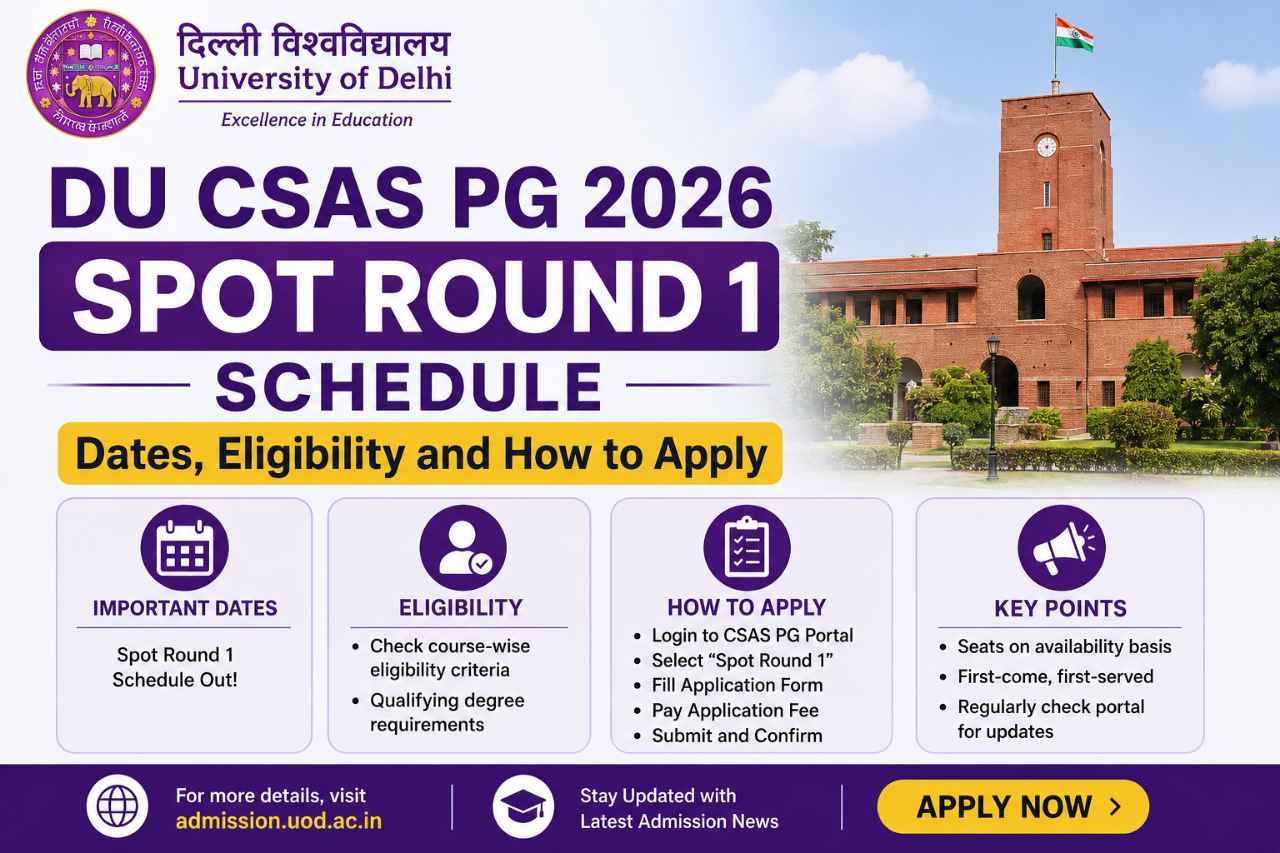

The University of Delhi (DU) has released the NCWEB first cutoff list for 2026 on July 27, 2026, opening the door for thousands of Delhi-based Women to pursue undergraduate study through the Non-Collegiate Women's Education Board. If you registered for the BA Programme or B.Com Programme under NCWEB, this is the moment to compare your Class 12 marks against college-wise cutoffs and complete Round 1 admission before the deadline of July 30, 2026.
Unlike regular DU colleges where students attend daily classes, NCWEB is designed for working women and homemakers who want a recognised Delhi University degree without leaving their jobs or family responsibilities. Classes are held on Sundays and public holidays at select DU-affiliated centres. This guide explains what the first cutoff means, who qualifies, how cutoffs compare with previous years, and exactly how to secure your seat on admission.uod.ac.in.
What Is DU NCWEB and Why Does the First Cutoff Matter?
The Non-Collegiate Women's Education Board (NCWEB) is a unique academic wing of Delhi University. It admits only women who are permanent residents of Delhi and offers the same BA and B.Com degrees that regular DU colleges award. The difference lies in the teaching model: learners study through weekend and holiday sessions, making higher education accessible to those who cannot join full-time programmes.
The first cutoff list is the initial round of seat allocation based on your Class 12 percentage and subject combination. Colleges under NCWEB publish separate PDFs for BA and B.Com, listing subject-wise minimum percentages for General, OBC, SC, ST, and other reserved categories. Meeting the cutoff does not automatically confirm admission you must log in, accept the allotted seat, upload documents, and pay fees within the Round 1 window.
For context, women's colleges across India from Lady Shri Ram College for Women (LSR), Delhi to Indraprastha College for Women, Delhi attract high cutoffs every year. NCWEB centres attached to premier DU colleges such as Miranda House and Hansraj College follow a similar competitive pattern, though the admission route and class schedule differ from regular CSAS counselling.
Key Dates and Facts at a Glance
| Particulars | Details |
|---|---|
| First cutoff release date | July 27, 2026 |
| Round 1 admission last date | July 30, 2026 |
| Programmes covered | BA Programme and B.Com Programme |
| Registration fee | Rs 250 |
| Mode of admission | Online via DU admission portal |
| Official portal | admission.uod.ac.in |
| Expected second cutoff | Early August 2026 (tentative) |
Who Is Eligible for NCWEB Admission in 2026?
Eligibility rules for NCWEB are strict because the board serves a specific population. Before you chase a cutoff, confirm that you satisfy every condition below.
Basic Eligibility Criteria
- Gender: Only women candidates can apply.
- Residence: You must be a permanent resident of Delhi. Valid proof such as Aadhaar, voter ID, or a Delhi domicile certificate is required during document upload.
- Educational qualification: You must have passed Class 12 from a recognised Indian board (CBSE, ICSE, state boards, or equivalent).
- Minimum marks: General category candidates need at least 40% aggregate in Class 12. Reserved category applicants receive relaxation as per DU norms.
- Subject requirements: B.Com typically requires Mathematics or a commerce-related subject combination depending on the college cutoff file. BA Programme combinations (History, Political Science, Economics, etc.) have separate subject-wise thresholds.
Students who cleared Class 12 from other cities but now live in Delhi should verify residence documentation carefully. NCWEB does not admit men or women from outside Delhi, even if they studied in the capital temporarily.
How Cutoffs Work for Different Categories
Each NCWEB centre uploads category-wise cutoffs. General category lists usually show the highest percentages. OBC, SC, ST, EWS, and PwBD columns appear in the official PDFs with lower qualifying marks. Always read the cutoff sheet for your exact BA subject pair or B.Com stream choosing the wrong combination on the portal can lead to rejection even if your overall percentage is strong.
Women's education institutions nationwide whether Bharathidasan Government College for Women, Chennai, SRD Modi College for Women, Kota, or DU's own Indraprastha College for Women often publish separate merit lists by category. NCWEB follows the same principle, so match both your percentage and your reservation category before assuming eligibility.
NCWEB Colleges and Programmes for 2026
NCWEB does not operate as a standalone college. Instead, it runs classes at selected Delhi University colleges spread across the city. When you accept a seat, you are assigned to one of these centres for weekend instruction while remaining an NCWEB student under DU.
Popular NCWEB Centres
Sought-after centres include Miranda House, Hansraj College, Kirori Mal College, and Aryabhatta College, among others. Each publishes its own cutoff PDF linked from the official NCWEB notification. Top combinations such as BA (History + Political Science) and B.Com historically draw the steepest cutoffs at Miranda House and Hansraj College.
Because classes meet on Sundays and public holidays, choose a centre you can reach consistently from your home or workplace. Travel time matters over three years of study, especially if you balance employment with assignments and annual examinations. Delhi's metro connectivity helps many learners reach north and south campus centres, but factor in Sunday rush and holiday schedules when planning.
BA Programme vs B.Com Programme
The BA Programme allows subject combinations across humanities and social sciences. Cutoffs vary sharply by pair for example, History with Political Science often ranks among the highest, while some language or interdisciplinary pairs may be slightly lower.
The B.Com Programme targets commerce-oriented learners. Hansraj College and Miranda House frequently lead B.Com cutoffs. If you aim for accountancy, business law, or corporate careers while working, B.Com through NCWEB offers a respected DU credential without daily campus attendance.
Students exploring design or creative fields alongside commerce may also look at institutions like the Centre for Design Excellence, Jaipur, but NCWEB remains the right path only if you specifically want a DU degree through the non-collegiate weekend model in Delhi.
NCWEB First Cutoff 2026: What Changed From 2025?
While the 2026 first cutoff PDFs carry the official numbers, comparing them with 2025 trends helps you set realistic expectations and backup choices.
2025 First Cutoff Benchmark (General Category)
| College | Course | General Category Cutoff (2025) |
|---|---|---|
| Miranda House | BA (History + Political Science) | 85% |
| Hansraj College | B.Com | 84% |
| Miranda House | B.Com | 82% |
| Hansraj College | BA (History + Political Science) | 81% |
In 2025, Miranda House topped BA charts while Hansraj led B.Com lists. If your percentage sits within two to three points of these benchmarks, you stand a reasonable chance at top centres in Round 1 or subsequent rounds. If you fall short, prepare for the second cutoff expected in early August 2026, when vacant seats and lower thresholds often appear.
Reading the 2026 Cutoff PDFs Correctly
Visit the official DU website and download the separate files for BA Programme and B.Com Programme. Each file lists colleges vertically and subject combinations horizontally (or in annex tables). Steps to interpret them:
- Locate your preferred college in the PDF.
- Find your exact subject combination row or column.
- Check the percentage listed for your category (General, OBC, SC, etc.).
- Compare your best-of-four or aggregate percentage as calculated by NCWEB rules.
- Shortlist two to three realistic options in case your first choice cutoff is out of reach.
Do not rely on screenshots from social media. Always use the PDF hosted on the official portal to avoid outdated or edited lists.
Factors That Influence Cutoff Movement Each Year
Cutoffs shift based on total applications, seat intake at each centre, and overall Class 12 result inflation. A strong CBSE or state board result year can push NCWEB thresholds up by one to two percentage points at popular colleges. Conversely, if fewer applicants choose a particular subject pair, cutoffs may dip in later rounds. Tracking year-on-year trends not just the previous year gives a fuller picture when you rank your preferences.
Round 1 Admission Process on admission.uod.ac.in
Meeting the first cutoff qualifies you to proceed, but admission is confirmed only after you complete online formalities before July 30, 2026. Missing this date typically means losing the allotted seat, which may pass to waitlisted or second-round candidates.
Documents to Keep Ready
- Class 12 mark sheet and passing certificate (scanned PDF, usually under 2 MB)
- Delhi residence proof (Aadhaar, voter ID, ration card, or domicile certificate)
- Category certificate (if applicable), issued by competent authority
- Recent passport-size photograph in specified format
- NCWEB registration ID and password from your original application
- Active email ID and mobile number linked to the portal
Scan documents in advance and store backups on your phone and email. Upload errors are a common reason for delayed confirmation during peak admission hours.
Payment and Confirmation
After document verification on the portal, pay the admission fee online through net banking, debit card, credit card, or UPI. Save the payment receipt and download the final admission slip immediately. These proofs are essential for future rounds, certificate verification, and any grievance you may need to raise with the NCWEB office.
Timeline for Round 1: Day-by-Day Action Plan
If you are reading this on July 28 or 29, treat admission as urgent. On day one, download cutoff PDFs and confirm eligibility. On day two, gather and scan all documents. On day three, log in early, upload files, pay fees, and download slips before evening peak traffic. Candidates who defer action to July 30 afternoon risk gateway timeouts and incomplete submissions.
Strategic Tips for Working Women and Repeat Applicants
NCWEB exists because many Delhi women cannot attend regular weekday college. If you are a working professional, homemaker, or caregiver, these practical tips can improve your admission outcome.
Balance Study With Work
Weekend classes reduce weekday pressure but still require consistent reading and assignment time. Before locking a seat, review the centre's distance, library access, and past student feedback. Institutions focused on flexible learning similar in spirit to training centres such as the International Academy for Certification and Training, Kota show how structured short-contact programmes can fit busy schedules. NCWEB applies the same logic at university degree level.
Plan Backup Options Beyond Delhi
If NCWEB cutoffs exceed your marks, consider other pathways: state universities, distance programmes, or women's colleges in your home region. For example, learners from Rajasthan might explore Shekhawati College for Education, Losal, Sikar, while those in Kota could review MD Mission College, Kota. These are not NCWEB substitutes, but knowing alternatives reduces panic if Round 1 does not go your way.
Stay Updated on Second Cutoff and Vacant Seats
DU typically releases subsequent NCWEB cutoffs when seats remain unfilled. Monitor admission.uod.ac.in daily after Round 1 closes. Enable notifications from official DU social channels rather than unverified WhatsApp forwards. The second cutoff in early August 2026 may open doors at colleges that seemed unreachable in Round 1.
NCWEB vs Regular DU CSAS Admission: Know the Difference
Many applicants confuse NCWEB with the Centralised Seat Allocation System (CSAS) used for regular DU undergraduate admission. They are separate processes.
- NCWEB: Weekend classes, women only, Delhi residents only, BA and B.Com through NCWEB registration.
- Regular DU CSAS: Daily college attendance, broader course list, national applicant pool subject to programme rules, separate portal workflow.
If you already secured a seat through CSAS at a regular college, understand that NCWEB is an alternative track not an upgrade path within the same system. Choose based on your schedule, not merely on college brand name.
Engineering and design aspirants should note that NCWEB does not offer B.Tech or professional design degrees. For technical programmes, explore exams and colleges such as DMI College of Engineering, Chennai or design entrances like NID DAT. NCWEB serves humanities and commerce undergraduate needs within DU specifically.
Understanding NCWEB Academic Life and Examination Pattern
Admission is only the first step. NCWEB students follow a structured academic calendar aligned with Delhi University norms. Internal assessments, assignments, and end-semester examinations carry weight toward your final grade. Because contact hours are limited to weekends, self-study discipline becomes essential for success.
Study centres provide library access on designated days, and faculty hold doubt-clearing sessions during scheduled classes. Peer study groups among working women are common many learners form WhatsApp groups for notes sharing, though always cross-check facts with official course material. The NCWEB degree holds equal value in government job applications and postgraduate admissions across India, provided you meet the minimum percentage required by the recruiting body or university.
Common Mistakes to Avoid During Round 1
Each year, eligible candidates lose seats due to preventable errors. Avoid these pitfalls:
- Waiting until the last hour on July 30: Portal traffic spikes and payment gateways may slow down.
- Uploading blurry or incomplete documents: Rejection triggers unnecessary appeals.
- Ignoring category columns: Applying under General when you hold a valid OBC certificate wastes eligible lower cutoffs.
- Choosing an unreachable college preference: Be realistic; use lower-cutoff centres as safe options.
- Not saving the admission slip: You may need it for identity verification at the study centre.
- Believing unofficial cutoff posts: Trust only PDFs from the DU website.
Grievance Redressal and Helpline Support
If your portal shows an error during document upload or payment, note the error code and take a screenshot. Contact the NCWEB helpdesk or DU admission support channels listed on the official website. Do not pay any third party claiming to "secure" a seat NCWEB admission is entirely online and fee-based through the official portal only.
For category certificate mismatches or residence proof queries, keep original documents ready. The verification team may request clarification via email. Respond within the stated deadline to avoid automatic cancellation of your provisional allotment.
What Happens After Round 1 Admission?
Once you confirm your seat, NCWEB or the allotted study centre will communicate orientation schedules, identity card collection, and academic calendar details. Classes generally begin after admission formalities conclude for the batch. You will appear in DU examinations as an NCWEB student and receive the same degree certificate as regular graduates of the parent university.
Maintain fee receipts, admission slips, and email confirmations until you complete the programme. If you need to migrate or withdraw, refer to NCWEB rules published on the official site seat cancellation policies may affect your participation in later admission rounds.
Conclusion
The DU NCWEB first cutoff 2026 marks a critical milestone for Delhi women seeking a flexible, recognised path to a BA or B.Com from Delhi University. Released on July 27, 2026, the college-wise lists demand quick action: compare your marks, verify eligibility, and complete Round 1 admission on admission.uod.ac.in by July 30, 2026.
Use 2025 cutoff trends as a benchmark, keep documents ready, and plan for the second cutoff if needed. NCWEB remains one of India's most practical higher-education models for working women a DU degree earned without sacrificing employment or family commitments. Act early, follow official sources, and secure your seat before the Round 1 window closes.