Thousands of Indian students choose to pursue an MBBS degree outside India every year. Russia, Georgia, Kazakhstan, Kyrgyzstan, the Philippines, Nepal, Bangladesh, and China remain popular destinations because of seat availability, fees, and admission timelines. After graduation, most of these students must clear the Foreign Medical Graduate Examination (FMGE) conducted by the National Board of Examinations in Medical Sciences (NBEMS) and then register with a State Medical Council to practise medicine in India.
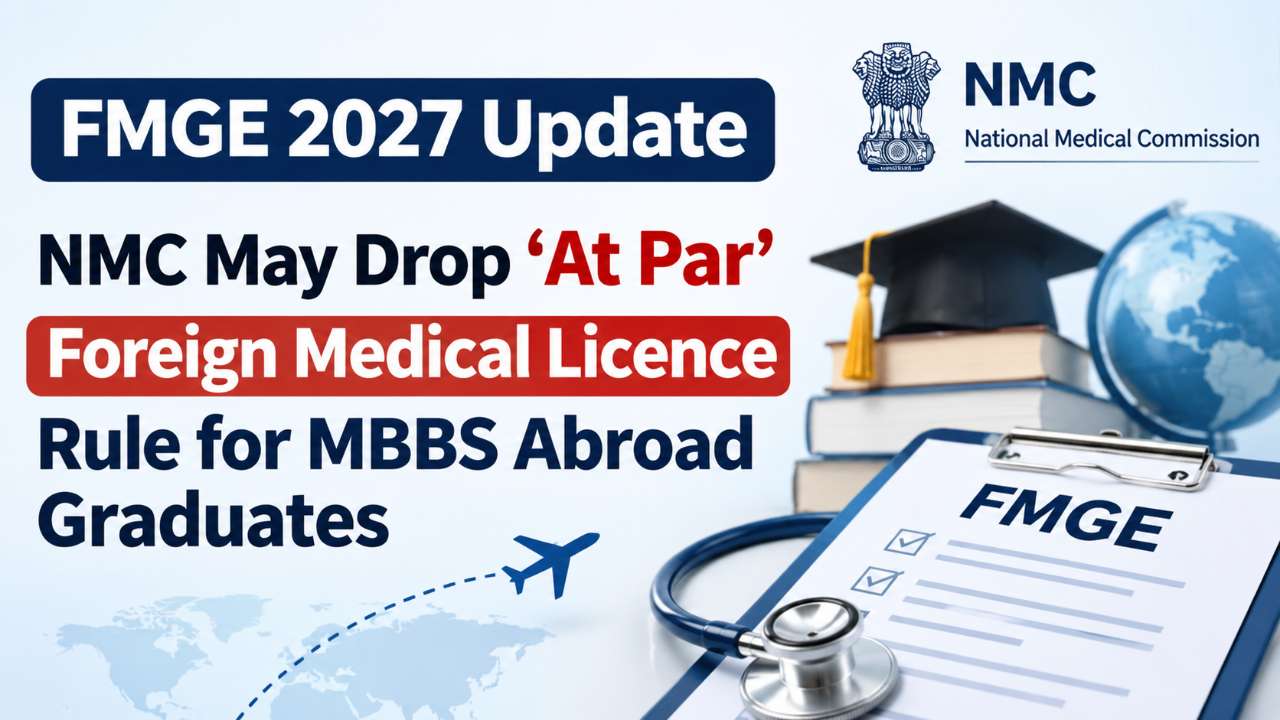
In November 2026, the National Medical Commission (NMC) released a draft amendment to the Foreign Medical Graduate Licentiate (FMGL) Regulations, 2021. The headline change: candidates may no longer need to prove that their right to practise medicine abroad is exactly at par with citizens of the country where they studied. If finalised, this could ease eligibility for FMGE 2027 and beyond for many Foreign Medical Graduates (FMGs) who struggle with unequal licensing rules overseas. The proposal is not yet law; stakeholders can submit objections and suggestions within a 30-day public consultation window.
What Is FMGE and How Does It Connect to NMC Rules?
FMGE is a screening test for Indian citizens and Overseas Citizens of India (OCI) who hold a primary medical qualification from a college outside India (with exceptions for degrees from the UK, USA, Canada, Australia, and New Zealand under separate pathways). Passing FMGE is a gateway step; provisional or permanent registration in India still depends on satisfying the NMC's FMGL Regulations and State Medical Council procedures.
The FMGL Regulations, 2021, set multiple conditions: recognised qualification, course duration, clinical exposure, internship where applicable, and compliance with licensing norms in the country of study. Until now, Regulation 4(b) also required that any registration or licence abroad be on the same terms as that country's own citizens the so-called "at par" requirement.
Quick glossary for students and parents
- FMG: Foreign Medical Graduate an Indian (or eligible OCI) student who completed MBBS outside India.
- FMGL Regulations: NMC rules that define when an FMG may be registered to practise in India.
- FMGE: The national screening examination; passing it does not by itself equal full registration.
- Primary medical qualification: The main degree (for example, MBBS or equivalent) listed in the World Directory of Medical Schools or recognised by NMC.
FMGE 2027 Latest Update: What Has NMC Proposed?
According to the draft amendment summarised in industry coverage, NMC intends to delete the "at par with citizens" limb of the foreign licensing condition. Students would still need to be registered with or eligible for registration with the professional regulatory body in the country where they completed MBBS. What goes away is the extra proof that foreign nationals enjoy the same practising rights as local citizens.
This distinction matters in countries where:
- Foreign graduates face a separate licensing exam or language test (for example, local medical language proficiency).
- Full medical licences are tied to citizenship, long-term residency, or years of local internship beyond what Indian students complete.
- Graduates receive a temporary registration or educational licence that is valid for training but not identical to a citizen's unrestricted licence.
The amendment, if notified, would apply to Regulation 4(b) only. Duration of study, clinical training, internship norms, recognised degree requirements, and the obligation to pass FMGE (or any successor exam) remain unchanged.
Why the 'At Par' Rule Created Problems for Indian Students
Indian families often compare abroad MBBS with securing a seat through NEET UG in government or private medical colleges at home. After return, however, regulatory parity matters more than brochure promises. The "at par" wording pushed students to obtain documents showing their overseas licence matched citizen-level rights a bar many countries never grant to international graduates at the internship stage.
Real-world friction points (illustrative)
- Extra residency years: Some nations require FMGs to complete postgraduate residency before an unrestricted licence timelines that exceed the FMGL framework Indian students planned for.
- Language barriers: Licensing interviews or exams in Russian, Kazakh, or other local languages delay registration even when the MBBS was taught in English.
- Dual-track registration: Universities issue completion certificates while the medical council issues a different class of registration, leading to document mismatch during Indian verification.
- Agent misinformation: Consultancies sometimes claim "automatic eligibility for FMGE" without explaining foreign council rules students discover gaps only at graduation.
Removing the strict parity test could align Indian policy with practical realities: many FMGs return home specifically because local unrestricted practice is difficult, yet they still hold legitimate regulatory enrollment with the host country’s medical body.
Who May Benefit If the Amendment Is Finalised?
The proposed relaxation is most relevant for FMGE 2027 aspirants and recent graduates from:
- Russia and former Soviet-region universities in Georgia, Kazakhstan, and Kyrgyzstan
- Philippines, Nepal, and Bangladesh (where council formats differ from Indian expectations)
- China (for batches that clear NMC recognition and medium-of-instruction rules)
Beneficiaries include students who already have provisional or educational registration abroad but cannot show citizen-equivalent licences. It may also help those caught in administrative delays at foreign councils through no fault of their own.
It does not help candidates with unrecognised degrees, short-course programmes, inadequate clinical hours, or missing internship. Those issues fall under other FMGL clauses and NMC advisories on fraudulent colleges.
What Does NOT Change Under FMGL 2021?
Media headlines can sound like "all MBBS abroad students become eligible." That is incorrect. Mandatory pillars likely to continue include:
- Recognised qualification: Degree and college must meet NMC criteria (screening of universities, prohibited institutions, and course duration).
- Minimum duration and subjects: Alignment with the Compulsory Rotating Medical Internship (CRMI) and subject coverage comparable to Indian MBBS.
- Clinical training: Documented hospital exposure; online-only or observer-only rotations rarely suffice.
- Internship: Where required abroad or in India per policy at the time of graduation.
- Licensing exam: FMGE (or National Exit Test / NEXT when applicable) remains the national competency filter.
- Good standing: Registration with the foreign medical council where such registration is possible not a waiver of all foreign paperwork.
After FMGE, graduates pursue State Medical Council registration, often compulsory rotatory internship in India if not completed abroad, and then employment or postgraduate training. Admission to MD and MS programmes in India is driven primarily by NEET PG and counselling rules not by FMGE alone. Premier institutes such as Jawaharlal Institute of Post Graduate Medical Education and Research, Puducherry, the Post Graduate Institute of Medical Sciences, and Sanjay Gandhi Post Graduate Institute of Medical Sciences, Lucknow illustrate how competitive clinical postgraduate pathways remain even after licensure hurdles shrink.
FMGE Exam Pattern and Preparation (Still Central to Your Plan)
Policy changes do not reduce the academic difficulty of FMGE. The exam historically uses multiple-choice questions covering pre-clinical, para-clinical, and clinical subjects aligned with Indian undergraduate medical standards. Low pass rates mean structured revision is essential regardless of foreign licensing reforms.
Actionable preparation tips
- Map your foreign syllabus to the Indian MBBS curriculum; fill gaps in forensic medicine, community medicine, and pharmacology.
- Use previous years’ FMGE question trends and timed mock tests to build exam stamina.
- Start licence documentation early with your foreign university and medical council so administrative work does not collide with final-year exams.
- Join peer groups with students from the same country of study to share verified council formats.
- If considering return to India for practice, budget for multiple FMGE attempts and possible Indian internship.
Higher education choices are not limited to medicine. Students exploring other globally oriented programmes sometimes research institutions such as the Indian Institute of Foreign Trade, Delhi or the ICFAI Foundation for Higher Education, Hyderabad for commerce and management pathways useful if a NEET UG outcome pushes you toward alternative careers while keeping healthcare as a long-term goal.
Impact on FMGE 2027 Timeline and Counselling Ecosystem
NBEMS typically announces FMGE session dates, application windows, and city-centre lists separately from NMC eligibility changes. If the amendment is finalised before the FMGE 2027 application cycle, application forms may ask only for proof of foreign council registration rather than citizen-parity affidavits. If finalisation is delayed, the older interpretation could still apply to that batch.
State Medical Councils may update checklists for provisional registration after FMGE results. Keep PDFs of degree, transcripts, passport, visa, foreign registration, NMC eligibility certificate (if applicable), and FMGE scorecards in one folder for faster verification.
Featured Snippet: At a Glance
| Topic | Current draft proposal |
|---|---|
| "At par" foreign licence | Proposed removal from FMGL Reg. 4(b) |
| Foreign council registration | Still expected where applicable |
| FMGE / NEXT | Still required for most FMGs |
| Course & clinical norms | Unchanged |
| Legal status (Nov 2026) | Draft; 30-day consultation |
Conclusion
The NMC’s draft move to drop the "at par with citizens" foreign medical licence test could remove a painful documentation barrier for Indian MBBS abroad graduates targeting FMGE 2027. It signals recognition that many students hold valid but not citizen-equivalent registration overseas. Yet the core quality filters remain: recognised degrees, adequate clinical training, passing FMGE, and honest foreign council paperwork.
Students should continue to track the official NMC notification after consultation, avoid agent hype, and align study plans with Indian exam standards. Whether you eventually practise in a district hospital or aim for superspecialty training at institutes like Sree Chitra Tirunal Institute for Medical Sciences and Technology, Thiruvananthapuram, your long-term success will depend less on one eligibility sentence and more on disciplined clinical learning and transparent compliance with every rule that stays in force.