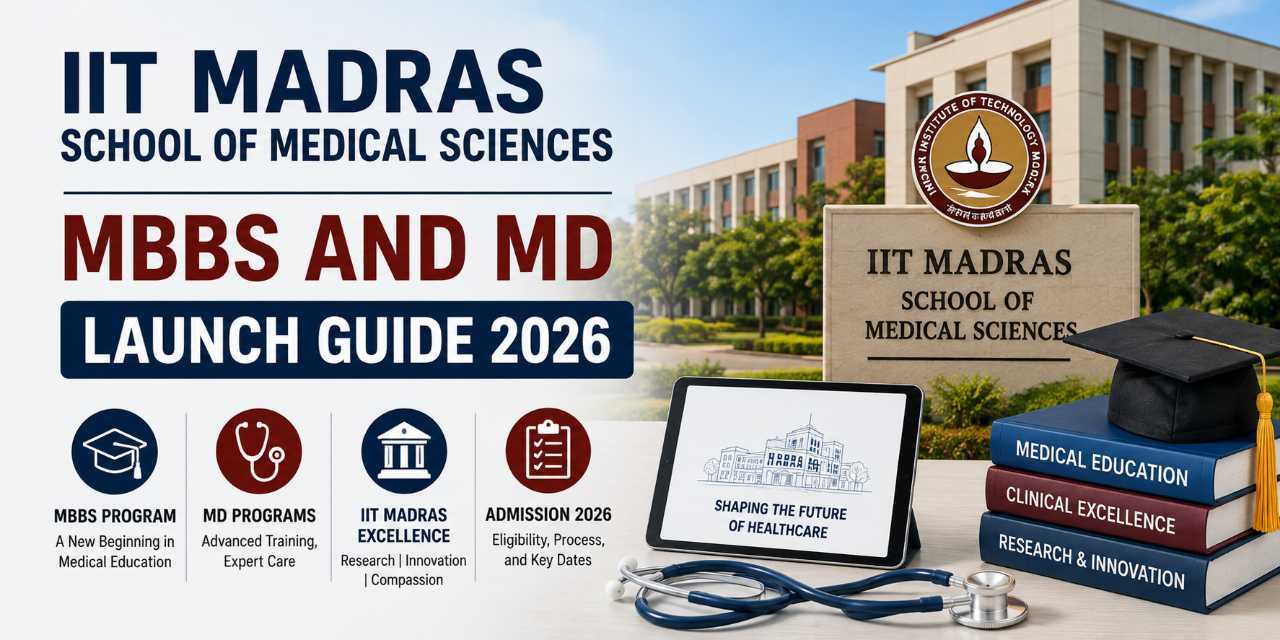
In a landmark shift for India's premier technical institutes, the Indian Institute of Technology Madras (IIT Madras) has announced plans to establish a School of Medical Sciences that will offer MBBS and MD degrees. Institute Director Prof. V. Kamakoti confirmed the initiative on August 20, 2026, signalling one of the first major moves by an IIT into full-scale clinical medical education not just research or postgraduate health programmes.
For students in Chennai, Tamil Nadu, and across India who dream of combining medicine with technology, this development opens a new category of medical college. The proposed school will sit alongside IIT Madras's existing strengths in biomedical engineering, medical devices, and health-tech startups. A dedicated teaching hospital on campus is part of the plan, blending patient care, student training, and joint research between engineers and clinicians.
This article explains what we know so far, what remains pending (including National Medical Commission approval), and how aspiring doctors can prepare. We also compare IIT Madras's vision with established institutes such as All india Institute of Medical Sciences Delhi (AIIMS Delhi) and technology-focused centres like the Sree Chitra Tirunal Institute for Medical Sciences and Technology, Thiruvananthapuram.
What Is the IIT Madras School of Medical Sciences?
The School of Medical Sciences is a proposed academic unit within IIT Madras, located on the institute's campus in Chennai, Tamil Nadu. Unlike standalone medical universities, this school will be embedded inside one of India's top IITs an institution historically known for engineering, science, and technology rather than undergraduate clinical training.
According to the August 2026 announcement shared through IIT Madras's official channels, the school will run:
- MBBS (Bachelor of Medicine, Bachelor of Surgery) the standard five-and-a-half-year undergraduate medical degree in India, including internship.
- MD (Doctor of Medicine) postgraduate clinical specialisations for doctors who have completed MBBS and cleared relevant entrance requirements.
The defining feature is an engineering-led approach to medicine. Students are expected to study core clinical subjects required under National Medical Commission (NMC) norms while also gaining exposure to medical artificial intelligence, data science, biomedical devices, and interdisciplinary research from the early years of training.
This model aligns with global trends where medical schools increasingly integrate digital health, robotics, and innovation labs into the standard doctor-training pathway. For Chennai-based learners already familiar with institutions like the Saveetha Institute of Medical and Technical Sciences (Deemed to be University), IIT Madras adds a public, research-intensive option rooted in the IIT ecosystem.
Key Announcement Details at a Glance
The following summary captures publicly confirmed information as of August 2026. Several operational details seat matrix, fees, and exact batch start year are still awaited from official notifications.
| Parameter | Details |
|---|---|
| Institute | Indian Institute of Technology Madras (IIT Madras) |
| New unit | School of Medical Sciences |
| Degrees planned | MBBS and MD |
| Announced by | Director Prof. V. Kamakoti |
| Announcement date | August 20, 2026 |
| Location | IIT Madras campus, Chennai, Tamil Nadu |
| Teaching hospital | Planned on campus |
| Regulatory next step | NMC approval and compliance |
| Expected admissions route | NEET UG (MBBS) and NEET PG (MD), subject to final confirmation |
Who Announced It and Why It Matters
Director Kamakoti has previously spoken about merging engineering excellence with healthcare innovation. The medical school announcement is the natural extension of years of medtech research at IIT Madras including work on affordable devices, biotechnology, and health-focused startups incubated on campus.
For the IIT system, this is more than a new course listing. It represents a first-of-its-kind undergraduate medical pathway at a top IIT. Earlier health initiatives at IITs tended to focus on postgraduate research, biomedical engineering departments, or hospital collaborations not a full MBBS programme with an attached teaching hospital.
MBBS and MD Programmes: What Students Can Expect
MBBS: Undergraduate Medical Training
The MBBS programme will follow the broad framework that governs medical education across India. The NMC's competency-based medical education (CBME) curriculum sets the foundation for subjects such as anatomy, physiology, biochemistry, pharmacology, pathology, community medicine, and clinical rotations in major specialties.
Where IIT Madras is likely to differ is in supplementary learning. Reports around the announcement suggest students may also engage with:
- Medical AI and health informatics
- Biomedical engineering fundamentals
- Data-driven diagnostics and clinical decision support
- Joint projects with IIT engineering departments
- Exposure to medtech startups and translational research
Topics like medical device design and health data analytics are often reserved for postgraduate or allied programmes at conventional medical colleges. At IIT Madras, they may become part of the undergraduate experience helping produce doctors who can collaborate effectively with engineers, data scientists, and product developers.
MD: Postgraduate Clinical Specialisations
The MD degrees will target doctors seeking advanced training in clinical branches such as general medicine, paediatrics, anaesthesiology, radiology, or other NMC-recognised specialties exact subject lists will be confirmed once postgraduate seats receive approval.
MD admissions across India typically run through NEET PG, followed by state or national counselling. Institutes like Sanjay Gandhi Post Graduate Institute of Medical Sciences, Lucknow and Nizam Institute of Medical Sciences, Hyderabad have long served as referral centres for advanced clinical care and PG training. IIT Madras would enter this space with a technology-forward identity rather than decades of standalone hospital legacy.
Teaching Hospital Plans on the IIT Madras Campus
A medical school cannot function without clinical exposure. IIT Madras plans to build a full teaching hospital on its campus to support MBBS and MD training. This facility is expected to serve three interconnected purposes:
- Patient care delivering outpatient and inpatient services to the community.
- Clinical training providing rotations, bedside teaching, and skill labs for medical students.
- Research translation enabling engineers and clinicians to test devices, digital tools, and treatment protocols in real clinical settings.
The on-campus hospital model mirrors how leading institutes combine academics and healthcare under one roof. AIIMS campuses nationwide such as AIIMS Madurai in Tamil Nadu and AIIMS Bhubaneswar use attached hospitals as the backbone of medical education. IIT Madras aims to replicate that structure while layering IIT-style innovation on top.
Construction timelines, bed capacity, and specialty departments have not been made public yet. These details usually emerge during NMC inspection and institutional recognition processes.
Why IIT Madras Is Entering Medical Education Now
Several converging factors explain the timing of this announcement:
- Existing research base: IIT Madras already conducts significant work in medical devices, biotechnology, and healthcare innovation. A medical school completes the pipeline from lab to clinic.
- National policy direction: The Ministry of Education has encouraged top institutes to expand into interdisciplinary fields. Medicine-plus-engineering fits that agenda.
- Doctor workforce needs: India continues to face uneven distribution of qualified doctors, especially in rural and underserved areas. New seats at reputed public institutions can widen access to quality training.
- Startup ecosystem: IIT Madras hosts a growing number of health-tech startups. Trained clinician-innovators can accelerate product development and regulatory understanding.
- Global education trends: Medical schools worldwide are integrating AI, genomics, and engineering modules into core curricula.
Director Kamakoti's vision treats medicine not as a separate silo but as a partner discipline to engineering. That philosophy distinguishes this project from a conventional private medical college opening MBBS seats purely for enrollment growth.
NMC Approval and the Regulatory Roadmap
Before any MBBS or MD batch can enrol, IIT Madras must secure approval from the National Medical Commission (NMC) the statutory body that regulates medical education and professional standards in India.
The regulatory pathway typically involves:
- Institutional assessment verifying land, infrastructure blueprint, and governance structure.
- Faculty and staffing norms meeting NMC requirements for professor, associate professor, and assistant professor ratios across preclinical, paraclinical, and clinical departments.
- Hospital infrastructure ensuring minimum bed strength, specialty coverage, ICU facilities, operation theatres, blood bank, and diagnostic services.
- Curriculum compliance aligning the MBBS programme with NMC's CBME guidelines and assessment standards.
- Inspection and recognition NMC site visits and final grant of permission to admit students.
IIT Madras has not announced a fixed launch date. Reports suggest the first MBBS batch could begin within a few years, but the actual timeline depends on how quickly land allocation, hospital construction, faculty recruitment, and NMC clearance progress. Students should treat any expected year as provisional until the institute publishes an official admission brochure.
Expected Admission Process: NEET UG and NEET PG
IIT Madras has not yet released seat numbers, fee structure, or reservation policy. However, based on national rules governing medical admissions, the following pathway is the most likely scenario:
MBBS Admissions via NEET UG
Undergraduate medical admissions in India are centrally tied to NEET UG (National Eligibility cum Entrance Test for Undergraduate). Candidates who qualify NEET UG and meet eligibility criteria typically including Physics, Chemistry, and Biology in Class 12 and minimum age requirements participate in counselling.
Depending on how IIT Madras is classified after NMC recognition, its MBBS seats may appear in:
- All India Quota counselling conducted at the national level
- State quota counselling managed by Tamil Nadu authorities
- Or a combination, based on seat distribution rules at the time of launch
Aspirants already preparing for medical entrances should continue focusing on NCERT-based Biology, Chemistry, and Physics, alongside mock tests and previous-year NEET analysis. A strong NEET score will remain the primary gateway regardless of the college's IIT branding.
MD Admissions via NEET PG
For postgraduate MD seats, NEET PG is the standard national entrance examination. Candidates must hold an MBBS degree, complete internship, and register with the NMC or state medical council before applying.
Counselling for MD seats follows national and state rounds. When IIT Madras launches MD programmes, details on recognised specialties, seat matrix, and fee structure will be published on the institute's official website and the NMC portal.
How IIT Madras Compares With Other Medical Institutes in India
India's medical education landscape includes several models. Understanding where IIT Madras fits helps students set realistic expectations.
Conventional Government Medical Colleges
Established colleges under state universities offer MBBS programmes with attached government hospitals. They follow NMC curriculum standards and admit through NEET. Tuition is generally subsidised. Examples include long-running state institutions and newer AIIMS campuses such as AIIMS Patna and AIIMS Guwahati.
Deemed and Private Medical Universities
Institutes like Pravara Institute of Medical Sciences, Ahmednagar and Mahatma Gandhi University Medical Sciences, Jaipur operate as deemed or private universities with their own hospital networks. They expand seat availability but often at higher fees than central institutes.
Technology-Integrated Medical Institutes
The closest comparators to IIT Madras's stated vision are institutes that explicitly merge medicine with technology such as the Sree Chitra Tirunal Institute for Medical Sciences and Technology, which focuses on medical technology and advanced clinical research. IIT Madras would differ by offering a full MBBS entry route inside an IIT rather than primarily postgraduate or super-speciality training.
Regional Context: Tamil Nadu and Chennai
Tamil Nadu is already a major hub for medical and technical education. Students in the region compare options across MBBS colleges, engineering institutes, and hybrid programmes. Chennai hosts diverse institutions from Madras School of Economics to medical institutes like Sri Venkateswara Institute of Medical Sciences, Tirupathi (a nearby regional referral centre) creating a competitive educational environment where IIT Madras's brand will attract strong applicants once seats open.
Impact on the IIT System and Indian Higher Education
IIT Madras's move may influence peer institutions. Other IITs and top engineering schools have explored healthcare research, but few have announced full MBBS programmes. If the Chennai model succeeds measured by NMC compliance, graduate outcomes, and research output peer IITs may evaluate similar proposals.
Broader implications include:
- More interdisciplinary career paths clinician-engineers, medtech founders, and clinical researchers with dual literacy in wards and labs.
- Stronger translational research shorter paths from prototype medical devices to clinical validation.
- Expanded seat diversity another high-quality public option beyond traditional medical colleges and AIIMS branches like AIIMS Jodhpur or AIIMS Nagpur.
- Policy precedent technical institutes entering regulated clinical education under NMC oversight.
For engineering aspirants, this does not replace JEE Advanced or IIT BTech admissions. The medical school is a parallel vertical. For NEET aspirants, however, it adds a prestigious new choice on the horizon.
Engineering-Led Curriculum: What Makes It Different?
The phrase engineering-led medical education can sound abstract. In practical terms, IIT Madras students may experience differences in how they learn not necessarily in the core competencies every Indian doctor must master.
Expected differentiators include:
- Early research exposure participation in labs working on diagnostics, imaging, or wearable health devices.
- Cross-department electives coursework or projects linked to computer science, electrical engineering, or biotechnology departments.
- Industry-linked capstone projects solving real clinical problems with technical tools.
- Startup and innovation culture access to IIT Madras incubators and industry partnerships.
- Data literacy training to interpret clinical datasets responsibly and understand AI limitations in healthcare.
Standard clinical skills history taking, physical examination, emergency care, ethics, and communication will still anchor the programme. NMC regulations ensure that every recognised MBBS graduate meets national competency standards before independent practice.
Actionable Tips for Aspiring Students and Parents
Because the school is not yet admitting students, preparation matters more than speculation. Here are practical steps:
- Monitor official sources bookmark iitm.ac.in and the NMC website for recognition updates. Avoid relying on unverified social media claims about seat counts or launch dates.
- Prepare for NEET UG seriously treat IIT Madras as a future NEET option, not a separate entrance exam, unless official notices state otherwise.
- Build a strong PCB foundation in Class 11 and 12 NCERT textbooks remain the NEET preparation backbone.
- Develop interest in interdisciplinary learning read about medtech, public health data, and biomedical innovation to understand the school's likely culture.
- Compare backup options apply broadly across established colleges such as University College of Medical Sciences (UCMS), Delhi, state medical colleges, and AIIMS campuses while waiting for IIT Madras details.
- Track Tamil Nadu counselling rules if you are a domicile or open-state candidate, understand how state quota policies may apply to new institutions.
- Plan finances conservatively fee structures for new IIT-linked programmes will be announced officially. Budget for tuition, hostel, and living costs in Chennai without assuming subsidised AIIMS-level fees until confirmed.
Challenges and Open Questions
Every ambitious medical education project faces hurdles. Transparent awareness of these issues helps students and families make informed decisions:
- Construction and staffing timelines building a teaching hospital and recruiting senior clinical faculty cannot be rushed without compromising quality.
- Regulatory scrutiny NMC standards are strict; partial compliance does not lead to admission permission.
- Integration complexity blending IIT's academic culture with clinical medicine requires careful governance and mentorship structures.
- Unconfirmed admission rules seat matrix, reservation categories, and fee details remain unknown.
- Competition for faculty attracting experienced clinicians to a new campus takes time and competitive packages.
Until IIT Madras publishes a formal prospectus, treat all secondary reports as indicative rather than final.
Conclusion
The proposed IIT Madras School of Medical Sciences marks a bold expansion of India's IIT mission from producing engineers and scientists to training doctors through an engineering-integrated lens. With MBBS and MD programmes, a planned on-campus teaching hospital, and leadership backing from Director V. Kamakoti, the project positions Chennai as a future hub for technology-driven medical education.
Regulatory approval from the National Medical Commission, infrastructure development, and faculty recruitment will determine when the first batch actually begins. For now, NEET UG and NEET PG remain the most realistic admission pathways. Students who aspire to study medicine at IIT Madras should excel in their board exams, master NEET preparation, and follow official announcements closely.
When the school opens, it could redefine what a doctor-engineer profile looks like in India much as institutes like Karunya Institute of Technology and Sciences, Coimbatore have blended technology with professional education in their domains. Until then, stay prepared, stay verified, and keep your medical college options open across India's diverse and growing healthcare education landscape.