Every year, millions of students across India burn the midnight oil preparing for two of the country's most competitive entrance exams JEE (Joint Entrance Examination) for engineering and NEET (National Eligibility cum Entrance Test) for medical admissions. These exams decide the futures of lakhs of students who dream of becoming engineers and doctors.
But what if there was just one exam instead of two? That is exactly what the Indian government is now actively exploring. In May 2026, top officials from the National Testing Agency (NTA) briefed a Parliamentary Standing Committee on Education about a proposal to create a single, unified national entrance test that would replace both JEE and NEET. This is one of the most significant education reform proposals India has seen in decades.
Why Is This Merger Being Discussed?
The NEET-UG 2024 and 2026 Controversies
In 2024, NEET-UG was hit by a major paper leak scandal. Thousands of students across multiple states had access to the question paper before the exam. This created outrage across the country, and the Supreme Court of India took note of the issue. Following this, the Supreme Court constituted a high-powered expert committee headed by Dr. K. Radhakrishnan, former chairman of the Indian Space Research Organisation (ISRO), to review the functioning of the NTA and recommend reforms to prevent paper leaks and malpractice.
In 2026, the controversy resurfaced when NEET-UG 2026 also faced allegations of a paper leak, leading to a re-examination scheduled for June 21, 2026. This back-to-back crisis put enormous pressure on the government to take strong, lasting action.
The Parliamentary Standing Committee Briefing (May 2026)
On May 21, 2026, NTA Director General Abhishek Singh and Higher Education Secretary Vineet Joshi appeared before the Parliamentary Standing Committee on Education, chaired by Digvijaya Singh. During this briefing, officials discussed the possibility of a common entrance examination that would combine JEE and NEET into one unified test. This was a major development that set off a nationwide discussion.
What Is the JEE-NEET Merger Proposal?
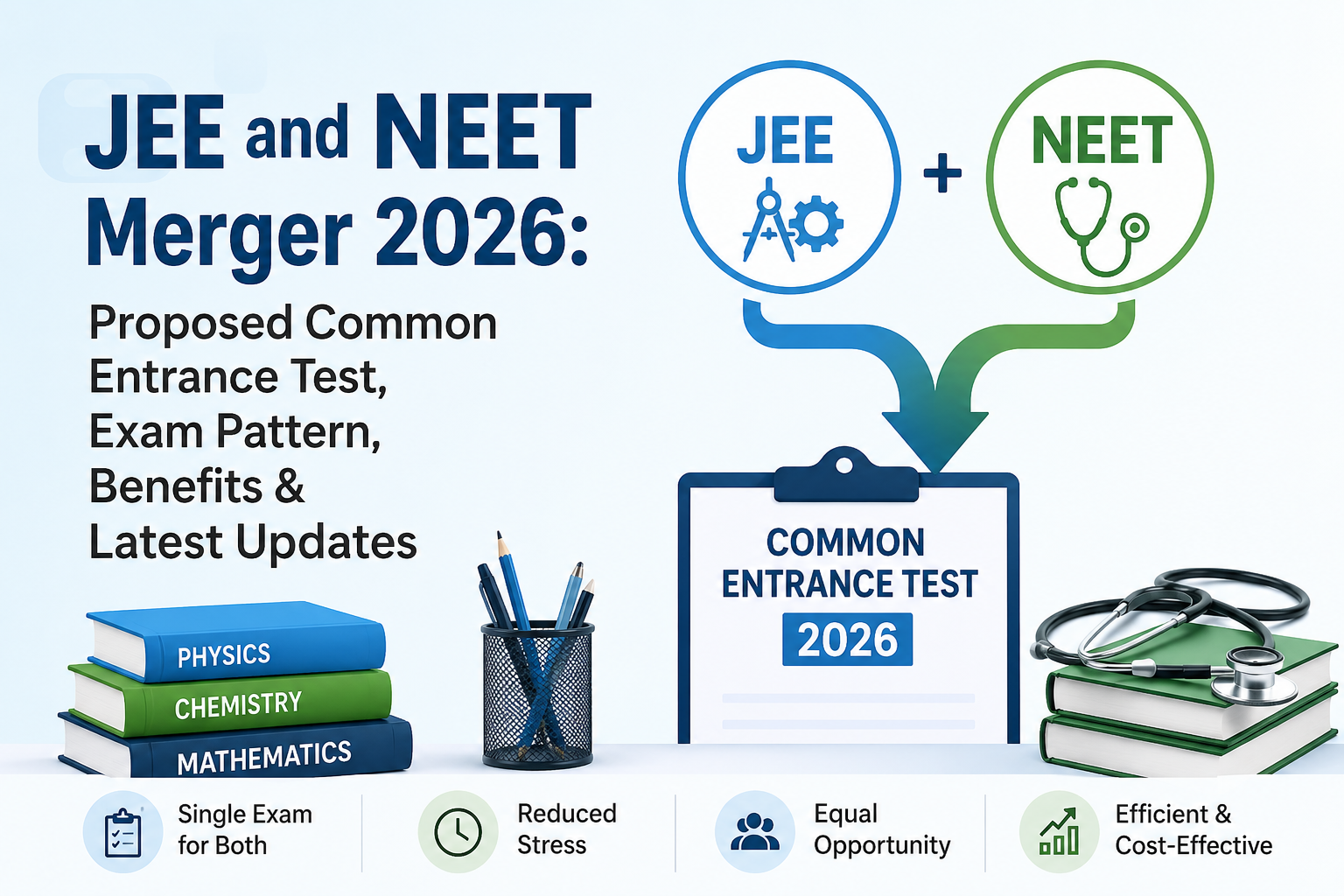
The proposal is simple to understand but complex to implement. The Central Government, guided by the Radhakrishnan Committee recommendations, is considering replacing both JEE Main and NEET-UG with a single national entrance exam under a "One Nation, One Exam" framework.
Here is what the proposed structure looks like:
• One common examination will be conducted at the national level
• The exam will have subject-specific sections for different streams
• Engineering aspirants will be assessed on Physics, Chemistry, and Mathematics
• Medical aspirants will be assessed on Physics, Chemistry, and Biology
• Students interested in both streams can attempt all sections
• A common section covering aptitude, reasoning, or general science may also be included
In simple terms, it is not that biology students will have to study maths, or that engineering students will have to study biology. The exam will be structured so that each student only needs to attempt the sections relevant to their chosen career path. Proposed Exam Pattern: What Could the New Test Look Like? While no official exam pattern has been confirmed yet, based on discussions and recommendations from the Radhakrishnan Committee, here is what the new exam structure may look like:
|
Feature |
Expected Details |
|
Exam Name |
Unified National Entrance Test (Proposed) |
|
Conducting Body |
National Testing Agency (NTA) — Reformed |
|
Mode of Exam |
Computer-Based Test (CBT) — Online |
|
Frequency |
Multi-session / Multi-stage (Proposed) |
|
Sections |
Physics, Chemistry, Mathematics (JEE), Biology (NEET) |
|
Duration |
Likely 3 to 3.5 hours |
|
Languages |
Multiple Indian languages |
|
Security |
AI-CCTV, Aadhaar Biometric Verification |
|
Question Type |
Multiple Choice Questions (MCQs) |
Also Read: How to Crack IIT-JEE & NEET 2026 with a High Rank: Complete Preparation Strategy
Key Reforms Being Proposed Along With the Merger
The merger is not the only change being discussed. The government and NTA are planning a comprehensive overhaul of how entrance exams work in India. Here are the major reforms:
1. Shift to Computer-Based Testing (CBT)
NEET-UG has traditionally been conducted using pen-and-paper OMR sheets. One of the most important proposed changes is shifting to a fully digital Computer-Based Test (CBT) format, similar to how JEE Main is conducted today. This will eliminate the risk of physical paper leaks, reduce manual errors, and speed up result processing.
2. Multi-Stage and Multi-Session Testing
Instead of a single high-stakes exam on one day, the Radhakrishnan Committee has recommended moving to a multi-stage, multi-session format. This means students may get more than one opportunity to appear in the exam within a year, reducing the enormous pressure of performing in just one day.
3. Age Limit and Attempt Restrictions
The government is also deliberating on setting an upper age limit for NEET candidates and capping the total number of attempts a student can make. This is aimed at ensuring that seats go to genuinely deserving and career-focused students.
4. Upgraded NTA Security Infrastructure
To prevent future paper leaks and malpractice, the NTA is planning to implement advanced technology safeguards including AI-powered CCTV surveillance, Aadhaar biometric verification of candidates, cloud-based encrypted test delivery, and 500 dedicated Computer-Based Test (CBT) centres in Kendriya Vidyalayas (KVs) and Jawahar Navodaya Vidyalayas (JNVs) across the country.
5. Transparent and Fast Results
Digital exams allow for faster and more accurate results. With the proposed reforms, result timelines are expected to become shorter and more transparent, with detailed score reports for every candidate.
Also Read: Online vs Offline Neet Coaching: Which One Gives Better Results
Benefits of a Unified JEE-NEET Exam
There are several strong arguments in favour of merging the two exams. Let us look at the key benefits:
Reduced Exam Stress and Fatigue
Students who wish to keep their options open between engineering and medicine currently have to prepare for two entirely different exams with separate syllabi, different exam dates, and different preparation strategies. A unified exam would drastically reduce this burden. Students can prepare once and appear in one exam, choosing to attempt only the sections they need.
Lower Coaching and Financial Burden
Today, students and families spend enormous amounts on coaching for both JEE and NEET separately. Some students enrol in two different coaching institutes simultaneously. A common exam would reduce this financial burden, particularly for students from middle-class and lower-income families.
More Fairness and Transparency
A single, standardized exam conducted in CBT mode with strong security safeguards is far harder to manipulate or leak than a paper-based exam conducted across thousands of centres. This will create a more level playing field for all students, irrespective of where they come from.
Streamlined Admissions Process
A unified exam means one score, one rank, and one counselling process. This would simplify the admission journey for students and reduce the chaos of managing multiple exam cycles, result dates, and counselling rounds.
Better Use of Resources
Conducting two massive national exams every year requires a huge investment of time, money, and administrative effort. A single exam would make better use of government and NTA resources, which can then be invested in improving exam quality and student support.
Challenges and Concerns Around the Merger
While the idea has merit, there are also legitimate challenges that need to be addressed before the merger can become a reality:
Different Academic Backgrounds
JEE and NEET currently test students with fundamentally different academic and career orientations. Engineering students focus heavily on problem-solving, mathematics, and physics applications. Medical students prioritize biology, memorization of concepts, and clinical reasoning. Designing a single exam that fairly assesses both streams without putting either group at a disadvantage is a complex challenge.
Huge Logistical Challenge
NEET-UG 2025 had over 22 lakh registered candidates, while JEE Main had over 12 lakh. Conducting a single exam for this combined pool of 30+ lakh students in CBT mode across the country would require an extraordinary infrastructure build-up.
Concerns from Medical and Engineering Communities
Doctors and medical professionals have often argued that NEET should remain a standalone, highly specific test that accurately measures a student's readiness for a medical degree. Similarly, IITs and top engineering institutions may be concerned that a merged exam might not adequately test the depth of mathematical and analytical skills they require.
No Official Decision Yet
It is important to note that as of May 2026, no official decision has been made. The proposal is under discussion and examination by the government and expert committees. Students currently preparing for JEE or NEET should not change their preparation strategy based on unconfirmed reports.
Timeline: What Has Happened So Far?
|
Date / Period |
Development |
|
2022 |
UGC first floated the idea of merging JEE, NEET, and CUET; the Education Ministry says no formal proposal exists. |
|
2024 |
NEET-UG 2024 paper leak controversy erupts; Supreme Court constitutes Radhakrishnan Committee for NTA reform. |
|
Dec 2024 |
Radhakrishnan Committee releases a report recommending CBT exams, dedicated test centres in KVs/JNVs, and multi-session testing. |
|
May 2026 |
NEET-UG 2026 paper leak allegations surface; NTA officials brief Parliamentary Standing Committee on reforms including a possible JEE-NEET merger. |
|
June 21, 2026 |
NEET-UG 2026 re-examination scheduled. |
What Should Students Do Right Now?
If you are currently preparing for JEE 2026 or NEET 2026, here is the most important message: Do not panic. Continue your current preparation as usual.
Here is a practical guide for students:
• Keep preparing according to existing JEE and NEET syllabi these will not change overnight
• Stay updated by following official announcements from NTA, Ministry of Education, and reliable news sources
• Do not fall for rumours or unverified social media posts about exam changes
• If the merger happens, the syllabus will largely overlap with what you are already studying Physics, Chemistry, Math, and Biology
• Focus on building strong fundamentals rather than exam-specific shortcuts these will help you regardless of the format
• Consult your teachers and mentors for updated guidance as official announcements are made
Also Read: NEET UG 2026 Re-Exam Date, Timings, City Intimation Slip, Admit Card & Important Updates
Conclusion
The JEE-NEET merger proposal represents one of the boldest and most ambitious ideas in Indian education reform in recent years. Driven by the urgent need to fix a broken testing system, restore student trust, and bring India's entrance exams in line with global standards, this idea has the potential to transform how millions of students pursue their dreams. At the same time, it is a proposal that requires careful thought, extensive consultation, and thorough infrastructure planning before it can become a reality. The next few months and years will be critical as the government, NTA, and education experts work toward building a fairer, more secure, and student-friendly examination system.
For students and parents navigating these uncertain times, staying informed is the best strategy. That is exactly where CollegeDwar can help. CollegeDwar is your trusted education partner, providing the latest updates, expert guidance, and complete information on entrance exams, college admissions, and career planning for engineering, medical, and other professional courses across India. Whether you are preparing for JEE, NEET, or any other entrance exam, CollegeDwar is here to help you make smart, informed decisions about your future.
Frequently Asked Questions (FAQs)
Q1. Has the JEE-NEET merger been officially confirmed?
No. As of May 2026, no official decision has been announced. The proposal is under active consideration and discussion by the government and expert committees.
Q2. Will students who want to become doctors have to study Mathematics?
No. The proposed exam would have subject-specific sections. Medical aspirants would only need to attempt Physics, Chemistry, and Biology — just as they do in NEET today.
Q3. When could the new merged exam be introduced?
There is no confirmed timeline. Given the scale of changes required — new infrastructure, policy decisions, and stakeholder consultations — it is unlikely to happen before 2027 or 2028 at the earliest.
Q4. Will JEE Advanced also be merged?
The current discussions are primarily focused on JEE Main and NEET-UG. JEE Advanced, which is a separate exam for IIT admissions, has not been included in these discussions so far.
Q5. Should I change my preparation strategy?
No. Continue preparing for the exams as they exist today. Any changes will be announced well in advance by official authorities, giving students sufficient time to adjust.