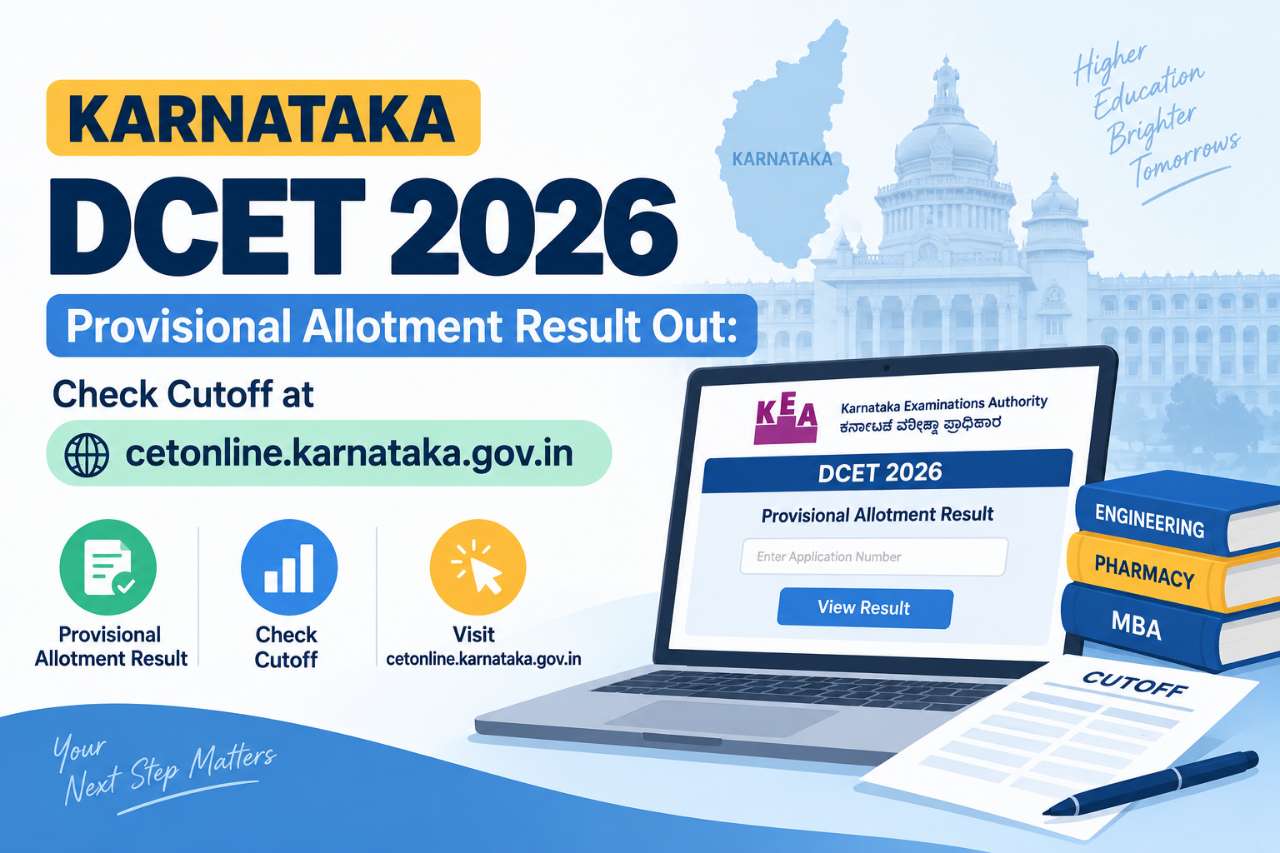
The Kanataka Examinations Authority (KEA) has released the DCET 2026 second round provisional seat allotment result along with category-wise cutoff ranks for engineering and architecture programmes. Diploma holders who appeared for the Diploma Common Entrance Test and participated in Round 2 counselling can now check their allotted college, branch, and closing ranks on the official portal at cetonline.karnataka.gov.in.
This guide explains what the provisional allotment means, how to download your result and cutoff PDFs, what to do after allotment, and the complete Round 2 schedule—including fee payment, confirmation slip download, and college reporting deadlines. Whether you are a lateral-entry engineering aspirant or an architecture candidate who cleared NATA, this article covers every step you need to take right now.
What Is Karnataka DCET 2026?
The Diploma Common Entrance Test (DCET) is a state-level entrance examination conducted by KEA for diploma holders seeking admission through the lateral entry scheme in Karnataka. Unlike regular undergraduate engineering admissions through KCET, DCET allows qualified diploma graduates to join directly into the second year (third semester) of B.E./B.Tech programmes, saving one academic year of study.
For architecture, DCET counselling covers admission to the first year of B.Arch. Architecture applicants must have a valid NATA score in addition to registering for DCET. The exam was held on May 23, 2026, and counselling is conducted entirely online through KEA's portal.
Who Can Apply Through DCET?
DCET is open to candidates who have completed a three-year diploma in engineering or technology (or equivalent) with at least 45% aggregate marks in the fifth and sixth semesters combined. Reserved category candidates from Karnataka (SC/ST) require a minimum of 40%. Diploma working professionals are also eligible under a separate government notification, subject to seat matrix availability.
Architecture aspirants must additionally qualify in the National Aptitude Test in Architecture and register for DCET separately. Engineering diploma holders from Karnataka polytechnics form the largest applicant pool, though candidates from other states may also participate depending on eligibility rules published in the official notification.
DCET 2026 Round 2 Provisional Allotment Result: Key Highlights
KEA published the Round 2 provisional seat allotment result on September 5, 2026, after 6:00 PM. Along with individual allotment details, the authority released provisional cutoff rank PDFs for four categories:
- Engineering (General)
- Engineering (HK – Hyderabad-Karnataka region)
- Architecture (General)
- Architecture (HK)
The final Round 2 seat allotment result was scheduled for release on September 6, 2026, after 6:00 PM. Candidates should treat the provisional result as an interim outcome—the final allotment confirms the seat and triggers the fee payment window.
What Does "Provisional Allotment" Mean?
A provisional allotment indicates the seat KEA has tentatively assigned based on your DCET rank, category, reservation claims, and the order of choices you submitted during option entry. It is subject to document verification, eligibility checks, and any corrections identified before the final allotment is published.
If your provisional allotment shows a college and branch you are satisfied with, prepare for fee payment once the final result is out. If you were not allotted any seat in Round 2, review whether you remain eligible for any subsequent rounds or need to explore alternative admission routes such as management quota or other state counselling processes like MHT CET for Maharashtra-based options.
How to Check DCET 2026 Provisional Allotment Result Online
Individual allotment results require login credentials on the KEA portal. Cutoff rank PDFs, however, can be downloaded without logging in—useful for candidates who want to assess their chances before the final allotment or compare branch-wise closing ranks across colleges.
Steps to Download Your Provisional Allotment Result
- Visit the official KEA website at cetonline.karnataka.gov.in.
- Under Quick Links, click on "Diploma Common Entrance Test (DCET - 2026)".
- Select the link labelled "DCET 2026 SECOND ROUND PROVISIONAL RESULT LINK".
- Log in using your application number and password.
- Open your candidate dashboard and click the download link for the provisional allotment document.
- Save and print the allotment order for your records.
How to Download Cutoff Rank PDFs (No Login Required)
KEA publishes cutoff documents as downloadable PDFs on the DCET portal. These lists show the closing rank (last rank admitted) for each college, branch, and category combination in Round 2. To access them:
- Go to cetonline.karnataka.gov.in and navigate to the DCET 2026 section.
- Look for the heading "DCET 2026 SECOND ROUND PROVISIONAL CUTOFF".
- Download the PDF matching your programme—Engineering, Engineering (HK), Architecture, or Architecture (HK).
- Search the PDF for your preferred college code or name to find the closing rank for each branch.
Tip: Compare your DCET rank against the closing rank of your allotted branch. If your rank is significantly better than the cutoff, you likely received your higher-preference choice. If your rank is close to the cutoff, the seat may be competitive and subject to confirmation after document verification.
Understanding DCET 2026 Cutoff Ranks
DCET cutoff ranks represent the last (highest) rank at which a seat was allotted in a particular college-branch-category combination during a given counselling round. A lower closing rank number indicates higher competition and stronger demand for that branch at that institution.
Factors That Influence Cutoffs
- Number of applicants and seat matrix: More applicants chasing fewer seats in popular branches like Computer Science, Information Science, or Artificial Intelligence drives cutoffs lower (more competitive).
- Category and reservation: Separate cutoff lists exist for General, SC, ST, OBC, and region-specific categories such as HK (Hyderabad-Karnataka).
- Choice order entered by candidates: KEA allots seats based on merit and the priority order of options submitted—not on the college's standalone popularity alone.
- Round of counselling: Round 1 typically has the widest seat availability. Round 2 includes leftover, forfeited, cancelled, and newly added seats, which can shift cutoffs compared to Round 1.
Reading a Cutoff PDF: Practical Example
Suppose the Round 2 Engineering cutoff PDF shows that Computer Science and Engineering at a top-tier institution closed at rank 450 for the General category, while Civil Engineering at the same college closed at rank 2,800. A candidate with rank 600 would not receive CS but might be allotted Civil if it appeared high enough in their choice list and seats were available.
Prestigious institutions such as the National Institute of Technology Karnataka (NITK Surathkal) typically have the most competitive closing ranks among participating colleges. Regional universities like Karnataka University Dharwad and the Central University of Karnataka Gulbarga may offer relatively higher closing ranks, making them accessible to a broader range of DCET ranks.
DCET 2026 Round 2 Complete Schedule
KEA released the official Round 2 notification on September 2, 2026. The following table summarises the full timeline candidates must follow:
| Event | Date and Time |
|---|---|
| Display of seat matrix and fee details | September 2, 2026 |
| Option entry window (add, modify, delete choices) | September 2, 2:00 PM – September 5, 1:00 PM |
| Provisional seat allotment result | September 5, 2026 after 6:00 PM |
| Final seat allotment result | September 6, 2026 after 6:00 PM |
| Fee payment and confirmation slip download | September 7, 11:00 AM – September 9, 5:00 PM |
| Last date for reporting to allotted college | September 10, 2026 till 6:00 PM |
Important Rules for Round 2 Candidates
KEA has issued strict instructions for Round 2 participants that every allotted candidate must understand:
- No option to reject the allotted seat: Once the final Round 2 allotment is confirmed and you complete choice selection, you cannot cancel or change the seat under any circumstances.
- Mandatory admission: Candidates allotted a seat in Round 2 must take admission at the allotted college within the specified reporting deadline.
- Fee adjustment: If you paid the counselling fee during Round 1 and are allotted a seat in Round 2, the previously paid amount will be adjusted—you do not pay twice.
- Consult before confirming: KEA advises candidates to discuss their choice list with parents or mentors before option entry, since allotment is binding once confirmed.
What to Do After Receiving Your DCET Allotment
Once the final allotment result is published and you are satisfied with your seat, follow this action checklist without delay:
Step 1: Pay the Prescribed Counselling Fee
Log in to the KEA portal during the fee payment window (September 7–9, 2026) and pay the required amount using the available online payment modes. Keep the transaction receipt safe—it is mandatory for college reporting.
Step 2: Download the Confirmation Slip
After successful fee payment, download the seat allotment confirmation slip from your dashboard. This document contains your allotment details, fee payment status, and reporting instructions. Print multiple copies.
Step 3: Gather Documents for College Reporting
Prepare the following documents before visiting your allotted institution:
- DCET 2026 allotment order and confirmation slip (printouts)
- DCET admit card and rank card/scorecard
- Diploma marksheets and provisional/original diploma certificate
- Class 10 marksheet and certificate (date of birth proof)
- Category certificate (SC/ST/OBC/Category 1, 2A, 2B, 3A, 3B) if applicable
- Karnataka domicile, rural, or Kannada medium certificate if claiming reservation
- Valid photo ID (Aadhaar card or passport)
- Recent passport-size photographs
- Fee payment receipt
Step 4: Report to the Allotted College
Visit the allotted engineering or architecture college on or before September 10, 2026, by 6:00 PM. Complete document verification, pay the college tuition and other fees as per the institution's schedule, and collect your admission confirmation. Missing the reporting deadline can result in forfeiture of your seat.
DCET 2026 Round 1 Recap: How We Got Here
Understanding Round 1 helps Round 2 candidates contextualise their current allotment. Round 1 counselling for DCET 2026 followed this timeline:
- Web option entry: July 21–24, 2026
- Mock allotment result: July 24, 2026 (after 6:00 PM)
- Option editing window: July 24–27, 2026
- Round 1 final seat allotment: July 27, 2026 (after 6:00 PM)
- Choice selection and fee payment: July 28–31, 2026
Candidates who did not receive a satisfactory seat in Round 1, or those whose allotted seats were forfeited due to non-reporting, became eligible for Round 2. The Round 2 seat matrix included Choice-3, Choice-4, forfeited, cancelled, and newly added seats across participating engineering colleges and architecture institutions in Karnataka.
Participating Colleges and Programmes
DCET counselling covers government, aided, and private engineering colleges across Karnataka that accept lateral entry students. Architecture seats are limited to institutions offering B.Arch under the KEA counselling framework.
Popular destinations for diploma lateral-entry students include NIT-level institutions, VTU-affiliated engineering colleges, and state universities. Beyond mainstream engineering campuses, Karnataka hosts specialised universities such as the Karnataka State Open University Mysore for distance learners and the Karnataka State Women University Bijapur for women-centric higher education—though DCET primarily feeds into conventional B.E./B.Tech programmes at engineering colleges.
When reviewing cutoff PDFs, pay attention to college codes, branch names, and whether the seat falls under government, private, or minority quota categories, as fee structures vary significantly across institution types.
DCET Eligibility and Exam Pattern: Quick Reference
Eligibility Summary
| Programme | Eligibility |
|---|---|
| B.E./B.Tech (Lateral Entry) | 3-year diploma in engineering/technology with 45% in 5th and 6th semesters (40% for SC/ST Karnataka candidates) |
| B.Arch (1st Year) | Diploma in relevant field + valid NATA qualification + DCET registration |
Exam Pattern Overview
DCET is conducted in offline (pen-and-paper) mode. The engineering paper typically covers applied science, applied mathematics, and an engineering subject aligned with the candidate's diploma discipline. Architecture candidates are assessed through DCET registration and NATA scores rather than a separate DCET subject paper for design aptitude.
The DCET rank is calculated based on performance in the entrance test for engineering candidates. For architecture, KEA considers both DCET registration compliance and NATA scores as per the admission rules notified for the academic year 2026–27. Candidates should refer to the official information bulletin on cetonline.karnataka.gov.in for the exact rank calculation methodology and tie-breaking rules applicable to their category.
Tips for Candidates Checking Cutoffs and Allotment
- Verify your category carefully: Download the cutoff PDF that matches your exact reservation category. Using the General list when you belong to a reserved category can lead to incorrect conclusions.
- Check both allotment result and cutoff PDF: Your personal allotment shows what you received; the cutoff PDF shows the competitive landscape for all colleges.
- Do not wait until the last day for fee payment: Payment portals often experience heavy traffic near deadlines. Complete payment on the first eligible day (September 7).
- Keep digital and physical copies: Store allotment orders, fee receipts, and confirmation slips in both printed and PDF formats.
- Contact KEA helpline for discrepancies: If your allotment shows incorrect category or missing reservation benefits, reach out to KEA immediately through official channels before the reporting deadline.
- Research your allotted college: Explore campus facilities, placement records, and accreditation status. Institutions affiliated with reputed universities often provide strong academic foundations for lateral-entry students transitioning from diploma to degree programmes.
Common Mistakes to Avoid During DCET Counselling
Many candidates lose seats or face delays due to avoidable errors during the post-allotment phase. Here are the most frequent mistakes and how to prevent them:
- Ignoring the mock allotment in Round 1: The mock allotment released on July 24, 2026, was designed to help candidates revise their choice lists before the final Round 1 allotment. Skipping mock analysis often leads to poor choice ordering and unwanted branch allotments.
- Entering too few options in Round 2: With limited seats available, candidates who submit only one or two choices risk going unallotted. Fill the maximum allowed options with a realistic mix of aspirational and safe colleges.
- Confusing provisional and final results: Fee payment and college reporting apply only after the final allotment is published—not after the provisional result alone.
- Missing document originals: Colleges require original certificates for verification. Photocopies alone are not sufficient for final admission confirmation.
What If You Are Not Allotted a Seat in Round 2?
Candidates who remain unallotted after Round 2 should monitor the KEA portal for announcements regarding any additional rounds or spot admission processes. Options outside KEA counselling include:
- Direct admission through management quota at private engineering colleges (subject to institution policies and AICTE norms)
- Exploring lateral entry or B.Tech programmes in other states through exams such as IPU CET for Delhi NCR institutions
- Continuing employment while preparing for the next year's DCET if upgrading your diploma marks or NATA score could improve your rank
Staying informed through official KEA notifications—not unverified social media posts—is the safest approach during the post-allotment phase. Karnataka's lateral entry pathway remains one of the most structured routes for diploma holders to earn a full engineering degree, and timely action during Round 2 can make the difference between securing a seat and losing it to deadline lapses.
Conclusion
The Karnataka DCET 2026 Round 2 provisional allotment result and cutoff ranks mark a decisive stage for diploma holders pursuing engineering and architecture degrees in the state. With the final allotment confirmed, eligible candidates must complete fee payment between September 7 and 9, 2026, and report to their allotted colleges by September 10, 2026. Use the cutoff PDFs on cetonline.karnataka.gov.in to understand branch-wise competition, download your allotment order through your login dashboard, and prepare all verification documents in advance. Acting promptly and following KEA's binding Round 2 rules will ensure you secure your lateral-entry seat without last-minute complications.