
If you appeared for the Karnataka Post Graduate Common Entrance Test (PGCET) 2026, your next big milestone is the result announcement. The Karnataka Examination Authority (KEA) is preparing to publish scorecards for MBA, MCA, M.Tech, and M.Arch aspirants on the official portal at cetonline.karnataka.gov.in. Your rank card is not just a score sheet—it is the document that determines your eligibility for seat allotment in Karnataka's Government, aided, and private postgraduate colleges.
Thousands of students across Bengaluru, Mysuru, Hubballi, Mangaluru, and other cities wait for this update every year. Whether you are targeting an MBA seat in a top B-school or an M.Tech specialisation in a reputed engineering College, understanding the result process in advance helps you act quickly once the link goes live. KEA conducted the M.Tech examination in May 2026, followed by MBA and MCA papers, and has already completed answer key revisions for several streams. With evaluation nearing completion, the result window is now the most important date on every PGCET candidate's calendar.
This article covers everything you need: key dates, step-by-step download instructions, scorecard details, counselling preparation, rank interpretation, and answers to the most common candidate questions—all written in simple language for students and parents navigating Karnataka's postgraduate admission system for the first time.
What Is Karnataka PGCET and Why Does the Result Matter?
Karnataka PGCET is the state-level entrance examination conducted by KEA for admission to postgraduate professional programmes in participating institutions across Karnataka. Unlike national exams such as GATE or CAT, PGCET specifically governs state-quota seats in Karnataka colleges offering MBA, MCA, M.Tech, and M.Arch courses.
The PGCET 2026 result converts your exam performance into a merit rank. This rank becomes the primary basis for counselling, option entry, and seat allotment rounds. Without a valid, error-free scorecard, you cannot participate in the KEA counselling process—even if you scored well in the examination.
Programmes Covered Under PGCET 2026
- MBA (Master of Business Administration): For management aspirants seeking admission to B-schools affiliated with Karnataka universities.
- MCA (Master of Computer Applications): For candidates aiming at postgraduate computer application programmes.
- M.Tech (Master of Technology): For engineering graduates pursuing advanced technical specialisations.
- M.Arch (Master of Architecture): For architecture graduates seeking postgraduate study. Candidates preparing for architecture-related entrances may also explore exams like NATA, though PGCET remains the gateway for M.Arch seats under Karnataka state quota.
If you have appeared for other state-level entrance tests such as MHT CET in Maharashtra or IPU CET for Delhi NCR institutions, you will find the PGCET result and counselling workflow broadly similar—login credentials, rank card download, document verification, and multi-round seat allotment.
Karnataka PGCET 2026: Key Dates and Timeline
Knowing the examination timeline helps you estimate when the result may arrive and plan your next steps accordingly. Based on KEA's published schedule and past release patterns, here is a summary of important milestones for PGCET 2026.
| Event | Date / Status |
|---|---|
| Conducting Body | Karnataka Examination Authority (KEA) |
| Exam Month | May 2026 (M.Tech); MBA/MCA papers held subsequently |
| Provisional Answer Key | May 25, 2026 |
| Revised Answer Key (M.Tech) | June 2, 2026 |
| Result Announcement | To be announced soon |
| Official Portal | cetonline.karnataka.gov.in |
| Login Credentials | Application number and date of birth |
| KEA Helpline | 080-23460460 (10:30 AM to 5:30 PM) |
How KEA Processes Results Before Publication
After the offline OMR-based examination, KEA follows a structured evaluation pipeline. First, the authority releases a provisional answer key and opens a short objection window for candidates to raise challenges. Objections are reviewed, and revised answer keys are published where necessary—for instance, the M.Tech revised key was released on June 2, 2026. Once answer keys are finalised, KEA calculates raw marks and assigns merit ranks stream-wise.
Historically, KEA has declared PGCET results roughly four to six weeks after the examination date, often during evening hours around 7 PM. While the exact date for 2026 has not been confirmed, candidates should monitor the official portal daily and keep login credentials ready. Setting a daily reminder to check cetonline.karnataka.gov.in ensures you do not miss the first hour of option entry registration once counselling opens.
Exam Structure and Paper Pattern by Stream
Understanding what you were tested on helps you interpret your scorecard more meaningfully. PGCET uses an offline OMR-based format with multiple-choice questions. The MBA paper typically covers proficiency in English, general knowledge, quantitative analysis, and reasoning. The MCA paper emphasises mathematics, computer awareness, and logical reasoning. M.Tech papers are discipline-specific, covering core engineering subjects aligned with the candidate's chosen specialisation. M.Arch candidates face questions related to architecture, planning, and design aptitude.
Each stream has a separate merit list. Your rank is calculated only against candidates who appeared for the same paper. This means an MBA rank of 200 and an M.Tech rank of 200 represent entirely different competitive pools and cannot be compared directly.
When and Where Will Karnataka PGCET 2026 Result Be Declared?
The Karnataka PGCET 2026 result will be published exclusively on the KEA official website. KEA does not release results through third-party apps, SMS services, or unofficial Telegram channels. The only reliable source is cetonline.karnataka.gov.in.
Once activated, the result link typically appears on the homepage under notifications or within the Admissions section. Candidates should look for links labelled "PGCET 2026 Result" or "Scorecard Download." Avoid clicking unverified links shared on social media, as phishing pages mimicking KEA portals are common during result season.
What You Need Before Checking Your Result
Keep the following details accessible before the result goes live:
- PGCET Application Number: Printed on your admit card and registration confirmation.
- Date of Birth: Must match the format used during registration (usually DD/MM/YYYY).
- Stable Internet Connection: Result portals experience heavy traffic immediately after release; patience and multiple attempts may be required.
- Printer or PDF Saver: You will need a downloadable copy for counselling and document verification.
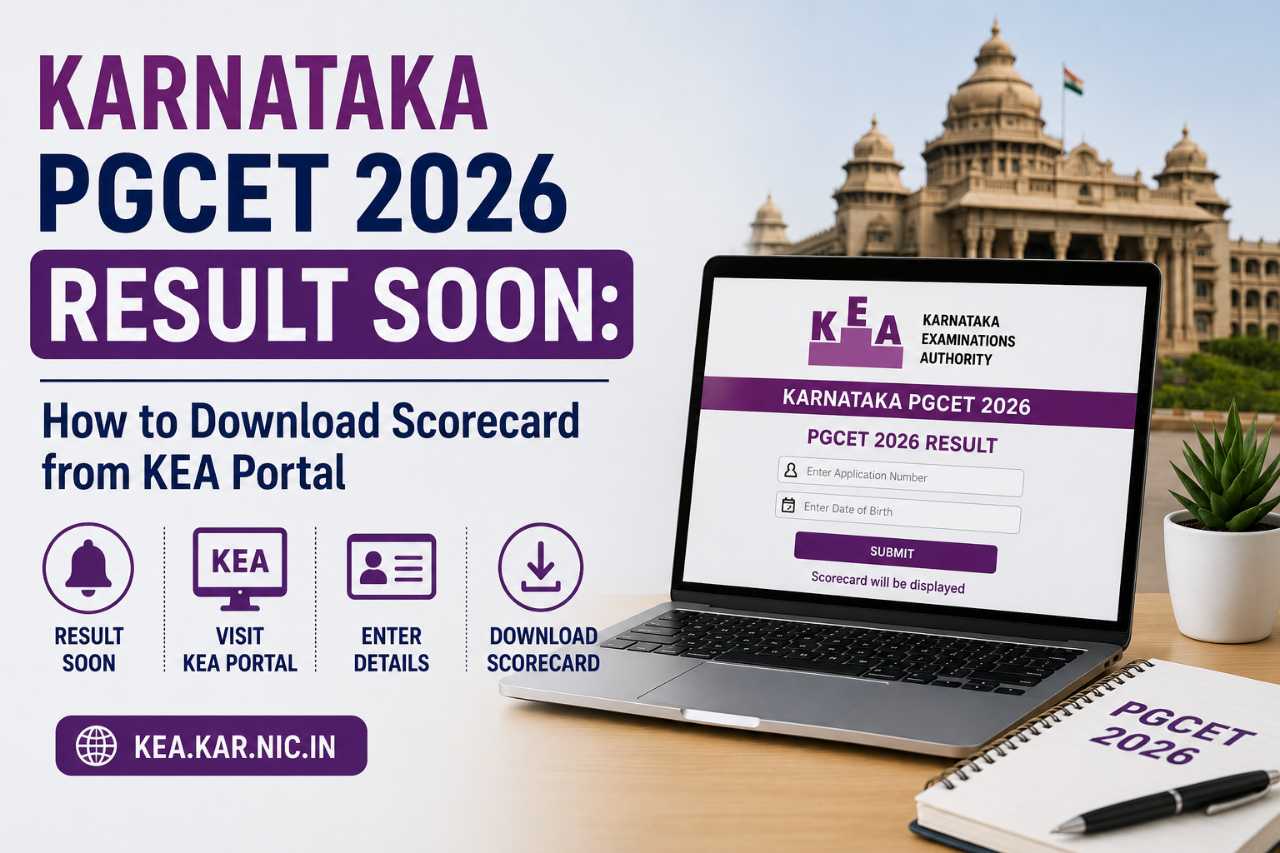
How to Download Karnataka PGCET 2026 Scorecard: Step-by-Step Guide
Downloading your PGCET scorecard is a straightforward online process. Follow these steps once KEA activates the result link.
- Visit the official KEA portal at cetonline.karnataka.gov.in using a secure browser (Chrome, Firefox, or Edge recommended).
- Locate the PGCET 2026 Result link on the homepage or under the Admissions tab.
- Click the result notification to open the candidate login page.
- Enter your application number exactly as printed on your admit card—avoid spaces or extra characters.
- Enter your date of birth in the prescribed format.
- Complete any captcha verification if prompted, then click Submit or Get Result.
- Review your scorecard on screen, checking personal details, marks, and rank carefully.
- Download the PDF and save multiple copies. Print at least two to three hard copies for counselling and verification rounds.
Troubleshooting Common Download Issues
If you face problems accessing your result, try these solutions before contacting KEA:
- Incorrect credentials: Double-check application number and date of birth against your admit card.
- Page not loading: Clear browser cache, disable VPN, or try during off-peak hours (late night or early morning).
- Server timeout: Refresh the page after a few minutes; heavy traffic on result day is normal.
- Blank scorecard: Screenshot the error and call the KEA helpline at 080-23460460 between 10:30 AM and 5:30 PM.
What Details Appear on the Karnataka PGCET Scorecard?
Your PGCET rank card is an official document that summarises your examination performance and standing among all candidates in your stream. Understanding each field helps you verify accuracy and plan counselling preferences.
Key Information on the Rank Card
- Candidate Name and Photograph: Must match your government ID and original certificates.
- Application / Registration Number: Your unique PGCET identifier.
- Category and Reservation Details: SC, ST, OBC, or other applicable categories as claimed during registration.
- Subject-Wise Marks: Sectional scores depending on your stream (management or technical papers).
- Total Raw Marks: Aggregate score before rank calculation.
- Qualifying Status: Whether you meet the minimum eligibility threshold for counselling.
- Merit Rank: Your overall rank within your stream and category, used for seat allotment.
The merit rank mentioned on the scorecard is the number that counselling algorithms use during option entry. A lower rank number indicates a better position. For example, a general-category MBA candidate ranked 500 will typically have wider College choices than someone ranked 5,000, though cutoffs vary by institution and round.
What to Do If You Find Errors on Your Scorecard
Carefully verify every detail immediately after downloading your result. Discrepancies in name spelling, category, photograph, or marks should be reported to KEA without delay. Errors left uncorrected before counselling begins can delay document verification and may even jeopardise seat confirmation. Contact the KEA helpline with your application number, scorecard copy, and supporting documents.
Understanding Merit Rank, Cutoffs, and Qualifying Criteria
Many candidates confuse raw marks with merit rank. In Karnataka PGCET, KEA assigns ranks based on performance relative to all test-takers in your stream. Higher marks generally translate to better (lower-numbered) ranks, but the exact relationship depends on paper difficulty and candidate volume.
How Cutoffs Work After Results
After results are declared, KEA and individual colleges publish opening and closing ranks for each programme and category across counselling rounds. Your rank must fall within a College's closing rank for that round to secure a seat. Cutoffs fluctuate between rounds—later rounds sometimes offer seats at slightly relaxed ranks as candidates drop out or upgrade.
Top institutions in Bengaluru and other cities often have competitive cutoffs for popular branches like Computer Science in MCA or core M.Tech specialisations. Use your rank as a realistic filter when preparing your College preference list during option entry.
Illustrative Rank-to-College Planning Example
Suppose an MCA candidate secures a general merit rank of 1,200. In Round 1, they might target Visvesvaraya Technological University (VTU) affiliated colleges in Bengaluru with closing ranks near 800 as aspirational choices, add institutions in Mysuru and Belagavi with closing ranks around 1,500 as realistic options, and include tier-3 colleges with closing ranks above 2,500 as safe backups. This tiered approach prevents the common mistake of listing only dream colleges and receiving no allotment in early rounds.
Remember that cutoffs shift every year based on seat availability, reservation rules, and the number of registered candidates. Use past data as a guide, not a guarantee.
What Happens After the PGCET 2026 Result?
Downloading your scorecard is only the first step. The admission journey continues through KEA's online counselling process, which typically begins within weeks of the result announcement.
Post-Result Action Plan for Candidates
- Bookmark cetonline.karnataka.gov.in for real-time updates on counselling schedules and option entry dates.
- Keep application number and date of birth handy for every subsequent login during counselling.
- Verify all personal details on the scorecard immediately after download.
- Gather original documents including degree certificates, mark sheets, category certificates, and identity proof for verification.
- Research participating colleges and prepare a priority list before option entry opens.
- Track KEA notifications for registration fees, choice filling deadlines, and seat allotment results.
- Stay prepared for multiple rounds including upgrade and stray vacancy rounds if you miss your preferred seat initially.
Documents Required for Counselling Verification
- PGCET 2026 scorecard (printed copy)
- PGCET admit card
- Class 10 and 12 mark sheets and certificates
- Graduation degree and consolidated mark sheet
- Category certificate (if applicable)
- Identity proof (Aadhaar, passport, or voter ID)
- Passport-size photographs
- Domicile or eligibility certificate as required by KEA guidelines
Overview of KEA Counselling Rounds
KEA typically conducts PGCET counselling in multiple phases. Round 1 allows qualified candidates to register, pay the counselling fee, and enter college and course preferences online. Seat allotment results are published based on merit rank and choice priority. Candidates who receive allotments must report to designated help centres for document verification and fee payment within the given deadline.
Subsequent rounds including Round 2, Round 3, and stray vacancy rounds—accommodate candidates who were not allotted seats earlier or wish to upgrade to a higher-preference option. Each round has its own registration window and choice modification rules. Missing a round deadline means waiting for the next phase, which may have fewer available seats.
Candidates allotted a seat in an earlier round can participate in upgrade rounds by paying the required fee and modifying choices, provided they have not confirmed admission at a lower-preference institution. Understanding this flexibility helps you strategise rather than panic if Round 1 does not deliver your top choice.
Karnataka PGCET vs Other State Entrance Exams
Students often appear for multiple entrance examinations to maximise admission options. Understanding how PGCET compares with other state-level tests helps you manage timelines and backup plans.
MHT CET serves Maharashtra's undergraduate and postgraduate admissions, while Karnataka PGCET is specific to PG seats in Karnataka. If you are considering institutions outside Karnataka, exams like MHT CET open doors to colleges in Mumbai, Pune, and other Maharashtra cities. Similarly, IPU CET facilitates admissions to Guru Gobind Singh Indraprastha University and its affiliated colleges in Delhi NCR. Architecture aspirants may additionally look at NATA for B.Arch and related programmes, while M.Arch candidates in Karnataka rely primarily on PGCET ranks.
Each exam has its own result portal, rank calculation method, and counselling authority. Treat every scorecard and rank as valid only on its respective official platform.
Tips to Maximise Your Admission Chances After PGCET Results
Smart planning after results can significantly improve your college outcome even if your rank is moderate.
Before Option Entry Opens
- Study previous years' opening and closing ranks for your target colleges and branches.
- Include a mix of ambitious, realistic, and safe choices in your preference list.
- Confirm eligibility criteria for each programme—some M.Tech seats require specific GATE or graduation backgrounds.
- Join official KEA communication channels and trusted education portals for schedule updates.
During Counselling Rounds
- Submit choices before deadlines; late submission may exclude you from that round.
- Pay counselling fees and complete registration steps on time.
- Accept allotted seats within the stipulated period to avoid automatic cancellation.
- Participate in upgrade rounds if you wish to move to a higher-preference college.
KEA Helpline and Official Support Channels
For result-related queries, technical login issues, or scorecard discrepancies, contact KEA directly rather than relying on unofficial sources.
- Helpline Number: 080-23460460
- Timings: 10:30 AM to 5:30 PM on working days
- Official Website: cetonline.karnataka.gov.in
When calling, keep your application number, registered mobile number, and a copy of your admit card ready. Written complaints via the official portal, if available, create a documented trail for dispute resolution.
Important Reminders for First-Time PGCET Candidates
If this is your first time navigating a KEA admission cycle, a few practical reminders can save last-minute stress. Save your admit card, application confirmation, and fee receipt in a dedicated folder—physical and digital. Screenshot your result page immediately after it loads, even before downloading the PDF, as a backup against server glitches. Share your result only through official channels; avoid posting full scorecards publicly on social media, as they contain personal information.
Parents and guardians should support candidates by helping organise documents and tracking KEA notifications, but the option entry login must be completed by the registered candidate using their own credentials. Finally, remember that PGCET is one pathway to postgraduate education—candidates who also appeared for GATE, CAT, or state exams like MHT CET or IPU CET should compare all available admission routes before confirming a seat.
Conclusion
The Karnataka PGCET 2026 result is expected to be released soon on cetonline.karnataka.gov.in, marking a critical turning point for MBA, MCA, M.Tech, and M.Arch aspirants across the state. Your scorecard will display raw marks, qualifying status, and merit rank—the three numbers that shape your counselling journey. Download your rank card promptly using your application number and date of birth, verify every detail, and begin preparing documents and college preferences immediately.
Seat allotment rounds follow quickly after results, so proactive candidates gain an advantage. Bookmark the official KEA portal, avoid unverified result links, and use the helpline for genuine discrepancies. Whether your goal is a management seat in Bengaluru or an engineering specialisation in a tier-2 city, a clear understanding of the result and post-result process puts you in the strongest position to secure the postgraduate admission you have worked toward.