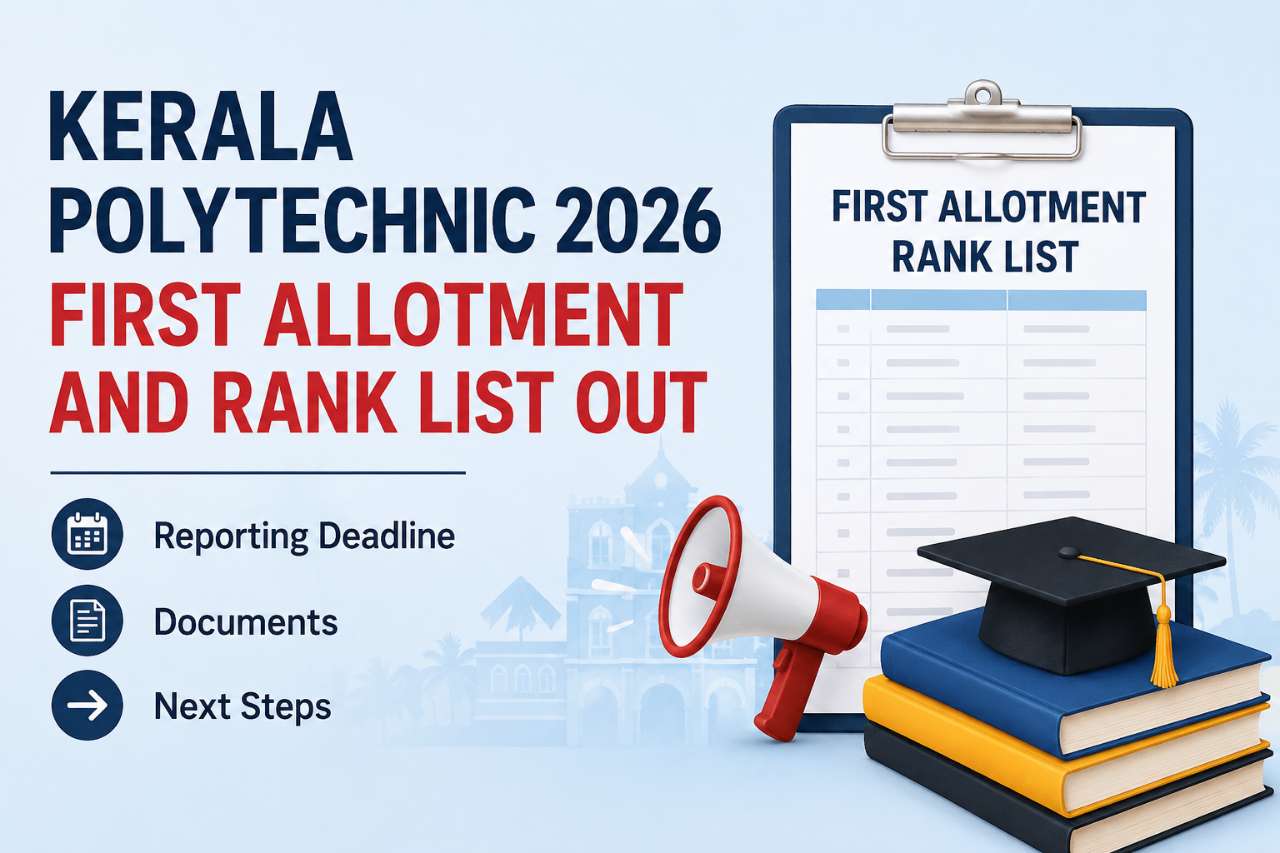

The Department of Technical Education (DTE), Kerala, has announced the Kerala Polytechnic 2026 first allotment result along with the final rank list on the official admission portal, polyadmission.org. For thousands of students who completed SSLC and applied for diploma programmes at government, aided, and self-financing polytechnic colleges across the state, this is the most decisive stage of the admission cycle. Your rank, reservation category, and the options you submitted during registration together determine whether you receive a seat in your preferred branch and institution.
If you have been allotted a seat, the next step is not optional. You must physically report to the allotted polytechnic college, complete document verification, and pay the prescribed admission fee on or before July 3, 2026. Missing this deadline can lead to automatic cancellation of your allotment, after which the seat may be offered to another candidate in subsequent rounds. This guide explains what the first allotment means, how to check your result, what documents to carry, and how the second round works—written in clear language for students, parents, and school counsellors following the process for the first time.
Kerala Polytechnic Admission 2026: What Candidates Should Know
Kerala Polytechnic admission is the state-level process through which students gain entry into three-year diploma programmes in engineering and technology, commercial practice, computer applications, and related technical fields. Unlike many national entrance exams, Kerala's diploma admission is primarily based on SSLC (Class 10) academic performance, along with applicable reservation rules and institutional preferences submitted during online registration.
The Directorate of Technical Education, Kerala, coordinates the entire process through a centralised online system. Participating institutions include government polytechnic colleges, aided polytechnics, and selected self-financing colleges approved by the state. Courses commonly offered include Mechanical Engineering, Civil Engineering, Electrical and Electronics Engineering, Computer Engineering, Electronics Engineering, Tool and Die Engineering, and diploma programmes in non-engineering streams depending on the college.
For students comparing technical education pathways beyond Kerala, diploma programmes at institutions such as Government Polytechnic College Kota or Government Polytechnic College Sikar follow a similar skill-focused model, though admission rules and counselling schedules differ by state. Understanding your home state's timeline—like Kerala's structured rank list and allotment rounds—helps you plan reporting, travel, and fee arrangements without last-minute stress.
Who Is Eligible for Kerala Polytechnic 2026?
Generally, candidates who have passed SSLC or an equivalent examination from a recognised board and who meet the age and domicile requirements specified in the official prospectus are eligible to apply. Reservation benefits apply for categories such as Scheduled Caste (SC), Scheduled Tribe (ST), Other Backward Classes (OBC), Economically Weaker Sections (EWS), and other special reservations announced by the state. Each applicant's eligibility is verified during document scrutiny at the allotted college after seat allotment.
Kerala Polytechnic 2026 First Allotment and Final Rank List: Key Highlights
On June 29, 2026, DTE Kerala published two closely linked outcomes on polyadmission.org:
- Final rank list 2026: The definitive merit ranking used for seat allotment in the first round.
- First allotment result 2026: The list showing which college and diploma programme each candidate has been allotted, based on rank, reservation, and preferences.
Before the final list, DTE had released a provisional (trial) rank list and allowed candidates a correction window to fix errors in their application details, category claims, or option entries. The final rank list incorporates only valid corrections submitted within that period. Once the final list was published, no further modifications to the merit list are accepted under normal circumstances.
Candidates can log in using their application number and date of birth to view allotment status, download the rank list PDF, and save their allotment details for college reporting. If your dashboard shows an allotted seat, treat the reporting deadline as fixed—extensions are rarely granted and should not be assumed.
Important Dates and Deadlines for Kerala Polytechnic 2026
Staying on top of dates is essential because Kerala Polytechnic admission moves quickly from rank list publication to physical reporting at colleges. Below is a summary of the key milestones relevant to the first and second allotment rounds for 2026.
| Event | Date |
|---|---|
| Publication of provisional (trial) rank list | Released before final list (check portal) |
| Online correction window for applications | Before final rank list publication |
| Final rank list and first allotment result | June 29, 2026 |
| Last date to report and join (Round 1) | July 3, 2026 |
| Second allotment result | July 6, 2026 |
| Last date to report and join (Round 2) | July 10, 2026 |
Always verify dates on the official portal before travelling to a college. While media reports and educational news outlets confirm the July 3 reporting deadline for first-round allottees, individual colleges may specify reporting hours, fee payment modes, or additional instructions on their notice boards and websites.
What Happens If You Miss the July 3 Reporting Deadline?
If an allotted candidate fails to report to the assigned polytechnic college and complete admission formalities by July 3, 2026, the seat allotment is typically cancelled automatically. The seat then becomes available for re-allotment in the second round or for other eligible candidates according to DTE rules. There is no guarantee that the same college or branch will remain available later, so timely action protects the seat you have already earned through your rank and preferences.
How the Kerala Polytechnic Rank List Is Prepared
The rank list is not arbitrary it follows a transparent, rule-based method defined in the admission prospectus. Understanding this helps you interpret your rank and set realistic expectations for allotment outcomes.
Basis of Merit Ranking
For most diploma programmes, merit is determined primarily by aggregate marks obtained in SSLC (or equivalent), subject to tie-breaking rules where applicable. Candidates are ranked in descending order of academic performance. Separate rank considerations may apply for certain categories or special quotas as notified by DTE Kerala.
Role of Reservation and Category Claims
After the general merit order is established, seat allocation respects statutory reservations for SC, ST, OBC, EWS, and other applicable categories. Your allotment letter and rank card will reflect the category under which you were considered. Any discrepancy between your claimed category and supporting certificates discovered during verification can lead to cancellation of allotment, so ensure your documents are authentic and match your application.
Choice Filling and the Single Window System
Kerala Polytechnic admission uses a Single Window System (SWS) for allotment. During registration, candidates enter multiple institution–programme combinations in order of preference—up to the maximum options permitted in the application (commonly up to 30 combinations across participating colleges). The system allots seats based on:
- Your rank in the final merit list
- Your eligible reservation category
- Your preference order among available seats
- Seat availability at each institution and branch
For example, if you ranked Mechanical Engineering at a government polytechnic in Thiruvananthapuram as your first choice and Civil Engineering at another district college as your second, the system will try your first option first—provided your rank and category qualify for a vacant seat there. This is why thoughtful preference filling matters as much as SSLC marks.
How to Check Kerala Polytechnic First Allotment Result 2026
The allotment result is published exclusively on the official portal. Avoid third-party websites that ask for unnecessary personal data. Use only polyadmission.org or links clearly redirected from DTE Kerala's official communications.
When checking your result, keep your application number, date of birth, and registered mobile number handy. After login, note your allotted college name, branch, allotment category, and any special instructions. Download and print multiple copies of the allotment memo and rank details—you will need them at the college admission counter.
Detailed step-by-step instructions are included in the HowTo section of this article for candidates who prefer a sequential checklist while using the portal.
Reporting Process at Your Allotted Polytechnic College
Receiving an allotment is only half the journey. Seat confirmation happens only after you complete in-person formalities at the allotted institution within the prescribed timeline.
Step-by-Step Reporting Overview
- Verify allotment online: Log in at polyadmission.org and confirm your allotted college, branch, and category.
- Check college-specific instructions: Visit the allotted polytechnic's website or notice board for reporting dates, fee structure, and document checklist.
- Prepare originals and photocopies: Arrange all certificates listed in the official prospectus and this guide.
- Report in person: Visit the admission office on or before July 3, 2026, with a parent or guardian if required by the college.
- Document verification: Submit originals for verification and provide photocopies as requested.
- Fee payment: Pay the admission fee through the mode specified by the college (online transfer, challan, or counter payment).
- Collect admission confirmation: Obtain a receipt, provisional admission letter, or joining report as proof of seat acceptance.
Arrive early on your chosen reporting day to avoid long queues, especially at popular government polytechnic colleges in major districts. Carry a folder with labelled sections for identity proof, academic records, reservation certificates, and fee receipts.
Common Mistakes to Avoid During Reporting
- Waiting until the last day of the deadline, when banks, notary services, or certificate offices may be closed or overcrowded
- Carrying expired or mismatched caste or income certificates
- Assuming online allotment alone confirms admission without physical reporting
- Ignoring SMS or email updates from DTE Kerala or the allotted college
- Submitting preferences for Round 2 without understanding upgrade and cancellation rules
Documents Required for Kerala Polytechnic Admission 2026
Document verification is strict because diploma seats—especially in government and aided colleges—are limited and reservation rules must be applied fairly. Prepare the following documents in original and photocopy sets unless the college specifies otherwise:
- Kerala Polytechnic allotment letter or seat allotment memo downloaded from the portal
- Final rank list copy or rank card showing your merit position
- SSLC mark sheet and pass certificate (Class 10)
- Transfer Certificate (TC) from the last attended school
- Caste or community certificate (if applicable, from competent authority)
- Income certificate (if applicable for fee concession or reservation)
- Passport-size photographs (recent, as per college specifications)
- Valid government photo ID proof (Aadhaar, voter ID, or other accepted ID)
- Fee payment proof or receipt after remittance
- Domicile or nativity proof if required under state rules
- Medical fitness certificate if mandated by the institution
Candidates claiming disability or other special reservations should carry certificates issued by recognised medical or government authorities as listed in the prospectus. Any document in a language other than English or Malayalam may require a certified translation—confirm this with the admission office in advance.
Second Round Allotment and Seat Upgrade Options
Kerala Polytechnic 2026 counselling includes two main allotment rounds. Candidates who did not receive a seat in the first round, or those who wish to participate for a better option, should monitor the portal for the second allotment scheduled on July 6, 2026.
Allotted candidates in Round 1 who report and join by July 3 may still have pathways to participate in subsequent processes depending on current DTE rules for re-allotment or upgradation. Conversely, candidates who were allotted a seat but did not report by the deadline lose that seat and may need to wait for the second round or spot admission phases if announced.
The last date for reporting based on the second allotment is July 10, 2026. Treat each round's deadline independently—Round 2 allottees cannot assume the July 3 date applies to them.
What If You Are Not Allotted a Seat in Round 1?
Not receiving a first-round allotment does not mean your diploma journey ends. Consider these practical steps:
- Review whether your preference list was too narrow or limited to high-demand branches
- Prepare to participate actively in the second allotment on July 6
- Monitor announcements for district-level counselling or spot admissions at nodal polytechnic colleges
- Explore diploma and technical programmes in other states if relocation is an option—for instance, private and government polytechnic options such as Kota Polytechnic College, BR Polytechnic College Reengus Sikar, or Deendayal Polytechnic College Fatehpur Shekhawati Sikar serve students seeking hands-on technical training outside Kerala
Understanding Polytechnic Education in the Indian Context
A diploma from a recognised polytechnic is a respected route into technical careers and higher studies. Many graduates join industry as junior engineers, technicians, supervisors, or entrepreneurs in manufacturing, construction, IT support, and electronics sectors. Lateral entry schemes also allow diploma holders to pursue B.Tech or equivalent degrees in engineering colleges after meeting state or institution-specific requirements.
Students who compare Kerala's government polytechnic ecosystem with institutions elsewhere often evaluate factors such as lab infrastructure, industry tie-ups, placement support, and fee levels. In Rajasthan, for example, Aryabhatta Polytechnic College Chandpura Sikar and Aravali Polytechnic College Neemkathana Sikar represent the broader network of diploma-granting colleges that parallel Kerala's technical education mission. Some students also weigh polytechnic diplomas against four-year engineering degrees at institutes like Bhartiya Institute of Engineering and Technology Sikar or Gurukul Institute of Engineering and Technology Kota, depending on budget, entrance exam performance, and career timeline.
For Kerala candidates specifically, the immediate priority remains confirming your 2026 allotment, not comparing distant alternatives—but knowing your options builds confidence if you need a backup plan after Round 2.
Actionable Tips for Students and Parents
Based on patterns from previous Kerala Polytechnic admission cycles and general diploma admission best practices across India, these tips can reduce stress and prevent costly errors:
- Print and backup digital copies of allotment letters, rank lists, and fee receipts on your phone and cloud storage.
- Call the allotted college admission office one day before reporting to confirm working hours and any COVID or local holiday adjustments.
- Budget for immediate expenses: admission fee, uniform deposits, tool kits for certain trades, and travel to the college district.
- Double-check reservation certificates for name spelling, validity dates, and issuing authority seals.
- Involve your school: Many SSLC schools help students obtain TC and bonafide letters quickly if requested early.
- Do not pay unofficial agents promising guaranteed seats—Kerala Polytechnic allotment is fully online and merit-based.
- Plan hostel or accommodation early if the allotted college is far from home; popular hostels fill quickly at the start of the academic session.
Official Sources and Authentic Updates
During admission season, misinformation spreads quickly through social media groups and unofficial Telegram channels. Rely on these authoritative sources:
- Official admission portal: polyadmission.org
- Directorate of Technical Education, Kerala, notifications
- Notice boards and websites of your allotted polytechnic college
- Reputed education news platforms reporting verified DTE announcements
Cross-check any viral message about date extensions or rank list changes against the portal before acting on it. Seat cancellation due to missed deadlines is difficult to reverse.
Conclusion
The release of the Kerala Polytechnic 2026 first allotment and final rank list marks a turning point for diploma aspirants across the state. If you have secured a seat, your focus should shift immediately to reporting at your allotted college and completing verification and fee payment by July 3, 2026. Keep your documents organised, follow official instructions on polyadmission.org, and treat every deadline as final unless DTE Kerala publishes a formal extension.
Candidates without a Round 1 allotment should prepare for the second allotment on July 6, 2026, with reporting due by July 10, 2026. Whether you join a government polytechnic in Kerala or eventually explore technical education pathways at institutions such as Shri Krishna Polytechnic College Kota or Government Polytechnic College Kota, the principle remains the same: timely action, accurate documents, and verified information determine success. Stay proactive, ask questions at your allotted college admission desk, and secure your place in Kerala's technical education pipeline for the 2026 academic year.