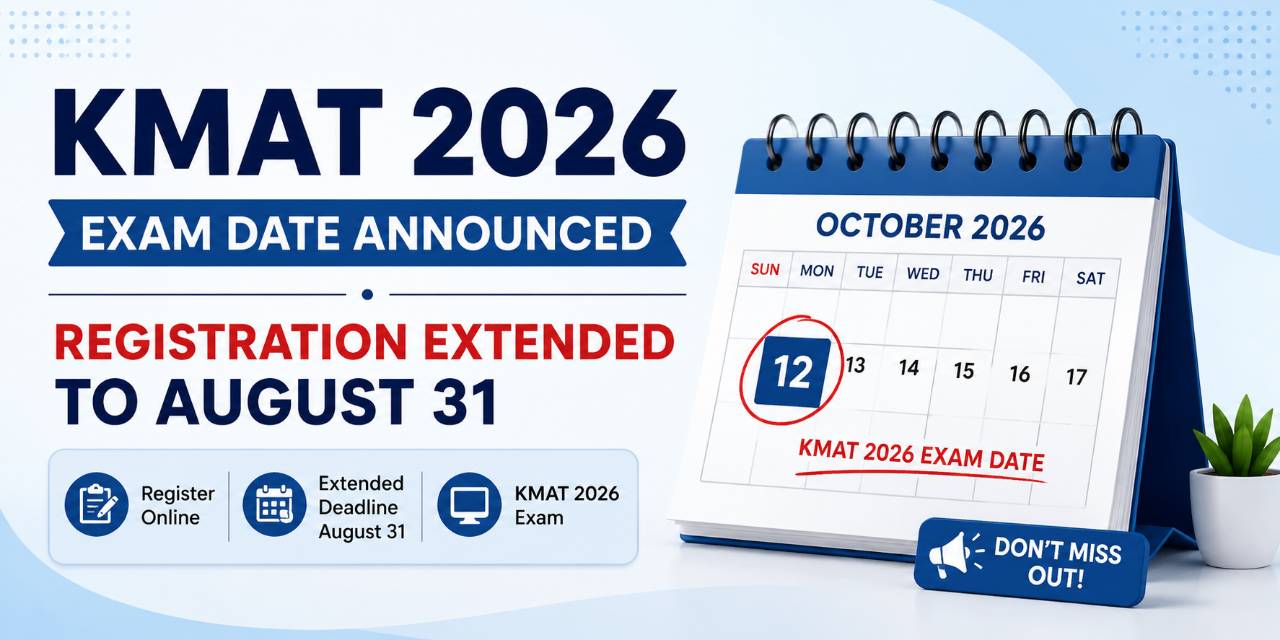

If you are planning an MBA or MCA in Karnataka, the Karnataka Managemnt Aptitude Test (KMAT) 2026 is one of the most practical routes to AICTE-approved B-schools across the state. The Karnataka Private Post Graduate Colleges Association (KPPGCA) has officially announced that KMAT 2026 will be held on Sunday, September 13, 2026, and the registration deadline has been extended to August 31, 2026. Applications remain open at the official portal kmatindia.com.
Unlike many national-level tests that require travel to a test centre, KMAT is conducted as a home-based online remote proctored examination. That makes it especially attractive for working professionals, final-year graduates, and candidates from outside Karnataka who want access to Bangalore's Managemnt education ecosystem without the logistics of a centre-based exam. This guide covers every date, eligibility rule, exam pattern detail, registration step, and preparation strategy you need written in clear language for students, parents, and career switchers exploring postgraduate options in 2026.
What Is KMAT and Who Conducts It?
KMAT stands for Karnataka Management Aptitude Test. Since 2003, KPPGCA has used this single-window entrance exam to streamline admissions into MBA, PGDM, and MCA programmes offered by private, self-financing colleges affiliated to universities in Karnataka. The exam is recognised by the Government of Karnataka and follows guidelines aligned with Supreme Court directives on professional course admissions.
Over the years, KMAT has become a dependable alternative to heavier national exams for candidates who specifically want to study in Karnataka home to Bangalore, often called India's Silicon Valley for tech, startups, and corporate hiring. Scores from KMAT 2026 are accepted by more than 189 AICTE-approved member institutions, including well-known names in management education across the state.
KMAT is an all-India exam. You do not need Karnataka domicile to apply. Whether you have completed a B.Com from Pune, a B.Tech from Jaipur, or an MA from a central university, you can register if you meet the academic cut-off. That openness makes KMAT a useful option alongside exams like MAT, which also feeds multiple B-schools through a single score.
KMAT 2026 Important Dates at a Glance
Missing a deadline can cost you an entire admission cycle. Below is the confirmed schedule based on the latest notification from KPPGCA. Keep checking the official website for admit card and mock test updates, which are marked as "to be announced" as of early August 2026.
| Event | Date / Timing |
|---|---|
| Registration start | April 2, 2026 |
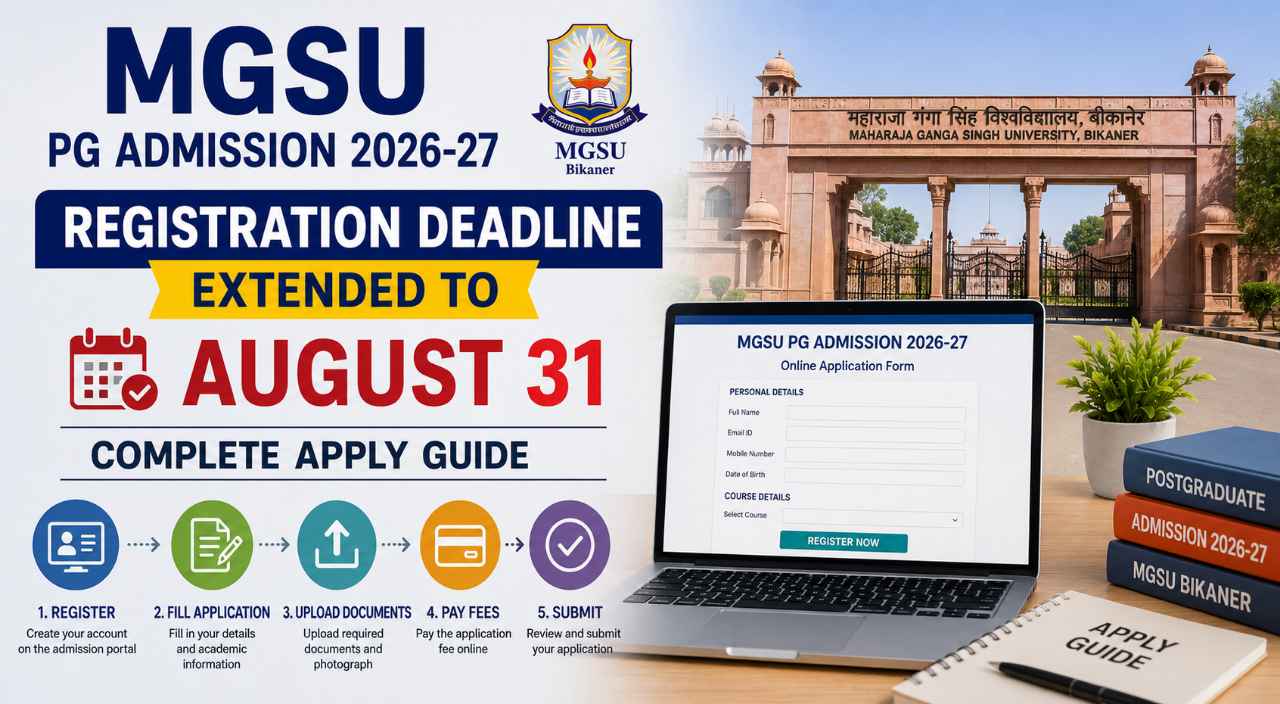
| Registration deadline (extended) | August 31, 2026 |
| Mock test | To be announced |
| Admit card release | To be announced |
| KMAT 2026 exam – MCA paper | September 13, 2026 (10:00 AM – 12:00 PM) |
| KMAT 2026 exam – MBA paper | September 13, 2026 (2:00 PM – 4:00 PM) |
| Result declaration | To be announced |
The extension from the earlier July 31 deadline gives late deciders roughly one extra month to complete forms, upload documents, and pay fees. If you are still comparing options between KMAT, MAT, CAT, or design entrances such as the NIFT Entrance Exam or NID DAT, treat August 31 as your hard stop for KMAT registration not a date to postpone until the last evening.
Why the Extended Deadline Matters
Entrance exam calendars in India often overlap. A student preparing for multiple tests may have prioritised CAT registration or state-level counselling first. The revised KMAT deadline reduces the risk of losing a full year of admission. It also helps candidates who were waiting for final-year semester results or degree certificates before they could upload documents confidently.
KMAT 2026 Eligibility Criteria Explained
Before you pay the application fee, confirm that you satisfy KPPGCA's academic requirements. The rules are straightforward but strictly enforced during document verification at the college level after admission.
Educational Qualification
- Candidates must hold a Bachelor's degree of minimum three years from a recognised university.
- A Master's degree from a recognised institution is also accepted.
- Final-year students may apply if they expect to meet the percentage requirement before admission is confirmed.
- Accepted backgrounds include Commerce, Management, Arts, Social Sciences, Engineering, Technology, and other equivalent recognised degrees.
Engineering graduates from institutions such as Northern India Engineering College frequently use KMAT to pivot into management roles. Similarly, arts and humanities graduates who complete an MA or hold a three-year undergraduate degree with the required marks are eligible to apply for MBA programmes through KMAT.
Minimum Percentage Requirements
| Category | Minimum Aggregate Marks |
|---|---|
| General / OBC / other unreserved categories | 50% |
| SC / ST | 45% |
These thresholds apply to your qualifying degree aggregate. Individual colleges may set higher cut-offs during counselling based on seat demand, past trends, and programme specialisation. KMAT opens the door; your percentile and profile determine which campus you ultimately join.
KMAT 2026 Exam Pattern and Marking Scheme
Understanding the paper structure helps you plan section-wise practice and time management. Both MBA and MCA papers contain 120 multiple-choice questions (MCQs) to be attempted in two hours (120 minutes). There is no sectional time limit you may move freely between sections within the overall duration.
Section-Wise Breakdown
| Section | MBA Paper | MCA Paper |
|---|---|---|
| Language Comprehension | 40 questions | 40 questions |
| Mathematical Skills | 40 questions | 40 questions |
| Basic Aptitude | 40 questions | Not applicable |
| Logical Reasoning | Not applicable | 40 questions |
| Total | 120 questions | 120 questions |
Key Pattern Highlights
- Mode: Home-based online remote proctored test no physical test centre.
- Duration: 2 hours per paper (MCA in the morning slot; MBA in the afternoon slot on the same day).
- Marking: Each correct answer typically carries +1 mark; there is no negative marking, according to KMAT's published scoring policy.
- Reporting time: Candidates are advised to log in about one hour before the scheduled start for verification and security checks.
- Documents on exam day: Admit card plus a valid photo ID proof.
The absence of negative marking is a significant strategic advantage. Attempt every question, even if you must make an educated guess on a few. Your goal is accuracy plus completion, not risky omission of uncertain items.
What Each Section Tests
Language Comprehension evaluates reading speed, vocabulary, grammar, and inference from passages skills you will use daily in case studies and corporate communication during an MBA.
Mathematical Skills covers arithmetic, algebra, geometry, and basic data interpretation. Brush up on percentages, ratios, time-speed-distance, and number systems.
Basic Aptitude (MBA) typically includes general awareness, business awareness, and situational judgement relevant to management programmes.
Logical Reasoning (MCA) focuses on patterns, series, coding-decoding, syllogisms, and analytical puzzles core skills for computer applications and structured problem-solving.
Colleges and Programmes Accepting KMAT 2026 Scores
One of KMAT's biggest strengths is breadth. Instead of applying separately to dozens of Karnataka B-schools, you take one exam and use your score across the KPPGCA member network.
| Programme | Number of Member Institutions (Approx.) |
|---|---|
| MBA / PGDM | 159 |
| MCA | 69 |
All participating institutes are AICTE-approved and university-affiliated self-financing institutions in Karnataka. Leading names historically associated with KMAT include Acharya Institiute of Management and Sciences (AIMS), Alliance University, IFIM, M.S. Ramaiah, PES, Mount Carmel Institiute of Management, and many others across Bangalore, Mysuru, Mangaluru, Hubballi, and other cities.
When shortlisting colleges, do not look at rankings alone. Compare placement reports, fee structures, faculty, internship tie-ups, and specialisations such as finance, marketing, HR, business analytics, or IT management. Institutions like Northern India Management College illustrate how regional B-schools outside Karnataka also prepare students for management careers useful for comparison when deciding whether relocating to Karnataka aligns with your goals and budget.
How to Register for KMAT 2026: Step-by-Step
Registration is entirely online. The official application link routes through kmatindia26.cbrt.co.in after you begin the process from kmatindia.com. Complete every step before midnight on August 31, 2026.
- Visit the official website at kmatindia.com and click the KMAT 2026 application link.
- Create an account using a valid email address and mobile number. These credentials are used for admit cards, results, and communication.
- Fill the application form with personal details, category, preferred programme (MBA or MCA), academic history, and domicile information.
- Upload documents in the prescribed format typically a recent passport-size photograph, signature scan, and degree/mark sheet proofs as requested.
- Pay the application fee online. The official KMAT FAQ lists the fee as Rs. 873 (including GST). Payment confirmation is essential; the fee is non-refundable except in cases of duplicate payment.
- Submit and save your confirmation or candidate summary sheet for future reference.
After submission, download and print your confirmation page. If you do not receive a confirmation email, contact KMAT helpline numbers (+91 9513270139 / +91 9513271046) or write to info@kmatindia.com promptly do not wait until admit card day.
Documents to Keep Ready Before You Apply
- Valid photo ID (Aadhaar, passport, driving licence, or voter ID)
- Recent passport-size photograph (digital, as per size and format guidelines)
- Scanned signature
- Degree certificate or final-year mark sheets
- Category certificate (if applicable)
- Active email ID and mobile number for OTPs and alerts
Preparing for the Home-Based Proctored Exam
A remote proctored test adds environmental factors that centre-based exams do not. Your preparation must cover syllabus mastery and exam-day logistics.
Study Plan Tips
- Start with diagnostics: Attempt one full-length timed mock to identify weak sections.
- Daily reading habit: Editorials and business news improve comprehension and general awareness for MBA candidates.
- Quant practice: Solve 20–30 questions daily, revising formulas weekly.
- Section rotation: Because there is no sectional timer, practise switching between verbal, quant, and reasoning without losing momentum.
- Mock tests: When KPPGCA releases the official mock on kmatindia.com, take it on the same device and network you plan to use on exam day.
If you are simultaneously preparing for MAT, you will notice overlap in verbal and quantitative areas. Shared preparation can reduce total study hours, though each exam has its own difficulty curve and general awareness weightage.
Exam-Day Setup Checklist
- Stable broadband connection with a backup option (mobile hotspot).
- Laptop or desktop with a working webcam and microphone, fully charged or plugged in.
- Quiet, well-lit room with a clear desk remove unauthorised materials.
- Admit card printed and photo ID placed within reach.
- Log in one hour early as instructed for identity verification.
Treat the proctored environment seriously. Looking away from the screen repeatedly, using a phone, or having another person in the room can trigger flags and disqualification. Read the remote proctoring guidelines on the official portal before test day.
KMAT vs Other Management Entrance Exams
Indian students often stack multiple entrance tests to maximise admission options. Here is how KMAT fits into that landscape:
- CAT / XAT / SNAP: Gateway to IIMs and top-tier national institutes; significantly harder quant and DI sections; centre-based for most tests.
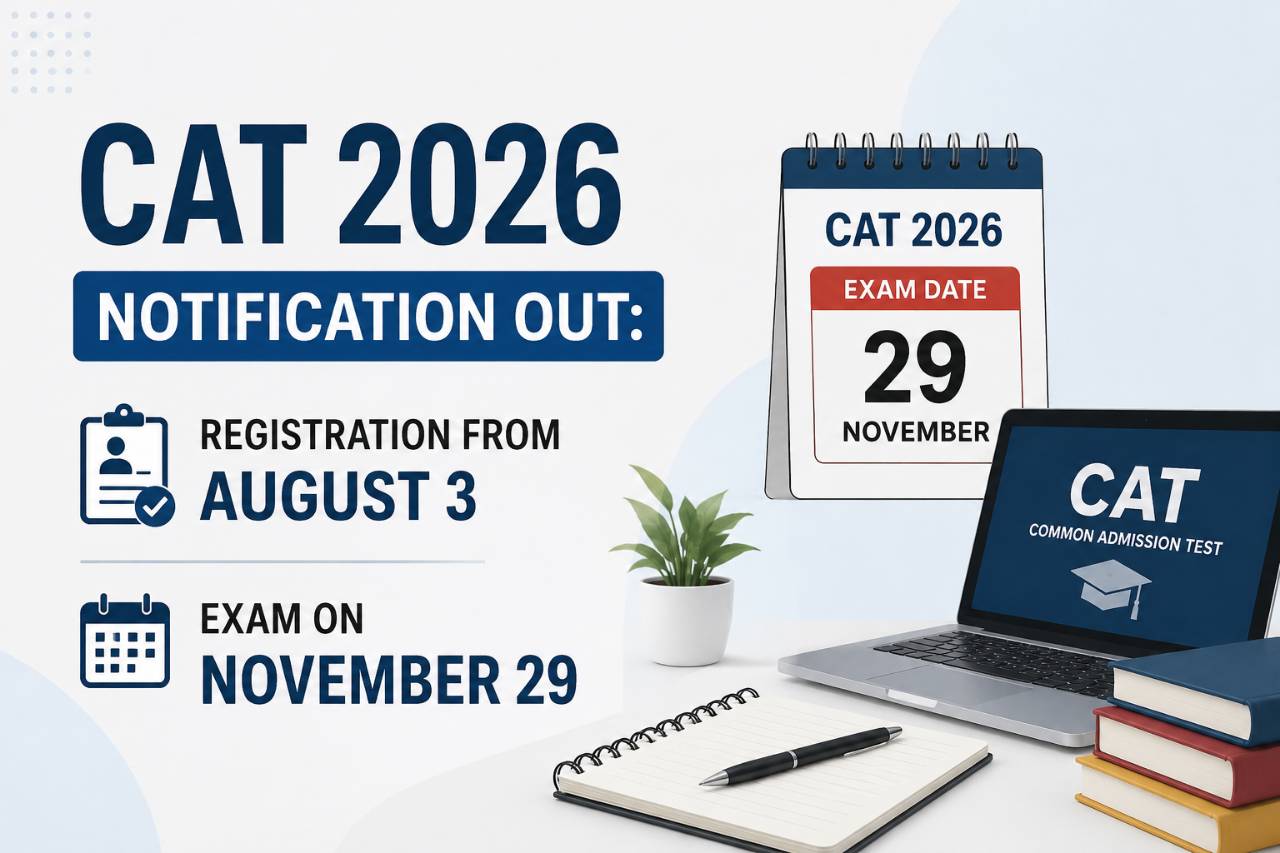
- MAT: National exam accepted by hundreds of B-schools; offered multiple times a year; useful if you want options beyond Karnataka.
- KMAT: Karnataka-focused network of 189+ institutes; home-based proctored mode; no negative marking; single annual session in 2026 on September 13.
KMAT is not a substitute for CAT if your target is an IIM. It is an excellent primary or secondary option if your goal is a quality AICTE-approved MBA or MCA in Karnataka with flexible exam logistics. Students from diverse backgrounds including those who cleared highly competitive exams for fields like medicine at institutes such as AIIMS Delhi sometimes pursue management later in their careers; KMAT offers them an accessible re-entry point without repeating undergraduate entrance rigour.
After KMAT 2026: Results, Cut-Offs, and Admission
Once results are declared on kmatindia.com, member colleges typically conduct their own counselling or selection rounds based on KMAT percentile, academic profile, and sometimes group discussion or personal interview stages depending on institute policy.
What Happens After the Score Card?
- Download your KMAT 2026 score card with percentile.
- Shortlist KPPGCA member colleges offering your preferred programme and specialisation.
- Check each college's website for application forms, fee payment, and document verification schedules.
- Participate in counselling or direct admission rounds as announced by individual institutions.
- Confirm your seat by paying the admission fee within the stipulated timeline.
Cut-offs vary widely. A percentile that secures admission in one Bangalore college may fall short for a premium campus with stronger placement records. Apply to a balanced mix of ambitious, moderate, and safe choices based on previous year trends published on college websites or verified education portals.
Who Should Consider KMAT 2026?
KMAT is especially well suited if you:
- Want an MBA or MCA specifically in Karnataka, particularly Bangalore's job market.
- Prefer a home-based exam without travel costs to a test centre.
- Are a final-year graduate who just met eligibility and needs a late-cycle option.
- Are a working professional seeking a part-time or flexible PG management pathway at select institutes.
- Already prepared for MAT or similar aptitude tests and want an additional score usable across 189+ colleges.
It may be less ideal if your sole ambition is a top-10 national B-school outside Karnataka or if you cannot guarantee a reliable internet setup on exam day. In those cases, plan complementary exams early rather than relying on a single attempt.
Conclusion
KMAT 2026 brings together a confirmed September 13 exam date, an extended registration deadline of August 31, 2026, and a candidate-friendly home-based proctored format that opens doors to more than 189 AICTE-approved MBA and MCA institutions across Karnataka. Whether you are a fresh graduate, a final-year student, or a professional exploring management education, the window is still open but only if you act before the revised deadline passes.
Visit kmatindia.com, verify your eligibility, complete registration with accurate documents, and begin timed mock practice aligned with the 120-question, no-negative-marking pattern. Track the portal for admit card and official mock test announcements, set up your exam-day tech environment in advance, and shortlist member colleges early so you can move quickly once results are out. For Karnataka-focused MBA and MCA aspirants in 2026, KMAT remains one of the most accessible and wide-reaching entrance pathways available today.