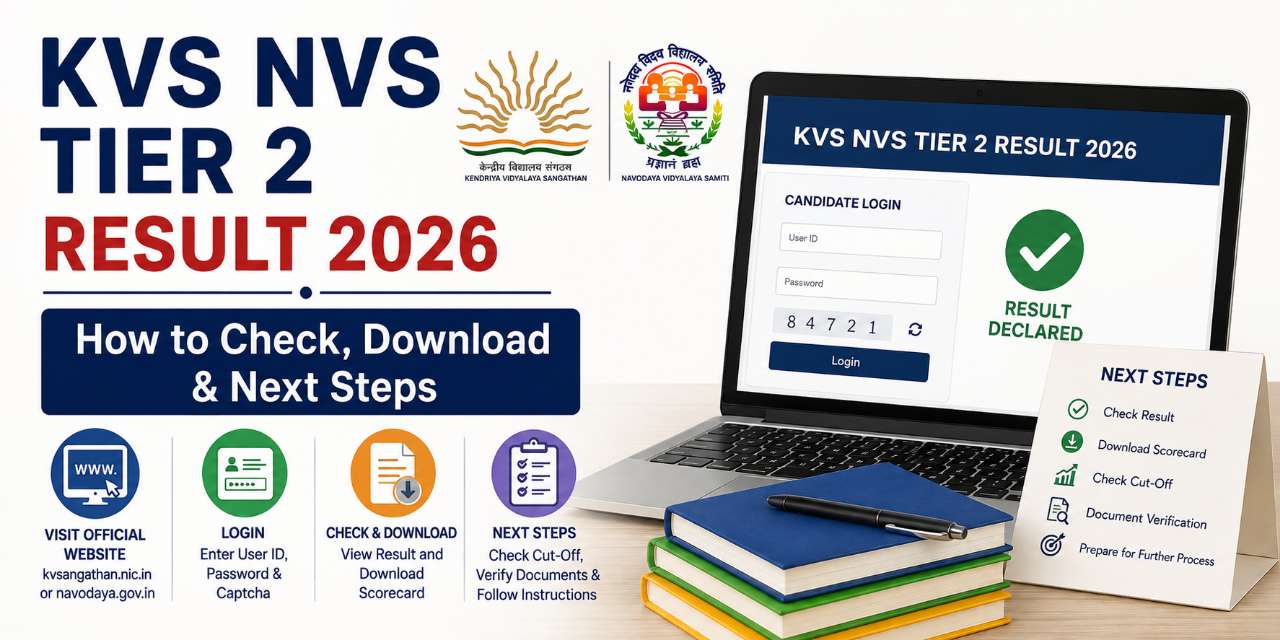
The Kendriya Vidyalaya Sangathan (KVS) and Navodaya Vidyalaya Samiti (NVS) Tier-II recruitment examination is one of the largest central-government teaching drives in India. In August 2026, the Central Board of Secondary Education (CBSE) began releasing results in phases on the official portal examinationservices.nic.in. If you appeared for posts such as PGT Physics, Vice-Principal, or Stenographer Grade II, your shortlisting status may already be live in your candidate login.
This guide explains what the Tier-II result means, which posts have been declared so far, how to download your status safely, and what happens next interview, skill test, or direct merit-based selection. Whether you are a working teacher upgrading your career or a fresh graduate entering school education, clear understanding of the phase-wise result process saves time and prevents misinformation.
Understanding KVS and NVS Tier-II Recruitment 2026
KVS and NVS together announced more than 15,700 vacancies for the 2026 recruitment cycle, covering teaching and non-teaching roles across India. Kendriya Vidyalayas (KVs) are central-government schools affiliated with CBSE, while Navodaya Vidyalayas (NVs) are residential schools aimed at talented rural students. Both organisations depend on a transparent, centralised selection process conducted by CBSE.
What Is Tier-II in the KVS NVS Selection Process?
The recruitment follows a multi-stage pattern. After Tier-I (often a screening or preliminary stage depending on the post), shortlisted candidates appear for Tier-II, the main written examination. Tier-II tests subject knowledge, pedagogy, general awareness, and reasoning depending on the post category. The 2026 Tier-II exams were held between 27 and 31 March 2026 at centres nationwide.
Unlike a single-day university entrance test where all results appear together, KVS-NVS results are released post-wise and in phases. CBSE declares results for a batch of posts, then moves to the next group. This staggered approach helps manage document verification, interview scheduling, and large candidate volumes across dozens of disciplines.
Who Conducts the Exam and Where to Find Official Updates?
CBSE is the examination conducting body. Authoritative updates appear on:
- examinationservices.nic.in candidate login and result
- cbse.gov.in examination notices
- kvsangathan.nic.in KVS recruitment announcements
- navodaya.gov.in NVS updates
Always cross-check information on these portals. Third-party websites may republish news quickly but can miss phase-wise nuances or post-specific instructions.
Eligibility Snapshot for Major Post Categories
Before interpreting your result, confirm that your qualifications matched the notification when you applied. Typical requirements include:
- PGT posts: Master’s degree in the concerned subject with B.Ed. or equivalent; age limits as per notification.
- TGT posts: Bachelor’s degree with B.Ed. and subject-specific criteria (for example, TGT Work Experience may require vocational training background).
- Vice-Principal: Combined teaching and administrative experience, often with service in recognised schools.
- Stenographer Grade II: Senior secondary pass with stenography certificate and prescribed typing speed.
Document verification at later stages is strict. A Tier-II shortlist does not override eligibility rules discrepancies in certificates can lead to disqualification even after a strong written exam score.
KVS NVS Tier-II Result 2026: Latest Updates
CBSE started declaring Tier-II results in mid-August 2026. The first announcements covered high-demand posts including PGT Physics, Vice-Principal, and Stenographer Grade II. Subsequent phases expanded to additional PGT, TGT, and non-teaching categories.
Phase-Wise Result Declaration Timeline
Based on official announcements reported through education news sources, the broad timeline looks like this:
| Phase | Approximate Date | Posts Covered (Examples) |
|---|---|---|
| Phase 1 | 17 August 2026 | PGT Physics, Vice-Principal, Stenographer Grade II |
| Phase 2 | 18 August 2026 | PGT (Assamese, Urdu, Bio-Technology, and others), TGT posts, select non-teaching roles |
| Phase 3 & 4 | 21 August 2026 | PGT History, PGT Economics, PGT Chemistry, TGT Work Experience, Assistant Commissioner, Junior Translator |
Remaining posts including Principal, PRT, Librarian, and other PGT/TGT subjects are expected in further phases. If your post is not yet listed, continue monitoring your login rather than assuming a delay means rejection.
What Does the Result Screen Show?
When you log in, you typically see one of the following:
- Shortlisted for next stage for posts that include interview, skill test, or document verification
- Not shortlisted candidature ends at Tier-II for that cycle
- Marks/score details for certain non-interview posts, Tier-II marks may appear directly
CBSE has clarified that for interview-based posts, detailed marksheets are generally released within 15 days of the final result, after the complete selection process finishes. For posts without an interview, Tier-II marks may be visible along with the result in your login.
Understanding Cut-Off and Merit Logic
Unlike some state TET exams that publish a single cut-off chart immediately, KVS-NVS Tier-II outcomes are often communicated through individual shortlisting status first. Cut-off marks when released depend on post category, number of vacancies, exam difficulty, and reservation norms under central government rules. Category-wise (UR, OBC, SC, ST, EWS, PwBD) relaxation applies as per the original notification.
Do not rely on social media cut-off screenshots. Wait for official communication in your login or on CBSE/KVS/NVS notices. If you are not shortlisted, analyse whether reattempt in a future cycle or parallel exams (state TET, other central recruitments) fits your career plan.
How to Check and Download KVS NVS Tier-II Result 2026
Results are accessible only through the individual candidate login on the recruitment portal. There is no public merit-list PDF for every post at once; your status is personal and post-specific.
Login Credentials You Will Need
Keep these details ready before you begin:
- Registration or application number (from your Tier-II admit card)
- Password or date of birth (as set during application)
- Captcha code displayed on the login page
If you forgot your password, use the portal’s “Forgot Password” option early result day traffic can slow recovery emails.
Step-by-Step Result Checking Process
- Open examinationservices.nic.in in a secure browser.
- Navigate to the KVS/NVS recruitment section and open Candidate Login.
- Enter registration number, password/DOB, and captcha.
- Look for the Tier-II result or shortlisting link on your dashboard.
- Download the status page and save a screenshot plus PDF copy.
- Print at least one hard copy for interview or document verification.
Actionable tip: Use the same device and browser profile you used during application if possible. Some candidates report session errors when switching browsers during peak traffic.
Common Login Problems and Fixes
- Page not loading: Try off-peak hours (early morning or late night). Avoid refresh spam it can temporarily lock sessions.
- Wrong credentials: Verify application number from admit card, not from SMS forwards.
- Result link missing: Your post’s phase may not be declared yet. Check the latest CBSE notice for your subject.
- Status shows blank: Clear cache or try incognito mode once before contacting helpdesk.
Mobile vs Desktop: Best Practice for Result Day
The recruitment portal is optimised for desktop browsers. Mobile access works but may display captcha or PDF download options differently. For a smooth experience, use a laptop with a stable broadband connection, disable VPN extensions that block .nic.in domains, and avoid multiple simultaneous login attempts from the same account.
Posts, Vacancies, and Selection Pattern Overview
The 2026 cycle is among the largest KVS-NVS drives in recent years, reflecting expansion in central school networks and replacement hiring across states and union territories.
Teaching Posts at a Glance
| Category | Typical Qualification | Selection Highlights |
|---|---|---|
| PGT (Post Gradute Teacher) | Master’s degree + B.Ed. in relevant subject | Subject test + pedagogy; often includes interview |
| TGT (Trained Graduate Teacher) | Bachelor’s degree + B.Ed./special training | Written exam + interview for many posts |
| PRT (Primary Teacher) | Graduation + D.El.Ed./B.Ed. | Tier-II plus further stages as notified |
| Vice-Principal / Principal | Experience + leadership criteria | Written test, interview, and service record review |
Non-Teaching Posts
Non-teaching roles such as Stenographer Grade II, Junior Translator, Assistant Commissioner, and administrative cadres follow post-specific skill tests. Stenography posts often include shorthand and typing assessments after Tier-II shortlisting. Read your post’s official notification to know whether interview, skill test, or both apply.
KVS vs NVS: What Changes for Candidates?
Both share the same examination portal and broad pattern, but posting locations, school type, and work environment differ. KVS schools are generally day schools in urban and semi-urban areas with transferable postings across zones. NVS schools are predominantly residential, located in rural and semi-rural blocks, with a focus on all-round student development. Your application form specifies the recruiting body; result checking remains identical through the shared portal.
Zone-Wise Posting and Transfer Policy Overview
After final selection, KVS appoints teachers under a zonal system (for example, Delhi, Mumbai, Bengaluru, and other regions). NVS postings align with Jawahar Navodaya Vidyalaya locations, many in district headquarters and rural blocks. New appointees should read service rules on mutual transfer, probation, and seniority. Understanding posting logic early reduces anxiety after selection.
What Happens After Tier-II Result?
Clearing Tier-II does not always mean final selection. The next stage depends on the recruitment rules for your specific post.
Interview and Document Verification
Shortlisted candidates must complete an online application or confirmation form when CBSE activates the link in the login portal. Keep scanned copies of:
- Educational certificates (10th, 12th, graduation, post-graduation)
- B.Ed./D.El.Ed. and professional qualifications
- Caste/category certificate (if applicable)
- Experience certificates for teaching or administrative posts
- Photo ID and passport-size photograph matching application
Interview call letters and schedules are uploaded to the candidate login once finalised in consultation with KVS and NVS. Monitor both the portal and official KVS/NVS websites for venue and date updates.
Document Verification Checklist
| Document | What Examiners Check |
|---|---|
| Matriculation certificate | Date of birth proof; name must match all records |
| Graduation/PG marksheets | Subject relevance for PGT/TGT posts |
| B.Ed./D.El.Ed. certificate | Recognition by NCTE or equivalent body |
| Category certificate | Format, validity, and issuing authority as per central norms |
| Experience letter | Designation, duration, and school recognition for leadership posts |
Skill Tests for Specific Posts
Stenographer, translator, and certain technical posts may require skill tests measuring speed, accuracy, or language proficiency. Treat skill-test preparation with the same seriousness as the written exam marginal performance here can eliminate otherwise strong candidates.
Final Merit and Appointment
Final merit usually combines Tier-II performance with interview or skill-test scores as per the weightage in the official notification. Selected candidates receive appointment orders through KVS or NVS regional offices. Keep your mobile number and email active for months after the result; communication often arrives via official channels rather than public lists.
Teaching Careers in India: Context Beyond KVS-NVS
Central school recruitment is a prestigious pathway, but Indian education offers multiple entry routes. Understanding the landscape helps candidates plan long-term careers even while awaiting KVS-NVS outcomes.
Central Schools vs Other Education Pathways
State government teachers’ eligibility tests (TET), university lectureships through UGC NET, and private school hiring remain parallel options. For students still in college who are exploring creative and design fields rather than school teaching, competitive exams such as the NIFT Entrance Exam open doors to fashion, design, and allied industries a different but equally structured admission route with its own merit lists and counselling stages. School teachers and design educators both shape young minds, but the entry exams and career trajectories differ sharply; choose the path that matches your qualification and interest.
Regional Higher Education and Teacher Supply
India’s teacher workforce needs vary by region. North-eastern states continue expanding techinal and professional education infrastructure. Universities such as North East Frontier Technical University illustrate how regional institutions complement central school networks by producing graduates who may later enter teaching, administrative, or technical roles across the education sector. KVS and NVS postings in NE states remain especially relevant for candidates seeking stable central-government jobs close to home.
Why E-E-A-T Matters When You Read Result News
Google’s helpful content and E-E-A-T (Experience, Expertise, Authoritativeness, Trustworthiness) standards reward pages that clarify official processes without sensationalism. For result announcements, trust comes from citing CBSE/KVS/NVS sources, explaining phase-wise release logic, and giving actionable steps not from unverified cut-off rumours. This article follows that approach: verify on the portal first, then plan your next stage.
Salary and Career Growth Overview
Selected KVS and NVS employees receive pay as per the 7th Central Pay Commission with allowances such as DA, HRA, and transport depending on posting location. Teaching posts offer structured promotion channels TGT to PGT, and for eligible candidates, pathways toward administrative roles with experience and departmental exams. While salary should not be the only factor, transparency about benefits helps candidates compare KVS-NVS with state-government teaching appointments in their home state.
Preparation Tips for Interview and Skill Test
If you are shortlisted, the gap between Tier-II result and interview is shorter than most candidates expect. Use it deliberately.
Interview Preparation for Teaching Posts
- Revise NCERT textbooks for your subject at the level you will teach (secondary or senior secondary).
- Prepare a crisp self-introduction covering qualification, teaching philosophy, and motivation for KVS/NVS.
- Practice demo-lesson outlines: objective, activity, assessment under five minutes verbal delivery.
- Stay updated on NEP 2020 themes: competency-based learning, multilingual education, and inclusive classrooms.
- Carry original documents in a folder arranged in notification order.
For Vice-Principal and Leadership Posts
Expect questions on school administration, CBSE affiliation norms, teacher mentoring, conflict resolution, and safety regulations. Reflect on real examples from your service record. Leadership posts reward clarity, ethics, and practical problem-solving over textbook definitions alone. Be ready to discuss how you handled inspection preparedness, student discipline cases, or teacher professional development in your previous school.
For Stenographer and Non-Teaching Posts
Practice dictation at notified speeds, review government letter formats, and confirm typing accuracy on the keyboard layout used in the skill test. Small daily drills outperform last-minute cramming for skill-based roles. Junior Translator candidates should brush up on official terminology in both source and target languages.
Sample Interview Questions by Post Type
PGT Physics: Explain Newton’s laws with a classroom demonstration idea; discuss common misconceptions about electricity.
Vice-Principal: How would you support teachers implementing CBSE competency-based questions?
Stenographer Grade II: Describe your experience with official correspondence and confidentiality protocols.
Practise answers aloud. Concise, structured responses score better than long unstructured monologues.
Quick Reference: Key Facts at a Glance
Use this snapshot for featured-snippet style revision:
- Official result portal: examinationservices.nic.in
- Conducting body: CBSE for KVS and NVS recruitment
- Tier-II exam dates 2026: 27–31 March 2026
- Total vacancies (approx.): 15,762 (KVS ~9,981; NVS ~5,841)
- Result mode: Phase-wise, post-wise login status
- Credentials: Registration number + password/DOB + captcha
- Marksheet timing: Within 15 days of final result (interview posts)
- Next steps: Interview/skill test/DV as per post notification
Mistakes to Avoid After Result Declaration
Result season attracts misinformation. Avoid these common errors:
- Trusting forwarded PDFs: Only your login status is authentic.
- Missing confirmation forms: Shortlisting can lapse if you skip portal formalities.
- Ignoring post-specific notices: Vice-Principal and PGT Physics follow different next-stage rules.
- Paying for fake score upgrades: CBSE does not offer paid re-evaluation through agents.
- Uploading incorrect documents: Name mismatches across certificates cause rejection at DV.
- Sharing login credentials: Never share password or OTP with coaching centres claiming to “check for you.”
- Assuming silence means rejection: Undeclared posts are still pending phase release keep checking officially.
Conclusion
The KVS NVS Tier-II result 2026 marks a decisive milestone for thousands of teaching and non-teaching aspirants across India. With CBSE releasing outcomes in phases on examinationservices.nic.in, candidates for posts like PGT Physics, Vice-Principal, and Stenographer Grade II should check their login promptly, download proof of status, and prepare for interviews or skill tests where applicable. If your post is not yet declared, patience and official portal monitoring are your best strategy.
Central school jobs offer stability, nationwide posting options, and meaningful impact on school education. Whether you are shortlisted or awaiting the next phase, stay focused on verified information, complete every portal form on time, and prepare thoroughly for the stage ahead. Your Tier-II performance has brought you this far approach the next step with the same discipline and clarity that carried you through the written examination.