
The Maharashtra State Common Entrance Test Cell (MAH CET Cell) has officially released the MAH Agri CAP 2026 counselling schedule for undergraduate admissions in agriculture and allied sciences. Registered candidates can download the full timetable from agri2026.mahacet.org. The Centralised Admission Process (CAP) governs state-quota seats for the 2026–27 academic session across 195 affiliated colleges offering more than 17,586 undergraduate seats under four state agricultural universities.
If you appeared in MHT CET 2026, JEE Main 2026, or NEET UG 2026 and completed CAP registration, this is your single window for BSc and BTech agriculture programmes in Maharashtra. Missing a deadline in any CAP round can cost you an entire admission year, so tracking the published schedule is essential. This article breaks down every stage—from provisional merit list to institutional quota—along with eligibility rules, course options, and practical tips drawn from the official notification.
What Is MAH Agri CAP 2026?
MAH Agri CAP is Maharashtra's centralised admission process for professional undergraduate degrees in agriculture and allied fields. Unlike direct college applications, every state-quota seat at participating institutes is filled only through this online CAP system managed by the State CET Cell on behalf of the Maharashtra Council of Agriculture Education and Research (MCAER).
The process covers document verification, merit list publication, option form filling, seat allotment, reporting to allotted colleges, and subsequent rounds for vacant seats. Four state agricultural universities—Konkan Krishi Vidyapeeth (Dapoli), Mahatma Phule Krishi Vidyapeeth (Rahuri), Dr. Panjabrao Deshmukh Krishi Vidyapeeth (Akola), and Vasantrao Naik Marathwada Krishi Vidyapeeth (Parbhani)—affiliate the 195 participating colleges spread across Maharashtra's regions.
Why the 2026 Schedule Matters Now
The CAP registration window opened on 10 July 2026 and closed for most candidates by early August 2026. With entrance exam results declared and the detailed CAP timetable now live, the focus shifts to merit lists, preference filling, and round-wise allotments beginning in mid-August 2026. Candidates who registered on time must now prepare documents, research college preferences, and monitor the portal daily for updates.
MAH Agri CAP 2026 at a Glance
Before diving into dates, here is a quick reference table summarising the key facts every aspirant should know:
| Particular | Detail |
|---|---|
| Conducting body | Maharashtra State CET Cell / MCAER |
| Official portal | agri2026.mahacet.org |
| Academic year | 2026–27 |
| Total UG seats | 17,586 |
| Participating colleges | 195 |
| Affiliating universities | 4 State Agricultural Universities |
| Accepted entrance exams | MHT CET 2026 (PCM/PCB), JEE Main 2026, NEET UG 2026 |
| Registration start | 10 July 2026 |
| Classes commence | 7 September 2026 |
| Final admission cutoff | 17 September 2026 |
Courses Covered Under MAH Agri CAP 2026
The CAP process covers nine professional degree programmes in agriculture and allied sciences. Only candidates who completed online registration and document upload before the deadline can participate in counselling rounds.
- BSc (Hons) Agriculture — the most popular choice for students aiming at farm management, agronomy, and crop science careers. Learn more about this pathway on our BSc Agriculture Hons course page.
- BSc (Hons) Horticulture — focused on fruits, vegetables, floriculture, and landscape design.
- BSc (Hons) Forestry — covers forest ecology, wildlife management, and conservation.
- BSc (Hons) Community Science — formerly Home Science; emphasises nutrition, family resource management, and extension work.
- BTech Food Technology — processing, preservation, and quality control in the food industry.
- BTech Agricultural Engineering — farm machinery, irrigation systems, and post-harvest technology.
- BTech Biotechnology — genetic improvement, tissue culture, and biotech applications in agriculture.
Each programme has separate seat matrices by category (Open, OBC, SC, ST, EWS, and others) and by college. The option form lets you rank both courses and institutes in order of preference, so plan your list carefully before Round 1 opens.
Complete MAH Agri CAP 2026 Schedule
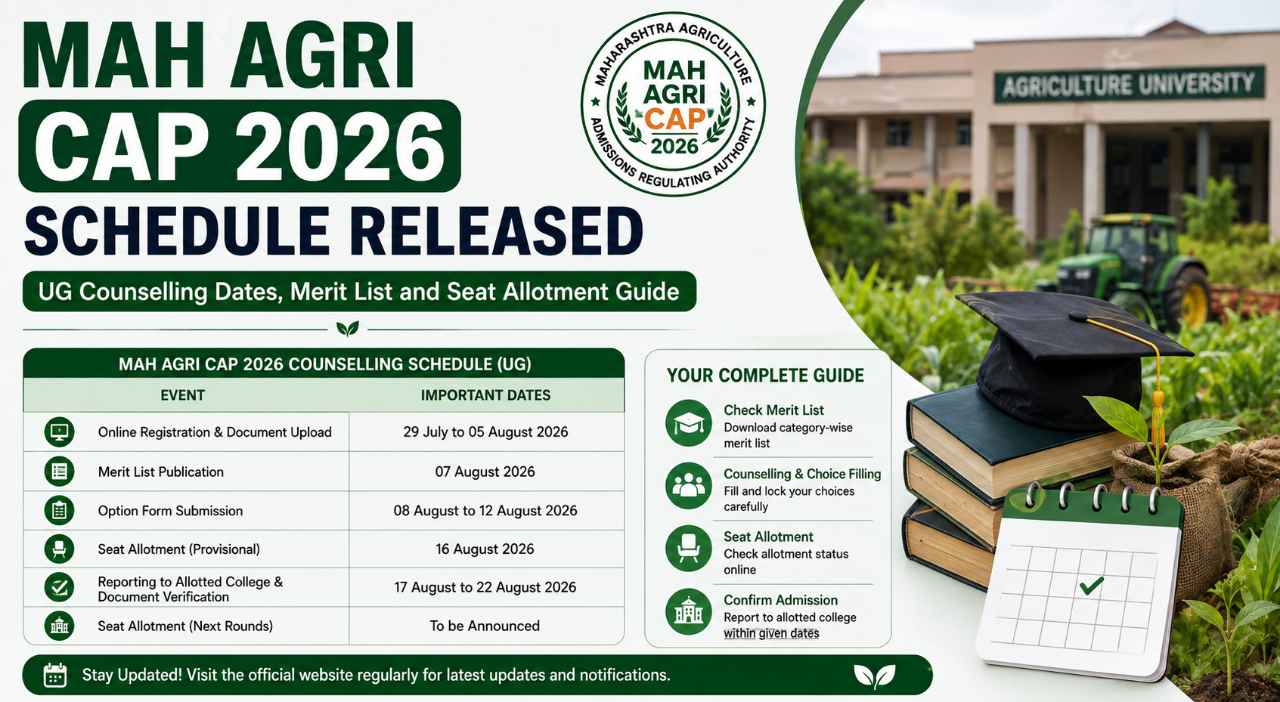
The official PDF titled AGRI UG CAP Schedule (2026–2027) lays out every phase from merit list publication through institutional quota admissions. Below is the consolidated timeline based on the notification released at agri2026.mahacet.org.
Phase 1: Registration and Merit Lists
| Stage | Date |
|---|---|
| Admission process start | 10 July 2026 |
| Last date for CAP application and document upload | 2 August 2026 |
| Provisional merit list display | 6 August 2026 (after 5:30 PM) |
| Online grievance window | 7–9 August 2026 |
| List of grievances considered | 11 August 2026 |
| Final merit list display | 12 August 2026 (after 5:30 PM) |
After the provisional merit list appears, candidates who find errors in their rank, category, or entrance score must file online grievances within the three-day window. The CET Cell publishes a grievance outcome list before releasing the final merit list, which becomes the basis for all CAP rounds.
Phase 2: CAP Round 1
| Stage | Date |
|---|---|
| Display of available seats (Round 1) | 12 August 2026 (after 5:30 PM) |
| Option form / preference submission | 13–14 August 2026 |
| Round 1 allotment list | 16 August 2026 (after 5:30 PM) |
| Reporting period | 17–19 August 2026 (9:00 AM – 6:00 PM) |
Round 1 is critical because the widest seat pool is available. Fill your option form with a realistic mix of dream, target, and safe college–course combinations. Seat allotment follows your merit rank and the order of preferences you submit.
Phase 3: CAP Round 2
| Stage | Date |
|---|---|
| College-wise cutoff and vacant seats display | 20 August 2026 (9:00 AM) |
| Option form for Round 2 | 20–21 August 2026 |
| Round 2 allotment list | 23 August 2026 (after 5:30 PM) |
| Reporting period | 24–26 August 2026 (9:00 AM – 6:00 PM) |
Phase 4: CAP Round 3 (Conversion Round)
| Stage | Date |
|---|---|
| College-wise cutoff and vacant seats display | 27 August 2026 (9:00 AM) |
| Option form for Round 3 | 27–28 August 2026 |
| Round 3 allotment list (conversion) | 31 August 2026 (after 5:30 PM) |
| Reporting period | 1–3 September 2026 (9:00 AM – 6:00 PM) |
Round 3 allows seat conversion—candidates allotted a seat in an earlier round may choose to accept a better option from the remaining pool, subject to rules in the information brochure. Read the conversion guidelines carefully before locking choices.
Phase 5: Document Submission, Centre Round, and Institutional Quota
| Stage | Date |
|---|---|
| Original document and fee submission at allotted college | 1–4 September 2026 |
| Display of vacant seats for centre-wise CAP round | 5 September 2026 (after 5:30 PM) |
| Centre-wise admission (percentile-wise) | 7 September: 85+ | 8 September: 65+ | 9 September: 50+ | 10 September: 35+ |
| All eligible candidates (centre round) | 9–11 September 2026 |
| College-level admission round | 11 September 2026 |
| Institutional quota: vacant seat display and applications | 12 September 2026 (till 5:30 PM) |
| Institutional quota merit/selection list | 13–14 September 2026 |
| Reporting with original documents (institutional quota) | 15–17 September 2026 |
| Commencement of classes | 7 September 2026 |
| Final cutoff date for all admissions | 17 September 2026 |
Candidates holding receipts for Caste/Tribe Validity, Non-Creamy Layer, or EWS certificates must upload the original certificates through their login and submit physical copies at the respective college during the document submission window.
Eligibility Criteria for MAH Agri CAP 2026
Admission is merit-based through accepted national and state entrance tests. You must satisfy academic, entrance exam, and domicile requirements for your chosen candidature type (Maharashtra State, All India, or other applicable categories).
Academic Requirements
- Passed Class 12 (HSC) or equivalent with Physics, Chemistry, and Biology (PCB) or Physics, Chemistry, and Mathematics (PCM).
- Minimum aggregate marks as specified in the official information brochure for your category.
- Subject combination must match the programme you apply for (PCB for most BSc programmes; PCM may apply for BTech streams).
Entrance Exam Requirements
Candidates must hold a valid score in at least one of the following examinations:
- MHT CET 2026 — PCB or PCM group; this is the primary state-level route for Maharashtra domicile students. Our detailed MHT CET guide covers syllabus, exam pattern, and preparation strategies.
- JEE Main 2026 — accepted for BTech programmes and as an alternative for BSc admissions per brochure norms.
- NEET UG 2026 — accepted for agriculture and allied UG admissions; a separate NEET-based CAP schedule may apply for NEET-qualified candidates.
Domicile and Reservation
Maharashtra State candidature requires domicile proof as defined in the CAP brochure. Reserved category candidates (SC, ST, OBC, SEBC, EWS, PwD, and others) must upload valid caste, income, and disability certificates during registration. Incorrect category claims can lead to cancellation at any stage, so verify documents against Appendix guidelines in the official brochure.
How to Check and Download the MAH Agri CAP 2026 Schedule
The full schedule is published as a downloadable PDF on the CAP portal. Follow these steps to access it:
- Visit the official website at agri2026.mahacet.org.
- Navigate to the Notifications or Instructions section on the homepage.
- Click the link titled AGRI UG CAP Schedule 2026–2027 (English) or the Marathi version.
- Download the PDF and save it on your phone and laptop for offline reference.
- Log in to your registered candidate account to cross-check personal deadlines for option forms and reporting.
Enable SMS and email alerts on your registered contact details. The CET Cell also publishes notices for date extensions or revisions—similar to other Maharashtra CAP processes such as MAH DSE and MAH BPharm CET.
Understanding CAP Rounds: What Happens at Each Stage
Document Verification and Merit List
During registration, you uploaded scanned copies of mark sheets, entrance exam scorecards, domicile certificates, and category documents. The CET Cell verifies these before publishing the provisional merit list. Merit is calculated using your entrance exam percentile/score with applicable weightages defined in the brochure. If your name is missing or your category is wrong, use the grievance window immediately—do not wait for Round 1.
Option Form Filling
The option form is where you rank college–course combinations in order of preference. Tips for effective filling:
- Research each college's location, hostel facilities, fees, and past cutoff trends before ranking.
- Include at least two to three safe options below your expected merit rank.
- Do not leave the form incomplete; unsubmitted forms mean no allotment.
- You can typically edit preferences only during the designated window—submit early to avoid last-minute server load.
Seat Allotment and Reporting
When allotment results are published, log in to check your status. If allotted a seat, you must report to the institutewithin the specified dates with original documents and fees. Failure to report may forfeit the seat and affect eligibility for subsequent rounds depending on current rules. Keep demand drafts, online payment receipts, and admission fee details ready in advance.
Centre-Wise CAP and Institutional Quota
After three online CAP rounds, remaining vacant seats are filled through centre-wise admission at designated centres (listed in Appendix H of the brochure) and then through college-level rounds. Institutional quota seats—typically up to 15% at participating institutes—are filled directly by colleges through a separate merit list published on institute notice boards and websites. Applications for institutional quota close on 12 September 2026, with final reporting by 17 September 2026.
Entrance Exams Accepted: A Comparative Overview
Understanding which exam aligns with your profile helps you estimate merit position before lists are published.
| Exam | Conducting Body | Typical Use in MAH Agri CAP |
|---|---|---|
| MHT CET 2026 | MAH CET Cell | Primary exam for Maharashtra state candidates; PCB/PCM groups |
| JEE Main 2026 | NTA | Accepted for BTech and as alternate merit for BSc programmes |
| NEET UG 2026 | NTA | Accepted for UG agriculture admissions; separate schedule may apply |
Students comparing admission routes across states often evaluate Maharashtra CAP alongside processes like IPU CET for Delhi NCR universities or state agriculture counselling in Rajasthan. For instance, aspirants exploring options beyond Maharashtra may look at institutions such as Agriculture University Kota, Rajasthan College of Agriculture and Technology Jaipur, or College of Agriculture Fatehpur Sikar. Agribusiness-focused programmes like those at the Institute of Agri Business Management IABM Bikaner offer complementary career paths after a UG agriculture degree.
Preparing for CAP Round 1: Actionable Checklist
Use this checklist to stay ahead of deadlines:
- Download the official schedule PDF and mark every date in a calendar app with reminders one day before each deadline.
- Verify your login credentials at agri2026.mahacet.org and ensure your registered mobile number and email are active.
- Organise original documents—HSC mark sheet, entrance scorecard, domicile certificate, caste/income certificates, Aadhaar, and passport-size photographs.
- Prepare a college preference list with 15–25 combinations ranked by your priority, including realistic backup options.
- Arrange finances for seat acceptance fees via net banking, debit card, credit card, or UPI.
- Check provisional and final merit lists on 6 and 12 August 2026 respectively and file grievances if needed.
- Fill Round 1 option form on 13–14 August 2026 without waiting for the last hour.
- Monitor allotment results on 16 August 2026 and plan travel for reporting between 17 and 19 August 2026.
Career Scope After UG Agriculture Programmes
A degree through MAH Agri CAP opens doors in public and private sectors. Graduates work as agricultural officers in banks and government departments, agronomists with seed and fertiliser companies, horticulture consultants, food technologists, and entrepreneurs in agri-startups. Many students pursue postgraduate specialisations—while CAP covers UG admissions, higher studies such as an MA in related disciplines or professional courses in design and other fields (for example, exams like NID DAT for design careers) remain options for interdisciplinary growth.
Maharashtra's agricultural education ecosystem benefits from strong industry linkages, Krishi Vigyan Kendras, and research stations under the four state universities. Konkan Krishi Vidyapeeth serves the coastal belt, MPKV Rahuri anchors western Maharashtra, PDKV Akola covers Vidarbha, and VNMKV Parbhani supports Marathwada—each region offers distinct agro-climatic learning opportunities. Choosing the right college during CAP counselling therefore affects not just your degree but also internship access, campus placements, and regional crop specialisation.
Fee payment for seat acceptance is processed online through net banking, debit card, credit card, or UPI on the CAP portal. Keep transaction receipts safely, as colleges may ask for proof during physical reporting. Hostel accommodation, if required, is arranged separately at the allotted institute after admission confirmation.
Common Mistakes to Avoid During MAH Agri CAP 2026
- Missing the grievance window — errors in the provisional merit list can only be corrected between 7 and 9 August 2026.
- Submitting an empty or incomplete option form — no preferences means no seat allotment.
- Ignoring reporting deadlines — late reporting can lead to seat cancellation.
- Uploading invalid category certificates — only upload documents that match Appendix specifications.
- Relying on unofficial websites — always verify dates at agri2026.mahacet.org.
- Choosing only top colleges — balance your list with mid-tier and safe options based on expected merit.
Conclusion
The release of the MAH Agri CAP 2026 schedule marks a decisive phase for thousands of agriculture aspirants in Maharashtra. With 17,586 seats across 195 colleges, the opportunity is substantial—but success depends on disciplined deadline management, accurate documentation, and smart option form strategy. From the provisional merit list on 6 August 2026 to the final admission cutoff on 17 September 2026, every stage requires active participation on the official portal.
Registered candidates should download the schedule PDF today, prepare their college preference lists, and stay alert for Round 1 option form filling on 13–14 August 2026. Whether you aim for BSc Agriculture Hons at a top krishi vidyapeeth college or a BTech specialisation, MAH Agri CAP remains the only authorised route for state-quota seats. Bookmark agri2026.mahacet.org, keep documents ready, and approach each CAP round with a clear plan to secure your seat for the 2026–27 academic year. For the latest updates on merit lists and allotment results, revisit the official portal daily during August and September 2026.