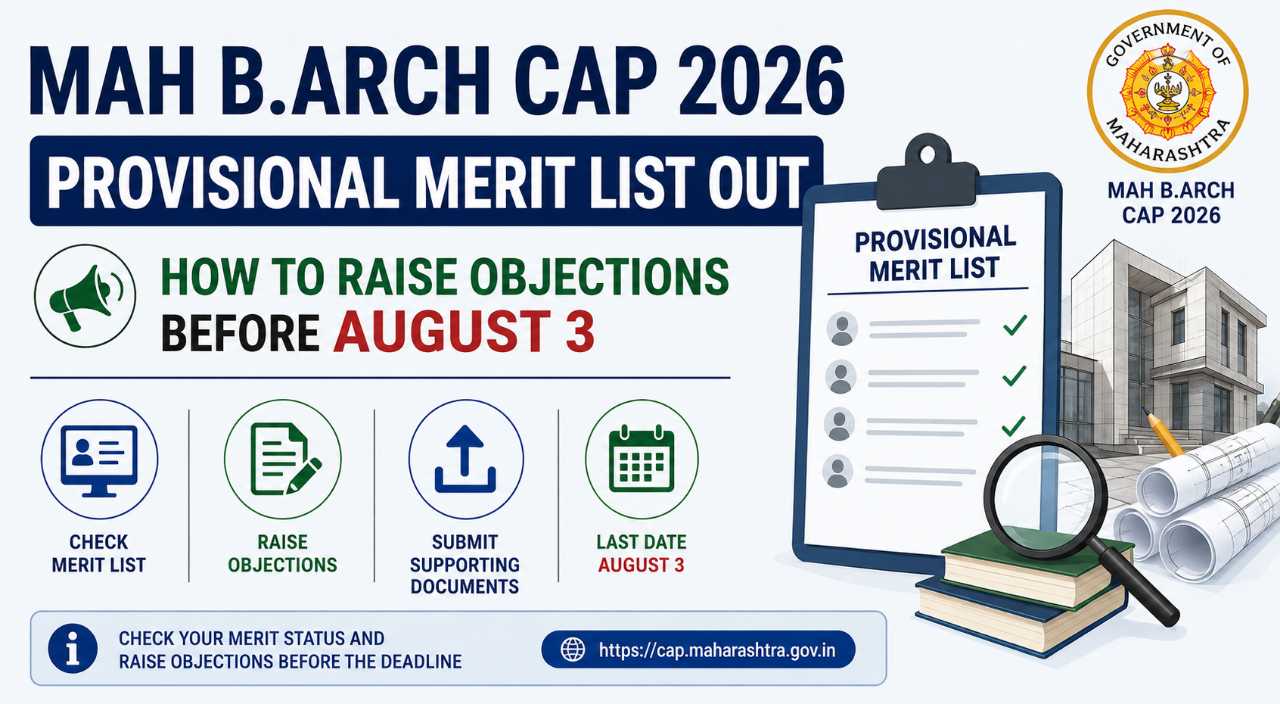

The Maharashtra State Common Entrance Test (CET) Cell has released the provisional merit list for B.Arch Centralised Admission Process (CAP) 2026, marking a critical checkpoint for thousands of architecture aspirants across the state. If you registered for first-year B.Arch admission for the 2026-27 academic session, this list determines your provisional rank before college preference filling begins. Candidates who spot errors in merit number, entrance exam score, category, gender, or qualifying exam details must raise objections before the deadline of August 3, 2026, up to 5:00 PM. Missing this window can permanently affect your CAP participation. This guide explains what the provisional merit list means, how merit is calculated, step-by-step objection submission, documents required, and what happens after the final merit list is published on August 5, 2026.
What Is the MAH B.Arch CAP 2026 Provisional Merit List?
The provisional merit list is an official ranking document published by the State CET Cell, Maharashtra, for candidates who completed online registration and document verification for B.Arch admissions through CAP. Unlike a final allotment result, this list is intentionally published in draft form so that applicants can cross-check every data point tied to their candidature before seat allocation rounds begin.
More than 6,000 candidates had registered for the 2026-27 B.Arch admission cycle by the time the revised schedule was announced. Each registered applicant receives a provisional merit number based on a standardised formula that combines entrance exam performance with qualifying examination marks. The list also reflects reservation category, gender, home university or region status, and other eligibility tags that influence seat allotment under Maharashtra's admission rules.
Think of the provisional merit list as a quality-control stage. The CET Cell processes thousands of applications, NATA scores, JEE Main Paper 2 (B.Arch) scores, and Class XII mark sheets in a compressed timeline. Errors—such as a mistyped NATA roll number, an unverified category certificate, or incorrect percentage calculation—can occur. The grievance window exists precisely so that genuine mistakes are corrected before irreversible CAP rounds start.
Key Details You Should Verify on Your Merit Entry
When you open your merit record on the official portal, review the following fields carefully:
- Provisional merit number — your rank among all verified applicants
- Entrance exam score used — NATA 2026 or JEE Main Paper 2 (B.Arch), whichever you submitted
- Qualifying exam percentage — Class XII aggregate or equivalent diploma marks
- Composite merit score — the weighted total used for ranking
- Category and sub-category — SC, ST, OBC, EWS, PwD, Defence, Orphan, or Open
- Gender and reservation benefits — including female candidature where applicable
- Candidature type — Maharashtra State, All India, NRI, or other applicable quota
- Document verification status — whether e-Scrutiny or physical scrutiny was completed successfully
If even one field is wrong, your rank—and therefore your college choices—can shift significantly. Architecture seats at top Maharashtra institutes are limited, so a few merit positions can determine whether you secure a preferred college in Round I or wait for later rounds.
MAH B.Arch CAP 2026 Important Dates and Schedule
The CET Cell revised several deadlines after extending the registration window. Candidates should follow the updated 2026 schedule rather than older notifications. The table below summarises the key milestones leading up to and following the provisional merit list.
| Activity | Schedule (2026) |
|---|---|
| Online registration and document upload | July 14 to July 28, 2026 (up to 5:00 PM) |
| Application verification and confirmation | July 15 to July 29, 2026 (up to 5:00 PM) |
| Release of provisional merit list | July 31, 2026 |
| Grievance / objection submission window | August 1 to August 3, 2026 (up to 5:00 PM) |
| Release of final merit list | August 5, 2026 |
| CAP Round I — choice filling (expected) | Shortly after final merit publication |
Always confirm dates on the official B.Arch admission portal at arch2026.mahacet.org.in or through notifications on cetcell.mahacet.org. Schedule changes are communicated through information brochures and press notes; relying on outdated social media posts is a common reason candidates miss deadlines.
How Is the B.Arch Merit Score Calculated in Maharashtra CAP?
Understanding the merit formula helps you decide whether an objection is necessary. For Maharashtra B.Arch CAP, the composite merit score typically follows a 50:50 weightage model approved by the admission regulating authority.
Entrance Examination Component (50% Weightage)
Candidates may appear through NATA 2026 (conducted by the Council of Architecture) or JEE Main Paper 2 (B.Arch). Maharashtra does not conduct a separate state-level B.Arch entrance test; instead, it normalises accepted national exam scores. Your application should reflect the exam you opted for during registration. If the merit list shows the wrong exam score—for example, a JEE score when you submitted NATA—you must raise an objection immediately with supporting scorecards.
Qualifying Examination Component (50% Weightage)
The second half of the merit score comes from your Class XII (or equivalent diploma) aggregate percentage in the subjects prescribed for B.Arch eligibility—generally including Mathematics and other qualifying subjects as per CoA norms. Diploma holders from approved polytechnics are also considered under defined rules. Verify that the percentage printed on the merit list matches your mark sheet after any board-normalisation rules the CET Cell applies.
Illustrative Merit Calculation Example
Suppose a candidate scored 120 out of 200 in NATA (normalised to the CET Cell's scale) and has 85% in Class XII aggregate. The composite score would combine half of the normalised entrance marks with half of the qualifying exam contribution. While the exact normalisation method is defined in the official information brochure, the principle is straightforward: stronger performance in both components yields a higher merit number (lower rank numeral means better standing in some displays—always check how your portal labels rank versus merit number).
Reservation and special category benefits are applied after base merit preparation according to Maharashtra government rules. If your category certificate was verified during scrutiny but the merit list shows you as Open category, that alone is sufficient grounds for a grievance.
Who Should Raise an Objection Against the Provisional Merit List?
Not every candidate needs to file a grievance. Raise an objection only when you have identified a factual discrepancy backed by documentary evidence. Common valid grounds include:
- Incorrect NATA or JEE Main Paper 2 score — mismatch with your official scorecard
- Wrong Class XII or diploma percentage — calculation or data-entry error
- Category not reflected — verified caste, income, EWS, PwD, or other certificate ignored
- Gender or reservation tag missing — affecting eligible seat types
- Merit number anomaly — rank inconsistent with your calculated composite score relative to published data
- Application marked unverified despite completed scrutiny — blocking merit inclusion or lowering priority
- Duplicate or merged candidature issues — rare but serious; requires immediate escalation
Do not file objections for strategic reasons—such as requesting a higher rank without evidence—or for issues that should have been corrected during the document verification phase unless new proof has become available. Frivolous grievances delay processing for all applicants and may be rejected without review.
Step-by-Step Guide to Raise Objections Online
The objection process is entirely online through the B.Arch CAP portal. Follow these steps before the August 3, 2026 deadline.
Step 1: Log In to the Official Portal
Visit arch2026.mahacet.org.in and log in using the application ID and password created during registration. Use the same credentials linked to your verified application. Avoid third-party websites that mimic the CET portal.
Step 2: Open the Provisional Merit List Section
Navigate to the merit list or grievance module from the candidate dashboard. Download or print your individual merit statement. Compare every field against your original application, scorecards, and verified documents.
Step 3: Select the Grievance / Objection Option
During the active grievance window (August 1–3, 2026), the portal enables an objection submission link. Choose the specific field you are challenging—exam score, qualifying marks, category, or other listed parameters.
Step 4: Upload Supporting Documents
Attach clear scanned copies of evidence: NATA or JEE scorecard, Class XII mark sheet, caste or category certificate, PwD certificate, revised scrutiny approval, or FC/e-Scrutiny confirmation. Files should be readable, within prescribed size limits, and in accepted formats (usually PDF or JPG as specified in the brochure).
Step 5: Write a Precise Objection Statement
In the text field, state the error factually: what the merit list shows, what the correct value is, and which document proves the correction. Avoid emotional language; clerical clarity speeds review.
Step 6: Submit and Save Acknowledgement
Submit before 5:00 PM on August 3, 2026. Save the confirmation page, email receipt, or grievance reference number. You may need this if follow-up is required before the final merit list on August 5, 2026.
Document Verification: E-Scrutiny vs Physical Scrutiny
Many merit list errors trace back to incomplete or rejected document verification. Maharashtra B.Arch CAP 2026 offered two verification modes during registration:
- E-Scrutiny — documents uploaded online are verified remotely by designated e-Scrutiny centres; no physical visit required
- Physical Scrutiny — candidates visit a Scrutiny Centre (SC) or Facilitation Centre (FC) with originals and uploads
If your application remained unconfirmed because verification was pending or discrepancies were flagged, the provisional merit list may exclude or misrepresent your candidature. Check your verification status first. If FC remarks noted a document issue that you have since resolved, include the updated approval in your objection package.
What Happens After You Submit an Objection?
After the grievance window closes on August 3, 2026, the CET Cell reviews submitted objections against uploaded records and verification data. Accepted corrections are incorporated into the final merit list scheduled for August 5, 2026. Rejected objections typically include a reason code or status update on the portal—monitor your dashboard daily during this period.
Once the final merit list is published, no further merit corrections are entertained except under exceptional circumstances defined by the authority. This makes the provisional list review phase non-negotiable for every serious applicant.
After the Final Merit List: CAP Round I and Beyond
With the final merit list in place, eligible candidates proceed to option form filling—ranking preferred architecture colleges and institutes participating in Maharashtra CAP. Allotment in Round I depends on your final merit, category, seat matrix, and preference order. Subsequent CAP rounds (Round II, Round III if held) and institutional-level rounds follow for vacant seats.
Architecture education combines design studio work, structural understanding, and urban planning foundations over five years. Whether you aim for a government-aided institute in Mumbai or Pune or explore private colleges elsewhere in India, your CAP merit is the primary gateway within Maharashtra. Students also research institutes outside the state—design-focused campuses such as Arch College of Design and Business Jaipur or engineering institutions offering allied programmes like Jaipur Engineering College JEC Jaipur—to understand broader options, though Maharashtra CAP allotments remain separate from other state processes.
Eligibility Reminder: Who Can Participate in MAH B.Arch CAP 2026?
Before raising objections, confirm you met baseline eligibility when registering:
- Passed or appeared for Class XII with Mathematics as a subject (or equivalent diploma) as per CoA requirements
- Valid NATA 2026 or JEE Main Paper 2 (B.Arch) score
- Completed online application with fee payment within the extended deadline
- Successful document verification through e-Scrutiny or physical scrutiny
- Fulfils domicile or All India quota conditions declared in the application
Candidates who missed registration cannot join the merit list at this stage. Those exploring alternative academic paths while planning future attempts might consider related undergraduate programmes—options range from a creative BA pathway to postgraduate study later through an MA—but B.Arch itself requires clearing the full CAP cycle with a valid entrance score.
Common Mistakes to Avoid During the Objection Window
Based on patterns from previous Maharashtra professional admission cycles, avoid these pitfalls:
- Waiting until the last hour on August 3 — portal traffic spikes and technical glitches can block submission
- Uploading blurry documents — reviewers cannot validate illegible scorecards
- Objecting without cross-checking your original application — sometimes the merit list is correct and the application contained the error
- Ignoring FC/e-Scrutiny messages — unresolved verification blocks meaningful merit correction
- Using unofficial agents — the CET Cell does not authorise third parties to file grievances on your behalf
- Assuming verbal complaints count — only portal-submitted objections within the window are official
Tips for Architecture Aspirants Planning CAP Choice Filling
While waiting for the final merit list, prepare for the next stage strategically:
- Download the seat matrix and list of participating institutes from the official website
- Research college accreditation, faculty, studio infrastructure, and placement records
- Prepare a tiered preference list—realistic, ambitious, and safe options
- Understand seat acceptance fees (typically ₹1,000 per CAP round when allotted)
- Keep original documents organised for institute reporting after allotment
- Discuss financial planning for five-year programme fees and material costs
Strong merit list accuracy today prevents painful preference recalculations tomorrow. Treat objection submission as seriously as the entrance exam itself.
Official Sources and Authentic Information
Maharashtra B.Arch admissions are governed by the State CET Cell under government admission rules aligned with Council of Architecture norms. Trust only:
- arch2026.mahacet.org.in — B.Arch CAP candidate portal
- cetcell.mahacet.org — official notifications and brochures
- NATA and JEE Main official websites for score verification
Bookmark these portals and enable notification alerts. Admission phishing sites peak around merit list and allotment dates.
Understanding CAP Seat Matrix and Participating Institutes
Alongside the merit list, the CET Cell publishes a seat matrix showing institute-wise and category-wise availability for B.Arch programmes across Maharashtra. Reviewing this matrix before choice filling helps you align preferences with realistic outcomes. Government-aided and private unaided institutes participate under defined quotas including Maharashtra State, All India, institutional, and minority seats where applicable.
Each institute's CAP code, location, and seat break-up appear in the official brochure. Cross-reference these codes carefully during option entry—a single transposed digit can send you to an unintended college. Architecture as a discipline demands five years of intensive studio and technical coursework; choosing an institute that matches your learning style and career goals matters as much as securing admission itself.
Role of NATA and JEE Main Paper 2 in Maharashtra B.Arch Admissions
Maharashtra accepts both NATA and JEE Main Paper 2 (B.Arch) as qualifying entrance examinations for the 2026-27 admission cycle. NATA, administered by the Council of Architecture, evaluates drawing aptitude, aesthetic sensitivity, mathematics, and critical thinking through a nationally recognised test. JEE Main Paper 2 serves candidates who already appeared for the Joint Entrance Examination architecture paper.
The CET Cell maintains separate merit processing tracks but merges eligible candidates for centralised allotment. Ensure your registration reflects the exam you intend to use. Candidates who improved their NATA or JEE score after initial registration should confirm whether updated scores were captured before the verification deadline; otherwise, the provisional merit list may reflect older data and an objection becomes necessary.
Conclusion
The MAH B.Arch CAP 2026 provisional merit list is more than a rank announcement—it is your last structured opportunity to ensure the data driving your architecture admission is accurate. With the grievance window open from August 1 to August 3, 2026, until 5:00 PM, every registered candidate should log in, verify merit number, exam scores, category tags, and verification status, and submit documented objections for any errors. The final merit list on August 5, 2026 will set the stage for CAP Round I choice filling and seat allotment across participating Maharashtra institutes. Act promptly, rely on official portals, and keep proof of every submission. A corrected merit position can be the difference between securing your preferred B.Arch seat in Round I and navigating multiple CAP rounds under unnecessary stress.