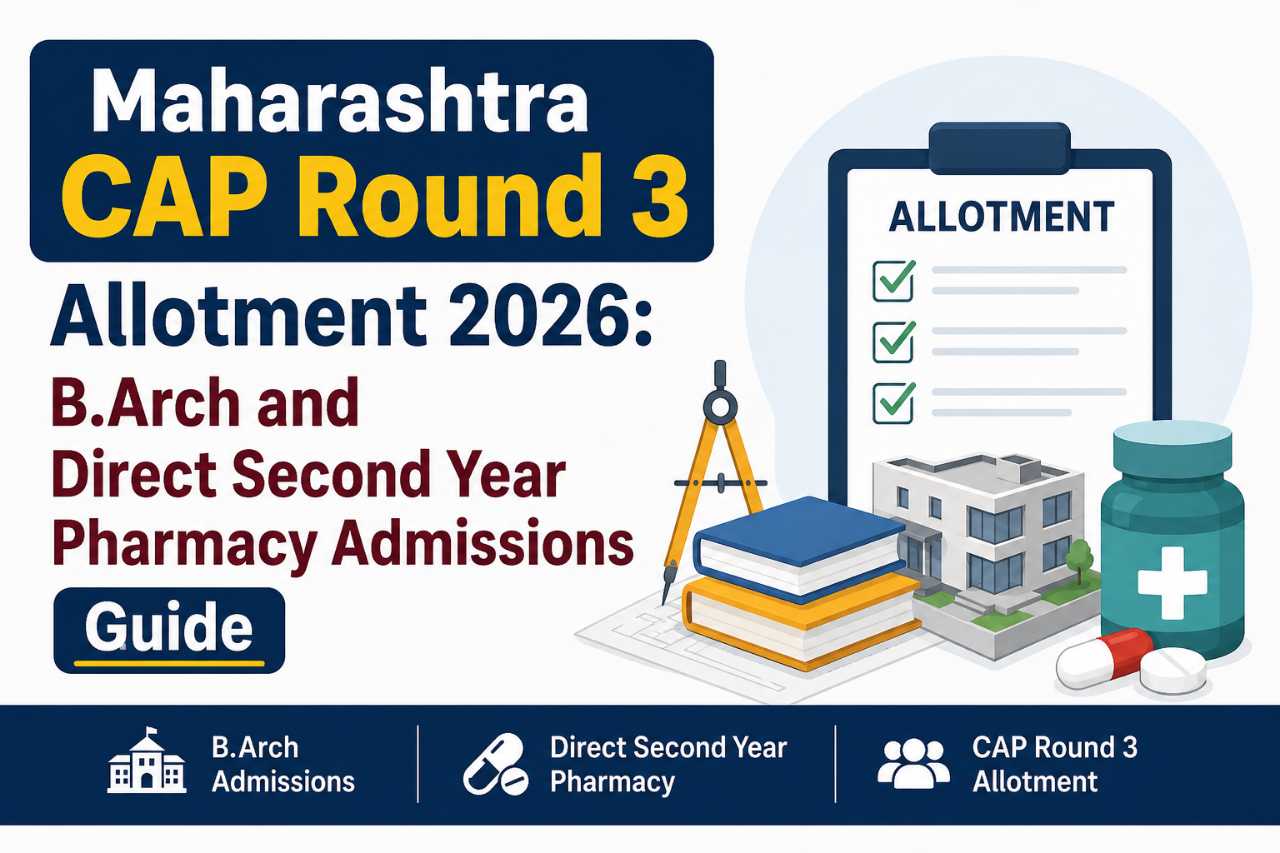

The Maharashtra State Common Entrance Test (CET) Cell has released the Centralised Admission Process (CAP) Round 3 allotment results for two important professional streams: Bachelor of Architecture (B.Arch) and Direct Second Year Pharmacy admissions for the academic year 2026-27. Candidates who participated in this round can now check their seat allotment on the official portal at cetcell.mahacet.org and must complete institute reporting by August 29, 2026.
This announcement marks a critical stage for thousands of aspirants across Maharashtra who are seeking seats in architecture colleges and lateral-entry pharmacy programmes. With 758 students allotted B.Arch seats and 1,208 students offered Direct Second Year Pharmacy admissions, CAP Round 3 has opened fresh opportunities for candidates who missed seats in earlier rounds or opted for betterment. Understanding the allotment rules especially the auto-freeze policy is essential before you report to your allotted institute.
What Is Maharashtra CAP Round 3?
The Centralised Admission Process (CAP) is Maharashtra's government-run online counselling system managed by the State CET Cell. Instead of applying separately to dozens of colleges, candidates register once, verify documents, fill preference forms, and receive seat allotments based on merit and choice order across participating institutes.
CAP Round 3 is typically the third major counselling round after initial allotments and betterment rounds. By this stage, many seats that remained vacant after Rounds 1 and 2 become available again. Students who did not secure admission earlier, those who were eligible for betterment, and fresh participants in the round can submit fresh option forms and compete for remaining seats.
For the 2026-27 session, CAP Round 3 covers:
- First Year B.Arch admissions five-year undergraduate architecture programmes at AICTE-approved institutes across Maharashtra
- Direct Second Year Pharmacy (DSP) admissions lateral entry into the second year of B.Pharmacy and related pharmacy degree courses for diploma holders
Both streams follow separate merit lists, separate option forms, and separate reporting schedules, although the CET Cell coordinates announcements through the common portal ecosystem.
Why CAP Round 3 Matters for Students
Round 3 often represents the last structured chance for many candidates to secure a government-regulated seat before the institutional (open) round begins. Architecture aspirants who cleared NATA or JEE Main Paper 2 but missed earlier rounds can still land seats at reputed colleges. Diploma in Pharmacy holders seeking lateral entry can move directly into degree programmes without repeating the first year.
Missing the reporting deadline in Round 3 can mean losing your allotted seat permanently for that round and in cases of auto-freeze, losing eligibility for Round 4 entirely.
CAP Round 3 2026: Key Highlights at a Glance
The following summary captures the most important numbers from the Maharashtra CET Cell's Round 3 declaration, as reported on August 27, 2026:
| Parameter | B.Arch (First Year) | Direct Second Year Pharmacy |
|---|---|---|
| Students who submitted preferences | 981 | 1,448 |
| Total seats allotted | 758 | 1,208 |
| Auto-freeze allotments (preferred college) | 536 | 941 |
| Reporting deadline | August 29, 2026 | |
| Round 4 vacant seat list | August 30, 2026 | |
These figures show strong participation in both streams. In pharmacy, more than 83% of allotted candidates received their preferred institute under auto-freeze, reflecting careful option-form planning. In architecture, roughly 71% of allotted students secured a college within their stated preference order.
B.Arch CAP Round 3 Allotment: What You Need to Know
Bachelor of Architecture is a five-year professional degree regulated by the Council of Architecture (CoA). In Maharashtra, B.Arch admissions are conducted through a dedicated CAP process linked to NATA and JEE Main Paper 2 scores, along with HSC (Class 12) merit criteria as prescribed by the CET Cell.
Participation and Allotment Statistics
In CAP Round 3, 981 candidates submitted their option forms for B.Arch programmes. Out of these, 758 students received seat allotments a significant number given that architecture seats are limited compared to engineering or general degree courses.
Among the 758 allotted candidates, 536 students were placed under the auto-freeze category. This means they were allotted a seat in one of the colleges they ranked within their top preference band (typically among their highest preferred choices), and their allotment is automatically frozen.
Architecture Colleges in Maharashtra: Context for Aspirants
Maharashtra hosts several well-known architecture institutes. Within the state, institutions such as the Sir J J School of Art Architecture and Design in Mumbai carry decades of legacy in design education. Pune-based universities like Tilak Maharashtra Vidyapeeth Pune also contribute to the state's architecture and arts ecosystem.
When comparing options nationally, students often look at premier institutes such as the School of Planning Architecture New Delhi, School of Planning Architecture Bhopal, and the School of Planning Architecture Vijaywada. While these SPAs sit outside Maharashtra's CAP system, they help aspirants benchmark curriculum quality, studio culture, and placement outcomes when evaluating their allotted Maharashtra institute.
Design-focused private colleges such as Centre for Design Excellence Jaipur and Arch College of Design and Business Jaipur represent the growing private architecture education market in India useful reference points when assessing whether your CAP allotment meets your career goals.
Actionable Tips for B.Arch Allotted Candidates
- Log in to the B.Arch admission portal immediately and download your allotment letter.
- Verify institute name, course code, category, and fee structure before reporting.
- Auto-freeze candidates must accept the seat declining it removes Round 4 eligibility.
- Carry original and photocopied documents listed in the official information brochure.
- Reach the institute well before August 29 to avoid last-minute rush or technical delays.
Direct Second Year Pharmacy CAP Round 3: Complete Guide
Direct Second Year Pharmacy (DSP) admissions allow candidates holding a Diploma in Pharmacy (D.Pharm) to enter the second year of B.Pharmacy or related undergraduate pharmacy programmes. This lateral-entry route saves one academic year and is especially popular among students who completed their diploma and wish to upgrade to a degree.
Round 3 Numbers Explained
In CAP Round 3 for Direct Second Year Pharmacy, 1,448 candidates submitted their preference forms. The CET Cell allotted seats to 1,208 students a high conversion rate indicating substantial vacancy availability in this round.
Of these 1,208 allotments, 941 students received seats in their preferred colleges and were marked under auto-freeze. This is a strong outcome: nearly 78% of allotted pharmacy candidates secured a college they actively prioritised in their option form.
Pharmacy Education Landscape in India
Pharmacy education in India is regulated by the Pharmacy Council of India (PCI). Degree programmes require approval from both PCI and the affiliating university. In Maharashtra, pharmacy colleges are affiliated to universities such as Maharashtra University of Health Sciences Nashik, which oversees a large network of health sciences institutions across the state.
Regional universities like Kavayitri Bahinabai Chaudhari North Maharashtra University Jalgaon and Krishna Vishwa Vidyapeeth Karad Maharashtra also affiliate pharmacy colleges, giving students options across urban and semi-urban locations.
Nationally, states like Rajasthan have a dense network of pharmacy institutes examples include Jaipur College of Pharmacy Jaipur, Rajasthan Pharmacy College Jaipur, and Kota College of Pharmacy. While these are outside Maharashtra CAP, they illustrate the competitive and expanding pharmacy education sector that Maharashtra candidates are entering.
Who Should Consider Reporting in Round 3?
If you hold a valid D.Pharm qualification, completed CAP registration and document verification, and received an allotment in Round 3, reporting by August 29 is mandatory to confirm your seat. Candidates who were allotted under auto-freeze have no option to participate in Round 4 if they reject this seat they must proceed to the institutional round instead.
Students seeking betterment who were not auto-frozen may still have options in Round 4, depending on CET Cell rules for the current admission cycle. Always check the latest notification on the official portal before making a decision.
Understanding Auto-Freeze in Maharashtra CAP Allotment
Auto-freeze is one of the most important and most misunderstood rules in Maharashtra CAP counselling. Here is a clear breakdown:
What Does Auto-Freeze Mean?
When a candidate is allotted a seat in a college that falls within their top preference choices (as defined by CET Cell rules for that round), the system automatically freezes the allotment. The candidate cannot reject this seat and continue to the next CAP round. They must either:
- Accept the seat by reporting to the institute, paying fees, and submitting documents; or
- Decline the seat and exit the CAP process for subsequent rounds, becoming eligible only for the institutional (open) round at individual colleges.
Auto-Freeze Numbers in Round 3
- B.Arch: 536 out of 758 allotted candidates (approx. 70.7%) are auto-frozen
- Direct Second Year Pharmacy: 941 out of 1,208 allotted candidates (approx. 77.9%) are auto-frozen
Why Does Auto-Freeze Exist?
The policy prevents seat blocking. Without auto-freeze, candidates could accept preferred seats in later rounds while holding less-preferred allotments, causing vacancies and delays for other aspirants. The rule ensures that students who receive their desired college commit to it, keeping the admission pipeline fair and efficient.
What If You Are NOT Auto-Frozen?
Candidates whose allotment is not auto-frozen may have received a seat lower in their preference list. Depending on round-specific rules, they might participate in Round 4 for betterment or accept the current allotment within the reporting window. Read your allotment status carefully on the portal it will explicitly mention whether your seat is frozen.
How to Check Your CAP Round 3 Allotment Result
Follow these steps to verify your seat allotment for B.Arch or Direct Second Year Pharmacy:
- Visit the official Maharashtra CET Cell website at cetcell.mahacet.org.
- Navigate to the relevant admission section B.Arch admissions or Direct Second Year Pharmacy admissions for 2026-27.
- Click on the link for CAP Round 3 Provisional Allotment List or log in to your candidate dashboard.
- Enter your application ID and password (or date of birth, as prompted).
- View your allotment status: institute name, course, category, allotment type (frozen/non-frozen), and reporting dates.
- Download and print the allotment letter for institute reporting.
Keep screenshots and printouts safe. Institutes may ask for the allotment printout during physical reporting.
Reporting to Your Allotted College: Deadline August 29, 2026
All candidates allotted seats in CAP Round 3 for B.Arch and Direct Second Year Pharmacy must report to their respective institutes and complete admission formalities by August 29, 2026. Late reporting is generally not permitted and may result in automatic cancellation of the allotted seat.
Step-by-Step Reporting Process
- Accept the seat online (if required by portal instructions for your stream).
- Visit the allotted institute in person during working hours within the reporting window.
- Submit original documents for verification and provide attested photocopies.
- Pay the prescribed admission fee as per the institute's fee structure.
- Collect the admission confirmation receipt and institute joining instructions.
- Complete any additional formalities such as anti-ragging affidavit, medical fitness, or hostel application.
Documents Typically Required at Reporting
While the exact list varies by stream and institute, candidates should generally carry:
- CAP Round 3 allotment letter (printout from portal)
- Admit card and scorecard (NATA/JEE Main for B.Arch; diploma marks for pharmacy)
- HSC (Class 12) mark sheet and passing certificate
- SSC (Class 10) mark sheet and passing certificate
- D.Pharm mark sheet and diploma certificate (for Direct Second Year Pharmacy)
- Transfer certificate (TC) from last attended institution
- Migration certificate (if applicable)
- Caste certificate and validity certificate (for reserved category candidates)
- Non-creamy layer certificate (for OBC/SBC/EWS as applicable)
- Domicile or nationality proof
- Gap certificate (if there is an academic gap)
- Passport-size photographs (6–8 copies)
- Photo ID proof (Aadhaar, passport, or voter ID)
- Income certificate (if claiming fee concession or scholarship)
Contact your allotted institute's admission office one day before visiting to confirm the exact document checklist and fee payment mode (cash, DD, online transfer).
What Happens After Round 3: CAP Round 4 on August 30
The Maharashtra CET Cell will publish the provisional vacant seat list for CAP Round 4 on August 30, 2026 for both B.Arch and Direct Second Year Pharmacy admissions. This list will show seats that remain unfilled after Round 3 reporting concludes.
Who Can Participate in Round 4?
- Candidates who were allotted in Round 3 but were not auto-frozen and chose not to accept may participate (subject to rules).
- Candidates who received no allotment in Round 3 and remain eligible.
- Candidates who did not submit options in Round 3 but are still within the eligibility window.
Candidates who were auto-frozen in Round 3 and decline their seat will not be eligible for Round 4. They must wait for the institutional round, where individual colleges fill remaining seats based on their own criteria.
Planning Ahead for Round 4
If you expect to participate in Round 4, monitor cetcell.mahacet.org on August 30 for the vacant seat matrix. Prepare a revised preference list based on realistic cutoffs from previous rounds. Option form submission windows for Round 4 will be announced alongside the vacant seat notification do not miss the deadline.
Important Official Portals and Contacts
Maharashtra professional admissions operate through dedicated sub-portals under the CET Cell umbrella:
- Main portal: cetcell.mahacet.org central hub for notifications and links
- B.Arch admissions: arch2026.mahacet.org.in (2026-27 cycle)
- Direct Second Year Pharmacy: DSP admission portal as notified on cetcell.mahacet.org
- CET Cell office: 8th Floor, New Excelsior Building, A.K. Nayak Marg, Fort, Mumbai-400001
Always rely on official CET Cell notifications rather than unverified social media posts or third-party websites for dates and rules.
Common Mistakes to Avoid During CAP Round 3 Reporting
- Ignoring the August 29 deadline: Even one day late can cost your seat.
- Declining an auto-frozen seat without understanding consequences: You lose Round 4 eligibility.
- Incomplete documents: Institutes will not confirm admission without full verification.
- Not carrying sufficient fee payment: Confirm DD details or online payment limits in advance.
- Skipping online seat acceptance: Some streams require online confirmation before physical reporting.
- Relying on unofficial cutoffs: Use only CET Cell-published vacant seat and allotment data.
Career Outlook: B.Arch vs Direct Second Year Pharmacy
After B.Arch
Architecture graduates can work as licensed architects, urban planners, interior designers, sustainability consultants, and project managers. With India's infrastructure and smart-city projects expanding, B.Arch remains a specialised professional degree with strong long-term demand though entry requires clearing the CoA licensing process after graduation.
After B.Pharmacy (via Direct Second Year Entry)
Pharmacy degree holders enter pharmaceutical manufacturing, quality control, regulatory affairs, hospital pharmacy, clinical research, and retail chain management. The PCI-regulated degree opens doors in both India and abroad, especially in generic drug production hubs. Maharashtra's pharmacy sector connects to health universities and hospital networks statewide.
Conclusion
The Maharashtra CET Cell's CAP Round 3 allotment for B.Arch and Direct Second Year Pharmacy admissions is a decisive moment for 758 architecture aspirants and 1,208 pharmacy lateral-entry candidates. With reporting due by August 29, 2026, allotted students must act quickly accept frozen seats, gather documents, pay fees, and confirm admission at their institute.
Auto-freeze rules demand careful decision-making: 536 B.Arch and 941 pharmacy candidates cannot reject their preferred allotment and still hope for Round 4. For everyone else, the vacant seat list on August 30 opens the door to one more CAP attempt before the institutional round begins.
Stay updated through cetcell.mahacet.org, double-check your allotment status today, and treat the reporting deadline as non-negotiable. A confirmed seat in Round 3 can set the foundation for a rewarding career in architecture or pharmacy two fields that continue to shape India's built environment and healthcare landscape.