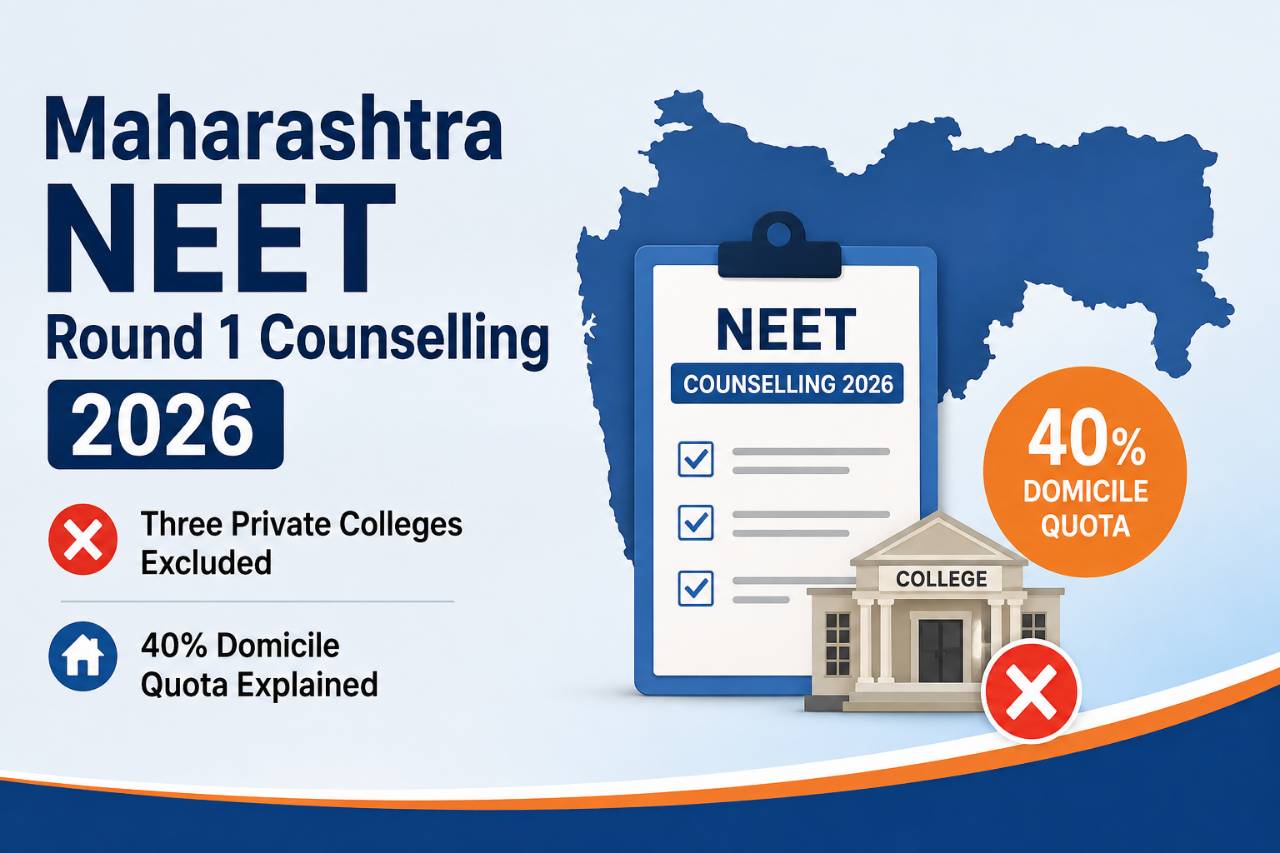

Maharashtra remains one of India's largest destinations for medical admissions, yet the 2026–27 NEET UG counselling cycle has brought an important policy shift that every MBBS and BDS aspirant must understand before locking choices. The Maharashtra State Common Entrance Test (CET) Cell, which conducts state-level medical admissions through medical2026.mahacet.org, has excluded three private institutions from the round 1 seat matrix while introducing a 40% domicile reservation and a 60% open quota for students from other states at these newly designated private university medical colleges.
For lakhs of families tracking cut-offs, fees, and scholarship eligibility, this is not a minor administrative detail. It directly affects seat availability in round 1, choice filling strategy, financial planning, and the timeline for admission to specific colleges in Ahilyanagar and Nagpur. Whether you are a Maharashtra domicile student aiming for a government seat or an out-of-state candidate exploring private options, knowing which colleges are in and which are temporarily out of the first allotment list can save weeks of confusion.
This article breaks down the official notice, explains the domicile rule in plain language, compares Maharashtra's wider medical college network (including institutions affiliated with Maharashtra University of Health Sciences Nashik), and offers practical steps for students and parents preparing for subsequent counselling rounds.
What Changed in Maharashtra NEET Round 1 Counselling 2026?
NEET UG counselling in Maharashtra follows a structured multi-round process managed by the CET Cell. In round 1, candidates register, pay fees, fill and lock preferences, and receive seat allotment based on NEET rank, category, and eligibility criteria. Most recognised MBBS and BDS colleges typically appear in the published seat matrix so that students can rank them in their choice list.
In August 2026, however, the state issued a clarification that three private medical and dental colleges would not participate in round 1. At the same time, for these institutions, the government outlined a seat-sharing formula once they enter counselling: 40% of seats for Maharashtra domicile holders and 60% for candidates from other states. This split applies specifically to the three colleges that have received or are in the process of receiving private university status not to the entire state's 85 undergraduate medical institutions.
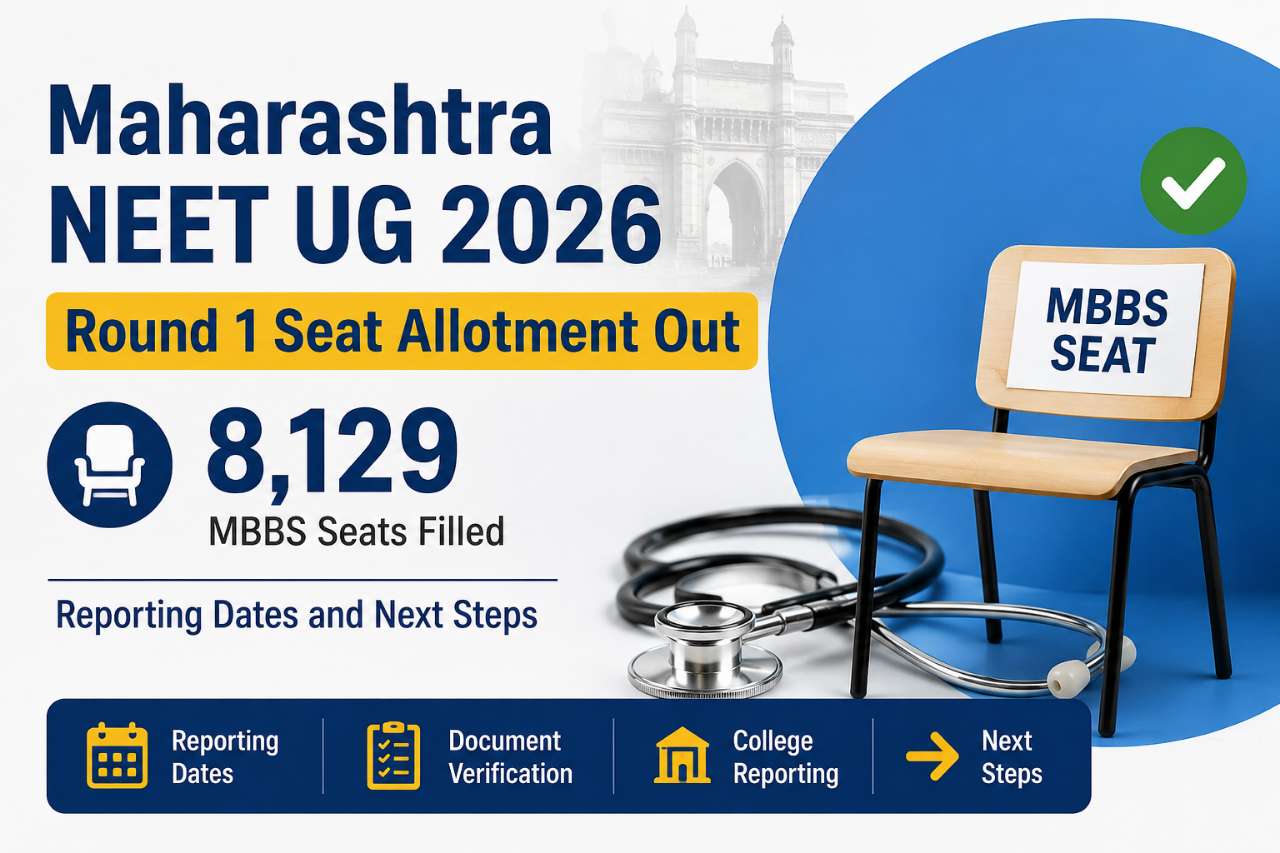
Round 1 seat allotment for Maharashtra NEET UG 2026 has already seen thousands of MBBS seats filled across participating colleges. The exclusion of these three institutes means aspirants who shortlisted them in anticipation of early admission must revise their strategy and monitor official updates for later rounds.
Key Takeaways at a Glance
- Three private colleges are absent from the round 1 seat matrix for academic year 2026–27.
- When they join counselling, 40% seats will be reserved for domicile students; 60% for other-state candidates.
- Admitted students will not receive Maharashtra government scholarship or fee reimbursement benefits.
- Fees will be fixed by each private university's Fee Fixation Committee, not state-controlled caps applicable to many trust-run colleges.
- These colleges may enter MBBS/BDS admissions in a subsequent round after private university formalities are completed.
Three Private Colleges Excluded from Round 1 Seat Matrix
The CET Cell named three institutions that will join state counselling only after establishment formalities for their respective private universities are complete. Until then, they do not appear in the round 1 allotment framework, which has led to concern among aspirants who expected these campuses to open seats immediately.
Dr Vithalrao Vikhe Patil Foundation's Medical College, Ahilyanagar
Located in Ahilyanagar (formerly Ahmednagar district), this medical college operates under the Dr Vithalrao Vikhe Patil Foundation. Ahilyanagar sits within Maharashtra's broader higher-education belt that also connects students to universities such as Kavayitri Bahinabai Chaudhari North Maharashtra University Jalgaon and Krishna Vishwa Vidyapeeth Karad Maharashtra for allied health and paramedical pathways. For NEET UG candidates, the Ahilyanagar campus represents a newer private medical seat pool that will eventually follow the 40–60 domicile split once it enters the matrix.
Action tip: If Ahilyanagar was your top choice, keep backup options among participating private and government colleges in round 1 and round 2. Do not wait for a college that is not yet listed secure a seat you can accept or upgrade later if rules permit.
NKP Salve Institute of Medical Sciences, Nagpur
Nagpur is a major medical education hub in Vidarbha. NKP Salve Institute of Medical Sciences adds to the city's cluster of health-science institutions, a region also home to universities like Maharashtra Animal Fishery Sciences University Nagpur and Maharashtra National Law University Nagpur. The institute's transition toward private university status is the stated reason for its delayed inclusion in round 1.
Students from outside Maharashtra often consider Nagpur for its relatively lower living costs compared with Mumbai or Pune. Once NKP Salve enters counselling with 60% seats open to other-state candidates, competition may intensify especially among high-ranking NEET scorers seeking private MBBS seats without domicile advantage.
Ranjit Deshmukh Dental College and Research Centre, Nagpur
Unlike the two MBBS-focused institutes above, Ranjit Deshmukh Dental College offers BDS (Bachelor of Dental Surgery) seats. Dental aspirants face a separate but equally competitive counselling track under the same Maharashtra NEET umbrella. This college, too, awaits completion of private university formalities before participating in state allotment rounds.
Action tip: BDS candidates should verify whether alternative dental colleges appear in the current round 1 matrix and note that excluded institutes may open later with the same domicile and fee rules announced for the MBBS colleges.
Understanding the 40% Domicile Quota and 60% Other-State Seats
Maharashtra domicile reservation in this context means that 40% of seats at the three specified private university medical colleges will be allocated preferentially to candidates who hold a valid domicile certificate issued by Maharashtra. The remaining 60% will be available to students from other states who meet NEET and counselling eligibility norms.
This arrangement differs from the domicile-heavy quotas seen in many state government medical colleges, where a large share of seats is reserved exclusively for state residents. Here, the policy explicitly preserves a substantial out-of-state share making these colleges potentially attractive to candidates from Uttar Pradesh, Bihar, Rajasthan, Delhi, and other states who miss cut-offs at home or at central institutions such as Maulana Azad Medical College MAMC Delhi or Vardhman Mahavir Medical College New Delhi VMMC Delhi.
Who Counts as a Domicile Student?
Generally, Maharashtra domicile is established through a certificate from the competent revenue authority, often requiring proof of continuous residence, schooling in the state, or parent domicile. Exact document requirements are published in the CET Cell's information brochure each year. Candidates should:
- Apply for domicile certificate early if not already held.
- Upload correct category and domicile documents during registration.
- Keep originals ready for physical verification at allotted colleges.
- Cross-check that the certificate matches the name and details on NEET and Aadhaar records.
How the Split May Affect Cut-Offs
When only 40% of seats compete among domicile students, cut-offs for Maharashtra residents at these three colleges could differ from the 60% pool open to all-India candidates. Domicile students may see relatively moderated ranks within their quota, while other-state students compete in a larger national pool for the majority share. Final cut-offs depend on seat intake, fees, and how many candidates prioritize these colleges in choice filling.
Why Were These Colleges Left Out of Round 1?
The official notice states that the three institutes will participate in subsequent admission rounds after completion of all necessary formalities for establishing their respective private universities. In India's regulatory framework, a medical college must satisfy National Medical Commission (NMC) norms, university affiliation or constituent status, and state approval before seats can be formally allotted through centralized counselling.
Private university status brings autonomy in governance and fee fixation but also requires legal and regulatory steps incorporation, recognition, course approval, and integration with the state seat matrix. Until those steps conclude, the CET Cell cannot responsibly include the colleges in round 1 allotment without risking invalid admissions or scholarship disputes.
This is distinct from colleges already listed in round 1 across Maharashtra's 85 undergraduate medical institutions, including 43 government and 42 private colleges. Most long-established private colleges affiliated with deemed universities or MUHS Nashik participated on schedule; the delay affects only this small set of newly upgraded campuses.
Scholarship, Fee Reimbursement, and Cost Planning
One of the most financially significant clauses in the notice is that candidates admitted to the three new private colleges will not be eligible for the Maharashtra government's scholarship or fee reimbursement scheme. Many domicile students in trust-run or partially subsidised private colleges rely on state financial aid to offset tuition. That support will not apply here.
Instead, fees determined by the Fee Fixation Committee constituted by the respective private university will govern these colleges. Private university fee committees typically set tuition, development, and hostel charges based on infrastructure costs and regulatory guidelines. Families should therefore:
- Request the approved fee structure from the college before accepting a seat.
- Budget for full private tuition without assuming state reimbursement.
- Compare total five-year MBBS cost with other private colleges already in the matrix.
- Explore education loans and institution-specific merit scholarships, if any.
Nationally, private MBBS fees at newer deemed and private university campuses have crossed very high thresholds at several institutions a trend reported widely during NEET counselling 2026. Treat fee transparency as a non-negotiable part of admission due diligence.
Maharashtra's Medical College Landscape in 2026
Context helps aspirants calibrate expectations. Maharashtra currently has 85 undergraduate medical colleges offering MBBS, comprising 43 government and 42 private institutions. Roughly 29 colleges are affiliated with MUHS Nashik, the state's dedicated health sciences university, while others are linked to deemed universities or autonomous private university structures.
Major cities anchor this network: Mumbai and Pune host premier government colleges and research hospitals; Nagpur and Aurangabad serve central Maharashtra; Nashik coordinates academic standards through MUHS. Students exploring non-medical higher education in the same state often parallel-track options at Tilak Maharashtra Vidyapeeth Pune, Maharashtra National Law University Mumbai, and Maharashtra National Law University Aurangabad but for NEET candidates, the priority remains seat matrix participation and cut-off trends in active counselling rounds.
Participating vs Delayed Colleges: A Simple Comparison
- Participating colleges (round 1): Appear in official seat matrix; eligible for choice filling, allotment, reporting, and upgradation per CET Cell schedule.
- Delayed colleges (three private university campuses): Absent from round 1; future entry with 40% domicile / 60% other-state split; no state scholarship or fee reimbursement; fees set by private university committee.
- Government colleges: Lower fees and strong domicile preference; separate seat categories under state policy.
- Established private colleges: May follow different fee and aid rules depending on trust status and affiliation.
PIMS Sangli and VIMS Palghar: The Shift from Trust to Company Structure
The counselling notice arrives amid broader structural changes in Maharashtra's private medical sector. Recently, Prakash Institute of Medical Sciences (PIMS) Sangli converted from a charitable trust model to a Section 8 company a not-for-profit corporate form that can still operate educational institutions under company law.
Similarly, Vedantaa Institute of Medical Sciences (VIMS) Palghar had earlier emerged as a notable case: it was described as the only private medical college in the state run directly by a private company rather than a traditional charitable trust. These governance shifts matter because they affect fee regulation, accountability, and eligibility for government aid programmes.
Aspirants comparing PIMS, VIMS, and the three delayed colleges should read each institution's legal status, NMC recognition letter, and counselling participation status separately. A change in corporate structure does not automatically mean exclusion from round 1 but regulatory alignment with CET Cell requirements does determine matrix inclusion.
Step-by-Step Guide for NEET Aspirants Affected by This Notice
If your preferred college is among the three excluded institutes, or if you plan to target their domicile or other-state quotas later, follow a disciplined counselling workflow.
Before the Next Round
- Download the latest seat matrix and information brochure from the official CET Cell medical counselling portal.
- Confirm whether Ahilyanagar, NKP Salve, or Ranjit Deshmukh Dental College have been added.
- Secure domicile certificate if claiming Maharashtra residency for the 40% quota.
- Shortlist participating alternatives across government and private categories.
- Calculate full course cost assuming no state fee reimbursement at the three colleges.
During Choice Filling
- Rank only colleges currently visible in the active matrix for the round you are joining.
- Place realistic safety choices below dream options to avoid blank allotment.
- Use category and quota filters correctly domicile vs all-India where applicable.
- Lock choices before the deadline; late changes are often not permitted.
After Seat Allotment
- Report to the allotted institute within the specified window with original documents.
- If waiting for an excluded college, understand freeze, float, and withdraw rules before rejecting a current seat.
- Monitor official notifications do not rely on unverified social media cut-off claims.
What to Expect in Subsequent Counselling Rounds
Maharashtra NEET counselling typically includes multiple rounds, mop-up rounds, and sometimes stray vacancy rounds after NEET UG results and central counselling timelines. The CET Cell has indicated that the three private university colleges will enter after establishment formalities are complete, which may align with round 2, mop-up, or a dedicated insertion round depending on regulatory clearance speed.
When these colleges join:
- Fresh seat numbers will be published in an updated matrix.
- Domicile and other-state quotas will apply as notified (40% / 60%).
- Candidates who already hold seats elsewhere may need to check whether upgradation or fresh registration is required for that round.
- Fee schedules from each private university's Fee Fixation Committee should be published alongside seat details.
Students who missed round 1 entirely should still complete registration if the portal allows late registration for subsequent rounds verify current year rules on medical2026.mahacet.org.
Practical Tips for Students and Parents
Verify every claim on the official portal. Counselling rumours peak during allotment week. The CET Cell website and registered newspaper notices are authoritative.
Do not pass up a secure seat indefinitely. Waiting for a college not yet in the matrix is risky if you reject a valid allotment without understanding withdrawal penalties.
Plan finances before acceptance. Without Maharashtra scholarship or reimbursement at the three institutes, total MBBS investment may rival premium private colleges elsewhere in India.
Compare with open seats nationally. Out-of-state students with strong NEET ranks should weigh these 60% quotas against options in Gujarat, Karnataka, Rajasthan, and other states conducting their own counselling.
Keep document folders organised. Domicile certificate, NEET scorecard, identity proof, class 10 and 12 certificates, caste or EWS certificates if applicable, and transfer certificate should be ready for reporting.
Use domicile strategically, not optimistically. If your domicile documentation is weak or under appeal, do not depend on the 40% pool without a backup plan in the general or other-state category where eligible.
For students also exploring flexible degree pathways outside NEET, Maharashtra offers distance and open learning through Yashwantrao Chavan Maharashtra Open University and professional programmes at Maharashtra State Skills University useful as parallel planning but not substitutes for timely medical counselling action.
Conclusion
Maharashtra's decision to exclude Dr Vithalrao Vikhe Patil Foundation's Medical College (Ahilyanagar), NKP Salve Institute of Medical Sciences (Nagpur), and Ranjit Deshmukh Dental College and Research Centre (Nagpur) from NEET UG round 1 counselling reflects pending private university formalities rather than a permanent bar on admissions. When these campuses enter the state matrix, they will operate under a clear 40% domicile and 60% other-state seat division, with fees set by private university committees and no access to Maharashtra government scholarship or fee reimbursement.
For aspirants, the path forward is proactive: track official CET Cell updates, secure domicile proof if applicable, fill choices among currently participating colleges, and budget realistically for private tuition. Maharashtra's 85 medical colleges still offer extensive MBBS opportunities in 2026 but success in counselling depends on reading the fine print, adapting to regulatory timelines, and making informed decisions at every round. Stay aligned with official notifications, and treat this policy shift as a planning signal not a dead end for your medical career goals.