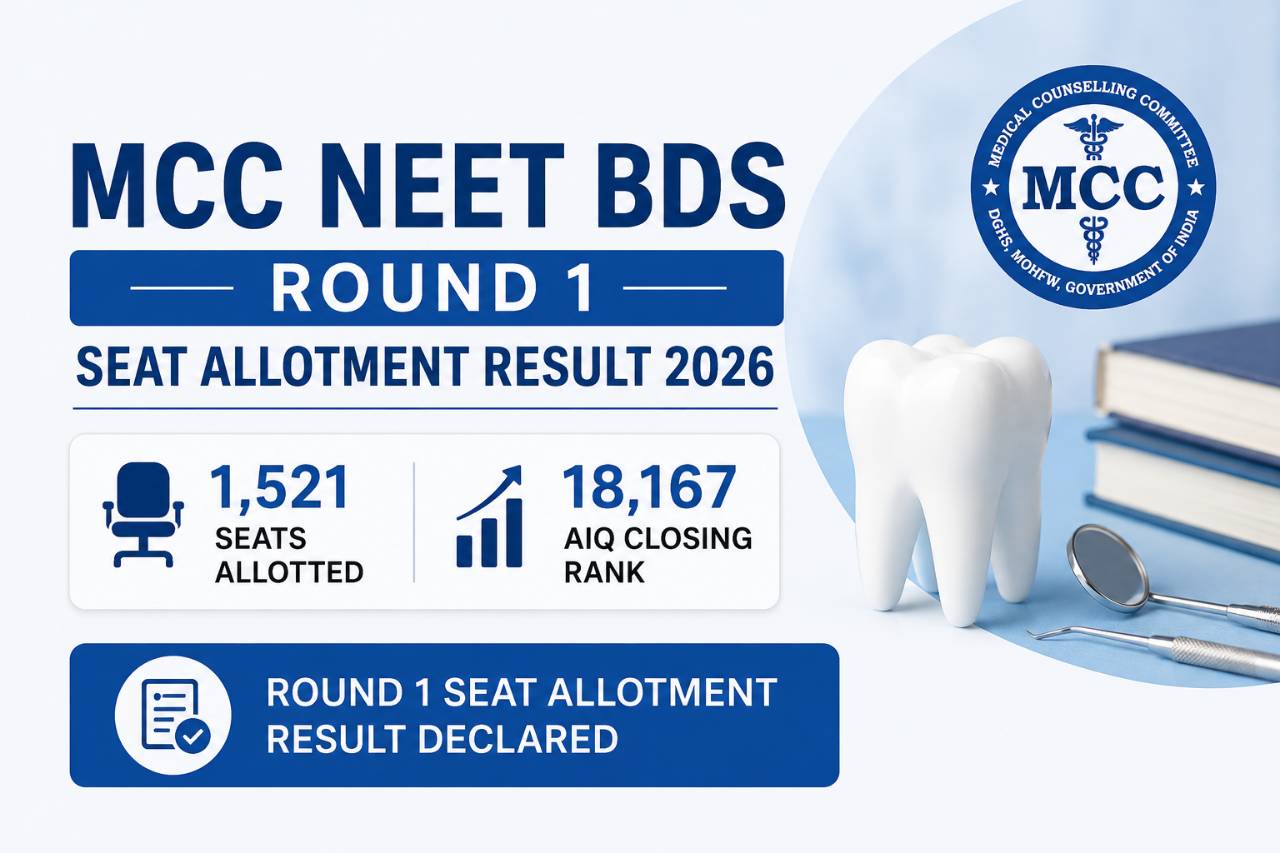

The Medical Counselling Committee (MCC) has released the provisional Round 1 seat allotment result for NEET UG BDS admissions 2026. According to the official data, 1,521 BDS seats have been allotted to candidates who participated in central counselling through mcc.nic.in. For the open (General) category, the closing rank stands at 18,167, giving aspirants a clear benchmark of how competitive this year's dental admissions have become.
If you appeared for the National Eligibility cum Entrance Test and registered for BDS counselling under MCC, this result is your first official indication of where you may study dentistry in India. This guide explains what the Round 1 allotment means, how seats are distributed across quotas, what to do after checking your result, and how to prepare for the next rounds—written in simple language for students and parents planning dental careers after NEET.
What Is the MCC NEET BDS Round 1 Seat Allotment Result 2026?
Every year, lakhs of students qualify NEET UG and compete for limited MBBS and BDS seats across government and private dental colleges. While state counselling fills most seats within each state, the Medical Counselling Committee (MCC) conducts centralised online counselling for seats under the All India Quota (AIQ), deemed universities, central universities, and certain institutional or minority quotas.
The NEET BDS Round 1 seat allotment result 2026 is the outcome of the first counselling round. Based on your NEET rank, category, choices filled during registration, and seat availability, the MCC system assigns a college, course (BDS), and quota to eligible candidates. Round 1 typically attracts the highest number of top-ranked candidates, which is why closing ranks and cut-offs observed here often set the tone for the entire admission season.
MCC has clearly stated that this Round 1 result is provisional and indicative. Candidates cannot claim any legal right to the allotted seat until the process is finalised, documents are verified, and admission fees are paid as per official instructions. Treat the result as guidance for your next steps—not as a confirmed admission letter.
Key Highlights of NEET BDS Round 1 Allotment 2026
Before diving into quota details, here is a quick snapshot of the most important numbers from the provisional Round 1 allotment:
- Total seats allotted in Round 1: 1,521
- All India Quota (AIQ) seats allotted: 457
- Largest category: Self-Financed Merit Seats — 972 seats
- Open category closing rank: 18,167
- Result status: Provisional; subject to change after verification and subsequent rounds
- Official portal: mcc.nic.in
These figures help you understand whether your rank falls within a realistic admission window for central counselling seats. Students with ranks better (lower) than 18,167 in the General category had a seat allotted in Round 1 under the open category framework reflected in the official data. Category-wise closing ranks for SC, ST, OBC, and EWS may differ and are published alongside the allotment list on the MCC portal.
Quota-Wise Seat Distribution in Round 1
Not every BDS seat in India is filled through the same quota. MCC Round 1 combines multiple seat types under one counselling umbrella. Understanding each quota helps you interpret your allotment letter correctly and plan whether to accept, upgrade, or participate in further rounds.
All India Quota (AIQ) — 457 Seats
The All India Quota allows candidates from any state to compete for a share of seats in participating dental colleges. AIQ is often the most sought-after route for students who want flexibility to study outside their home state. In Round 1, 457 AIQ BDS seats were allotted. AIQ seats generally have tighter cut-offs than many self-financed options because fees are relatively lower and colleges include well-known government and central institutions.
Students targeting premier institutions such as AIIMS Delhi or other AIIMS campuses should note that dental (BDS) programmes, where available, are highly competitive. Newer AIIMS locations—including AIIMS Bhopal, AIIMS Bhubaneswar, AIIMS Jodhpur, AIIMS Patna, AIIMS Raipur, AIIMS Rishikesh, AIIMS Guwahati, and AIIMS Nagpur—expand access to quality medical education across regions, though BDS seat availability varies by campus and year.
Self-Financed Merit Seats — 972 Seats
The Self-Financed Merit Seat category accounted for the largest share of Round 1 allotments, with 972 seats. These seats are typically associated with private or self-financing institutions where tuition fees are higher than government colleges. Merit still determines allotment—your NEET rank decides which college you receive—but the fee structure differs significantly.
Candidates allotted self-financed seats should immediately check the college's official fee schedule, bond conditions (if any), hostel costs, and refund policy before accepting. A seat in Round 1 is valuable, but financial planning is essential so that admission does not become a burden mid-course.
Institutional, Central University, and Minority Quotas
Round 1 also distributed seats under specialised quotas tied to specific universities or minority frameworks:
| Category / Quota | Seats Allotted (Round 1) |
|---|---|
| All India Quota | 457 |
| Self-Financed Merit Seat | 972 |
| Non-Resident Indian (NRI) | 32 |
| Muslim Minority Quota | 17 |
| Delhi University Quota | 14 |
| Aligarh Muslim University (AMU) Quota | 10 |
| Banaras Hindu University (BHU) Quota | 10 |
| Jain Minority Quota | 7 |
| IP University Quota | 2 |
| Total | 1,521 |
Each quota has its own eligibility rules. For example, Delhi University Quota seats may require fulfilment of domicile or institutional criteria beyond a qualifying NEET score. NRI quota seats involve separate fee structures and documentation such as NRI sponsorship proof. Always read the MCC information bulletin and the allotted college's admission notice together.
Understanding Closing Rank and Cut-Off Trends
The closing rank is the NEET All India Rank (AIR) of the last candidate who received a seat in a particular category or quota during a given round. For Round 1 2026, the open category closing rank is reported at 18,167 in the provisional allotment data.
Closing ranks are useful but must be read with context:
- Round-wise variation: Cut-offs often relax in Round 2, Round 3, and stray vacancy rounds as seats remain unfilled.
- Category-specific cut-offs: Reserved categories (SC, ST, OBC, EWS, PwBD) have separate closing ranks that are typically higher (numerically) than General.
- College-specific cut-offs: A national closing rank is an aggregate picture; individual colleges may have much tighter or looser cut-offs.
- Quota impact: AIQ and government seats usually close at better ranks than self-financed seats.
Use closing rank data as a planning tool. If your rank is close to 18,167 in the General category, you may still have options in subsequent MCC rounds or in state-level BDS counselling conducted by your domicile state's medical admissions authority.
Provisional vs Final Allotment: What Every Candidate Should Know
MCC's use of the word "provisional" is deliberate. The Round 1 list is generated automatically based on seat matrix data and candidate choices, but several checks happen before admission is confirmed.
Reasons a provisional allotment may change include:
- Document verification failure at the allotted college
- Ineligibility discovered for a specific quota (domicile, minority, NRI status)
- Non-payment of admission fee within the stipulated time
- Candidate opting for upgradation and moving to a higher choice in a later round
- Seat cancellation by the candidate or counselling authority
Actionable tip: Download your allotment result, cross-check your NEET application details (name, category certificate, PwBD status), and keep originals and photocopies of all documents ready. Even a small mismatch in spelling or category can delay or cancel admission.
How to Check Your NEET BDS Round 1 Seat Allotment Result
Candidates can access the result only through the official MCC website. Avoid third-party apps or unofficial Telegram channels that claim to show results early—they may spread incorrect information or phishing links.
Follow the official process on mcc.nic.in. You will need your NEET UG roll number, registration credentials created during MCC counselling registration, and a stable internet connection. Once logged in, verify your allotted institute name, course (BDS), quota, and category status line by line.
What to Do After Round 1 Seat Allotment
If You Have Been Allotted a Seat
Congratulations—Round 1 allotment is a strong start. Your immediate checklist should include:
- Download and print the provisional allotment letter from mcc.nic.in.
- Check reporting dates and admission schedule on the MCC website and the college website.
- Pay the required fee within the deadline mentioned in the counselling schedule. Missing the deadline can lead to automatic forfeiture of the seat.
- Report to the allotted college with original documents for verification.
- Decide on upgradation: If you wish to participate in Round 2 hoping for a better college, you must follow MCC rules—usually requiring you to join the current seat and indicate willingness to upgrade rather than simply skipping reporting.
Reporting procedures may differ slightly for central universities, deemed universities, and private colleges. Read the latest MCC public notice for BDS 2026 before travelling to the campus.
If You Have Not Been Allotted a Seat
Not receiving a seat in Round 1 is not the end of your BDS admission journey. Many candidates secure seats in later rounds when others vacate seats or when cut-offs move. Consider these parallel options:
- Register and participate in MCC Round 2 and subsequent rounds if you remain eligible.
- Apply for state counselling in your domicile state, which fills the majority of government and private BDS seats.
- Review your choice filling strategy—candidates who list only top-tier colleges often miss allotments in Round 1.
- Explore management or NRI seats only through official counselling channels, never through unverified agents.
State Counselling vs MCC Central Counselling for BDS
A common misconception among first-time NEET candidates is that MCC counselling alone covers all BDS seats in India. In reality, state medical counselling authorities fill the bulk of dental seats—including most government college seats within each state—while MCC handles AIQ slices, deemed universities, and specific institutional quotas.
If you did not register for state counselling earlier, check whether your state still allows late registration or has an upcoming round. States such as Maharashtra, Karnataka, Tamil Nadu, Uttar Pradesh, and Rajasthan run separate online portals with independent schedules. Running MCC and state counselling in parallel maximises your chances. Always verify domicile rules, as some state government seats require local residency proof.
Security Deposit, Fees, and Refund Rules
MCC BDS counselling typically requires a security deposit at registration, separate from the college admission fee due after allotment. Refund rules depend on whether you join the allotted seat, withdraw within the notified window, or fail to report. Before paying any amount, read the refund schedule in the official information bulletin.
For self-financed BDS seats, annual tuition can range widely depending on the institution. Ask the college for a written fee breakdown covering tuition, development charges, clinical fees, hostel, and caution deposit. Compare at least three allotted or potential colleges before locking choices in Round 2.
Common Mistakes to Avoid After Round 1 Allotment
- Ignoring reporting deadlines: Even a one-day delay can cancel your seat with no recovery option.
- Skipping document preparation: Missing category or PwBD certificates is a frequent reason for admission rejection.
- Trusting unofficial WhatsApp forwards: Dates and fee amounts change; only mcc.nic.in and your allotted college site are authoritative.
- Leaving choices unchanged in Round 2: Refresh your preference list based on Round 1 cut-off trends.
- Not joining before upgradation: Assuming you can hold a seat without reporting is a costly error under most MCC rules.
Important Dates and Next Steps in MCC BDS Counselling 2026
While exact dates should always be confirmed on mcc.nic.in, the typical MCC BDS counselling flow after Round 1 includes:
- Publication of Round 1 allotment result (completed)
- Reporting and admission at allotted colleges within the notified window
- Registration and choice filling for Round 2 (for eligible candidates seeking upgradation or fresh allotment)
- Round 2 seat allotment result
- Further rounds or stray vacancy round, if announced
Missing a deadline at any stage can cost you a seat even if your NEET rank is strong. Set phone reminders and check the MCC portal daily during the counselling period.
Choice Filling Strategy for Upcoming Rounds
Whether you were allotted a seat or not, smart choice filling improves outcomes in Round 2 and beyond:
- Mix ambition with realism: Include dream colleges, moderate options, and safe backups in every round.
- Research fees and bonds: Especially for self-financed seats, confirm total cost before locking choices.
- Consider location and internship exposure: Dental education benefits from clinical case volume; metro and tier-1 hospitals often provide diverse patient load.
- Do not ignore newer institutions: Colleges such as AIIMS Gorakhpur, AIIMS Jammu, AIIMS Kalyani, AIIMS Mangalagiri, AIIMS Madurai, AIIMS Rajkot, AIIMS Deoghar, AIIMS Bathinda, AIIMS Bibinagar, AIIMS Bilaspur, and AIIMS Raebareli represent expanding public healthcare infrastructure; where BDS seats exist, they can offer affordable education with strong clinical training.
- Reorder choices before each round: MCC allows modification within notified dates—use it.
BDS vs MBBS Counselling: Quick Comparison
Students often participate in both MBBS and BDS counselling tracks. While both use NEET scores, seat matrices and closing ranks differ sharply. BDS typically has more self-financed seats and a different rank curve. If you are also eligible for MBBS allotments, decide early whether your priority is medicine or dentistry, because accepting one course may affect options in the other depending on current MCC rules for the year.
Dental graduates can later pursue specialisation through exams such as NEET PG for MDS admissions—another reason to choose a college with solid clinical facilities and faculty from the start.
Documents Typically Required for BDS Admission Reporting
Although colleges may request additional papers, keep these documents ready:
- NEET UG 2026 admit card and scorecard
- MCC counselling registration printout and allotment letter
- Class 10 certificate for date of birth proof
- Class 12 mark sheet and passing certificate
- Category certificate (SC/ST/OBC/EWS) issued by competent authority, if applicable
- PwBD certificate in prescribed format, if applicable
- Domicile certificate, if required for specific quotas
- Photo ID (Aadhaar, passport, or other government ID)
- Passport-size photographs
- NRI documents for NRI quota seats
Arrive at the reporting centre with both originals and self-attested copies. Colleges may also conduct medical fitness checks as part of admission.
Conclusion
The MCC NEET BDS Round 1 seat allotment result 2026 marks an important milestone for more than 1,500 candidates who received provisional seats, with 457 under All India Quota and 972 under Self-Financed Merit categories. The open category closing rank of 18,167 offers a reference point for thousands still navigating counselling.
Remember that this result is provisional—verify every detail on mcc.nic.in, meet reporting deadlines, and prepare documents meticulously. Whether you secured a seat at a central institution like AIIMS New Delhi, a regional AIIMS campus, a DU-affiliated college, or a private dental institute, your next actions in the coming days will determine whether the allotment converts into confirmed admission.
Stay tuned to official MCC notifications for Round 2 dates, keep your state counselling registration active, and use reliable resources like CollegeDwar to compare colleges, understand exam pathways from NEET UG to postgraduate dentistry, and make informed decisions throughout the 2026 admission season.