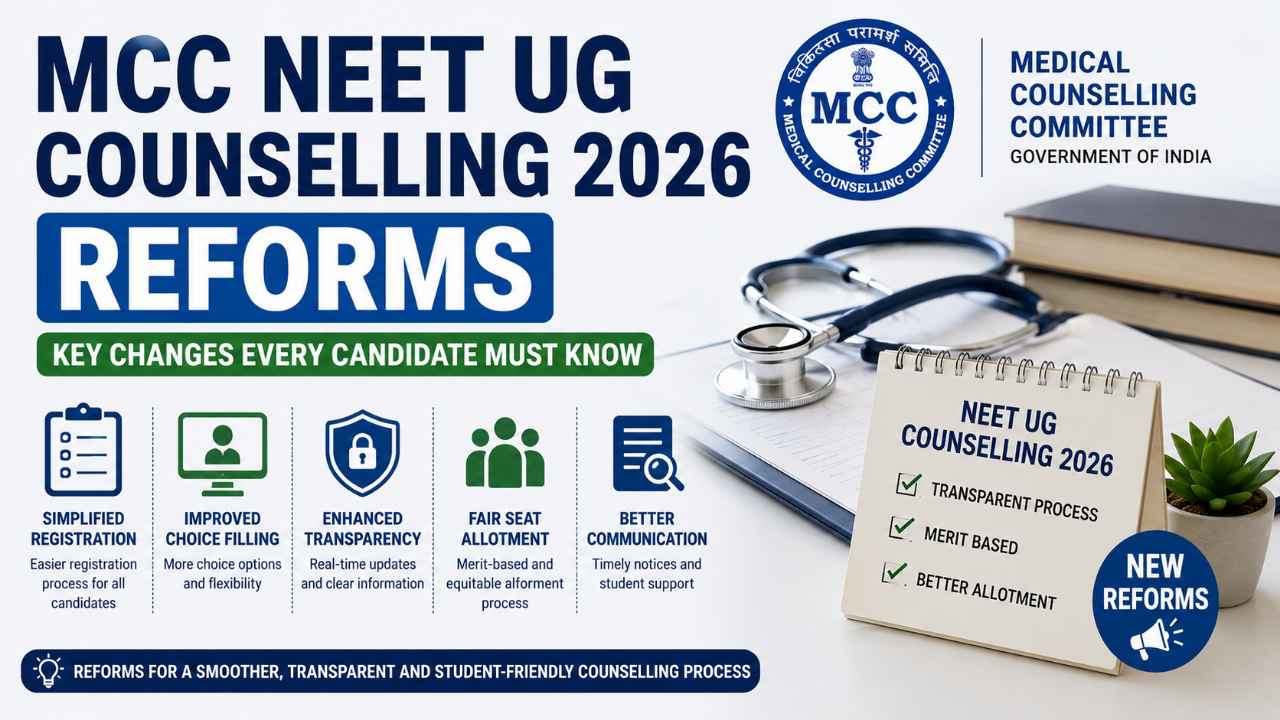

If you cleared NEET UG 2026 and are waiting for medical seat allotment, the Medical Counselling Committee (MCC) has announced important reforms for this year's process. Union Health Minister Jagat Prakash Nadda reviewed MCC preparedness in July 2026, pushing for a counselling system that is faster, more transparent, and easier for students across India.
These changes affect how you register, verify documents, choose colleges, and finally join your allotted institute. Whether you are targeting AIIMS, JIPMER, ESIC, AFMC, or 15% All India Quota (AIQ) seats in government and private medical colleges, understanding the new rules can save you time, money, and unnecessary travel. This guide explains every major reform in simple language, with practical tips for candidates and parents planning admissions in 2026.
What Is MCC NEET UG Counselling and Why Do Reforms Matter?
The Medical Counselling Committee conducts centralised online counselling for undergraduate medical and dental admissions based on NEET scores. Unlike state counselling, which handles 85% of seats within each state, MCC manages:
- 15% All India Quota (AIQ) seats in participating states
- 100% seats at central institutes such as AIIMS, JIPMER, ESIC medical colleges, and AFMC
- Deemed and central university medical institutions covered under the MCC umbrella
NTA declared NEET UG 2026 results on July 16, 2026. With lakhs of qualified candidates competing for limited MBBS and BDS seats, even small procedural delays can cost a year. Past counselling cycles often required students to visit allotted colleges multiple times for document checks, resignations, and upgradation formalities. The 2026 reforms directly address these pain points.
For context, after MBBS, many graduates later appear for NEET PG for specialisation seats. Getting the UG admission process right is the first critical step in a long medical career.
Six Major NEET UG Counselling 2026 Reforms Explained
MCC and the Union Ministry of Health and Family Welfare have rolled out six student-friendly changes. Here is what each reform means in practice.
1. One-Time Physical Reporting After Seat Allotment
Earlier, candidates choosing the Float option often had to report physically to a college after every round, even when they hoped to upgrade to a better seat in the next round. Under the new system, you report to your allotted college only once—after you accept your final seat or complete your last preferred round.
What this means for you:
- Less travel cost, especially for students from Northeast, rural areas, or distant states
- Reduced confusion about whether reporting in Round 1 blocks upgradation
- Freeze option holders can complete joining formalities immediately after allotment, as before
- Float option holders retain seat protection in the system while pursuing online upgradation
Actionable tip: Do not skip the official reporting deadline even if you are waiting for upgradation. Read the Information Bulletin carefully—MCC will specify exactly when physical reporting is mandatory for Float and Freeze candidates.
2. Online Document Verification
Document verification is shifting from repeated in-person visits to a digital workflow. Candidate details will be pre-filled from NTA records at registration. The National Medical Commission (NMC) validates the seat matrix first; then allotted institutes verify documents through the MCC portal.
Documents you should keep ready (originals and scanned copies):
- NEET UG 2026 scorecard and admit card
- Class 10 certificate (date of birth proof)
- Class 12 mark sheet and passing certificate
- Category certificate (SC/ST/OBC/EWS/PwBD) if applicable
- Domicile or state eligibility proof where required
- Photo ID (Aadhaar, passport, or other accepted ID)
- NRI or OCI documents if applying under those categories
Trained Document Verification Officers (DVOs) and college nodal officers have received fresh training for this digital process. Keep file sizes and formats as specified on mcc.nic.in to avoid upload rejections.
3. Online Resignation from Allotted Seats
Previously, resigning from an allotted seat sometimes required visiting the college or following lengthy manual procedures. Now, candidates can resign online through the MCC portal within the notified window. This is especially useful if you receive a better seat in a subsequent round or decide to participate in state counselling instead.
Important: Resignation is usually allowed only during specific periods between rounds. Missing the window may forfeit your security deposit or affect eligibility for further MCC rounds—always check the official schedule.
4. Digital NRI Document Submission
NRI, OCI, PIO, and foreign national candidates no longer need to email documents separately in most cases. They can upload required certificates directly on the MCC portal. Designated officers are trained to examine these submissions online, reducing delays and improving audit trails.
If you are an NRI aspirant, ensure passport, sponsorship, and eligibility proofs are attested as per MCC norms before uploading.
5. Expanded PwBD Assessment Centres (16 to 61)
Persons with Benchmark Disabilities (PwBD) must obtain an eligibility certificate from a designated medical board. MCC has expanded assessment centres from 16 to 61 across India, making functional disability assessment more accessible.
Key features of the PwBD framework in 2026:
- Designated Medical Boards conduct functional assessment, not just paper-based certification
- An Appellate Board handles appeals from candidates who disagree with assessment outcomes
- More centres mean shorter travel for candidates in tier-2 and tier-3 cities
Apply for PwBD assessment early—delays in certification can block counselling registration even if your NEET score is strong.
6. Cybersecurity and Technology Upgrades
MCC has reviewed cybersecurity arrangements with the National Informatics Centre (NIC) to protect candidate data during registration, choice filling, allotment, and verification. While technical details are handled at the backend, students benefit from fewer portal crashes and safer document uploads during peak traffic.
Always use the official portal mcc.nic.in and avoid third-party websites asking for login credentials or payments.
Summary Table: NEET UG Counselling 2026 Reforms at a Glance
| Reform | Earlier Practice | 2026 Change | Benefit for Students |
|---|---|---|---|
| Physical reporting | Often required after each round for Float candidates | One-time reporting after final allotment | Lower travel burden and clearer timelines |
| Document verification | Repeated in-person checks at colleges | Online verification via MCC portal with NTA pre-fill | Faster processing, fewer campus visits |
| Seat resignation | Manual or college-level process | Online resignation on MCC portal | Quicker exit for upgradation or state counselling |
| NRI documents | Email-based submission common | Portal upload with trained reviewers | Standardised, trackable submissions |
| PwBD assessment | 16 centres nationwide | 61 centres with appellate mechanism | Better geographic access and fair review |
| Portal security | Periodic upgrades | NIC-reviewed cybersecurity for 2026 | Safer data handling during peak load |
Who Can Participate in MCC NEET UG Counselling 2026?
Not every NEET qualifier goes through MCC—only those seeking seats under MCC's jurisdiction. Eligibility conditions include:
- NEET UG 2026 qualification: You must meet NTA's minimum qualifying percentile and cut-off marks for your category
- Academic requirement: Passed Class 12 with Physics, Chemistry, Biology/Biotechnology, and English
- Age limit: Completed 17 years by December 31, 2026
- Nationality: Indian nationals, NRIs, OCIs, PIOs, and foreign nationals (as per seat matrix rules)
Candidates allotted seats through MCC must also satisfy institute-specific rules—some central universities or deemed colleges may have additional clauses in the Information Bulletin.
MCC Counselling vs State Counselling: Do You Need Both?
Most students register for both MCC (for AIQ and central institutes) and their domicile state's counselling (for 85% state quota seats). You cannot hold two MBBS seats simultaneously. If you accept a seat in one system, you must resign from the other within prescribed timelines.
States release separate schedules on portals such as cetonline.karnataka.gov.in, ugsm.ac.in, or state medical counselling boards. Watch both MCC and state notices if you want maximum seat options.
NEET UG 2026 Counselling Rounds: Round 1, Round 2, Mop-Up, and Stray Vacancy
MCC typically conducts four rounds of counselling:
- Round 1: First choice filling and seat allotment based on NEET rank, category, and preferences
- Round 2: Upgradation and fresh allotment for candidates who did not join or resigned from Round 1 seats
- Mop-Up Round: Fills remaining vacant seats after Round 2
- Stray Vacancy Round: Final mop-up of isolated vacant seats at institute level
Freeze, Float, and Withdraw Options
After allotment, you choose one of these paths:
- Freeze: Accept the seat and stop participating in further upgradation rounds
- Float: Accept the seat provisionally but remain eligible for upgradation in later rounds; under 2026 reforms, your seat stays protected without repeated physical reporting
- Withdraw: Exit the round without accepting the seat (rules and fee implications vary—check the bulletin)
Example: A candidate ranked 8,000 in General category might Float after Round 1 allotment to a private medical college, hoping for a government seat in Round 2. Previously, they might have travelled to the private college to verify documents. In 2026, online verification and deferred one-time reporting reduce that burden.
How Online Document Verification Works Step by Step
Understanding the digital verification chain helps you avoid last-minute rejections:
- NTA data sync: Your name, category, NEET roll number, and basic details auto-populate when you register on mcc.nic.in
- Registration and fee payment: Complete MCC registration and pay the counselling fee plus refundable security deposit
- Choice filling: Lock preferences for colleges and courses in order of priority
- Seat allotment: MCC publishes allotment results; download the allotment letter
- Institute-level digital verification: The allotted college's nodal officer verifies uploaded documents on the portal
- Physical reporting (once): Visit the college with originals for final admission as per the notified schedule
Correction windows may open briefly after registration if NTA data mismatches your certificates—use them promptly.
Support Channels: Helpline, Email, and Official Bulletin
MCC has strengthened candidate support for 2026:
- 24x7 toll-free helpline: 1800-102-7637
- Official email: Grievances can be sent to the MCC 2026 mailbox listed on mcc.nic.in
- Information Bulletin: The primary legal document for fees, timelines, reservation, and institute lists
When calling the helpline, keep your NEET application number, registered mobile number, and allotment details handy. For complex category or PwBD issues, email often creates a documented trail.
Preparing for Medical College: Beyond Counselling
Once allotment is confirmed, focus shifts to joining formalities, hostel booking, and academic preparation. Many aspirants spend their gap year after Class 12 in coaching hubs—for example, Kota remains popular for competitive exam preparation, and institutes like the International Academy For Certification And Training Kota serve students building strong foundations before professional courses.
Medical aspirants targeting MBBS should research clinical exposure, hospital attachments, and NMC recognition of their allotted institute. Kota also hosts several health-science institutions such as Sudha Medical College and Hospital Kota, Bharat Vikas Parishad Hospital and Research Center Kota, and Sarvodaya College of Paramedical and Nursing Education Kota for allied health pathways. Dental candidates may explore Daswani Dental College and Research Center Kota as a reference point when comparing BDS options nationwide.
For veterinary sciences linked to NEET counselling in some states, institutions like the College of Veterinary and Animal Sciences CVAS Bikaner illustrate how specialised admissions run on separate state matrices even when the same entrance exam applies.
Common Mistakes to Avoid During MCC Counselling 2026
- Missing registration deadlines: MCC windows are strict; late registration is usually not permitted
- Random choice filling: List colleges in true order of preference—allotment is rank and preference driven
- Ignoring security deposit rules: Refund timelines depend on proper resignation and non-joining declarations
- Uploading blurry documents: Leads to verification failure and admission delays
- Using unofficial websites: Phishing sites spike during counselling season
- Not reading Float vs Freeze rules: Wrong choice can limit upgradation or trigger fee penalties
- Delaying PwBD assessment: Without eligibility certificate, reserved seats cannot be allotted
Timeline: What to Watch After NEET UG 2026 Results
While MCC publishes the final schedule on mcc.nic.in, candidates should monitor these milestones:
- Release of MCC Information Bulletin and registration dates
- NMC seat matrix publication for AIQ and central institutes
- Round-wise choice filling, locking, and allotment result dates
- Online verification windows for allotted candidates
- One-time physical reporting dates for joining
- State counselling parallel schedules for domicile quota seats
Bookmark mcc.nic.in and your state medical counselling portal. Enable notifications only from official sources—social media rumours about date changes are common every year.
Why These Reforms Align with Student Welfare Goals
The Health Ministry's push for technology-enabled counselling reflects broader goals: transparency, reduced harassment at college gates, equitable access for PwBD candidates, and lower financial stress on middle-class families travelling across states. Union Health Minister Nadda's review emphasised a "seamless, transparent and technology-enabled" process—language that signals continued digitisation in coming years.
For NEET UG 2026 candidates, the practical takeaway is simple: master the online portal, prepare documents digitally, use official support channels, and plan physical travel only once. Combined with disciplined choice filling and parallel state counselling awareness, these reforms can make your admission journey significantly smoother than in previous cycles.
Security Deposit, Fees, and Refund Rules You Should Know
MCC counselling requires two types of payments at registration: a non-refundable counselling fee and a refundable security deposit. The exact amounts for NEET UG 2026 will be listed in the Information Bulletin on mcc.nic.in. Generally, the security deposit is adjusted against institute fees if you join the allotted seat, or refunded if you resign within the permitted window without joining.
Refund scenarios to understand:
- If you are not allotted any seat in a round, the deposit may remain with MCC for subsequent rounds or be refunded as per bulletin rules
- If you resign online before the deadline to accept a state quota seat, refund timelines apply as notified
- Failure to report physically after accepting a seat can lead to forfeiture of deposit and debarment from further rounds
Keep payment receipts and transaction IDs. Bank refunds sometimes take several weeks after counselling ends—track status through the MCC dashboard rather than relying on unofficial WhatsApp forwards.
Reservation, Category Certificates, and PwBD Documentation
MCC counselling follows central reservation norms for AIQ seats, including categories such as General, EWS, OBC-NCL, SC, ST, and PwBD. Your NEET application category must match your uploaded certificate. Discrepancies between NTA records and certificate details are a leading cause of verification failure.
For OBC-NCL, ensure your certificate is issued in the current financial year and names the issuing authority recognised by MCC. PwBD candidates must obtain the functional assessment-based eligibility certificate from one of the 61 designated centres before choice filling for reserved seats. If assessment is pending, you may be treated as General category for allotment purposes until certification is complete—plan timelines accordingly.
Expert Tips for Choice Filling and Seat Strategy
Choice filling is where most rank improvement—or loss—happens after the exam. Treat it as a data-driven exercise, not guesswork:
- Study previous years' AIQ closing ranks for your category on mcc.nic.in or trusted education portals
- Place dream colleges higher, but include realistic safety options lower in the list
- Do not leave the list too short—unfilled lower preferences mean no allotment even if seats exist
- For BDS versus MBBS, decide your minimum acceptable course before locking choices
- Discuss budget for private medical colleges upfront; tuition and hostel costs vary widely
Parents and students in coaching ecosystems—whether in Kota, Delhi, or other hubs—often benefit from structured counselling guidance alongside self-research on official portals. The goal is an informed preference list aligned with your NEET rank, category, and financial plan.
Conclusion
MCC's NEET UG Counselling 2026 reforms mark a meaningful shift toward digital-first admissions—one-time physical reporting, online document verification, portal-based resignation, digital NRI submissions, 61 PwBD assessment centres, and NIC-backed cybersecurity together address long-standing student grievances. With results already declared on July 16, 2026, qualified candidates should prepare documents now, study the upcoming Information Bulletin on mcc.nic.in, and register the moment counselling opens.
Whether your goal is a premier central institute or an AIQ seat in your preferred state, understanding Freeze and Float rules, verification timelines, and support helplines at 1800-102-7637 will put you ahead of lakhs of competitors. Stay on official portals, avoid misinformation, and treat choice filling as seriously as the NEET exam itself—your medical career begins with these counselling decisions.