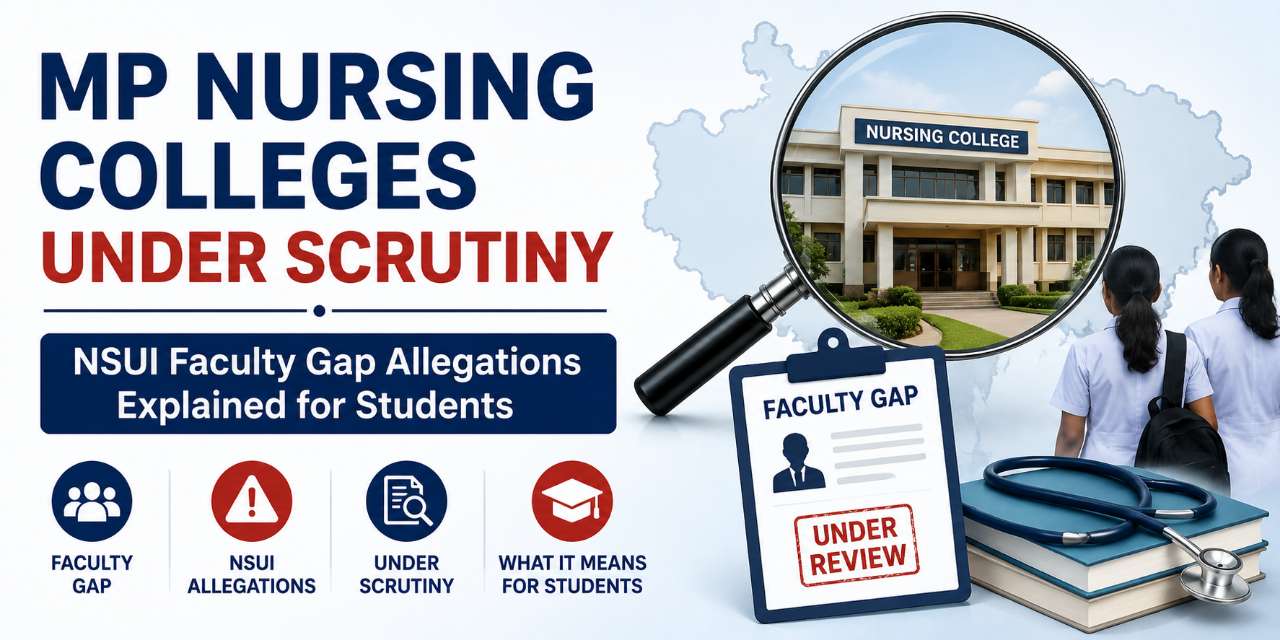

Madhya Pradesh's government nursing colleges are back in the headlines. On August 23, 2026, the National Students' Union of India (NSUI) alleged serious staffing gaps and submission of forged faculty experience certificates at several state-run institutions seeking recognition for the 2026-27 academic session. For students planning a nursing career, these claims are not abstract politics they directly affect classroom quality, clinical training, exam eligibility, and whether your degree will be accepted by hospitals and nursing councils.
This guide explains what NSUI has alleged, how MP's 2018 nursing recognition rules work, the wider regulatory crisis in the state, and what you should verify before taking admission anywhere in India. Whether you are comparing colleges in Bhopal, Indore, Gwalior, or looking at options in Rajasthan and Tamil Nadu, the checklist here helps you choose with confidence.
What NSUI Alleged About MP Government Nursing Colleges
At a press conference in Bhopal on Sunday, August 23, 2026, NSUI state vice-president Ravi Parmar raised concerns about anomalies in Madhya Pradesh's government-run nursing colleges. The student organisation, affiliated with the Congress, claimed that multiple institutions are operating without the administrative and teaching staff mandated under state recognition norms.
According to NSUI's public statements reported in national media, the key allegations include:
- Six government nursing colleges are functioning without a principal.
- Ten colleges do not have a vice-principal in place.
- Many institutions lack the minimum faculty strength required under the Madhya Pradesh government's 2018 recognition regulations.
- Some colleges allegedly submitted forged or fabricated experience certificates of faculty members while applying for recognition for the 2026-27 session.
NSUI has demanded a high-level inquiry and warned of agitation if authorities do not act. An advocate present at the press conference stated that the organisation has filed a petition in the Madhya Pradesh High Court seeking an investigation and action against those responsible if the allegations are proven.
It is important to note: these are allegations at the time of reporting. The colleges, the state government, and regulatory bodies may respond with clarifications or counter-evidence. As a prospective student or parent, treat this as a signal to verify not as a final verdict on any single institution.
Recognition for 2026-27: What 22 Government Colleges Applied For
NSUI stated that 22 government nursing colleges in Madhya Pradesh submitted applications for recognition for the 2026-27 academic year. Of these, three were not granted recognition, according to the organisation's claims at the press conference.
Recognition is not a formality. It confirms that a college meets minimum standards for infrastructure, affiliated hospital access, library and lab facilities, and critically qualified faculty. Without valid recognition from the competent authority and affiliation with the relevant university, students risk completing a programme that may not be accepted for registration with the state nursing council or for employment in government and private hospitals.
Why the 2018 MP Recognition Rules Matter
An advocate cited at the NSUI press conference explained that Madhya Pradesh's 2018 recognition regulations prescribe clear minimum faculty requirements for nursing colleges. For an intake of 30 students, the rules reportedly require:
- One principal
- One vice-principal
- Two associate professors
- Additional teaching staff as specified in the norms
These thresholds exist because nursing education is clinical at its core. A student in a BSc Nursing programme spends substantial time in skills labs, community health postings, and hospital wards. Short-staffed colleges often compensate with recorded lectures, irregular practical sessions, or overburdened preceptors each of which weakens graduate readiness.
MP Nursing Colleges in Context: A Long-Running Regulatory Crisis
The August 2026 NSUI allegations did not emerge in a vacuum. Madhya Pradesh has faced scrutiny over nursing college quality for several years, with court-directed probes and large-scale closures making national news.
High Court and CBI Scrutiny
The Madhya Pradesh High Court has heard multiple public interest litigations concerning nursing institutions that allegedly lacked adequate infrastructure, faculty, and mandatory facilities. In an earlier phase of this crisis, the court ordered a Central Bureau of Investigation (CBI) examination of nursing colleges in the state.
Figures cited during court proceedings have been striking: of hundreds of nursing colleges once operating in MP, a large share was found unsuitable and barred from academic activity, while others were allowed to operate only after correcting deficiencies. CBI reports submitted to the court have described colleges with poor ventilation, insufficient toilets, missing clinical facilities, and in some cases institutions continuing to list faculty despite closure or non-renewal of permissions.
For students, the lesson is clear: historical recognition on a brochure is not enough. You must check current-year recognition status, affiliation, and council registration pathways before paying fees.
Why Faculty Shortages Hurt More Than Other Gaps
Missing buildings or outdated equipment are visible problems. Missing faculty is easier to hide on paper especially if experience certificates are allegedly fabricated. Nursing programmes require:
- Theory instruction in anatomy, pharmacology, medical-surgical nursing, obstetrics, psychiatry, and community health
- Skills lab supervision for injections, catheterisation, wound care, and emergency protocols
- Clinical preceptorship in medicine, surgery, paediatrics, orthopaedics, and OBG departments
- Research and exam preparation aligned with university and Indian Nursing Council (INC) frameworks
When principals and vice-principals are absent, academic governance suffers timetables slip, hospital tie-ups weaken, and internal quality checks disappear. When associate professors and clinical instructors are missing, students bear the cost at the bedside, where errors have real consequences for patients.
NEET and State Counselling: Where Nursing Admissions Fit In
Most BSc Nursing seats in India are filled through NEET UG scores and state counselling. Madhya Pradesh conducts its own allotment process for recognised institutions. When colleges apply for fresh recognition as 22 government campuses did for 2026-27 students must confirm that their allotted college appears on the official approved list for that session.
Do not assume last year's counselling PDF applies this year. Recognition can change year to year, especially when inspections expose staffing gaps. Save screenshots or downloaded PDFs from official portals dated after seat allotment. If a college's name disappears from updated lists, contact the state counselling cell immediately before paying hostel or kit fees.
How MP Compares With Other States: What Strong Nursing Colleges Look Like
Regulatory stress is not unique to Madhya Pradesh, but the scale of MP's nursing sector cleanup has been exceptional. Students often compare options across states. Well-run institutions whether government or private tend to share visible traits you can evaluate before admission.
Signs of a Credible Nursing College
- Named, verifiable faculty listed on the college website with qualifications (BSc Nursing, MSc Nursing, PhD) and registration numbers where applicable
- Parent hospital or formal clinical tie-ups with bed strength adequate for student rotations
- Current recognition and affiliation documents for the admission year not prior years only
- Transparent fee structure and published admission criteria through NEET or state counselling where applicable
- Active alumni placement in recognised hospitals, including government facilities
Students exploring alternatives outside MP often research established colleges such as SRM College of Nursing Chennai in Tamil Nadu or Rajasthan College of Nursing Jaipur. These comparisons are not endorsements; they illustrate how applicants routinely benchmark faculty profiles, hospital attachments, and council approvals when deciding where to study.
In Rajasthan's nursing hub cities, applicants frequently evaluate multiple options side by side institutions like Government Nursing College Kota, Jaiswal Nursing College Kota, and Sudha College of Nursing Kota precisely because reputation alone is insufficient without checking current approvals.
Faculty Norms at a Glance: MP 2018 Rules vs Student Expectations
The table below summarises what regulators expect versus what students should insist on during campus visits or counselling.
| Parameter | Regulatory expectation (MP 2018 norms, intake 30) | What students should verify |
|---|---|---|
| Principal | One full-time principal | Name, qualification, joining date, office availability |
| Vice-principal | One full-time vice-principal | Role in academics and clinical coordination |
| Associate professors | Two | Subject allocation and weekly teaching load |
| Clinical instructors / tutors | As per norms | Presence during ward postings |
| Experience certificates | Genuine, verifiable service records | Cross-check with previous employers if possible |
| Recognition status | Valid for admission year | Written confirmation from university or council |
NSUI's allegation that some colleges submitted forged faculty experience certificates, if proven, would represent a serious breach of trust. Fabricated credentials undermine the entire quality assurance chain from university inspection to council registration.
Impact on Students: Admissions, Exams, and Registration
When nursing colleges operate below norms, students face layered risks:
1. Disrupted academic calendars
Court cases and sudden closure orders can delay exams, internships, and convocation. Students mid-programme may be forced to migrate or repeat clinical postings adding cost and stress.
2. Registration with the state nursing council
Graduates typically register with bodies such as the Madhya Pradesh Nurses Registration Council (MPNRC). If a college loses recognition retroactively or fails inspection, registration may be delayed or denied, affecting eligibility for government jobs and work abroad.
3. Employment and patient safety concerns
Hospitals increasingly verify council registration and college credentials. A weak programme does not just limit careers it can leave graduates underprepared for ward duty.
4. Financial loss
Hostel fees, clinical kit charges, and travel for postings are significant. Due diligence before admission prevents sunk costs at non-compliant institutions.
What NSUI Wants: Inquiry, Accountability, and Student Protection
NSUI's immediate demands, as reported, include a detailed examination of staffing positions across government nursing colleges, verification of faculty documents submitted for 2026-27 recognition, and action against officials if forgery or negligence is established. The organisation has also indicated willingness to escalate through agitation if grievances remain unaddressed.
From a student welfare perspective, these demands align with broader calls for:
- Public disclosure of college-wise faculty rosters
- Independent verification of experience certificates
- Clear communication to enrolled students when institutions fail inspection
- Migration pathways for affected batches where closures occur
How to Choose a Nursing College Safely: Actionable Checklist
Use this practical checklist whether you apply in Madhya Pradesh, Rajasthan, Delhi NCR, or elsewhere.
Before counselling or direct admission
- Confirm the college name matches the official recognition list for the current academic year.
- Verify affiliation with the stated university cross-check on the university website.
- Read the BSc Nursing course structure: duration, internship hours, and exam pattern.
- Ask for the clinical affiliation letter and visit the hospital if possible.
During campus visit or open house
- Meet faculty listed for your year not only admission counsellors.
- Inspect skills labs, simulation equipment, library, and hostel separately.
- Request the previous year's university exam results and council registration outcomes for graduates.
- Speak to current students about ward posting frequency and supervision.
Red flags that warrant extra scrutiny
- Reluctance to share recognition or affiliation letters
- Principal or vice-principal posts described as "in process" for multiple years
- Faculty names on brochures that do not appear on campus
- Pressure to pay full fees before seat allotment confirmation
- Claims of "guaranteed registration" without council documentation
In Rajasthan's Sikar region a major nursing education cluster students apply similar scrutiny across institutions such as Sikar Nursing College, Rajasthan College of Nursing Sikar, Swami Keshwanand College of Nursing Sikar, and Government Girls School of Nursing Sikar. The geographic spread of options makes comparative verification essential.
Similarly, Kota hosts numerous nursing and paramedical campuses including Madhav College of Nursing Kota, Arihant College of Nursing Kota, Daswani Nursing College Kota, and Florence Nursing College Kota where applicants should never skip document verification because a city has many colleges.
Role of Regulatory Bodies: INC, State Councils, and Universities
Nursing education in India operates under multiple layers:
- Indian Nursing Council (INC) sets national standards for programmes and prescribes minimum requirements.
- State nursing councils (such as MPNRC in Madhya Pradesh) handle registration of practitioners.
- State governments issue recognition under local rules such as MP's 2018 regulations cited in the NSUI allegations.
- Universities (for example, Madhya Pradesh Medical Science University for many nursing colleges) grant affiliation and conduct examinations.
When allegations involve forged certificates submitted for recognition, accountability questions extend to inspection committees, document verification desks, and institutional leadership not only to individual colleges.
Students comparing regulatory ecosystems may also review how state councils publish information. For instance, applicants researching ayurvedic nursing pathways in Rajasthan encounter bodies like the Rajasthan Ayurvedic Nursing Council, which underscores that different nursing streams have different registration routes always match your course type to the correct council.
Expert Perspective: Why Due Diligence Is Non-Negotiable in 2026
India needs more qualified nurses not more certificates. The NSUI allegations highlight a recurring pattern in professional education: rapid expansion without proportional faculty hiring and governance. For families investing years and lakhs of rupees in nursing education, verification is cheaper than litigation.
Counsellors and educators consistently recommend:
- Prioritise government colleges with stable recognition when seats are available through merit counselling.
- For private colleges, insist on written undertakings tied to recognition status for your batch year.
- Keep copies of every fee receipt, prospectus, and admission letter.
- Follow High Court and council notifications if you are already enrolled in a college under scrutiny.
Top medical universities attached to leading hospitals such as Vardhman Mahavir Medical College (VMMC) Delhi and Maulana Azad Medical College (MAMC) Delhi set high benchmarks for clinical exposure. Nursing applicants need not study at an MBBS college, but they should expect similarly structured oversight of hospital training.
What Happens Next in Madhya Pradesh
As of August 23, 2026, the NSUI allegations are part of an active political and legal conversation. The Madhya Pradesh High Court petition seeks formal inquiry and punitive action if wrongdoing is confirmed. Possible outcomes include:
- Court-ordered verification of faculty documents for 2026-27 recognition applicants
- Withholding or revoking recognition for colleges that fail audit
- Administrative transfers or suspensions if forgery is established
- Directions for student protection, including migration or fee refunds for affected batches
Students should monitor official notifications from the state medical education department, MPNRC, and affiliating universities rather than relying on social media rumours alone.
Questions to Ask Any Nursing College Before You Enroll
Bring this short question list to counselling centres, open houses, or phone calls with admission desks. A credible institution will answer clearly; evasive replies are data points in themselves.
- Who is the current principal and vice-principal, and since when have they held these posts?
- Is recognition valid specifically for the 2026-27 batch I am joining?
- Which hospital departments will I rotate through in the first and final year?
- How many students share each clinical instructor during ward duty?
- What percentage of last year's graduates received MPNRC or state council registration without delay?
Writing down answers creates a paper trail. If later disputes arise as they have in MP's prolonged nursing litigation documented responses help students assert their rights before courts and ombudsman offices.
Conclusion
The NSUI allegations against Madhya Pradesh government nursing colleges missing principals and vice-principals, inadequate faculty under 2018 recognition rules, and claims of forged experience certificates for the 2026-27 session serve as an urgent reminder for every nursing aspirant in India. Quality nursing education depends on qualified, present faculty and honest regulatory compliance, not just buildings and brochures.
If you are seeking admission this year, use recognition lists, faculty rosters, hospital tie-ups, and council registration track records as your primary filters. Compare options carefully whether in MP or at established institutions like SRM College of Nursing Chennai or Rajasthan College of Nursing Jaipur and never hesitate to ask colleges hard questions about who will teach you and where you will train clinically.
In a sector where patient safety and graduate employability are at stake, informed choices are your strongest protection.