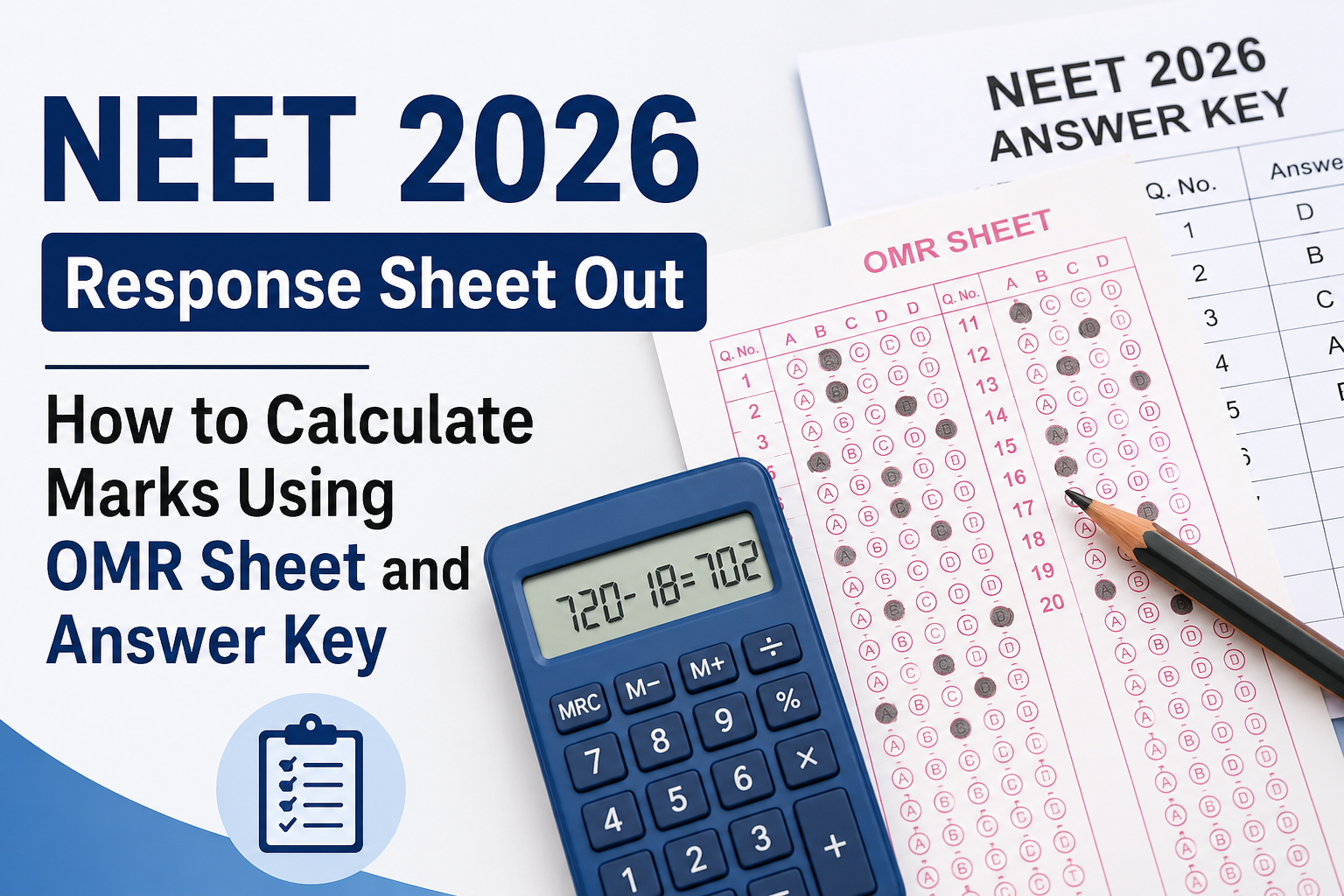

The National Testing Agency (NTA) has released the NEET 2026 response sheet along with the provisional answer key on the official portal neet.nta.nic.in. For the more than 20 lakh students who appeared for NEET UG 2026, this is the first transparent window to check what the scanning system recorded on their OMR sheet and compare those responses against NTA's officially accepted answers. Instead of waiting anxiously for the result, you can now calculate a reliable expected score, spot recording errors early, and plan your next steps for MBBS, BDS, BAMS, BHMS, and other medical admissions across india.
This article is written for Indian medical aspirants and parents who want a clear, practical explanation of how the NEET 2026 OMR response sheet works, how it differs from the answer key, and how to calculate marks without mistakes. Whether you appeared for the main exam or the re-NEET session, the process remains largely the same: download your response sheet, match it with the correct paper code answer key, apply the official marking scheme, and use your estimated score to understand admission possibilities. Read through each section carefully before you start tallying answers, because small errors in paper code matching or question counting can change your expected score significantly.
What Is the NEET 2026 Response Sheet?
The NEET 2026 response sheet, also called the OMR response sheet or recorded response document, is NTA's digital copy of the answers captured from your OMR sheet during evaluation. It shows question numbers and the option (A, B, C, or D) that the system recorded for each attempt. In many cases, NTA also displays a scanned image of your actual OMR sheet so you can visually confirm whether your bubbling was read correctly.
This document serves three important purposes for candidates:
- Transparency: You can see exactly what was scanned, not what you think you marked from memory.
- Verification: You can identify misread bubbles, blank responses, or technical recording issues before results are finalized.
- Score estimation: Once cross-checked with the provisional answer key, your recorded responses become the basis for calculating expected NEET marks.
The response sheet is candidate-specific and login-protected. Unlike the answer key, which is released paper-code wise for all students, your response sheet belongs only to you and reflects your individual performance in Physics, Chemistry, and Biology (Botany and Zoology).
Response Sheet vs Scanned OMR Image
Many students confuse the recorded response PDF with the scanned OMR image. The recorded response is a machine-readable list of your answers. The scanned image is a photograph of your physical OMR sheet. Both should ideally match. If they do not, you may need to raise an objection within the challenge window announced by NTA. Always download and save both files immediately after login, because access may be time-bound.
NEET 2026 Response Sheet vs Provisional Answer Key
Although NTA releases the response sheet and provisional answer key around the same time, they answer different questions. Understanding this difference is essential for accurate score calculation and for knowing which document to use when raising challenges.
- Response sheet tells you: "What did the system record as my answer?"
- Provisional answer key tells you: "What does NTA consider the correct answer for each question in my paper code?"
Here is a quick comparison:
- Released by: Both are released by NTA on the official NEET portal.
- Contains: Response sheet has your marked options; answer key has officially accepted correct options.
- Purpose: Response sheet is for verification; answer key is for evaluation against the marking scheme.
- Used for: Response sheet helps detect scanning errors; answer key helps calculate marks.
- Format: Response sheet is individual; answer key is shared by paper code (for example, Q1, Q2, R1, S3, etc.).
Your expected score comes from comparing these two documents. Never use a coaching institute's unofficial answer key as the final basis for objections. For official challenges and score estimation before results, rely only on NTA's provisional key matched with your response sheet.
NEET 2026 Marking Scheme Explained
Before you calculate NEET 2026 marks, you must apply the exact marking pattern prescribed by NTA. The NEET UG exam follows a standardized negative-marking system designed to reduce guessing and reward accuracy.
Official NEET 2026 Marking Pattern
- Correct answer: +4 marks
- Incorrect answer: −1 mark (negative marking)
- Unattempted question: 0 marks
- Questions with multiple responses: Treated as incorrect unless NTA specifies otherwise in official notifications
The NEET UG question paper contains 200 questions, of which candidates attempt 180. The maximum score remains 720 marks (180 × 4). Sections are divided into Physics (45 questions), Chemistry (45 questions), and Biology (90 questions covering Botany and Zoology).
NEET 2026 Score Calculation Formula
Use this official formula to estimate your score:
Total NEET Score = (Number of Correct Answers × 4) − (Number of Incorrect Answers × 1)
Example: If you have 140 correct, 30 incorrect, and 10 unattempted responses among the 180 questions you answered, your score would be:
(140 × 4) − (30 × 1) = 560 − 30 = 530 marks
Unattempted questions do not add or subtract marks. They simply reduce your scoring opportunity. This is why accuracy matters as much as attempt rate in NEET.
Subject-Wise Marks Calculation
For deeper analysis, calculate subject-wise expected scores separately:
- Physics score = (Physics correct × 4) − (Physics incorrect × 1)
- Chemistry score = (Chemistry correct × 4) − (Chemistry incorrect × 1)
- Biology score = (Biology correct × 4) − (Biology incorrect × 1)
Biology carries the highest weightage with 90 questions, so strong Botany and Zoology performance often decides overall rank. Physics and Chemistry balance is equally important for students targeting top government medical colleges.
How to Download NEET 2026 OMR Response Sheet and Answer Key
Both documents are available only through the candidate login section on the official NTA NEET website. Keep your application number, password or date of birth, and security pin ready before you begin.
Documents You Need Before Login
- NEET 2026 application number
- Password created during registration (or date of birth, as applicable on the portal)
- Access to the mobile number and email registered with NTA
- Your question paper code noted from the exam booklet or admit card
Steps to Download on neet.nta.nic.in
- Visit the official website: neet.nta.nic.in or the NTA exams portal.
- Click on the candidate login link for NEET UG 2026.
- Enter your application number and password or date of birth.
- Complete any security verification shown on screen.
- Select the option for View OMR Sheet / Recorded Responses.
- Download the PDF and save a backup copy on your phone and email.
- Return to the dashboard and open Provisional Answer Key.
- Download the answer key PDF for your exact paper code only.
Important tip: Paper code mismatch is the most common reason for wrong score calculation. If your booklet code is Q3, do not use the Q1 or R3 answer key even if questions appear similar. Always use the key that exactly matches your booklet code printed on the exam paper.
Step-by-Step: Calculate NEET 2026 Marks Using OMR Sheet and Answer Key
Once both documents are downloaded, follow this structured method to calculate your expected NEET 2026 score with minimum error.
Step 1: Organize Your Working Sheet
Create a simple tally table with columns for question number, your recorded response, official answer, and result (Correct / Incorrect / Unattempted). You can use a notebook, spreadsheet, or trusted NEET score calculator tool. Manual tallying is often more accurate because it forces you to check every question.
Step 2: Match Question by Question
Start from Question 1 and move sequentially to Question 180 (or the full 200 if you are reviewing unused sections). For each question:
- Read the option recorded on your response sheet.
- Compare it with the official answer in the provisional key.
- Mark as correct if both match exactly.
- Mark as incorrect if your recorded answer differs from the official answer.
- Mark as unattempted if your response sheet shows blank or no response captured.
Step 3: Count Totals Carefully
After completing all questions, count:
- Total correct responses (C)
- Total incorrect responses (I)
- Total unattempted responses (U)
Verify that C + I + U equals the number of questions you are evaluating (typically 180 attempted out of 200 total). If the total does not match, recheck before applying the formula.
Step 4: Apply the Official Formula
Substitute your counts into the formula:
NEET Score = (C × 4) − (I × 1)
Round to the nearest whole number. NEET scores are reported as whole numbers on the final scorecard.
Step 5: Cross-Verify With a Second Pass
Ask a parent, mentor, or study partner to independently verify at least 20 random questions, especially in Biology where question numbers are long and repetitive. A second review often catches transposition errors and skipped rows.
Worked Example for Clarity
Suppose after matching your response sheet with the provisional answer key you find:
- Physics: 32 correct, 11 incorrect, 2 unattempted
- Chemistry: 30 correct, 13 incorrect, 2 unattempted
- Biology: 68 correct, 20 incorrect, 2 unattempted
Overall: 130 correct and 44 incorrect (assuming 180 attempted)
Score = (130 × 4) − (44 × 1) = 520 − 44 = 476 marks
This is an expected score, not the final result. NTA may revise answers after the challenge window, which can increase or decrease your final marks.
Common Mistakes While Calculating NEET 2026 Score
Even bright students make procedural errors during score calculation. Avoid these pitfalls to protect the accuracy of your estimate.
- Using the wrong paper code answer key: Always confirm the code on your OMR and admit card before downloading the key.
- Confusing response sheet with memory: Calculate only from NTA's recorded responses, not what you remember marking in the exam hall.
- Counting unattempted as incorrect: Blank answers carry zero marks; they should not be added to the incorrect tally.
- Ignoring multiple marked responses: If two options appear recorded, treat the question based on NTA's official policy for invalid responses.
- Skipping scanned OMR verification: Always compare the scanned image with the recorded response list.
- Rounding too early: Apply the formula once at the end, not after each section.
- Using unofficial answer keys for challenges: Coaching keys help for practice analysis but not for official objections.
NEET 2026 Answer Key Challenge Window: What You Should Know
After releasing the provisional answer key and response sheet, NTA opens a limited challenge window during which candidates can submit objections online. This window is crucial if you believe a question has multiple correct answers, an error in the key, or a mismatch between your scanned OMR and recorded response.
When and How to Challenge
- Log in to the NEET candidate portal during the announced challenge period.
- Select the question you wish to challenge.
- Upload supporting explanation or reference, as permitted by NTA.
- Pay the prescribed objection fee per question (refunded if the challenge is accepted, as per NTA rules).
- Save the payment receipt and challenge confirmation for future reference.
Only challenges submitted within the deadline are considered. Late objections are not accepted. After reviewing all valid challenges, NTA releases the final answer key, which is used to prepare the NEET 2026 result and rank.
Should You Challenge or Not?
Challenge only when you have a strong, evidence-based reason such as a clearly misread OMR bubble visible on the scanned sheet or a demonstrably incorrect official key supported by standard textbooks. Random challenges without justification waste time and money. Discuss doubtful questions with your teachers before submitting.
What to Do After Calculating Your NEET 2026 Expected Score
Once you have a reliable expected score, shift focus from calculation to planning. Your estimated marks help you understand broad admission trends, but final rank depends on overall candidate performance and any answer key revisions.
Estimate Rank and Cutoff Range
Compare your expected score with previous years' NEET marks vs rank trends and category-wise cutoffs for MBBS and BDS seats. Treat this as a planning range, not a guarantee. Cutoffs change every year based on paper difficulty, number of candidates, and seat matrix.
Explore Medical and Allied Health Colleges
Start researching institutions aligned with your expected score band. Beyond MBBS and BDS, NEET qualifies candidates for several allied programmes. Students interested in veterinary sciences may explore options such as College of Veterinary and Animal Sciences CVAS Bikaner. Ayurveda aspirants can review colleges like Jaipur College of Ayurved and Pharmacy Jaipur.
In rajasthan medical education hub, institutions such as Sudha Medical College and Hospital Kota, Daswani Dental College and Research Center Kota, and Bharat Vikas Parishad Hospital and Research Center Kota remain popular among NEET candidates exploring diverse healthcare pathways. Use CollegeDwar college pages to compare fees, courses, and location before counselling begins.
Prepare Documents for Counselling
While waiting for results, organize your category certificate, domicile documents, class 10 and 12 mark sheets, identity proof, and passport-size photographs. MCC conducts All India Quota counselling for MBBS/BDS, while state authorities manage state quota seats. Keep track of both schedules if you plan to participate in multiple rounds.
Stay Updated on Final Answer Key and Result
After the challenge window closes, NTA publishes the final answer key followed by the NEET 2026 result and scorecard. Recalculate your score using the final key if any answers change. Your official AIR (All India Rank) and category rank on the scorecard—not your estimated score—will determine counselling eligibility.
NEET 2026 Result Timeline and What Happens Next
Although exact dates are announced by NTA through official notifications, the typical sequence after the response sheet release looks like this:
- Release of provisional answer key and response sheet
- Challenge window for answer key and OMR-related objections
- Expert review of submitted challenges
- Release of final answer key
- Declaration of NEET UG 2026 result and scorecard
- MCC and state counselling registration
Candidates planning postgraduate medical courses in future years should also stay familiar with the separate NEET PG process, which follows a different schedule and counselling structure under the National Medical Commission.
Expert Tips for Accurate Score Estimation and Peace of Mind
- Download immediately: Do not wait until the last day of portal access.
- Calculate in a quiet block: Score tallying requires focus; avoid distractions.
- Separate emotion from analysis: An unexpected low score on one section is data, not a final verdict until results arrive.
- Keep proof: Save PDFs, challenge receipts, and your calculation sheet until admission is confirmed.
- Use trusted sources: Follow only NTA and official counselling websites for dates and rules.
- Plan multiple scenarios: Prepare backup options across MBBS, BDS, AYUSH, and other NEET-based courses.
Conclusion
The release of the NEET 2026 response sheet and provisional answer key gives medical aspirants a transparent opportunity to verify OMR-recorded answers and calculate expected marks before official results. By downloading the correct paper code answer key, matching it carefully with your recorded responses, and applying the official formula (Correct × 4) (Incorrect × 1) you can arrive at a realistic score estimate that supports smarter counselling preparation.
Remember that your calculated score is provisional until NTA publishes the final answer key and result. Use this phase wisely: verify your OMR, raise valid objections within the challenge window, organize admission documents, and research suitable medical and allied health colleges. With a methodical approach, the response sheet release becomes less stressful and more strategic—helping you move confidently toward your goal of a career in healthcare.