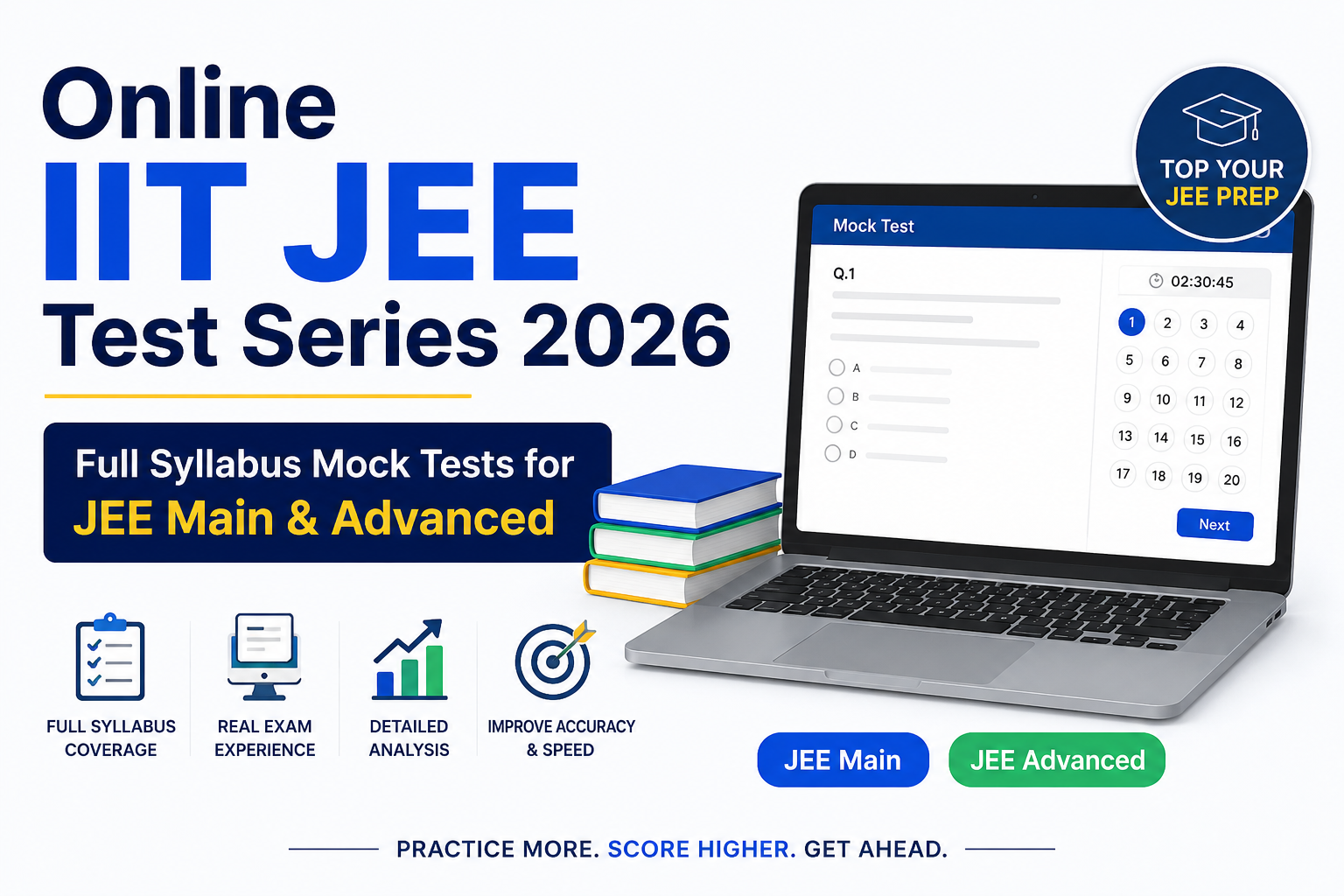
Every year, more than 12 lakh and more then students appear for JEE Main, and a fraction of them make it to JEE Advanced the gateway to the prestigious IITs. The difference between students who crack the exam and those who don't often comes down to one thing: practice under real exam conditions. A well-structured mock test series does far more than just test your knowledge. It trains your mind to handle pressure, improves your time management, highlights your weak areas, and builds the exam-day confidence you need to perform at your best. Whether you're preparing for JEE Main, JEE Advanced, or both, taking regular full-syllabus mock tests is not optional, it's essential.
What Is an Online IIT JEE Test Series?
An Online IIT JEE Test Series is a structured set of computer-based mock examinations designed to simulate the actual JEE Main and JEE Advanced exams. These tests are conducted on digital platforms and cover the complete syllabus of Physics, Chemistry, and Mathematics as prescribed by the National Testing Agency (NTA) for JEE Main and the IIT Joint Admission Board (JAB) for JEE Advanced. Each test is followed by a detailed performance analysis, which is one of the most powerful tools a student can use for self-improvement.
The test series typically includes:
• Chapter-wise Tests – Focused on individual topics for concept clarity
• Subject-wise Tests – Covering one full subject at a time
• Part Syllabus Tests – Testing a combination of topics across subjects
• Full Syllabus Mock Tests – Complete simulation of the actual JEE exam
• Previous Year Question Papers – Solved and unsolved papers from past years
• Revision Tests – Quick tests for high-priority topics near the exam
JEE Main 2026: Exam Pattern Overview
Before you begin any test series, it's important to understand the exam you're preparing for. Here's a breakdown of the JEE Main 2026 exam pattern:
|
Feature |
Details |
|
Exam Mode |
Computer-Based Test (CBT) |
|
Duration |
3 Hours |
|
Subjects |
Physics, Chemistry, Mathematics |
|
Total Questions |
90 (75 to be attempted) |
|
Question Types |
MCQs + Numerical Value Questions |
|
Marking Scheme |
+4 correct, -1 wrong (MCQs); No negative for numericals |
|
Total Marks |
300 |
|
Sessions |
January and April 2026 |
JEE Advanced 2026: Exam Pattern Overview
JEE Advanced is significantly more challenging and has a more complex question format. Here's what to expect:
|
Feature |
Details |
|
Exam Mode |
Computer-Based Test (CBT) |
|
Papers |
Paper 1 and Paper 2 (both mandatory) |
|
Duration |
3 Hours per paper |
|
Subjects |
Physics, Chemistry, Mathematics |
|
Question Types |
MCQs (single & multiple correct), Integer type, Match the column, Paragraph-based |
|
Marking Scheme |
Varies by section; partial marking in some sections |
|
Negative Marking |
Yes, in specific sections |
Key Features of a Good Online JEE Test Series 2026
Not all test series are created equal. Here are the features you should look for when choosing an Online JEE Mock Test Series for 2026:
1. Full Syllabus Coverage
The test series must cover 100% of the Class 11 and Class 12 syllabus for Physics, Chemistry, and Mathematics including every chapter, every concept, and every topic that has appeared or can appear in JEE Main and Advanced.
2. NTA-Pattern Based Questions
Every mock test must be based on the latest NTA question pattern for JEE Main 2026. This ensures the difficulty level, question distribution, and marking scheme are aligned with what students will face in the real exam.
3. Adaptive Difficulty Levels
A strong test series offers tests at beginner, intermediate, and advanced difficulty levels. This helps students gradually build confidence and tackle progressively harder problems without burnout.
4. Detailed Solutions and Explanations
After every test, detailed step-by-step solutions must be available for all questions. Simply knowing the right answer isn't enough; students need to understand why it is correct.
5. Performance Analytics and Reports
A quality online platform provides in-depth performance analytics after every test, including:
• Subject-wise and chapter-wise accuracy
• Time spent per question
• Comparison with toppers and average performers
• Percentile ranking among all test-takers
• Improvement tracking over time
6. Previous Year Question Papers (PYQs)
The best test series integrates JEE Main and Advanced PYQs from the past 10–15 years in test format. Solving PYQs is one of the most effective strategies for JEE preparation.
7. Mobile and Desktop Accessibility
The platform should work smoothly on both mobile devices and laptops/desktops, so students can take tests anytime, anywhere, without technical disruptions.
Full Syllabus Mock Tests: Subject-Wise Breakdown
1. Physics:
Physics is often considered the most challenging subject in JEE. A full-syllabus test series covers:
Class 11 Topics:
• Units and Measurements
• Kinematics (Motion in a Straight Line and Plane)
• Laws of Motion and Friction
• Work, Energy, and Power
• Rotational Motion and Moment of Inertia
• Gravitation
• Properties of Solids and Fluids
• Thermodynamics and Kinetic Theory of Gases
• Simple Harmonic Motion and Waves
Class 12 Topics:
• Electrostatics and Electric Potential
• Current Electricity and Circuits
• Magnetic Effects of Current
• Electromagnetic Induction and AC Circuits
• Ray Optics and Wave Optics
• Dual Nature of Matter and Radiation
• Atoms, Nuclei, and Radioactivity
• Semiconductors and Electronic Devices
2. Chemistry:
Chemistry is divided into Physical, Organic, and Inorganic Chemistry. A balanced test series covers all three:
Physical Chemistry:
• Mole Concept and Stoichiometry
• Atomic Structure and Chemical Bonding
• States of Matter (Gases, Liquids, Solids)
• Thermodynamics and Thermochemistry
• Chemical Equilibrium and Ionic Equilibrium
• Electrochemistry
• Chemical Kinetics
• Solutions and Colligative Properties
Organic Chemistry:
• General Organic Chemistry (GOC)
• Hydrocarbons and their Reactions
• Haloalkanes and Haloarenes
• Alcohols, Phenols, and Ethers
• Aldehydes, Ketones, and Carboxylic Acids
• Amines and Nitrogen Compounds
• Polymers and Biomolecules
Inorganic Chemistry:
• Periodic Table and Periodicity
• Chemical Bonding and Molecular Structure
• s-Block, p-Block, d-Block, and f-Block Elements
• Coordination Compounds
• Qualitative Analysis
3. Mathematics:
Mathematics is the most scoring subject if approached strategically. The test series covers:
Class 11 Topics:
• Sets, Relations, and Functions
• Trigonometric Functions and Equations
• Sequences and Series
• Straight Lines and Conic Sections
• Permutations and Combinations
• Binomial Theorem
• Limits and Derivatives (Introductory Calculus)
• Statistics and Probability (Basic)
Class 12 Topics:
• Relations and Functions
• Inverse Trigonometric Functions
• Matrices and Determinants
• Continuity and Differentiability
• Applications of Derivatives
• Integrals and Applications of Integrals
• Differential Equations
• Vectors and 3D Geometry
• Linear Programming
• Probability (Advanced)
Mathematics mock tests train students to solve problems quickly and accurately a skill that directly determines JEE rank.
How to Use the JEE Test Series Most Effectively
Taking tests is only half the battle. Here's a proven strategy to get maximum benefit from your online JEE mock test series:
Step 1: Start with Chapter-wise Tests
Begin by taking individual chapter tests after finishing each topic. This strengthens your foundation before you move on to combined or full-length tests.
Step 2: Move to Subject-wise Tests
Once you've covered all chapters in a subject, take full subject tests. This helps you manage time across an entire subject and identify your relative strengths and weaknesses.
Step 3: Take Full Mock Tests Under Exam Conditions
Simulate the real exam environment: sit in a quiet room, do not use your notes or phone, follow the same 3-hour time limit, and take the test at the same time of day as the actual exam.
Step 4: Analyse Every Test Thoroughly
This is the most important step. After every test:
• Review every wrong answer and understand the mistake
• Note down concepts you were unclear about
• Revisit those topics before the next test
• Track your time per question and work on reducing it
Step 5: Revise and Repeat
Use the test series performance report to create a personalised revision plan. Focus more on weak chapters while maintaining your strong ones. Take the same test again after 2–3 weeks to measure improvement.
Benefits of an Online JEE Test Series Over Offline Tests
|
Feature |
Online Test Series |
Offline Test Series |
|
Instant Results |
Yes |
Delayed |
|
Detailed Analytics |
Yes |
Limited |
|
Accessibility |
Anytime, Anywhere |
Fixed Location |
|
Exam Interface Practice |
CBT Simulation |
Paper-based |
|
National Rank Comparison |
Yes |
No |
|
Cost |
Usually Affordable |
Higher Cost |
Also Read: Best JEE Coaching in Rajasthan: Everything Students Need Before Admission
Common Mistakes Students Make with Mock Tests
Mistake 1: Taking Tests Without Preparation
Don't attempt a full-length mock before completing the syllabus. Use chapter and part-syllabus tests during your preparation phase.
Mistake 2: Not Reviewing Wrong Answers
Many students just check their score and move on. This is a wasted opportunity. The real learning happens in the review session.
Mistake 3: Ignoring Time Management
If you're consistently running out of time, you need to practice solving problems faster. Use the per-question time report in your analytics to identify where you're losing time.
Mistake 4: Taking Too Many Tests Without Revision
More tests does not equal better results. Balance test-taking with revision. A test should always be followed by a study session.
Mistake 5: Comparing Scores Instead of Growth
Your rank among lakhs of students will improve gradually. Focus on your own improvement trajectory, not just the percentile number.
Also Read: Top 10 IIT JEE Coaching Institutes in India Fees, Results & Admission Details
Conclusion:
Cracking IIT JEE is one of the most demanding challenges a student can take on but with the right resources, strategy, and consistent effort, it is absolutely achievable. The Online IIT JEE Test Series 2026 is not just a practice tool; it is your personal coaching system that tells you exactly where you stand, what you need to improve, and how close you are to your target. From full-syllabus mock tests that mirror the real exam to chapter-wise quizzes that build your foundation, the right test series can significantly accelerate your preparation and boost your rank.
FAQs
Q1. What is the best online IIT JEE test series for 2026?
The best IIT JEE test series depends on exam pattern accuracy, detailed analysis, All India ranking, and quality of mock tests for JEE Main and Advanced preparation.
Q2. Are online JEE Main mock tests useful for rank improvement?
Yes, online mock tests help students improve speed, accuracy, time management, and exam temperament before the actual JEE exam.
Q3. How many mock tests should students attempt before JEE Main 2026?
Students should ideally attempt 30–50 full syllabus mock tests before JEE Main to build confidence and improve performance.
Q4. Which test series is best for both JEE Main and JEE Advanced?
A good combined test series should include chapter-wise tests, part tests, full syllabus mocks, and Advanced-level analytical questions.
Q5. Is an online IIT JEE test series enough for preparation?
An online test series is highly beneficial, but students should also focus on NCERT, coaching material, revision notes, and previous year papers.
Q6. When should students start taking full syllabus mock tests for JEE 2026?
Students should start full syllabus mock tests after completing around 70–80% of the syllabus to evaluate preparation effectively.
Q7. Do online IIT JEE test series provide All India rank prediction?
Many leading test series platforms provide All India ranking, percentile analysis, and performance comparison with other aspirants.
Q8. Are previous year JEE questions included in online test series?
Yes, most reputed IIT JEE test series include previous year questions along with updated pattern-based mock tests.
Q9. How can students improve scores using JEE mock tests?
Students can improve scores by analyzing mistakes, revising weak topics, maintaining a test schedule, and practicing regularly.
Q10. What features should students check before buying an IIT JEE test series?
Students should check exam pattern accuracy, question quality, detailed solutions, analytics dashboard, rank prediction, and bilingual support before purchasing.