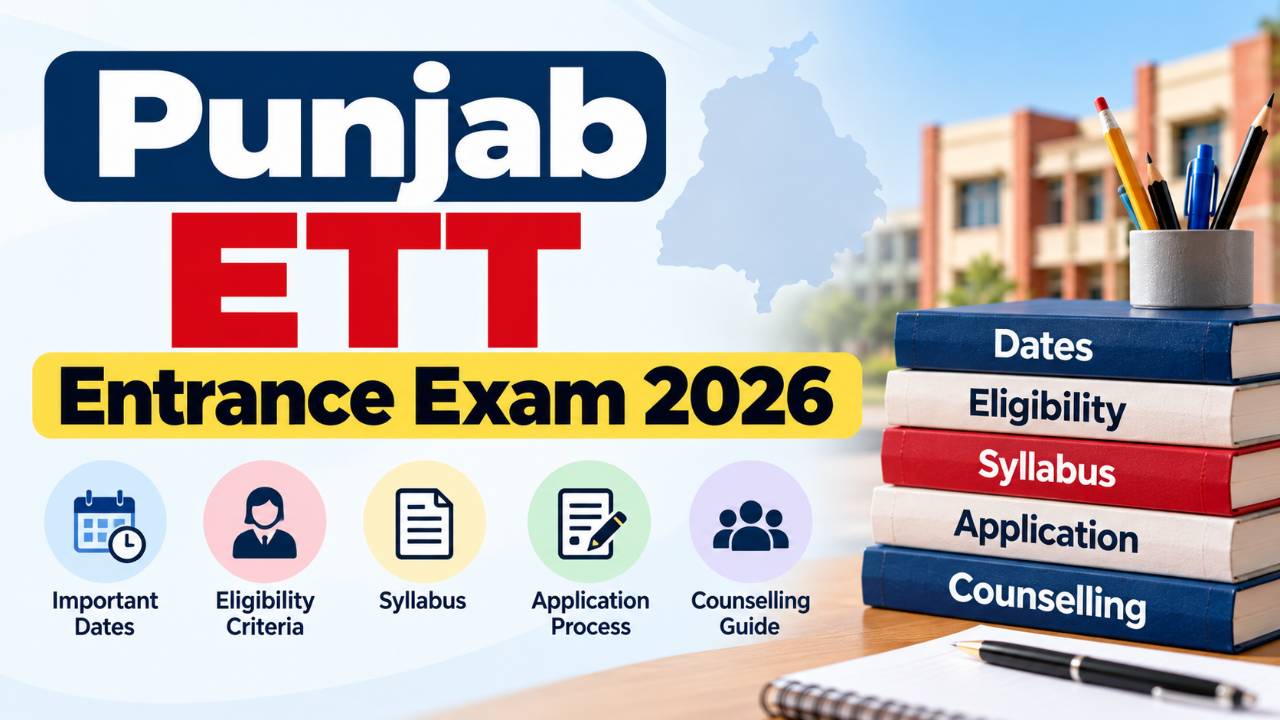
If you want to become an elementary school teacher in Punjab, the Punjab ETT entrance exam 2026 is the main gateway to the Diploma in Elementary Education (DElEd), also known as Elementary Teacher Training (ETT). The exam is conducted by the State Council of Educational Research and Training (SCERT), Punjab, and successful candidates gain seats in government DIETs (District Institutes of Education and Training) as well as recognised private institutions across the state.
According to the latest updates referenced for the 2026 cycle, SCERT was expected to release the official notification around 21 October 2026, with online registration opening in October 2026 and the written test likely in November 2026. Merit lists, counselling, and seat allotment typically follow in December 2026. Because dates are tentative until the notification is published, always confirm details on the official portal punjabdeledadmission.gndu.ac.in.
This article explains what the Punjab ETT exam is, who can apply, what you will study for the test, and how admission works after results—written in plain language for students, parents, and career changers exploring teaching in Punjab’s public and private school ecosystem.
What Is the Punjab ETT Entrance Exam?
The Punjab ETT entrance test is a state-level admission exam for the two-year DElEd programme. The diploma trains you to teach at the primary and upper-primary level (typically Classes 1–8, as per state norms and NCTE guidelines). Unlike degree programmes at large universities such as Punjab Agricultural University Ludhiana or professional institutes like Punjab Engineering College Chandigarh, ETT is a focused teacher-preparation pathway with practical school experience built into the curriculum.
Admission is merit-based: your entrance score, category, reservation rules, and counselling preferences decide whether you get a seat in a DIET or a private DElEd college. There is no separate “central” national test for this course in Punjab; SCERT’s process is the standard route for aspirants who meet eligibility and domicile requirements.
Who Conducts Punjab ETT and Where Do You Apply?
Conducting body: SCERT Punjab.
Official application and counselling portal: punjabdeledadmission.gndu.ac.in (hosted in association with Guru Nanak Dev University's admission infrastructure for DElEd).
Keep your mobile number and email active from registration through counselling. All admit cards, results, and allotment letters are usually published online.
Punjab ETT Entrance Exam 2026: Important Dates (Tentative)
Until SCERT publishes the notification PDF, treat the timeline below as indicative. Past years follow a similar October–December pattern.
- Notification release: Around 21 October 2026 (as per latest reporting)
- Online registration: October 2026
- Application correction window: October 2026 (if enabled)
- Admit card: November 2026
- Exam date: November 2026
- Result: December 2026
- First merit list: December 2026
- Counselling and seat allotment: December 2026
- Reporting to allotted institute : December 2026 (physical verification and fee payment)
Action tip: Screenshot the notification’s date table on day one. Set reminders for registration deadline, admit card download, and choice filling—missing a counselling window can cost you a seat even with a good rank.
Eligibility Criteria for Punjab ETT 2026
Before you register, verify that you satisfy academic qualification, age limit, subject background in Class 10, and Punjab residency rules stated in the official notification. The criteria below reflect the structure commonly listed for the 2026 cycle; minor changes are possible in the final brochure.
Educational Qualification
- General category: Minimum 50% aggregate in an undergraduate (UG) degree from a recognised university.
- SC/OBC categories: Minimum 45% aggregate in UG degree (as per usual Punjab reservation norms—confirm category labels in the notification).
- Class 10 (Matric) subject requirement: Candidates are generally required to have studied specified subjects at the matriculation level, including areas such as Punjabi, Science, Hindi, Mathematics, and Computer (exact wording and combinations are defined in the official eligibility table—match your matric marksheet before applying).
If you completed graduation through open or distance modes, ensure your degree is from a UGC-recognised institution. Open universities in the region, such as Jagat Guru Nanak Dev Punjab State Open University, may be acceptable when the degree is valid for government admission—still cross-check the notification’s list of recognised qualifications.
Age Limit
- General: Upper age limit is typically 37 years (calculated as on the cutoff date mentioned in the notification).
- SC/OBC: Often 5 years relaxation over the general limit.
- Persons with benchmark disabilities: Often 10 years relaxation, subject to valid certificate.
Teaching is a popular second-career choice in Punjab; if you are near the age cap, apply in the year you first become eligible rather than waiting.
Domicile and Other Requirements
Punjab DElEd admissions generally require Punjab domicile or residency proof. You will also need valid identity proof, category certificates (if applicable), and matric/graduation documents at counselling. Non-Punjab graduates sometimes ask whether they can apply—only if the notification explicitly allows; most seats are reserved for state domicile candidates.
Punjab ETT Exam Pattern and Syllabus 2026
The entrance test assesses whether you can handle Class 10–level school subjects, basic reasoning, awareness of Punjab and national events, and aptitude related to teaching. Think of it as a combination of academic revision and a light “teacher readiness” check—not a postgraduate specialisation exam like law or design entrances elsewhere in India (for example, candidates comparing multiple careers might also look at NIFT Entrance Exam or NID DAT, but Punjab ETT content is firmly rooted in school-level pedagogy and general studies).
Subject-Wise Syllabus Overview
General Knowledge
- Punjab history, culture, society, and landmarks
- National movement and current events (focus on factual, exam-style GK)
General Mental Ability (Reasoning)
- Verbal reasoning (series, analogies, coding-decoding style questions)
- Analytical and visual/temporal reasoning
Teaching Potential Test
- Teaching and pedagogy basics
- Educational environment and classroom context
- Interpersonal relations and use of technology in learning
Languages: Punjabi, Hindi, English
- Comprehension, grammar, and usage at a level aligned with school curriculum expectations
Mathematics
- Number systems and arithmetic
- Commercial mathematics
- Topics such as kinematics and work (as listed in official syllabus tables—revise NCERT Class 9–10 concepts)
Social Science
- History and freedom movement
- Polity and governance
- Geography, economy, and demographics
Science
- Physics, chemistry, and biology/human systems at matric level
Qualifying Marks
Candidates must usually secure minimum percentages to be considered for merit:
- General category: 50% in the entrance exam
- SC/ST categories: 45% (confirm exact category mapping in the result notice)
Scoring above the qualifying mark alone does not guarantee a DIET seat; rank and seat matrix matter.
How to Prepare for Punjab ETT: Study Plan and Resources
A practical 8–10 week plan works well if you already hold a graduation degree and remember part of your matric syllabus.
- Week 1–2: Collect Punjab State Board Class 10 textbooks for Science, Social Science, Mathematics, and languages. Mark chapters that match the syllabus table.
- Week 3–5: Daily rotation—two school subjects, one reasoning set, and 30 minutes of Punjab GK (history, culture, current affairs PDFs from reputable sources).
- Week 6–7: Teaching aptitude—read basic concepts of child development, inclusive education, and classroom communication (ETT guidebooks aligned with SCERT).
- Week 8 onward: Full-length timed mocks; analyse weak chapters; revise formula sheets for maths and science.
Previous year papers: Practising Punjab ETT previous question papers helps you understand weightage and question framing. Solve at least 5–7 years if available through coaching libraries or official samples.
Comparison note: Punjab ETT preparation is different from highly specialised UG entrances such as the Amity Entrance Test or tech-focused admissions at institutions like I K Gujral Punjab Technical University Jalandhar. Here, consistency and revision of school fundamentals matter more than niche aptitude.
Punjab ETT Application Form 2026: Fees, Documents, and Common Mistakes
Registration is expected to be fully online. You typically create an account, fill personal and academic details, upload scans, pay the fee, and download a confirmation receipt.
Documents Usually Required at Application Stage
- Class 10 mark sheet
- Class 12 mark sheet and passing certificate
- Graduation mark sheets and degree/provisional certificate
- Recent passport-size photograph and scanned signature
- Government photo ID (Aadhaar, PAN, driving licence, etc.)
- Caste certificate (if claiming reservation)
- Disability certificate (if applicable)
- Punjab domicile/residency certificate
- Migration certificate (if applicable)
- Active email ID and mobile number
Common mistakes to avoid: Name mismatch between matric and graduation certificates; blurred uploads; wrong category selected without certificate; leaving the form unsubmitted after payment failure. Always download the payment receipt and application summary PDF.
Punjab ETT Admit Card 2026
The admit card is expected in November 2026. Download it from the official portal using your login credentials. Without the hall ticket and valid ID, entry to the exam centre is generally not permitted.
Details printed on the admit card typically include:
- Candidate name, roll number, and application number
- Parent/guardian name
- Photograph
- Exam centre address and code
- Exam date and reporting time
- Instructions (items allowed/banned in the hall)
Visit your exam centre a day early if it is in an unfamiliar city. Carry multiple printouts and keep a soft copy on your phone as backup.
Result, Merit List, and Rank Logic
SCERT Punjab is expected to declare Punjab ETT result 2026 in December. The merit list ranks candidates who meet qualifying marks and eligibility. Factors affecting your rank include total marks, number of applicants, category, and sometimes tie-breaking rules defined in the notification.
The first merit list is usually followed by additional lists if seats remain vacant in DIETs or private colleges. Download merit PDFs from the official site and note your counselling registration requirements.
Punjab ETT Counselling and Seat Allotment 2026
Counselling is where ranks convert into actual college seats. Eligible candidates register on the counselling portal, fill institute choices, and wait for allotment rounds.
Counselling Steps (Overview)
- Visit the official Punjab ETT counselling portal when the link opens.
- Register or log in with credentials created during admission process.
- Pay counselling fee if required (check notification).
- Fill choices—rank DIETs and private colleges in true order of preference, not just by distance.
- Lock/submit choices before the deadline.
- Check seat allotment result; download allotment letter if a seat is assigned.
- Report physically to the allotted institute with documents for verification.
- Pay admission/course fee to confirm the seat.
Documents for Counselling Verification
- Class 10 and 12 certificates and mark sheets
- UG degree and mark sheets
- Admit card and scorecard of Punjab ETT 2026
- Category, domicile, and disability certificates (if applicable)
- Passport-size photographs
- Allotment letter printout
Failure to report within the given window often leads to seat cancellation and movement to the next candidate—treat deadlines as strict.
Where Will You Study? DIETs and Private DElEd Colleges in Punjab
Government DIETs are spread across districts and are the preferred choice for many aspirants because of lower fees and strong school tie-ups. Private colleges also offer DElEd seats allotted through the same counselling when they are recognised by NCTE and empanelled with SCERT.
While ETT is a diploma route, Punjab’s higher-education map includes many universities you might encounter for future degrees or transfers—for example Central University of Punjab Bathhinda, Maharaja Ranjit Singh Punjab Technical University Bathinda, Rajiv Gandhi National University of Law Punjab, and Lamrin Tech Skills University Punjab. Teacher trainees sometimes later pursue B.Ed., MA Education, or subject degrees to advance their careers—plan long term even as you focus on DElEd admission today.
Aspirants from other states exploring teacher education may compare programmes at colleges such as Shekhawati College for Education Losal Sikar, but Punjab ETT remains specific to Punjab domicile rules and SCERT seat matrix.
Career After DElEd (ETT) in Punjab
After completing DElEd, candidates typically appear for teacher eligibility tests and state recruitment drives for primary teachers (rules evolve with government policy). Your ETT diploma demonstrates pedagogical training; staying updated on Punjab School Education Board notifications is essential.
Teaching offers stability and community impact. If you are also interested in parallel career tracks, you might explore unrelated degrees—for instance Bachelor of Computer Application (BCA) for IT, or sports sciences at The Maharaja Bhupinder Singh Punjab Sports University—but for school teaching, completing DElEd and meeting recruitment eligibility is the core path.
Conclusion
The Punjab ETT entrance exam 2026 opens the door to a structured two-year DElEd programme that prepares you for elementary teaching roles across Punjab. With notification and registration expected in October 2026, exam in November 2026, and counselling in December 2026, now is the time to verify eligibility (UG percentage, matric subjects, age, domicile), revise Class 10 syllabus areas, and gather documents for a smooth online application at punjabdeledadmission.gndu.ac.in.
Rely on the official SCERT notification for final dates, fees, and seat matrix. Use this guide as a roadmap—from first registration to merit list and physical reporting—so you can focus on preparation while staying compliant with every admission milestone.