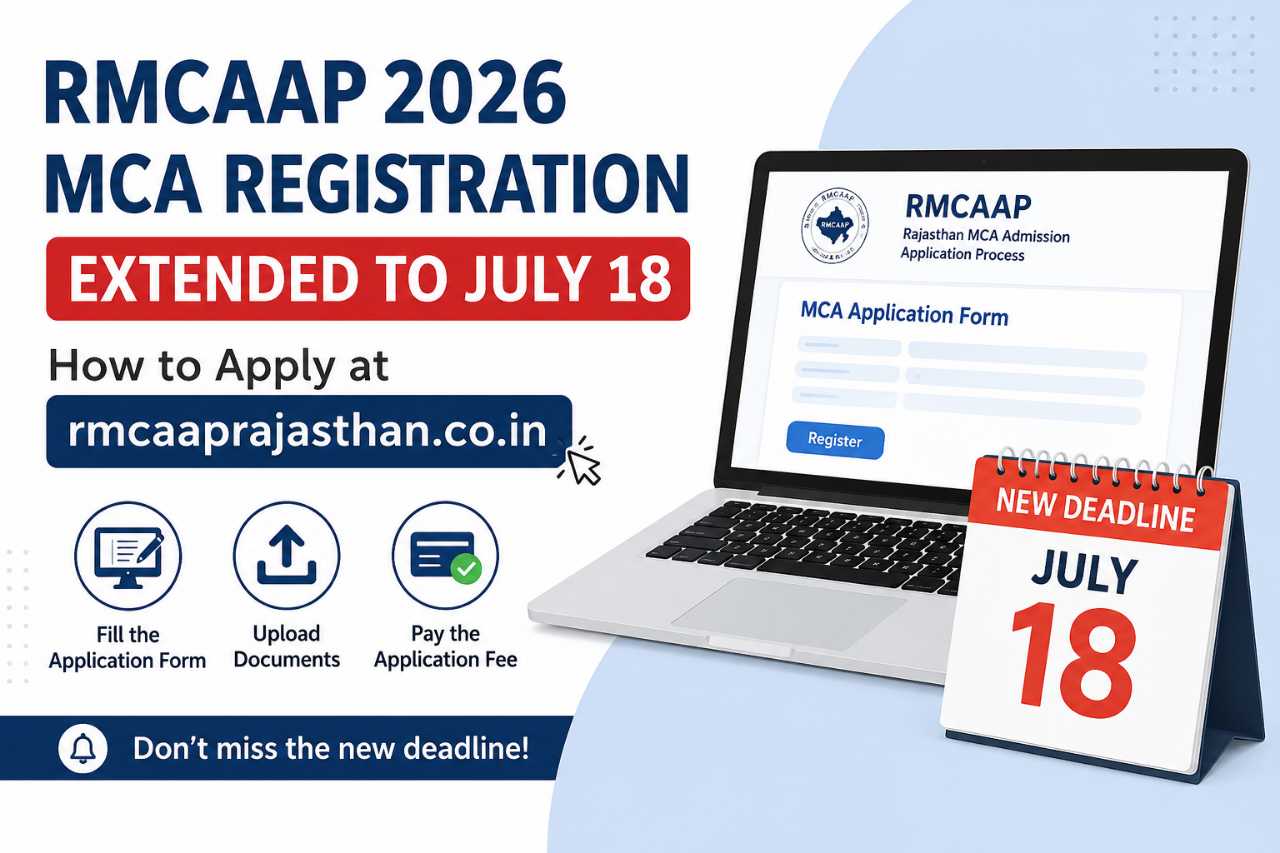

If you cleared NIMCET 2026 and want to pursue a Master of Computer Applications (MCA) in Rajasthan , the extended registration window for RMCAAP 2026 is your most important immediate task. The Department of Technical Education (DTE), Rajasthan has pushed the application deadline to July 18, 2026, giving candidates roughly ten extra days beyond the original July 8 cutoff. Fee payment, however, must be completed by July 17, 2026.
This guide explains what RMCAAP is, who can apply, key dates, participating colleges, and a practical step-by-step plan to register without last-minute errors. Whether you are a Rajasthan domicile student or an out-of-state NIMCET qualifier exploring affordable postgraduate computer education, this article is designed to answer the questions students and parents search for most often.
What Is RMCAAP 2026?
RMCAAP stands for the Rajasthan Master of Computer Applications Admission Process. It is a state-level, centralised online counselling system through which eligible candidates are allotted seats in MCA programmes at colleges affiliated with Rajasthan Technical University Kota (RTU).
Unlike older entrance exams such as RMCAAT, the current process does not conduct a separate Rajasthan MCA entrance test. Instead, admission is based on NIMCET 2026 scores, which are issued by the National institute of Technology (NIT) system after a national-level computer application aptitude test.
The counselling is organised by the Center for Electronic Governance (CEG), Jaipur, functioning under DTE Rajasthan. From registration and document verification to choice filling, seat locking, and allotment rounds, the entire workflow runs on the official portal at rmcaaprajasthan.co.in.
Why RMCAAP Matters for MCA Aspirants
For students targeting a two-year MCA degree in Rajasthan, RMCAAP is the primary admission route. Around 41 MCA colleges participate in this counselling, making it one of the most structured pathways for postgraduate computer education in the state.
Because seat allotment is merit-driven and centrally managed, candidates from across India can participate. However, Rajasthan state domicile applicants receive preference during seat distribution, which is an important factor when comparing your NIMCET rank with available seats.
RMCAAP 2026 Registration Deadline Extension Explained
Registration for RMCAAP 2026 opened on June 23, 2026. The original schedule required candidates to pay the application fee by July 7, 2026 and submit the completed form by July 8, 2026. DTE Rajasthan later issued an extension notice, shifting the timelines as follows:
| Event | Original Date | Extended Date |
|---|---|---|
| Application Fee Payment | July 7, 2026 | July 17, 2026 |
| Online Form Submission | July 8, 2026 | July 18, 2026 |
The extension is especially helpful for candidates who received their NIMCET scorecards late, faced document preparation delays, or needed additional time to review the official instruction booklet. That said, students should treat July 17 and July 18 as firm deadlines rather than waiting for another revision. Extensions in admission cycles are announced when feasible, but they are never guaranteed.
What the Extension Means in Practical Terms
- More time to gather documents: Graduation mark sheets, NIMCET scorecard, category certificates, and domicile proof can be arranged without rushing.
- Reduced portal congestion risk: Early applicants often face fewer payment gateway failures and upload errors.
- Better decision-making: Extra days allow you to study the seat matrix and college list before registration.
- No change in eligibility: The extension affects only timelines, not qualification rules or fee structure.
RMCAAP 2026 Key Details at a Glance
Before you begin registration, keep these core facts handy. They are useful for quick reference and for answering common family or peer questions about the process.
- Conducting Authority: Center for Electronic Governance, Jaipur (under DTE Rajasthan)
- Programme: Master of Computer Applications (MCA), 2 years
- Admission Basis: NIMCET 2026 scores
- Application Fee: Rs 885 (non-refundable)
- Official Website: rmcaaprajasthan.co.in
- Helpline: 7597772292 (9:30 AM to 6:00 PM, Monday to Friday)
- Participating Institutes: Approximately 41 RTU-affiliated MCA colleges
Eligibility Criteria for RMCAAP 2026
Meeting eligibility requirements is non-negotiable. Even a perfectly filled application can be rejected during verification if academic or entrance exam conditions are not satisfied.
Educational Qualification
Candidates must hold a bachelor's degree of minimum three years duration from a recognised university or institution. The qualifying degree should align with MCA admission norms, which typically include:
- BCA or a Bachelor's degree in Computer Science/Computer Applications or an equivalent qualification
- B.Sc., B.Com., or B.A. with Mathematics at Class 10+2 level or at graduation level (subject to university bridge course norms where applicable)
The minimum aggregate required is 50% for General category candidates and 45% for reserved category applicants. Always cross-check your exact percentage calculation method—some universities count all semesters, while others consider only the final year or core subjects.
NIMCET 2026 Requirement
A valid NIMCET 2026 scorecard is mandatory. RMCAAP counselling uses your NIMCET performance as the primary merit parameter. If you have not appeared for NIMCET or your result is withheld, you cannot participate in the current admission cycle through this route.
Domicile and Nationality
RMCAAP is open to candidates across India. There is no restriction that limits registration to Rajasthan residents alone. However, during seat allotment, preference is given to applicants with Rajasthan state domicile where applicable quotas or state-resident categories are defined in the official seat matrix.
If you are claiming domicile benefit, keep attested or self-attested domicile certificates ready in the format prescribed in the instruction booklet. Out-of-state students should still apply if they are interested in RTU-affiliated MCA colleges, but they should realistically assess seat availability based on previous counselling trends.
Participating Colleges and Seat Allotment Process
Admission through RMCAAP is not limited to a single campus. The process covers a network of MCA institutes linked to RTU, including government, aided, and self-financed colleges across Rajasthan.
How Seat Allotment Works
After successful registration, candidates typically move through these stages:
- Choice Filling: Select preferred colleges and MCA programmes in order of priority.
- Choice Locking: Confirm your preferences before the locking deadline. Unlocked choices may not be considered.
- Merit-Based Allotment: Seats are distributed based on NIMCET rank, category, and available quota.
- Reporting and Further Rounds: Candidates who accept allotment proceed to document verification and admission formalities. Vacant seats may move to subsequent rounds or spot counselling, as announced on the portal.
The detailed institute list and category-wise seat matrix are published in the official instruction booklet on rmcaaprajasthan.co.in. Download and read this document before locking choices. Choosing colleges only by name popularity—without checking fees, location, faculty strength, and placement history often leads to regret after allotment.
Exploring MCA Education in Rajasthan
Rajasthan has a growing higher education ecosystem beyond MCA alone. Students evaluating the state as a study destination often compare institutions such as Uniraj University Of Rajasthan Jaipur and Central University Of Rajasthan Curaj Ajmer for other programmes. For technology-oriented learners, colleges like Rajasthan College Engineering Research Technology Jaipur reflect the state's expanding technical education infrastructure.
While these institutions may not all fall under the RMCAAP seat matrix, understanding the broader academic landscape helps students plan long-term goals—such as pursuing research, switching to interdisciplinary tech programmes, or relocating within Rajasthan for internships and industry exposure.
Documents Required for RMCAAP 2026 Registration
Document preparation is where many otherwise eligible candidates lose time. Scan all files in advance and ensure they meet the portal's format and size specifications.
Commonly Required Documents
- Recent passport-size photograph
- Signature scan
- Class 10 mark sheet or certificate (for date of birth proof)
- Class 12 mark sheet
- Graduation mark sheets of all semesters/years
- Graduation degree or provisional certificate
- NIMCET 2026 scorecard
- Category certificate (if applicable)
- Rajasthan domicile certificate (if claiming state quota benefit)
- Photo identity proof (Aadhaar, passport, or other accepted ID)
Document Upload Tips
Use clear, legible scans—mobile photos with glare or cropped edges are a common reason for form rejection. Save files in the prescribed format (usually PDF or JPG) and keep file sizes within portal limits. Maintain a folder with both original and renamed versions so re-uploading is quick if a technical error occurs.
How to Apply for RMCAAP 2026 Online
The registration process is fully online. Below is a detailed walkthrough you can follow on a laptop or smartphone with a stable internet connection.
Step-by-Step Registration Guide
- Visit the official portal: Open rmcaaprajasthan.co.in in your browser. Avoid third-party links shared on social media.
- Read the instruction booklet: Download and review eligibility, fee rules, document formats, and important dates before creating an account.
- Click on candidate registration: Create your login credentials using a valid email ID and mobile number.
- Fill personal details: Enter name, date of birth, gender, category, contact information, and address exactly as they appear on official records.
- Enter academic information: Provide Class 10, Class 12, and graduation details, including board/university, year of passing, and percentage/CGPA.
- Add NIMCET 2026 details: Input roll number, score, rank, and other fields as requested. Cross-verify against your scorecard.
- Upload scanned documents: Attach photograph, signature, certificates, and supporting proofs one by one.
- Pay the application fee: Complete payment of Rs 885 on or before July 17, 2026. Save the payment receipt.
- Submit the application form: Review every field carefully, submit before July 18, 2026, and download the confirmation or acknowledgement page.
- Print and store records: Keep hard and soft copies of the confirmation page, fee receipt, and uploaded documents for counselling rounds.
Common Mistakes to Avoid
- Entering a slightly different spelling of your name across sections
- Uploading low-resolution or incomplete mark sheets
- Waiting until the final hour to pay the fee, when payment servers may be overloaded
- Ignoring category or domicile fields that affect seat eligibility
- Using an inactive email ID or phone number for OTP verification
Application Fee and Payment Guidelines
The non-refundable application and registration fee is Rs 885. Payment must be completed by July 17, 2026, which is one day before the final form submission deadline. This staggered timeline is deliberate: the portal needs time to reconcile successful payments before final submission closes.
Use only the payment gateway integrated on the official website. If a transaction fails but the amount is debited, note the transaction reference number and contact the helpline during working hours. Do not make duplicate payments unless the portal explicitly shows a failed status.
What Happens After Registration?
Submitting the RMCAAP application form is only the first milestone. Candidates who successfully register must stay alert for subsequent counselling announcements on rmcaaprajasthan.co.in.
Upcoming Stages to Watch
- Publication of registered candidate list (if released by the authority)
- Choice filling schedule with opening and closing timestamps
- Choice locking window
- Provisional seat allotment results
- Reporting instructions for allotted institutes, including fee payment and document verification dates
Enable notifications for the official portal and check it daily during peak admission season. Many students miss seat acceptance deadlines because they assume allotment results will be communicated individually by SMS or email for every stage.
Candidates should also note that failure to complete registration by July 18, 2026, will exclude them from the current RMCAAP counselling cycle entirely. There is no offline application option, and late submissions are generally not accepted once the portal closes. If you are awaiting a revised mark sheet or a domicile certificate, contact the issuing authority immediately and upload the document as soon as it becomes available, following any correction window instructions published by DTE Rajasthan.
Strategic Tips for NIMCET Qualifiers
Your NIMCET rank is the engine that drives allotment, but smart counselling behaviour can significantly improve outcomes.
Rank-Based Choice Planning
Prepare three tiers of college choices:
- Realistic targets: Institutes where your rank historically fits comfortably
- Stretch options: Slightly competitive colleges worth listing higher if you prefer location or specialization
- Safe backups: Colleges you would still attend rather than skip the admission year
Research previous year cutoffs where available, college websites, and student forums—but always treat unofficial data as indicative, not guaranteed.
When comparing institutes, look beyond cutoffs alone. Evaluate annual tuition and hostel fees, city connectivity, faculty profiles, lab infrastructure, internship tie-ups, and recent placement summaries. Colleges in education hubs such as Jaipur, Kota, Jodhpur, and Udaipur may offer different industry exposure levels, so align your preference list with career goals—whether that is software development, data analytics, government IT roles, or higher studies after MCA.
Why Early Action Still Beats Last-Minute Filing
Even with the extended deadline, completing registration early reduces stress and leaves time to correct technical issues. Candidates who delay until July 18 risk losing the chance to fix upload errors, payment mismatches, or OTP-related login problems.
RMCAAP vs Other MCA Admission Routes in India
Indian MCA admissions operate through multiple channels. Understanding how RMCAAP fits into the national picture helps you avoid missed opportunities elsewhere.
- NIT MCA through NIMCET: National-level admission to NITs and select participating institutes
- State counselling processes: Similar to RMCAAP, many states conduct their own MCA counselling using NIMCET scores
- University-level entrance tests: Some universities conduct independent exams or accept national test scores
- Direct institute applications: Limited and usually outside centralised state quotas
If Rajasthan is among your preferred destinations—owing to affordability, growing IT hubs in Jaipur and Kota, or proximity to home—RMCAAP should be on your active list. Parallelly, track national and other state counsellings so you do not depend on a single allotment outcome.
Students already studying in Rajasthan—whether in engineering, science, or allied disciplines at institutions such as Rajasthan College Of Agriculture And Technology Jaipur or other degree colleges—often find RMCAAP a convenient next step because they are familiar with the state's academic environment and relocation costs are lower compared with moving to a distant metro.
Who Should Apply Before July 18?
You should complete RMCAAP registration if you:
- Hold a valid NIMCET 2026 score
- Meet the minimum academic percentage for your category
- Want admission to RTU-affiliated MCA colleges in Rajasthan
- Are prepared with scanned documents and fee payment capability
You may reconsider or postpone only if you are definitively committing to another confirmed admission offer elsewhere and no longer need Rajasthan-based options. In most cases, registering preserves flexibility without forcing you to accept an allotted seat later.
Action Plan: 7-Day Checklist Before the Deadline
Use this practical checklist to stay on track as July 17 and July 18 approach:
- Day 1: Download the instruction booklet and verify eligibility.
- Day 2: Collect and scan all academic and identity documents.
- Day 3: Create your registration account on rmcaaprajasthan.co.in.
- Day 4: Complete the application form and upload documents.
- Day 5: Pay Rs 885 and confirm successful transaction status.
- Day 6: Submit the form and download acknowledgement.
- Day 7: Review college list and begin preliminary choice research for upcoming counselling.
Conclusion
The RMCAAP 2026 registration extension to July 18, 2026 is a valuable opportunity for NIMCET qualifiers who need a little more time to apply for MCA seats in Rajasthan. With fee payment closing on July 17, 2026, candidates should act now rather than assuming another extension. The process is straightforward when you follow the official instruction booklet, keep documents ready, and complete payment and submission on time.
RMCAAP opens access to around 41 MCA colleges under Rajasthan Technical University Kota, making it a major gateway for students seeking a structured, merit-based route into postgraduate computer education. Visit rmcaaprajasthan.co.in, complete your registration, and stay tuned for choice filling and allotment updates. For broader context on the MCA programme and related higher education options in the state, continue tracking verified admission announcements and official university notices.
Helpline reminder: For registration support, call 7597772292 between 9:30 AM and 6:00 PM, Monday to Friday.