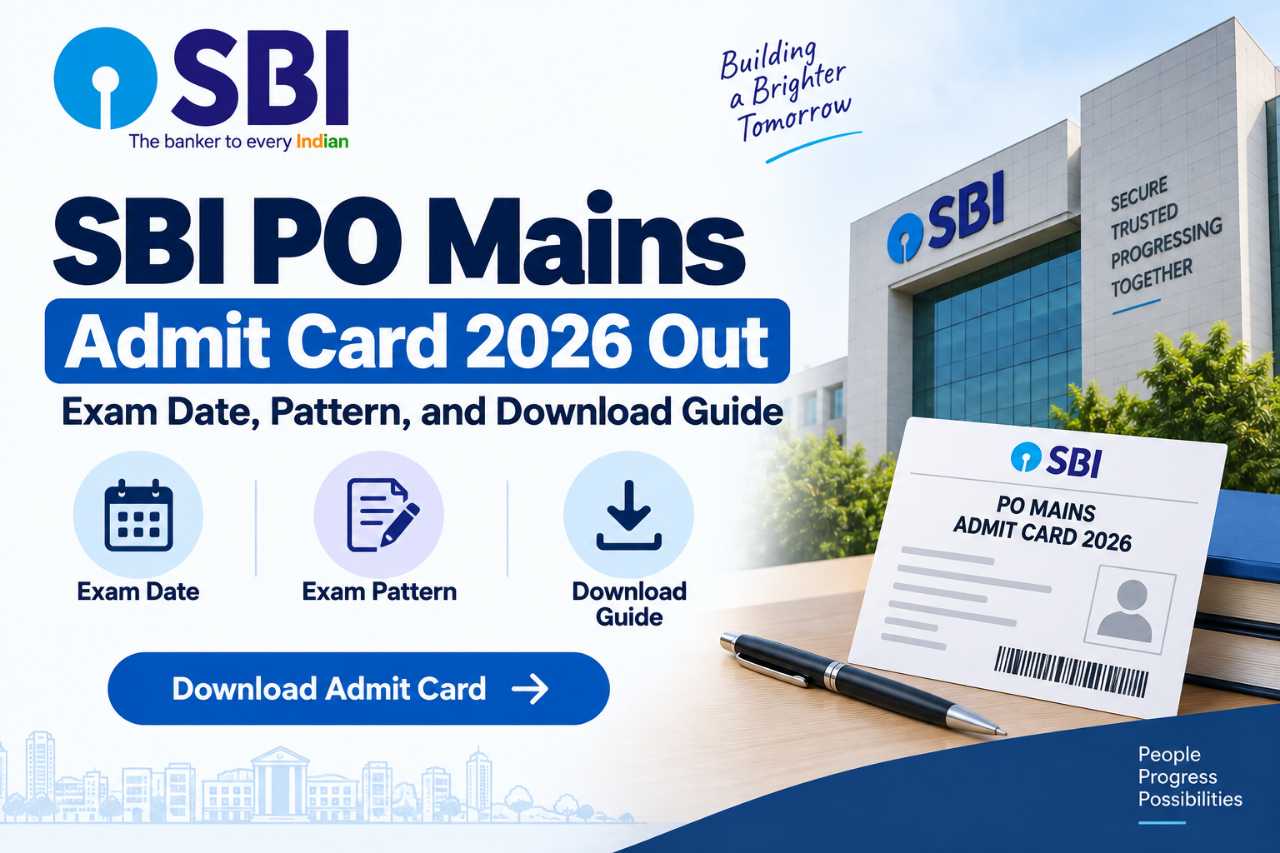
The State Bank of India (SBI) has released the SBI PO Mains admit card 2026 for candidates who cleared the preliminary stage. If your name appeared on the prelims merit list published on September 2, 2026, you can now download your call letter from the official SBI careers portal and confirm your exam centre, reporting time, and other important instructions.
The SBI PO Mains 2026 exam will be held on September 12, 2026 in online mode across designated centres in India. This stage is crucial because it carries significant weight in the final selection for Probationary Officer (PO) posts at India's largest public sector bank. Unlike college entrance tests such as JEE Main or the NIFT Entrance Exam, which open doors to undergraduate programmes, SBI PO is a graduate-level recruitment exam that leads directly to a banking career with structured training and long-term growth.
This guide explains how to download your admit card, the complete exam pattern, documents you must carry, preparation tips, and what happens after Mains—written in simple language for first-time and repeat aspirants alike.
SBI PO Mains Admit Card 2026: Key Highlights
Before you log in to download your call letter, note these essential facts at a glance:
- Admit card status: Released for shortlisted prelims candidates
- Official website: sbi.bank.in (Careers section)
- Exam date: September 12, 2026
- Exam mode: Online (Computer-Based Test)
- Login credentials: Registration number or roll number + password or date of birth
- Tests on exam day: Objective test (200 marks) + Descriptive test (30 marks)
- Prelims merit list: Published on September 2, 2026
Candidates who do not find their admit card after logging in should verify that they qualified prelims and that login details match the information submitted during registration. SBI typically does not send physical call letters by post; the online download is mandatory.
Who Can Download the SBI PO Mains Call Letter?
Only candidates who cleared the SBI PO Prelims 2026 and met the sectional and overall cut-off are eligible for the Mains call letter. The prelims stage acts as a screening test; Mains evaluates deeper aptitude, banking awareness, and written communication skills.
Eligibility Reminder for SBI PO
Generally, SBI PO recruitment requires a bachelor's degree in any discipline from a recognised university. Graduates from engineering colleges such as MIT Anna University Chennai or DMI College of Engineering Chennai, as well as students from arts, commerce, and science backgrounds—including those who pursued a postgraduate MA—can apply if they meet age and other criteria specified in the official notification.
Many graduates today explore multiple paths: some prepare for design institutes like those requiring the NIFT exam, others target engineering through JEE Main, and a large number choose stable public-sector careers through banking exams. SBI PO remains one of the most sought-after options because of salary structure, job security, and nationwide posting opportunities.
How to Download SBI PO Mains Admit Card 2026
Follow these steps carefully on the official portal. Use a desktop or mobile browser with a stable internet connection, and keep your registration details ready before you begin.
- Visit the official SBI website at sbi.bank.in.
- Navigate to the Careers section on the homepage.
- Open the SBI PO recruitment notification or active recruitment link.
- Click on the link titled "Recruitment of Probationary Officers Download Main Exam Call Letter".
- Enter your registration number or roll number and password or date of birth.
- Complete any captcha or security verification if prompted.
- Submit the login details and review your call letter on screen.
- Download the PDF and take at least two colour printouts on A4 paper.
What to Check Immediately After Download
Do not wait until exam morning to verify your admit card. Cross-check the following details the same day you download:
- Your name, photograph, and signature
- Registration or roll number
- Exam date (September 12, 2026) and reporting time
- Exam centre name and complete address
- Instructions regarding permitted and prohibited items
- Category and PwBD status, if applicable
If you spot spelling errors in your name or incorrect category details, contact SBI through the helpline or email mentioned in the official notification. Centre changes are usually not permitted except in rare, documented cases.
SBI PO Mains Exam Pattern 2026 Explained
Understanding the paper pattern helps you allocate revision time wisely. The Mains exam has two parts conducted on the same day: an objective test followed by a descriptive test.
Objective Test: Structure and Timing
The objective paper carries 200 marks, lasts 3 hours, and contains 170 questions divided into four sections. Each section has a separate time limit—you cannot carry unused time from one section to another.
| Section | Questions | Maximum Marks | Duration |
|---|---|---|---|
| Reasoning & Computer Aptitude | 40 | 60 | 50 minutes |
| Data Analysis & Interpretation | 30 | 60 | 45 minutes |
| General Awareness / Economy / Banking Knowledge | 60 | 60 | 45 minutes |
| English Language | 40 | 20 | 40 minutes |
| Total | 170 | 200 | 3 hours |
Section-Wise Preparation Focus
Reasoning & Computer Aptitude (60 marks): Expect puzzles, seating arrangements, syllogisms, coding-decoding, and basic computer terminology. Practice timed sets daily because this section offers high scoring potential for well-prepared candidates.
Data Analysis & Interpretation (60 marks): Focus on tables, bar graphs, line charts, pie charts, and caselet-based questions. Strong calculation speed and accuracy with percentages, ratios, and averages are essential.
General Awareness / Economy / Banking (60 marks): Cover the last six months of current affairs, RBI policies, banking terms, financial institutions, government schemes, and economic indicators. Read a standard banking awareness compendium and revise daily news notes.
English Language (20 marks): Although it carries fewer marks, poor performance here can affect your overall score. Revise reading comprehension, cloze tests, para jumbles, and grammar rules.
Descriptive Test: Pattern and Scoring
After the objective test, candidates attempt a 30-minute descriptive paper worth 30 marks. All answers must be written in English only.
| Component | Format | Marks |
|---|---|---|
| Email writing | 1 out of 2 options | 10 |
| Situation analysis writing | 1 out of 2 options | 10 |
| Report writing / Precis writing | Any 1 out of 2 options | 10 |
| Total | — | 30 |
The descriptive test evaluates professional communication—exactly the skills a Probationary Officer uses when drafting emails to branches, summarising reports, or responding to customer situations. Practice writing concise, formal responses within word limits.
Documents Required at the Exam Centre
SBI strictly verifies identity before allowing entry. Carry the following originals and photocopies as instructed on your call letter:
- SBI PO Mains admit card 2026 (printout with clear photograph)
- Valid photo ID proof such as Aadhaar card, PAN card, passport, driving licence, voter ID, or employee ID
- Passport-size photographs (keep extras in case the invigilator requests)
- PwBD certificate, if applicable
Exam Day Rules and Best Practices
Arrive at the centre at least 60 90 minutes before reporting time to account for security checks and biometric verification. Mobile phones, smart watches, calculators, bags, and study material are generally not allowed inside the hall. Wear comfortable clothing and avoid accessories that may slow frisking.
Carry a transparent water bottle only if permitted by centre rules listed on your admit card. Once inside, listen carefully to invigilator instructions regarding login credentials for the online test interface.
Last-Week Preparation Strategy for SBI PO Mains
With the exam on September 12, 2026, your revision plan should prioritise high-yield topics over learning entirely new concepts.
Seven-Day Revision Plan
- Days 1 2: Full-length objective mock tests under timed sectional limits. Analyse mistakes immediately.
- Day 3: Banking awareness and current affairs marathon—RBI circulars, monetary policy, SBI history, and recent government schemes.
- Day 4: Data interpretation drill—30 questions from mixed chart types within 45 minutes.
- Day 5: Reasoning mixed sets—puzzles, seating, and computer aptitude revision.
- Day 6: Descriptive writing practice—one email, one situation analysis, and one report or precis within 30 minutes.
- Day 7: Light revision, admit card check, centre visit if feasible, and rest.
Actionable Tips from Past Toppers
- Respect sectional timers: Do not spend extra minutes on Reasoning at the cost of General Awareness.
- Attempt wisely: Negative marking applies in the objective test; avoid random guessing.
- Read GA questions carefully: Many options look similar; banking terminology precision matters.
- Structure descriptive answers: Use greeting, body paragraphs, and closing lines for emails; headings and bullet points for reports.
- Simulate exam fatigue: Practice a 3-hour objective session followed immediately by descriptive writing.
Banking Careers vs Traditional Higher Education Paths
Indian students often weigh banking exams against degree programmes at universities and institutes. There is no single "better" route—it depends on your interests and long-term goals.
Engineering aspirants who appeared for JEE Main may later consider SBI PO as an alternative if they prefer administrative and customer-facing roles over technical specialisation. Similarly, design candidates preparing for the NIFT Entrance Exam might explore banking for financial stability while pursuing creative interests part-time.
Graduates from institutions such as Dr Vishwanath Karad MIT World Peace University, MIT Art Design and Technology University Pune, and MIT Vishwaprayag University—across engineering, management, and humanities—regularly appear in PSU bank recruitment. A strong academic record plus consistent exam preparation can make any graduate competitive.
Postgraduates, including those with an MA in economics, English, or political science, often perform well in General Awareness and descriptive sections because of their reading and writing background.
What Happens After SBI PO Mains 2026?
Mains is not the final stage. SBI typically follows a multi-step selection process:
- Mains result and shortlisting: Candidates clearing the cut-off move to the next stage.
- Group Exercise (GE) and Interview: Assesses teamwork, communication, and personality fit.
- Final merit list: Combines Mains, GE, and Interview scores as per official weightage.
- Document verification and medical examination: Original certificates, caste or PwBD documents, and fitness clearance.
- Probationary training: Selected POs undergo structured training before branch posting.
Keep scanned copies of degree certificates, category certificates, and experience documents ready. Discrepancies during verification can lead to cancellation even after a strong exam performance.
Common Mistakes to Avoid Before September 12
- Downloading the admit card on exam morning without checking centre location beforehand
- Using a black-and-white printout when colour print is required
- Carrying an ID proof that does not match the name on the call letter
- Ignoring the descriptive test because it carries only 30 marks—it can decide borderline cases
- Skipping computer aptitude in Reasoning section preparation
- Reading outdated current affairs beyond the relevant six-month window
General Awareness Topics to Revise Before Mains
The General Awareness section carries 60 marks and 60 questions—one of the highest-weight areas in SBI PO Mains. Because questions are direct and fact-based, focused revision can yield quick score gains in the final week.
Banking and Financial Awareness Checklist
- RBI functions, monetary policy repo rate, CRR, SLR, and recent policy decisions
- SBI history, headquarters, tagline, subsidiaries, and recent initiatives
- NPA classification, insolvency code basics, and priority sector lending norms
- Digital banking: UPI, IMPS, NEFT, RTGS, and cybersecurity awareness campaigns
- Important committees and reports related to banking reform in India
- Stock exchanges, SEBI role, mutual funds, and insurance regulator basics
Current Affairs and Government Schemes
Revise national and international events from roughly March 2026 backward through the preceding six months. Pay special attention to Union Budget highlights, economic survey data, G20 or bilateral agreements involving India, appointments to constitutional bodies, and sports or awards news that major dailies covered prominently. Create one-page notes for each month and read them twice daily until exam day.
Economy-related questions may test your understanding of inflation, GDP growth, fiscal deficit, and employment schemes rather than mere headlines. Link each scheme to its implementing ministry and intended beneficiary group—for example, rural credit programmes, MSME support, or finincal inclusion drives.
Troubleshooting Admit Card Download Problems
Some candidates face technical or login issues when accessing the call letter. Here is how to resolve the most frequent problems without panic.
Login Credentials Not Working
If your registration number and password combination fails, first confirm you are on the correct recruitment cycle link—not an older PO notification. Try logging in with date of birth instead of password if the portal allows either option. Clear browser cache, disable VPN, or switch browsers. Avoid third-party websites that claim to provide direct download links; always use sbi.bank.in.
Admit Card Not Visible After Login
A blank screen or "not found" message usually means you did not meet the prelims cut-off or there is a temporary server load issue during peak hours. Retry during off-peak times such as early morning. Cross-check your prelims result against the merit list released on September 2, 2026. If you are certain you qualified but still cannot download, email the official recruitment helpdesk with your registration details and a screenshot of the error.
Print Quality and Photograph Issues
Print the admit card in colour on white A4 paper so your photograph and barcode remain clearly visible. If the PDF photograph appears blurred, do not alter the file—carry an additional passport-size photo and your original ID to the centre for manual verification if permitted by centre staff.
Why SBI PO Mains Matters for Your Career
Clearing SBI PO Mains opens the door to one of India's most respected public-sector banking careers. Probationary Officers receive structured induction training, exposure to retail and corporate banking operations, and opportunities for internal promotion to middle and senior management over time.
The role combines analytical work—analysing loan proposals, monitoring accounts, and understanding regulatory compliance—with leadership responsibilities at the branch level. For graduates who chose not to pursue specialised paths after exams like JEE Main or NIFT, or who completed degrees at institutions such as MIT Anna University Chennai, banking offers geographic mobility, pension and medical benefits, and a clear performance-based growth ladder.
Starting salary and allowances for SBI PO compare favourably with many entry-level private-sector roles, especially when factoring in job stability during economic downturns. The Mains exam therefore deserves your full attention: it is the academic filter before the personality assessment stages that evaluate how you will represent the bank in front of customers and colleagues.
Understanding Sectional Timing and Exam-Day Flow
On September 12, 2026, expect a tightly scheduled exam-day experience. Reporting times on admit cards are often one hour before the login window opens. After identity verification, you will be assigned a computer terminal. The objective test begins with Reasoning and Computer Aptitude and proceeds through each section automatically when the timer ends—plan your attempt order within each section but never assume you can revisit earlier sections later.
When the objective test concludes, you may receive a short break before the descriptive test begins. Use any permitted break to relax your eyes and hands; do not discuss questions with other candidates, as that violates exam discipline rules. The descriptive interface typically provides a text box with word-count guidance—practice typing formal English on a standard keyboard without autocorrect assistance, because exam systems may not offer spelling aids.
After both tests, collect your belongings only when the invigilator instructs you to leave. Results will be published on the SBI careers portal; save your registration credentials securely for checking Mains scores and downloading future call letters for Group Exercise and Interview.
Conclusion
The SBI PO Mains admit card 2026 is now available on sbi.bank.in for all prelims-qualified candidates. With the exam scheduled for September 12, 2026, focus your remaining days on sectional timed practice, banking current affairs, and descriptive writing in English. Download and verify your call letter today, arrange your documents, visit your centre if possible, and enter the exam hall with a calm, strategy-driven mindset.
Whether you come from an engineering background, a design institute, a liberal arts postgraduate programme, or any other field, SBI PO rewards disciplined preparation and clear communication. Treat Mains as both an aptitude test and a preview of the professional writing you will do as a Probationary Officer—and prepare accordingly.