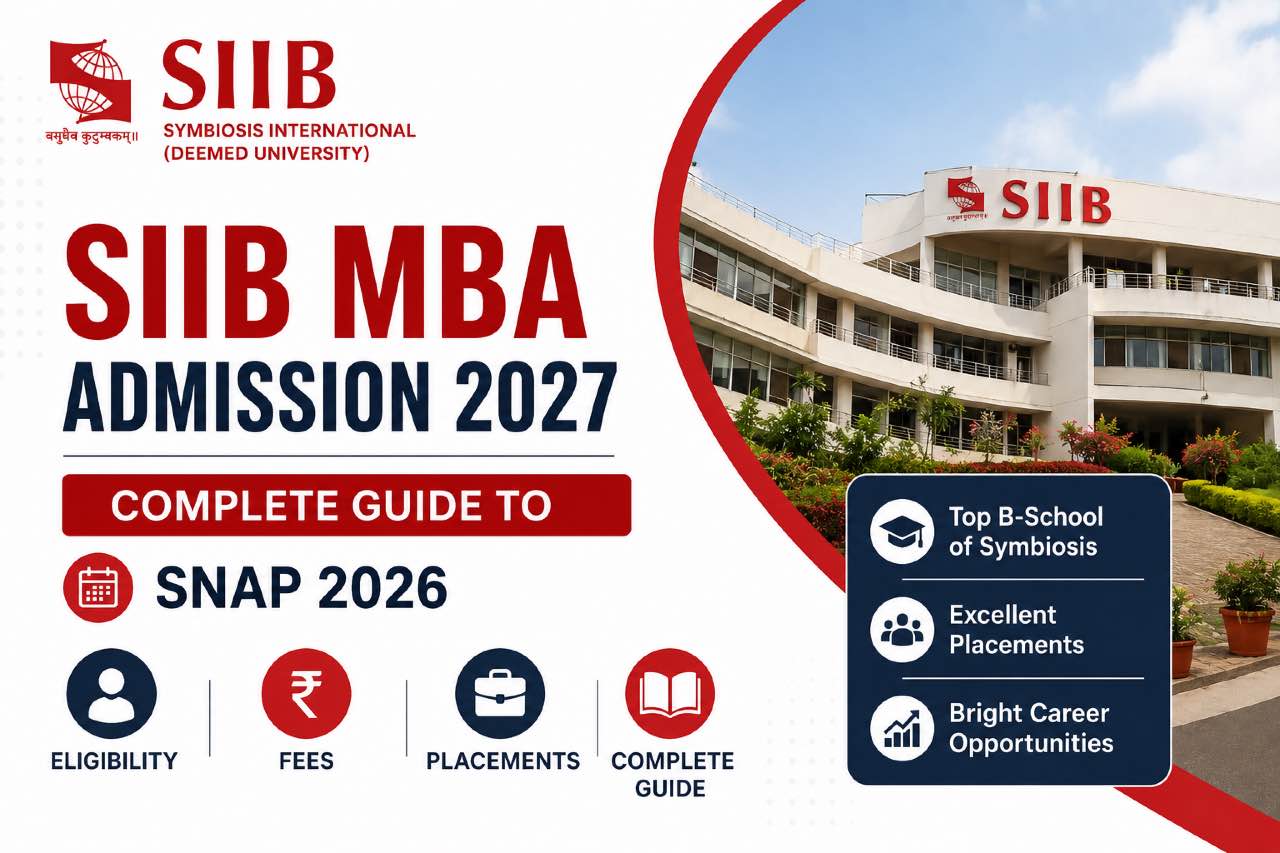
If you are planning a specialised MBA in Pune with a global outlook, the Symbiosis Institute of Internat Business (SIIB) should be on your shortlist for the 2027–28 academic batch. Applications for SIIB MBA admission 2027 are now open exclusively through SNAP 2026—the national entrance test conducted by Symbiosis International (Deemed University ). With just 240 seats across three niche programmes, competition is selective but transparent.
This guide explains everything Indianaspirants need: eligibility, programme details, SNAP 2026 dates and pattern, fees, placement trends, and a step-by-step application roadmap. Whether you are a final-year graduate, a working professional exploring management education, or someone comparing SIIB with institutes that accept exams like CAT, you will find actionable information here—written for clarity, not jargon.
What Is SIIB and Why Does It Matter for MBA Aspirants?
Symbiosis Institute of International Business (SIIB) is a constituent institute of Symbiosis International (Deemed University), located in Pune, Maharashtra. Unlike a general management school, SIIB focuses on three distinct verticals that align with India's evolving economy: international trade, agriculture and rural business, and sustainability-led corporate leadership.
For students who want more than a generic MBA Finance or marketing track, SIIB offers domain depth from day one. The institute combines classroom learning with live projects, Harvard case studies, industry certifications, and international exchange opportunities—making it attractive for candidates who aim to work in export houses, agri-corporates, ESG consulting, or global supply chains.
Key Highlights at a Glance
- Total intake: 240 seats across three MBA programmes
- Entrance exam: SNAP 2026 only (no separate SIIB test)
- Registration closes: 25 November 2026
- Exam dates: 13, 19, and 26 December 2026
- Result: 12 January 2027
- Attempts allowed: Up to three; best score counted
SIIB MBA Programmes and Seat Intake 2027–28
Through SNAP 2026, candidates can apply to one or more of the following SIIB programmes. Each has a fixed intake, so your programme preference during registration matters for shortlisting and merit lists.
Programme Comparison Table
| Programme | Seats | Core Focus Areas | Ideal Candidate Profile |
|---|---|---|---|
| MBA International Business | 150 | Global trade, export–import, forex, international logistics | Commerce, economics, engineering graduates targeting MNC roles |
| MBA Agri Business | 60 | Agri-retail, rural marketing, commodity trading, supply chains | Agriculture, life sciences, rural development backgrounds |
| MBA Sustainability Management | 30 | ESG, carbon markets, renewable energy, green financing | Engineers, environmental science graduates, CSR professionals |
1. MBA in International Business (150 seats)
This flagship programme trains managers for cross-border operations, export–import management, global marketing, foreign exchange, and international logistics. Graduates typically join multinational corporations, export firms, trade consultancies, and global sourcing divisions. With 150 seats, it is the largest cohort at SIIB and historically reports the strongest placement metrics.
2. MBA in Agri Business (60 seats)
India's agriculture and allied sectors employ nearly half the workforce, yet structured management talent remains scarce. SIIB's Agri Business MBA covers agri-retail marketing, rural marketing, commodity trading, supply chain management in farm-to-fork models, and agricultural economics. This programme suits graduates from agriculture, life sciences, rural development, or even commerce backgrounds who want to bridge field knowledge with business strategy.
3. MBA in Sustainability Management (30 seats)
With ESG reporting now mandatory for large listed companies and investors prioritising green portfolios, sustainability management has moved from CSR desks to boardroom strategy. This 30-seat programme covers corporate sustainability, ESG frameworks, renewable energy business models, carbon markets, environmental management systems, and green financing. It is ideal for engineers, environmental science graduates, and professionals pivoting into climate-tech and responsible business roles.
Tip: Apply to multiple programmes if your profile fits more than one, but prepare a clear statement of purpose for each during the GE-PI (Group Exercise and Personal Interaction) stage—admission panels look for genuine domain interest, not generic MBA ambition.
Eligibility Criteria for SIIB MBA Admission 2027
Before registering for SNAP 2026, confirm that you meet SIIB's academic requirements. The criteria are straightforward and align with most Symbiosis MBA institutes.
- General category: Minimum 50% marks in graduation (any discipline) from a recognised university
- SC/ST category: Minimum 45% marks in graduation
- Final-year students: Can apply provisionally; admission is confirmed upon completing degree requirements before the institute's deadline
- Work experience: Not mandatory for SIIB, though relevant experience strengthens your GE-PI profile
Graduates from diverse backgrounds—including commerce, engineering, agriculture, and even Computer Applications or a Bachelor of Computer Application (BCA)—are eligible. Tech graduates often choose International Business or Sustainability Management when targeting product roles at global firms or climate-tech startups.
Who Should Consider SIIB Over a General MBA?
Choose SIIB if you already know your career direction—global trade, agri-value chains, or sustainability—and want curriculum depth rather than a broad MBA with electives. If you prefer a general management degree without a national exam tied to one university group, institutes accepting CAT scores may offer wider choice. SIIB works best when Symbiosis's ecosystem, Pune's education hub, and niche specialisation align with your goals.
SNAP 2026: Exam Dates, Registration, and Important Timeline
SIIB does not conduct its own entrance test. Admission is entirely through SNAP 2026. Missing a deadline at any stage can disqualify your application, so mark these dates carefully.
Complete Timeline
- SNAP 2026 registration opens: Already live (as of August 2026)
- Registration last date: 25 November 2026
- SNAP Test 1: 13 December 2026
- SNAP Test 2: 19 December 2026
- SNAP Test 3: 26 December 2026
- SNAP result: 12 January 2027
- GE-PI shortlist and rounds: Typically January–February 2027 (check siib.ac.in for exact dates)
- Final admission list: Expected by March–April 2027
Important: You may attempt SNAP up to three times. Symbiosis considers your highest score across attempts when calculating your final percentile—so a weak first attempt is not the end of your candidacy.
SNAP 2026 Exam Pattern and Marking Scheme
Understanding the test format helps you plan preparation alongside final-year exams or job commitments. SNAP is shorter than CAT but demands speed and accuracy.
Exam Structure
- Mode: Computer-Based Test (CBT)
- Duration: 60 minutes
- Total questions: 60 objective-type (MCQ)
- Test cities: 79 cities across India
- Negative marking: 25% deduction for each wrong answer
Section-Wise Breakdown
SNAP 2026 comprises four sections:
- General English: Reading comprehension, vocabulary, grammar, verbal reasoning
- Analytical and Logical Reasoning: Puzzles, arrangements, syllogisms, series, coding–decoding
- Quantitative, Data Interpretation & Data Sufficiency: Arithmetic, algebra, graphs, tables, data sufficiency
- Ethics, Morality & Values: A Symbiosis-specific section on ethical dilemmas, social responsibility, and value-based decision-making—often overlooked by candidates preparing only for quant and verbal
Preparation tip: Allocate at least two weeks exclusively to the Ethics section. It is relatively scoring if you practice official SNAP mock tests and understand Symbiosis's emphasis on responsible leadership—themes that also resonate during SIIB's GE-PI rounds.
SNAP 2026 Fees and SIIB Programme Registration Costs
Budget for both the entrance exam fee and programme registration fee when planning your application.
- SNAP registration fee: ₹2,550 per test attempt (plus applicable taxes)
- Programme registration fee: ₹1,000 per Symbiosis programme you apply to (plus taxes)
If you register for SNAP once and apply to SIIB's International Business and Agri Business programmes, you pay one SNAP fee plus two programme fees. Attempting SNAP three times means three separate SNAP fees (₹2,550 each), though programme registration is typically a one-time cost per selected institute/programme combination.
Compared with coaching and application costs for multiple national exams, SNAP offers a focused route into 15+ Symbiosis institutes—including SIIB—with a single test series.
SIIB MBA Admission Process After SNAP 2026
Scoring well in SNAP is necessary but not sufficient. SIIB follows Symbiosis's standard two-stage selection: entrance percentile plus GE-PI performance.
Stage 1: SNAP Shortlisting
Based on your best SNAP 2026 percentile, SIIB publishes programme-wise shortlists on its official website. Cut-offs vary by programme and category; International Business typically has the highest threshold due to larger applicant volume.
Stage 2: GE-PI (Group Exercise & Personal Interaction)
Shortlisted candidates attend GE-PI rounds, usually conducted in major cities or online as per Symbiosis guidelines. Components typically include:
- Written ability test or group exercise: Assesses communication, teamwork, and analytical thinking
- Personal interview: Covers academics, work experience, career goals, and domain awareness (e.g., global trade trends for IB, MSP reforms for Agri Business, ESG regulations for Sustainability)
Final Merit List
Final admission weightage generally combines SNAP score (around 50%), GE-PI performance (around 40–50%), and components such as academic profile or work experience. Exact weightages are published in SIIB's admission brochure each year—always verify on siib.ac.in before applying.
Placements and Career Outcomes at SIIB
Return on investment matters. SIIB publishes placement statistics that help aspirants compare programmes within the institute.
MBA International Business – Recent Placement Highlights
- Highest package: ₹27.60 lakh per annum
- Average package: ₹15.64 lakh per annum
- Median package: ₹14.40 lakh per annum
Recruiters span consulting, banking, FMCG, logistics, and international trade firms. The strong average for IB reflects both cohort size and established industry linkages.
Application Conversion Rates (Previous Cycle)
SIIB also reports register-to-paid-application conversion rates—a useful indicator of how many serious candidates convert offers:
- International Business: 72.23%
- Agri Business: 49.28%
- Sustainability Management: 28.67%
The lower conversion for Sustainability Management reflects the niche nature of the programme and smaller batch—not necessarily weak placements. Candidates who join often target specialised roles in ESG, renewable energy, and corporate sustainability where competition for skilled talent is growing.
Academic Experience: Industry Linkages and Global Exposure
SIIB's value proposition extends beyond placement numbers. The institute integrates practical learning throughout the two-year MBA.
Industry Connect
- Internships and live projects with corporates and NGOs
- Guest lectures by industry leaders and alumni
- Certifications through collaborations (e.g., SAP, Six Sigma)
- Harvard case studies, business simulations, and skill workshops
International Opportunities
SIIB maintains collaborations with overseas business schools and universities. Students can access winter schools, summer schools, semester exchanges, semester-abroad programmes, and study tours—critical for International Business students and increasingly relevant for Sustainability Management given global ESG standards.
Director Alka Maurya emphasises that SIIB aims to produce managers who "think strategically and lead responsibly"—a message that aligns with the Ethics section in SNAP and the institute's sustainability-focused programmes.
Life at SIIB: Campus, Location, and Symbiosis Ecosystem
SIIB is located in Pune—a city known for its student-friendly environment, moderate cost of living compared to Mumbai, and proximity to industrial corridors in Maharashtra. As part of Symbiosis International (Deemed University), SIIB students benefit from shared libraries, cultural events, sports facilities, and cross-institute networking with peers at SIBM, SCMHRD, and other Symbiosis campuses.
Pune's status as an automotive, IT, and manufacturing hub also supports summer internships and live projects. For International Business students, the city's export-oriented industries and port connectivity via Mumbai provide practical exposure. Agri Business students often engage with agri-cooperatives and food-processing units across western Maharashtra, while Sustainability Management students find growing opportunities in Pune's green-tech and manufacturing compliance sectors.
Hostel accommodation is typically available through Symbiosis, though seats are limited—apply early once admitted. Day scholars from nearby cities also commute, but most outstation students prefer on-campus or Symbiosis-affiliated housing for the full MBA experience.
How SIIB Compares with Other MBA Pathways in India
Indian aspirants today have multiple routes to a management degree. Context helps you decide whether SIIB fits your profile.
SNAP Institutes vs CAT-Based B-Schools
CAT opens doors to IIMs and hundreds of AICTE-approved MBA colleges nationwide. SNAP is exclusive to Symbiosis institutes—a closed but reputable ecosystem. SIIB suits candidates committed to Symbiosis's pedagogy and Pune campus life rather than those spreading applications across 20 unrelated colleges.
Full-Time MBA vs Open/Distance Options
Working professionals who cannot attend a full-time programme sometimes explore open universities such as the Indira Gandhi National Open University, Yashwantrao Chavan Maharashtra Open University, or state open universities like Tamil Nadu Open University, Chennai. These pathways serve different goals—flexibility and affordability versus immersive placement-driven MBAs. SIIB's full-time, residential-style experience targets early-career professionals and fresh graduates seeking campus recruitment and international exposure.
Other Private Management Institutes
Institutes such as the ICFAI Foundation for Higher Education, Hyderabad offer management programmes with their own admission tests. Compare curriculum, fees, accreditation, and placement reports side by side before committing to one entrance exam season.
Preparation Strategy for SNAP 2026 and SIIB GE-PI
A structured plan from August to December 2026 can maximise your SNAP score and GE-PI readiness.
Months 1–2 (August–September): Foundation
- Diagnose weak areas with one full-length SNAP mock
- Revise quant basics: percentages, ratios, time–speed–distance, permutations
- Read editorials daily for General English (The Hindu, Indian Express, or Livemint)
- Start Ethics section familiarisation using official Symbiosis resources
Months 3–4 (October–November): Intensive Practice
- Two timed sectional tests per week
- One full mock every weekend; analyse errors meticulously
- Complete SNAP registration before 25 November 2026—avoid last-day server issues
- Shortlist SIIB programmes and pay programme registration fees
December: Exam Month
- Take Test 1 on 13 December; treat it as a real attempt, not a warm-up
- Use gap days between tests to revise weak sections
- Tests 2 and 3 on 19 and 26 December if you want to improve your score
January–February 2027: GE-PI Prep
- Prepare answers for "Why SIIB?", "Why this programme?", and "Where do you see yourself in five years?"
- Stay updated on global trade news (IB), agri-policy and FPO trends (Agri Business), and ESG regulations (Sustainability)
- Practice group discussions on current affairs
Documents Required for SIIB MBA Admission
Keep these documents ready during SNAP registration and GE-PI to avoid delays:
- Recent passport-size photograph (digital format as per portal specifications)
- Scanned signature
- Class 10 and Class 12 mark sheets
- Graduation mark sheets and degree certificate (or provisional certificate for final-year students)
- Category certificate (SC/ST/OBC/EWS/PwD) if applicable
- Work experience certificates, if claiming experience
- Valid photo ID (Aadhaar, passport, or driving licence)
All uploaded documents should be clear, legible, and match the details entered in the registration form. Discrepancies discovered during document verification at admission can lead to cancellation of your seat.
Common Mistakes to Avoid During SIIB MBA Admission
- Ignoring programme registration: SNAP registration alone does not apply you to SIIB—you must select SIIB programmes separately
- Skipping the Ethics section: It can differentiate toppers in a 60-minute exam
- Applying without domain clarity: GE-PI panels detect generic answers quickly
- Missing GE-PI deadlines: Shortlisted candidates must confirm slots promptly
- Overlooking graduation marks: 50% (45% for SC/ST) is a hard eligibility filter
- Assuming one SNAP attempt is enough: With three attempts allowed, plan a backup test date
Conclusion
SIIB MBA admission 2027 offers a focused pathway for students who want specialised management education in international business, agri-business, or sustainability—not a one-size-fits-all MBA. With 240 seats, SNAP 2026 as the sole gateway, and registration closing on 25 November 2026, the window for action is open now. Strong SNAP preparation—especially across all four sections including Ethics—combined with genuine domain interest during GE-PI gives you the best shot at Pune's premier international business school.
Verify every date, fee, and weightage on the official SIIB and SNAP websites before submitting your application. Start early, attempt SNAP strategically across three dates if needed, and align your programme choice with a clear career vision. That discipline—exactly what SIIB expects from its future managers—starts with your application today.