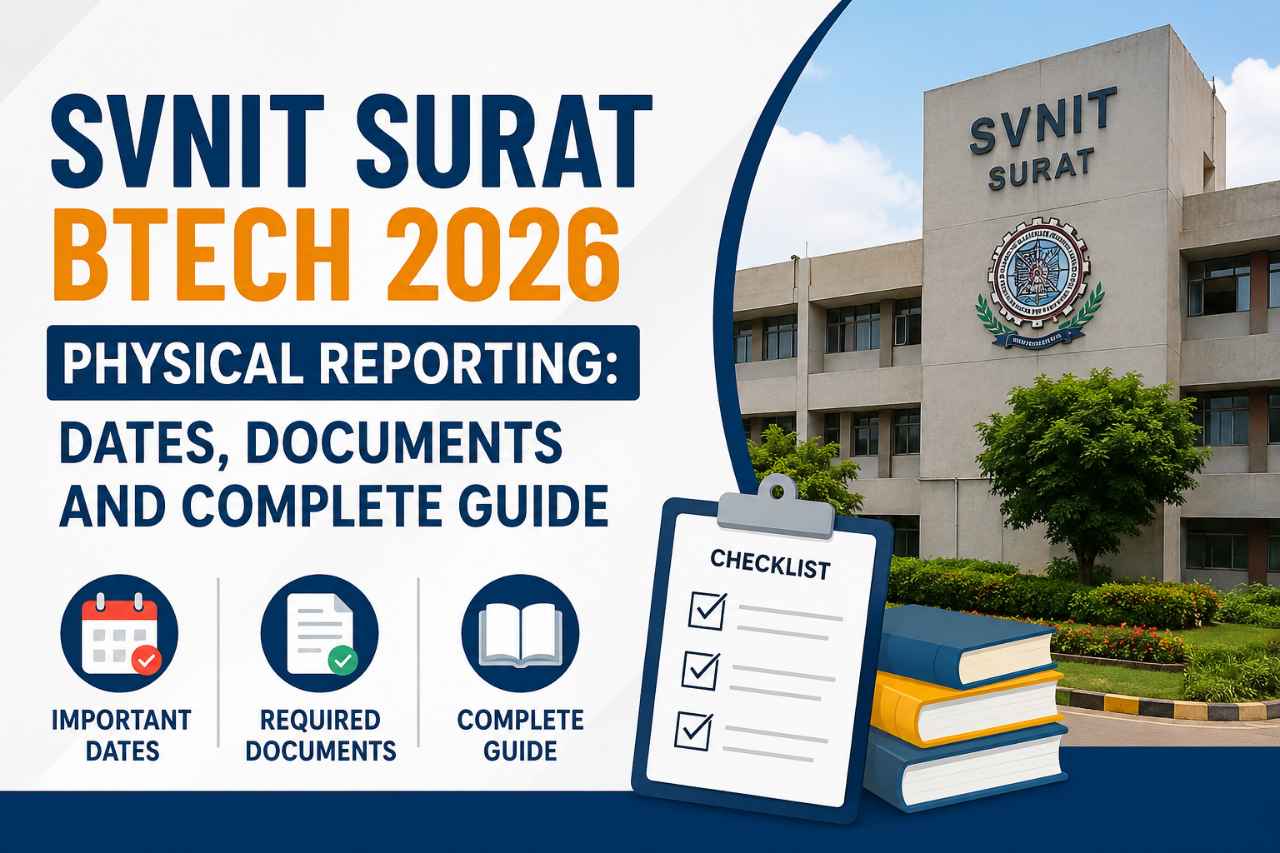

If you have secured a Bachelor of Technology (BTech) seat at Sardar Vallabhbhai National institute of Technology (SVNIT), Surat through JoSAA 2026 or the CSAB Special Round, physical reporting is the last step before you officially become an NIT student. SVNIT has announced that in-person reporting for BTech Admission 2026 will run from August 13 to August 18, 2026 at the institute campus in Ichchhanath, Surat. The notification was released on July 28, 2026, and is available on the official portal at svnit.ac.in.
Physical reporting is not optional. You must appear in person with original documents for verification, complete biometric formalities, and pay the remaining institute fee. Missing your assigned slot within this six-day window can lead to cancellation of your allotted seat. This guide explains the full schedule, documents required, step-by-step reporting process, travel tips for Surat, and what to do if you face any issue during verification.
What Is SVNIT Surat BTech 2026 Physical Reporting?
Physical reporting is the final admission stage after online seat allotment through the Joint Seat Allocation Authority (JoSAA) or the Central Seat Allocation Board (CSAB). Once you accept a seat online and pay the seat acceptance fee, the institute calls you to the campus to verify your identity, academic records, and category certificates before confirming your admission.
At SVNIT Surat, this process applies to all BTech programmes offered under JoSAA 2026 rounds and the CSAB Special Round. Whether you are allotted Computer Science, Mechanical Engineering, Electrical Engineering, or any other branch, the reporting procedure and document checklist remain largely the same. Candidates exploring similar programmes at other institutes such as National institute of Technology Delhi (NIT Delhi) will find comparable reporting norms across NITs, though dates and fee details differ by campus.
Why Physical Reporting Matters
Online seat acceptance alone does not complete your admission. NITs are required to verify originals against the data submitted during JEE Main counselling. This protects seat integrity, prevents document fraud, and ensures that reserved-category benefits are applied correctly. For CSAB Special Round candidates especially, this window represents the final opportunity to secure an NIT seat in 2026 there is no further round after reporting closes.
SVNIT Surat BTech 2026 Physical Reporting Dates and Venue
SVNIT has fixed a six-day reporting window so that candidates allotted across different JoSAA rounds and the CSAB Special Round can report in an organised manner. The institute publishes a slot-wise schedule assigning specific dates to different candidate groups.
| Event | Date / Details |
|---|---|
| Official notification release | July 28, 2026 |
| Physical reporting window starts | August 13, 2026 |
| Physical reporting window ends | August 18, 2026 |
| Reporting venue | SVNIT Campus, Ichchhanath, Surat, Gujarat |
| Official website | svnit.ac.in |
How to Find Your Assigned Reporting Date
Do not assume you can report on any day between August 13 and 18. SVNIT assigns specific dates or slots based on your counselling round, branch, or category. Follow these steps:
- Visit svnit.ac.in and open the Admissions or Notices section.
- Download the Physical Reporting notification PDF for JoSAA/CSAB Special Round BTech 2026.
- Search the PDF for your allotted branch, category, or round to find your reporting date.
- Note the reporting time slot if mentioned arriving at least one hour early is advisable.
- Save a screenshot or printout of your assigned date for travel planning.
For queries, contact the UG admission helpline at 0261-2201919 or 0261-2201543, or email ugadmission@svnit.ac.in / acad_btech1@svnit.ac.in.
Who Must Report During August 13–18, 2026?
The reporting window is meant for candidates who received a BTech seat allotment at SVNIT Surat through:
- JoSAA 2026 counselling rounds (including upgraded allottees who moved to SVNIT from another institute)
- CSAB Special Round 2026 (the final central counselling round for vacant NIT seats)
Candidates Who Should Not Report
You do not need to visit the campus if you have already withdrawn your seat through JoSAA or CSAB before the reporting deadline, or if you chose not to accept the SVNIT allotment and did not pay the seat acceptance fee. Only candidates with a valid, accepted allotment should report.
Fresh Allottees vs Upgraded Candidates
Fresh allottees are students receiving SVNIT as their first confirmed NIT seat. Upgraded candidates previously held a seat at another NIT or IIT and moved to SVNIT through float or slide options. Both groups must complete physical reporting at SVNIT even if they reported elsewhere earlier your new institute is now SVNIT, and previous reporting does not transfer automatically.
Documents Required for SVNIT Surat BTech Reporting 2026
Document verification is the core of physical reporting. Carry original documents plus one complete set of self-attested photocopies. Many candidates also prepare a second photocopy set as backup. Missing or mismatched documents are among the most common reasons for delayed admission or seat cancellation.
Core Academic Documents
- Provisional seat allotment letter from JoSAA 2026 or CSAB 2026 (printout from the counselling portal)
- JEE Main 2026 admit card
- JEE Main 2026 scorecard / result
- Class 10 mark sheet and passing certificate
- Class 12 mark sheet and passing certificate
Category and Identity Documents
- Category certificate (SC, ST, OBC-NCL, EWS, or PwD), if applicable must match the format prescribed for NIT admissions and be issued by a competent authority
- Valid photo identity proof (Aadhaar card, passport, or other government-issued ID)
- Recent passport-size colour photographs (carry at least 6–8 copies; some NITs ask for additional photos for hostel and library records)
Medical and Fee Documents
- Medical fitness certificate from a registered medical practitioner (as per the format specified in the SVNIT notification)
- Proof of seat acceptance fee payment (JoSAA/CSAB payment receipt or bank transaction proof)
Document Preparation Tips
Arrange documents in a folder in the order listed in the official notification. Use separate clear files for originals and photocopies. For OBC-NCL and EWS certificates, ensure validity for the admission year expired or incorrectly formatted certificates are frequently rejected. PwD candidates should carry the disability certificate in the prescribed format. If your name differs across certificates, carry a gazette notification or affidavit as supporting proof.
Step-by-Step Physical Reporting Process at SVNIT Surat
Reporting at SVNIT follows a structured sequence. Understanding each stage helps you complete formalities smoothly and avoid last-minute confusion on campus.
- Verify your slot online Confirm your reporting date and any branch-specific instructions on svnit.ac.in before travelling.
- Arrive at the campus Reach SVNIT, Ichchhanath, Surat, on your assigned date with all documents and fee payment readiness.
- Document verification Submit originals at the verification desk. Officials will cross-check details against your JoSAA/CSAB data.
- Biometric and photograph capture Complete identity capture as directed by the admission team.
- Balance fee payment Pay the remaining institute fee through the approved mode (online transfer, demand draft, or other method listed in the notification).
- Collect confirmation Obtain your admission confirmation slip or receipt before leaving. This proves you completed reporting successfully.
What Happens After Reporting?
After successful verification and fee payment, SVNIT will confirm your admission for the 2026–27 academic session. Watch svnit.ac.in for follow-up notices on hostel allotment, orientation schedule, and the academic calendar. Hostel allocation is typically announced separately after reporting, so keep checking the website even after you receive your confirmation slip.
Understanding JoSAA and CSAB in the SVNIT Admission Context
To report correctly, it helps to know which counselling body allotted your seat.
JoSAA 2026
The Joint Seat Allocation Authority conducts centralized counselling for IITs, NITs, IIITs, and other GFTIs based on JEE Main and JEE Advanced ranks. If you accepted a SVNIT seat during regular JoSAA rounds (Round 1 through Round 6), your allotment letter will show JoSAA as the issuing authority. JoSAA candidates typically report earlier in the overall NIT admission cycle, but SVNIT has consolidated reporting for its BTech 2026 batch into the August 13–18 window as per the latest notification.
CSAB Special Round 2026
The Central Seat Allocation Board conducts special rounds for vacant seats remaining after JoSAA closes. CSAB is often the last chance for students who did not secure a preferred NIT seat earlier. Registration and seat acceptance for CSAB happen on csab.nic.in. If your allotment letter mentions CSAB, ensure you completed CSAB-specific seat acceptance before heading to Surat. Missing CSAB deadlines before physical reporting makes the campus visit pointless online acceptance is a prerequisite.
SVNIT Surat: What BTech Aspirants Should Know
Sardar Vallabhbhai National Institute of Technology, Surat, is one of 31 NITs in India and ranks among the most sought-after engineering institutes in Gujarat. Established in 1961 as Sardar Vallabhbhai Regional College of Engineering, it was upgraded to an NIT in 2002. The campus spans Ichchhanath in Surat and offers undergraduate programmes across core and emerging branches.
Students joining popular branches like Computer Science and Engineering can expect rigorous academics, active coding clubs, and strong placement participation from IT and core-sector companies. If you are comparing programme options, resources on BTech CSE and BTech programmes help you understand curriculum structures across institutes. Diploma holders exploring entry beyond first year may refer to BTech Lateral CSE pathways at other colleges, though JoSAA/CSAB reporting at SVNIT applies to standard four-year BTech entrants via JEE Main.
Branches and Academic Environment
SVNIT offers BTech in disciplines including Chemical Engineering, Civil Engineering, Computer Science and Engineering, Electronics and Communication Engineering, Electrical Engineering, Mechanical Engineering, and more. The institute follows a semester system with credits, internal assessments, and end-semester examinations. New students should monitor notices for branch-specific orientation and mentor allocation after reporting.
Fee Payment and Financial Planning for Reporting
During JoSAA/CSAB counselling, you already paid a seat acceptance fee (typically ₹35,000 for General/OBC/EWS and adjusted amounts for SC/ST as per JoSAA rules). At physical reporting, you pay the balance institute fee, which covers tuition, hostel deposit (if applicable), and other charges listed in the SVNIT fee structure for 2026–27.
Payment Modes
Check the official notification for approved payment methods. Most NITs accept online bank transfer to the institute account, demand draft in favour of the institute, or digital payment through designated portals. Carry printed payment proof. Avoid last-day payment failures by completing transfers a day before reporting if online modes are allowed.
Scholarship and Fee Concession
SC, ST, and PwD students may be eligible for tuition fee waivers as per government norms. OBC-NCL and General category students from economically weaker backgrounds should enquire about institute-level scholarships after admission. Carry income certificates if you plan to apply for financial aid some schemes require separate applications post-reporting.
Travel and Stay Guide for Reporting in Surat
Surat is a major city in south Gujarat, well connected by rail, road, and air. SVNIT is located in the Ichchhanath area, approximately 10–12 km from Surat Railway Station depending on the route.
How to Reach SVNIT Campus
- By train: Surat Railway Station (ST) is the nearest major railhead. Auto-rickshaws and app-based cabs are available from the station to the campus.
- By air: Surat International Airport (SVU) serves domestic flights. The airport is roughly 10 km from the institute.
- By road: Gujarat State Road Transport Corporation (GSRTC) and private buses connect Surat with Ahmedabad, Vadodara, Mumbai, and other cities.
Accommodation Tips
If you are travelling from another state, book hotel or guest-house stay near Ichchhanath or Vesu at least a week before reporting. August is monsoon season in Gujarat carry an umbrella, waterproof document pouch, and extra photocopies in case papers get damp. Arrive in Surat a day before your slot to account for travel delays.
Parent and Guardian Guidelines
Parents often accompany students for physical reporting. While document verification is done by the candidate, having a guardian present helps with fee payment coordination and travel logistics. SVNIT may restrict entry to specific reporting halls check the notification for visitor policies. Carry snacks and water, as queues during peak reporting days can run long.
Common Mistakes to Avoid During Physical Reporting
Even well-prepared students lose seats due to avoidable errors. Keep these points in mind:
- Reporting on the wrong date Stick to your assigned slot; do not rely on unofficial WhatsApp groups for dates.
- Category certificate mismatch Certificate name, category code, and validity must match JoSAA registration exactly.
- Incomplete fee payment Partial payments without official approval may not be accepted.
- No proof of seat acceptance Without JoSAA/CSAB acceptance receipt, verification cannot proceed.
- Leaving without confirmation slip Always collect written proof of completed reporting.
- Bringing only photocopies Originals are mandatory for every document listed.
Comparing NIT Reporting: SVNIT vs Other Institutes
Every NIT publishes its own reporting schedule. While the document checklist is broadly similar, dates vary. A student allotted both SVNIT and another institute must report only at the institute they finally accepted through JoSAA/CSAB freeze or float logic. If you are evaluating alternatives alongside NIT admission such as private universities like Vel Tech Chennai remember that NIT seats require JEE Main-based counselling and mandatory physical verification; private institute processes differ significantly.
For broader context on engineering undergraduate options, explore detailed guides on BTech CSE programmes and the general Bachelor of Technology landscape to understand how NIT Surat fits your career goals.
Action Checklist Before You Leave for Surat
Use this practical checklist one week before your reporting date:
- Download and read the full SVNIT physical reporting notification PDF
- Confirm your assigned date and time slot on svnit.ac.in
- Organize originals plus two sets of self-attested photocopies
- Verify category and medical certificates for format compliance
- Complete balance fee payment or arrange demand draft / online transfer
- Book travel and accommodation for Surat
- Save helpline numbers: 0261-2201919, 0261-2201543
- Carry a power bank, pen, stapler, and document folder
- Inform family of your reporting schedule and campus address
- Check weather and pack accordingly for August monsoon conditions
What If You Face Problems During Verification?
If officials flag a document issue, stay calm and ask for specific guidance. Minor discrepancies (such as spelling variations) may be resolved with affidavits if allowed. For serious mismatches wrong category, invalid OBC-NCL certificate, or failure to meet eligibility you may be given limited time to submit corrected documents as per institute rules. Contact ugadmission@svnit.ac.in immediately and keep copies of all communication.
Do not pay unofficial agents who promise to fix verification outside the official desk. SVNIT admission is handled only through designated counters on campus during the reporting window.
Conclusion
SVNIT Surat BTech 2026 physical reporting from August 13 to August 18, 2026 is the decisive step that converts your online seat allotment into a confirmed admission. JoSAA and CSAB Special Round candidates must appear at the Ichchhanath campus with complete originals, self-attested photocopies, medical fitness proof, and balance fee payment ready. Check your assigned slot on svnit.ac.in, plan travel to Surat in advance, and follow the verification sequence carefully.
Missing this window can mean losing your NIT seat with no further allotment opportunity in 2026 especially critical for CSAB Special Round students. Prepare documents early, use official helplines for doubts, and collect your admission confirmation slip before leaving campus. Once reporting is done, focus on hostel notices, orientation, and a strong start to your four-year BTech journey at one of Gujarat's premier engineering institutes.