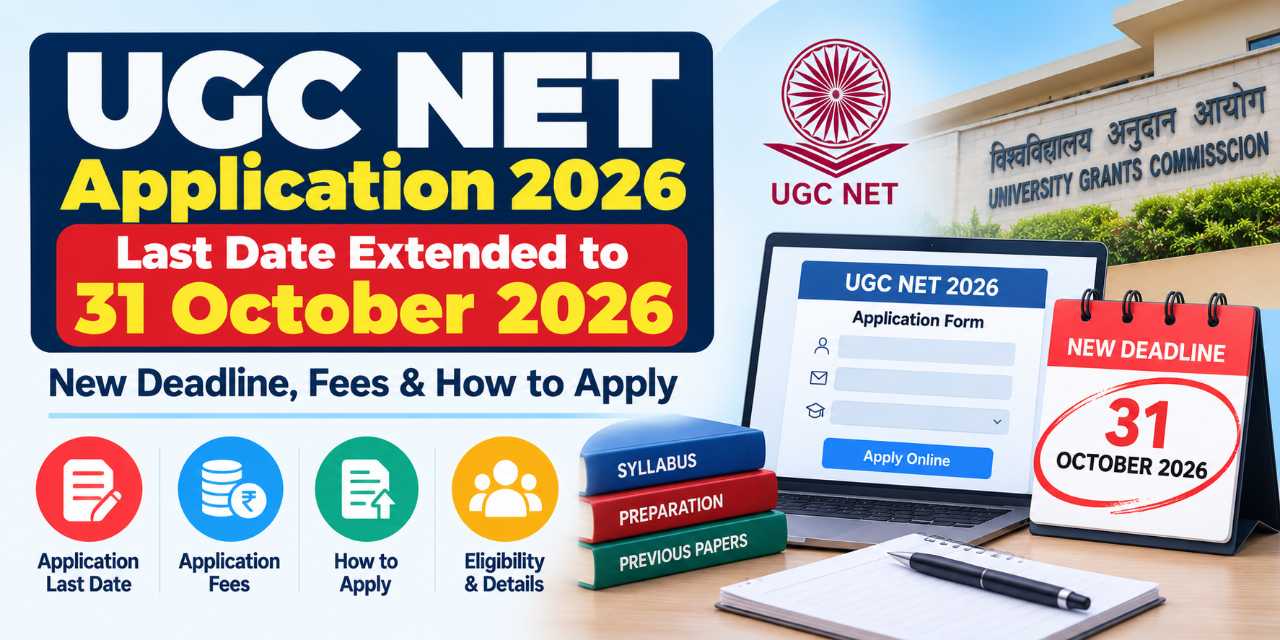
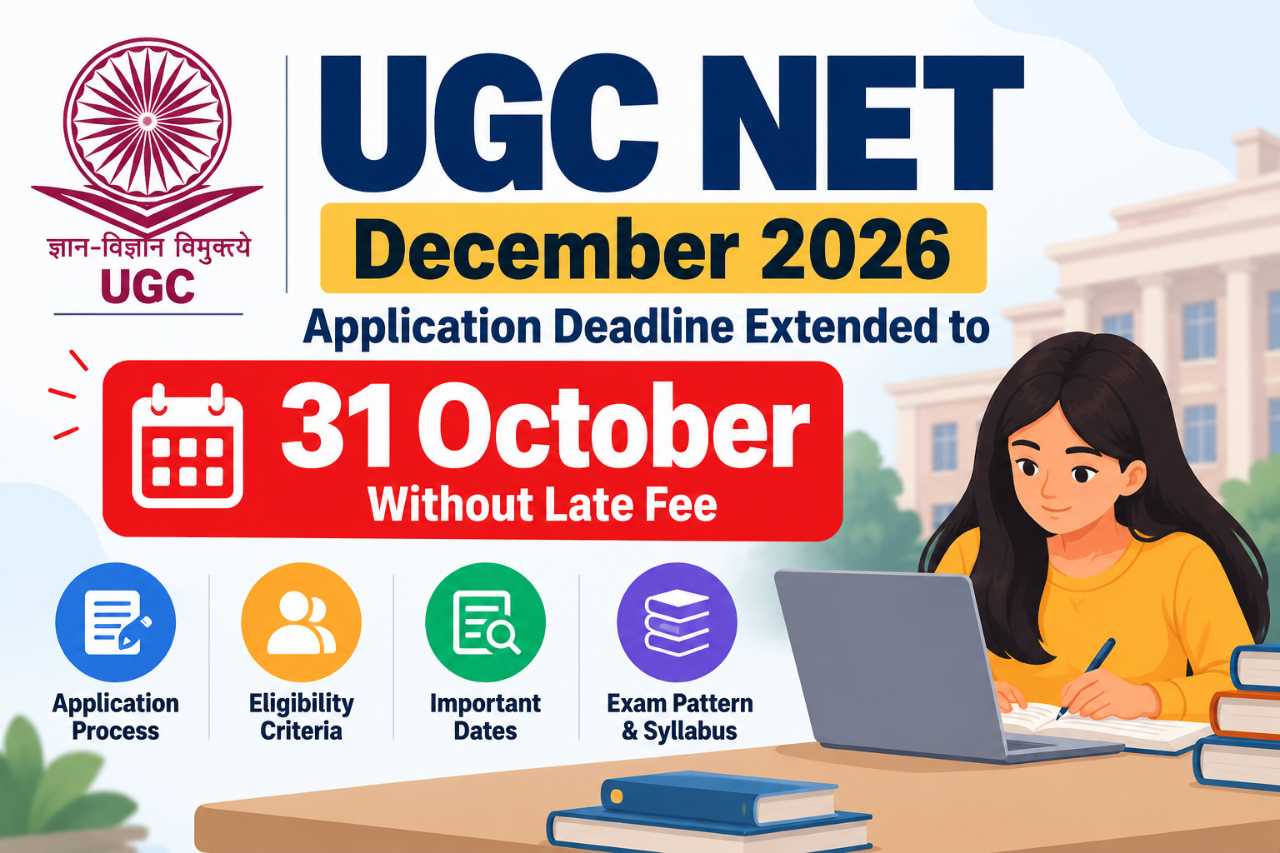
If you plan to teach in a university, pursue a Junior Research Fellowship (JRF), or use a national eligibility test for PhD admission, the UGC NET December 2026 cycle is one of the most important dates on your calendar. On 27 October 2026, the National Testing Agency (NTA) issued a public notice extending the last date to submit the online application and complete the examination fee transaction to 31 October 2026, up to 11:50 pm, through the official portal at ugcnet.nta.nic.in. Crucially, candidates can use this revised window without paying any late fee, which removes a common barrier for students who were waiting for documents, fee arrangements, or subject-paper finalisation.
By 25 October 2026, NTA reported that 5,50,048 candidates had registered, while 3,73,419 had fully completed applications and paid the fee. That gap roughly 1.76 lakh registrations still incomplete shows why the extension matters. For CollegeDwar readers balancing final-year postgraduate coursework, college lab schedules, or coaching for other competitive exams, these extra days are a practical buffer not an invitation to delay until the final hour. Whether you are a postgraduate student in humanities, a scinece graduate eyeing research, or a professional degree holder exploring academia, finishing your form before the clock runs out on 31 October can keep your December attempt on track. This article explains the extension in plain language, walks you through a safe application checklist, and connects the exam to real career outcomes in Indian higher education.
What NTA Changed for UGC NET December 2026 Applications
The December 2026 UGC NET is conducted by NTA on behalf of the University Grants Commission (UGC). The test assesses whether Indian nationals meet eligibility norms for JRF, appointment as Assistant Professor, and in many cases admission to PhD programmes at universities and colleges. The October 2026 notice does not rewrite the exam pattern or eligibility; it only shifts deadlines for registration and fee payment.
Revised deadline at a glance
| Activity | Revised last date and time | Late fee |
|---|---|---|
| Online application submission | 31 October 2026, 11:50 pm | None (per current notice) |
| Successful examination fee transaction | 31 October 2026, 11:50 pm | None (per current notice) |
| Official application portal | ugcnet.nta.nic.in | |
| Updates and announcements | nta.ac.in | |
NTA has stated that all other terms and conditions in the information bulletin and earlier public notices remain unchanged. That means your chosen subject, category, PwBD status, city preferences, and eligibility proofs must still match the bulletin you cannot treat the extension as permission to alter fundamental details without following correction rules published by NTA.
Why NTA extended the deadline without a late fee
Extensions with zero late fee are usually designed to help candidates who started registration but could not finish payment, faced gateway errors, or needed time to verify postgraduate marks and subject codes. NTA explicitly advised applicants to submit well before 11:50 pm on 31 October to reduce risk from server load, banking timeouts, or incomplete document uploads. In practice, treating 30 October as your personal deadline is one of the simplest ways to avoid stress.
Who Should Complete UGC NET December 2026 Registration Now
UGC NET is not limited to M.A. or M.Sc. students. Anyone who meets postgraduate eligibility for a given subject and in some cases integrated or professional postgraduate qualifications as listed in the bulletin can appear. The exam opens doors across disciplines, from Education and Commerce to Computer Science and Environmental Science.
Typical candidate profiles
- Aspiring Assistant Professors who want a national eligibility certificate recognised by UGC-aligned institutions.
- Research-oriented postgraduates targeting JRF stipend and PhD admission in central universities, state universities, and deemed universities.
- Working professionals with PG degrees planning a mid-career shift into teaching or funded research.
- Candidates who registered but did not pay by 25 October they remain in the incomplete pool unless they finish by 31 October.
If your background is in computing or applications for example after a Bachelor of Computer Application (BCA), a broader Computer Applications programme, or lateral entry via B.Tech Lateral CSE you may qualify for NET in subjects such as Computer Science or Electronic Science depending on your postgraduate degree and bulletin rules. Always map your PG specialisation to the official subject list before selecting papers.
How UGC NET differs from CSIR NET
Both exams are national eligibility tests, but they serve different subject domains. UGC NET covers a wide basket of humanities, social sciences, commerce, and many interdisciplinary papers under UGC. CSIR NET focuses on science subjects for JRF and lectureship in the CSIR framework. Science postgraduates sometimes qualify for both depending on subject overlap; choosing the wrong exam wastes time and fees. Read each bulletin’s subject codes carefully and pick the test that matches your master’s discipline.
What UGC NET December 2026 Is Used For
Understanding outcomes helps you decide whether December 2026 is the right attempt or whether you should prepare for a later cycle while strengthening your PG profile.
Junior Research Fellowship (JRF)
JRF is aimed at candidates who score above the fellowship cut-off (subject to age and other conditions in the bulletin). Fellowship holders often pursue PhD work with financial support. Institutions may also consider JRF scores alongside interviews and academic records during doctoral admission.
Assistant Professor eligibility
For many colleges and universities, qualifying NET (Assistant Professor) is a baseline eligibility requirement alongside a postgraduate degree. Clearing NET does not guarantee a job; it certifies national eligibility. You still compete in interviews, presentations, and experience-based shortlists.
PhD admission pathway
Several universities treat NET qualification as fulfilling part of PhD entrance norms, especially when combined with interviews or course work. Policies vary by institution and state; check the PhD ordinance of each university you target.
Registration Statistics: What the Numbers Mean for You
NTA’s snapshot till 25 October 2026 shows high interest: more than half a million registrations. Yet only about two-thirds had completed payment. If you are in the incomplete group, you are not alone but you are also not guaranteed a seat in the exam hall until payment succeeds and the application status shows complete.
- 5,50,048 candidates who had registered (partial or complete).
- 3,73,419 candidates who completed application and paid the examination fee.
High registration often correlates with competitive cut-offs in popular subjects such as English, Commerce, Education, and Political Science. Use the extra days to confirm your subject paper, practise with previous-year patterns, and align your study plan with whether you are aiming for JRF only, Assistant Professor only, or both.
Step-by-Step: Finishing Your Application Before 31 October
The procedural part of this cycle is straightforward if you treat it like an exam in itself: one careless error in subject selection or category can cause rejection later.
Before you log in
- Download and read the UGC NET December 2026 information bulletin from the official portal.
- Keep scanned copies of photograph, signature, and PG marksheets ready in prescribed size and format.
- Confirm postgraduate percentage and subject match eligibility for your chosen NET paper.
- Use a stable internet connection and a working email and mobile number you will receive OTPs and status updates.
On the portal
- Visit ugcnet.nta.nic.in and open the active registration link for December 2026.
- Complete or review personal, academic, and category details; double-check spelling as on certificates.
- Select the correct subject paper and exam cities as per priority rules in the bulletin.
- Pay the examination fee through the enabled payment modes and wait for successful transaction confirmation.
- Download the confirmation page and fee receipt; store PDFs in cloud storage and offline backup.
After submission
Monitor nta.ac.in for admit card release, city intimation, and any correction windows. Do not rely on unofficial Telegram forwards; verify every date on the official site.
Eligibility and Documentation: Common Mistakes to Avoid
Eligibility for UGC NET is tied to your postgraduate qualification and sometimes to specific subject combinations. While this article cannot replace the bulletin, these mistakes appear every cycle:
- Wrong subject paper choosing a popular paper that does not match your PG specialisation.
- Incomplete payment assuming registration ID alone confirms a seat.
- Category certificate mismatch uploading outdated or incorrectly formatted certificates.
- Name variations differences between Aadhaar, PG degree, and application form without affidavit support where required.
If you hold professional degrees, cross-check whether your institution’s PG programme is recognised for the subject you select. When in doubt, contact your university examination section before 31 October rather than after results.
Exam Pattern and Preparation: Practical Tips for December 2026
UGC NET is typically conducted in computer-based test mode with papers structured around subject knowledge and, where applicable, general aptitude components as per the current scheme in the bulletin. Preparation strategies that work for most postgraduates include:
- Syllabus mapping break the official syllabus into weekly topics and track completion percentages.
- Previous-year analysis identify high-weightage units in your subject; do not ignore Paper 1-style reasoning and teaching aptitude if applicable to your cycle.
- Mock tests under timed conditions build stamina for long CBT sessions and reduce negative marking surprises if the scheme includes it for your paper.
- Answer writing for interview stage even after NET, Assistant Professor recruitment often includes presentation and subject interviews; keep notes organised early.
Candidates from technical backgrounds should revise core PG topics plus recent developments in their field. Humanities and social science aspirants benefit from structured reading lists and monthly revision of thinkers, schools, and statutory frameworks relevant to their paper.
Career Planning Beyond NET
Qualifying NET is one milestone in a longer academic career. Some graduates combine teaching eligibility with administrative roles in colleges; others move into research centres, policy think tanks, or curriculum design. If academia is not your only goal, compare pathways openly: management entrance exams such as CAT lead toward MBA programmes and corporate leadership tracks, while NET anchors university teaching and research. Many students attempt NET while working as lecturers or research assistants plan finances and study hours accordingly.
Understanding Public Notices and the Information Bulletin
Every NTA extension including the 27 October 2026 notice for December 2026 should be read together with the master information bulletin. Public notices typically change dates or clarify procedures; they rarely replace eligibility tables, subject lists, or fee categories. Build a simple folder on your phone or laptop labelled “UGC NET Dec 2026” and save PDFs of each notice with the download date in the file name. When friends share screenshots on social media, open the same text on nta.ac.in before acting. Misinformation during deadline week has caused unnecessary panic and duplicate payments in past cycles.
If you already paid and your dashboard shows “complete,” you do not need to register again. Instead, note upcoming milestones: correction windows (if announced), city intimation, admit card, and exam-day instructions. Candidates who only partially filled forms should log in, resume from the saved application ID, and walk through each tab until a green tick or completion message appears.
Exam Cities, Admit Card, and Exam-Day Planning
During registration you usually select multiple exam cities in order of preference. NTA allocates centres based on availability; you cannot assume your first choice will be granted. Pick cities where you can travel safely and afford lodging if the exam is scheduled on consecutive shifts for multiple papers. Keep government photo ID ready that matches your application name.
The admit card will be released only on the official portal for candidates with complete applications. Download it immediately, check spelling of your name, photograph, subject, and reporting time, and report discrepancies through the helpline channels listed on NTA’s site. On exam day, arrive early with admit card, ID proof, and allowed items only follow the live instructions because security rules can be updated close to the test.
Fee Categories and Reservation: Check Before You Pay
Examination fees differ by category (General, EWS, OBC-NCL, SC, ST, PwBD, etc.) as defined in the bulletin. Select category honestly and upload valid certificates where required. Changing category after payment may not be possible unless NTA opens a formal correction window. PwBD candidates should also complete facility requirements on the form so allotted centres can support accessibility needs.
Remember that qualifying NET under a category follows UGC cut-off rules published after the exam. Your application category affects fee and reservation in recruitment later, but NET merit lists are subject to the official key and final answer keys. Save payment receipts; they are often needed during document verification in college appointments.
After Registration: Building a December 2026 Study Plan
Once your application is complete, shift from admin mode to preparation mode. Divide remaining weeks into three layers: core syllabus coverage, revision cycles, and full-length mocks. If you teach tuition or work part-time, block fixed morning hours for difficult units. Group study helps for Paper 1-style teaching and research aptitude topics; solo deep reading suits specialised Paper 2 content.
Track official sample papers and previous bulletins to understand question framing. Maintain a error notebook each wrong mock question should lead to a one-page revision note. For technical postgraduates, pairing conceptual revision with short coding or problem sets (where relevant to your subject) keeps skills exam-ready. Humanities students should practise concise definitions and comparative charts (schools of thought, periods, reforms) that speed up multiple-choice elimination.
From NET Qualification to College Appointment
Clearing UGC NET proves eligibility; appointment as Assistant Professor still requires clearing institutional recruitment under UGC Regulations and state or central rules. Advertisements may ask for NET, SET (where applicable), PhD, teaching experience, and publications. Build a portfolio early: conference presentations, research proposals, and teaching practicum records strengthen your CV even before results.
Central universities, state universities, private universities, and affiliated colleges each run separate timelines. Subscribe to their official recruitment pages rather than third-party job aggregators alone. If you miss December 2026 cut-offs, later cycles and SET exams in some states remain options NET is a long-horizon qualification, not a single-shot gamble.
Important Reminders for the Extended Window
- The extension applies to application submission and fee payment till 31 October 2026, 11:50 pm with no late fee as announced.
- All other bulletin conditions remain in force read correction and edit rules if NTA opens a window later.
- Apply early in the day during the last week to avoid payment gateway congestion.
- Keep NTA helpline numbers and the official FAQ handy; save screenshots of every successful step.
Conclusion
The UGC NET December 2026 application deadline extension to 31 October 2026 gives incomplete registrants a final, no-late-fee chance to secure their attempt. With over five lakh registrations already recorded and a significant share still awaiting fee completion, the next few days will decide who actually appears in the exam hall. Use the official portals ugcnet.nta.nic.in and nta.ac.in, verify your subject and eligibility against the bulletin, and submit early. Whether your goal is JRF, Assistant Professor eligibility, or PhD admission, treating this registration window with the same discipline as your study plan is the smartest move you can make before you shift focus fully to preparation.