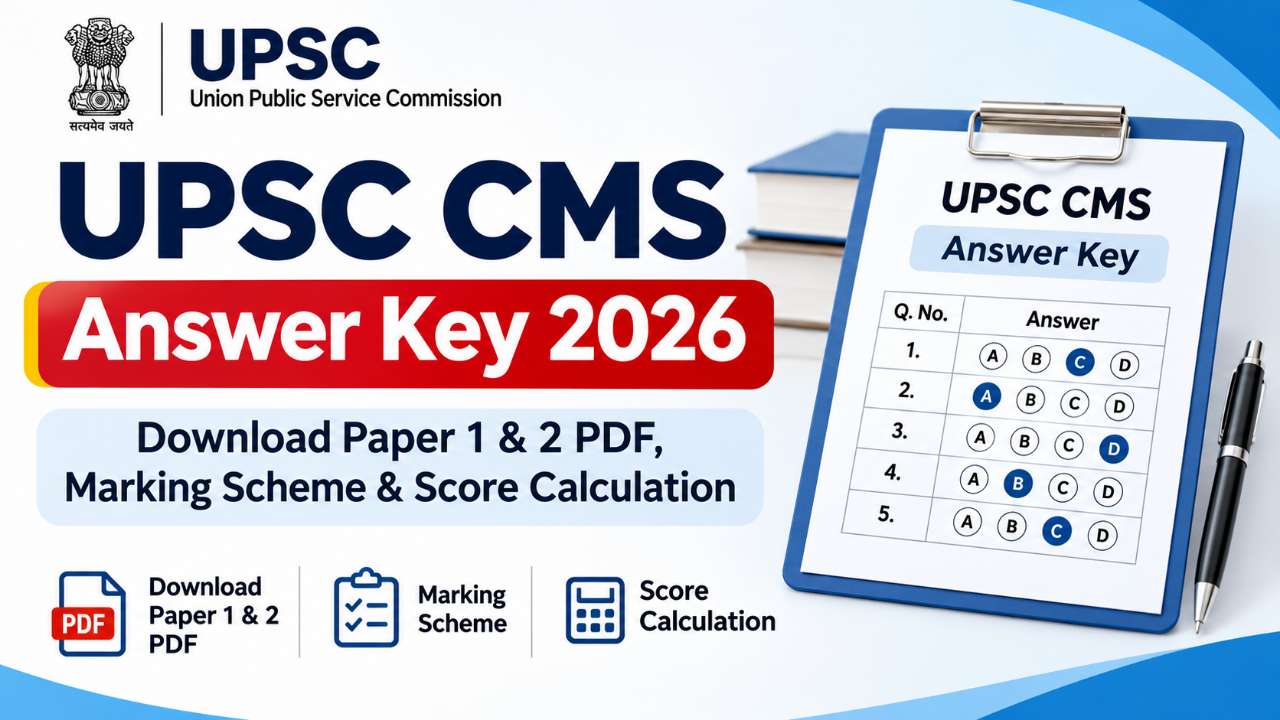
The UPSC CMS answer key 2026 is one of the most important post-exam resources for MBBS graduates targeting government medical officer roles through the Combined Medical Services (CMS) Examination. Once the Union Public Service Commission publishes the key, you can match your responses against the officially declared correct options for both computer-based test papers and work out a realistic score range before the final result.
Whether you appeared for CMS in the current cycle or are planning for upcoming attempts, understanding how answer keys are released, how negative marking works, and how to raise objections can save you from costly mistakes in preparation and exam strategy. This article is written for Indian medical students and young doctors navigating government medical recruitment, with clear steps you can follow today.
What Is the UPSC CMS Examination?
The UPSC Combined Medical Services Examination is a national-level recruitment test conducted by the Union Public Service Commission. It selects candidates for posts such as Assistant Medical Officer in central health services, railways, ordnance factories, and allied departments. The selection process typically includes a written examination (CBT), document verification, and a personality test (interview).
For most aspirants, the written stage is the highest-pressure milestone because it filters a large pool of medically qualified applicants. The exam tests clinical knowledge across medicine, pediatrics, surgery, obstetrics and gynecology, and preventive social medicine areas you already studied during MBBS and internship, but at a competitive, time-bound level.
Who Should Track the CMS Answer Key?
- Candidates who completed the CMS CBT in the current year and want an early score estimate.
- Repeaters comparing their performance across attempts using previous years’ keys.
- Final-year MBBS students and interns building a realistic timeline from graduation to government service.
- Doctors exploring parallel paths NEET PG, state health services, or academic degrees while keeping CMS as a backup goal.
Medical education pathways vary across India; institutions such as Assam Down Town University and other universities shape your foundational training, but CMS success ultimately depends on disciplined revision of standard textbooks, previous papers, and exam-specific strategy.
UPSC CMS Answer Key 2026: Official Release Overview
When headlines say UPSC CMS answer key 2026 (out), they usually refer to the commission uploading provisional answer keys for the CBT papers on upsc.gov.in. UPSC generally releases keys subject-wise or paper-wise in PDF format. Each file lists question numbers alongside the officially accepted correct answer, along with metadata such as exam date, subject name, maximum marks, and details about questions dropped from evaluation.
There are two practical versions of any CMS answer key you will encounter:
- Official UPSC CMS answer key: Published by the commission on the official portal. This is the only version used for final score calculation after the objection window closes.
- Unofficial or coaching-institute keys: Released within hours of the exam by teachers and institutes. Useful for same-day discussion, but answers may differ from the final official key.
Paper 1 and Paper 2 Structure (CBT Stage)
The CMS computer-based test is split into two papers, each carrying significant weight in the overall merit at the written stage:
| Paper | Subjects (broad areas) | Question pattern (typical) | Maximum marks (typical) |
|---|---|---|---|
| Paper 1 | General Medicine and Paediatrics | Multiple-choice questions | 250 |
| Paper 2 | Surgery; Gynaecology & Obstetrics; Preventive & Social Medicine | Often divided into parts with MCQs | 250 |
UPSC may adjust fine details in the notification for a given year; always cross-check the latest official advertisement and exam instructions. When the UPSC CMS Paper 1 answer key and Paper 2 answer key PDFs appear, download both files separately and label them clearly on your device to avoid mixing subjects during score calculation.
How to Download UPSC CMS Answer Key 2026 (Official PDF)
The official answer key is never shared individually by email or SMS. You must fetch it from the UPSC website. Keep your question paper booklet codes or memory of question order handy when matching answers.
Step-by-Step Download on upsc.gov.in
- Open the official UPSC website in a secure browser.
- Navigate to the “Examination” or “Answer Key” section (wording on the menu may vary slightly by site update).
- Look for the link titled along the lines of “Combined Medical Services Examination, 2026” or the examination year mentioned in the notification.
- Select the relevant subject or paper PDF link (for example, General Medicine and Paediatrics, or Surgery/Gynaecology/PSM).
- Download the file and store it in a folder named by exam year and paper number.
- Optionally print the key if you marked answers in the question paper printout during the exam.
If the portal is slow on release day, avoid unofficial mirror sites. Scammers sometimes host fake PDFs. Use only upsc.gov.in or PDFs linked from authenticated UPSC communications.
Details Mentioned on the UPSC CMS Answer Sheet PDF
Before you start tallying marks, scan the header and footnotes of the official document. A standard CMS answer key PDF usually includes:
- Subject or paper name
- Date of examination
- Maximum marks for that paper
- Question number and corresponding correct option
- Number of questions dropped or treated as null for scoring
Dropped questions matter. If UPSC excludes a item due to ambiguity or error, it is typically not counted for positive or negative marks. When unofficial keys award points for such questions, your estimate will diverge from the final result until the official clarification is published.
UPSC CMS Marking Scheme and Score Calculator
Understanding negative marking is essential for both post-exam analysis and future attempt strategy. For the CMS CBT, each incorrect response usually attracts a penalty of one-third (0.33) of the marks assigned to that question, consistent with UPSC’s standard pattern for many multiple-choice examinations.
Illustrative Score Formula
Use this framework once you have counted correct and incorrect responses against the official key:
Estimated score = (Number of correct answers × marks per correct answer) − (Number of incorrect answers × 0.33 × marks per question)
Example: If a section has questions worth one mark each, 90 correct and 20 wrong responses yield an estimated score of 90 − (20 × 0.33) = 90 − 6.6 = 83.4, before accounting for dropped questions or sectional rules in the official notification.
Smart Estimation Tips
- Mark questions you are genuinely unsure about separately; many CMS rank improvements come from reducing reckless guesses.
- Reconcile Paper 1 and Paper 2 estimates before comparing with past cut-off trends written stage qualifying rules can change with vacancies.
- If your unofficial institute key differs from UPSC on 10–15 questions, wait for the objection outcome rather than panic-adjusting your study plan.
Official vs Unofficial CMS Answer Key: Which One to Trust?
Coaching centres release unofficial keys quickly because discussion drives engagement and helps students psychologically process the exam. Treat them as discussion drafts, not verdicts.
The official key goes through administrative review and an objection window. Medical science questions sometimes have two defensible interpretations until a board standardizes the acceptable option. In borderline clinical scenarios, only UPSC’s final key counts for merit lists.
When Unofficial Keys Still Help
- Identifying obviously flawed memory of question stems the same evening.
- Building a list of doubtful questions to research before filing objections.
- Comparing how different faculty teams interpret controversial items useful for learning, not for legal claims.
Objections Against the UPSC CMS Provisional Answer Key
UPSC typically opens a short representation window after publishing provisional keys. Candidates must pay a prescribed fee per objection (refundable if the commission accepts the challenge, as per rules notified for that examination cycle).
How to Prepare a Strong Objection
- Cite standard textbooks (e.g., widely used Indian author references or international texts referenced in MBBS curricula).
- Quote guideline documents from national bodies where applicable without misrepresenting their scope.
- Attach clear scans; follow the online form’s file format and size limits.
- Submit before the deadline shown on the portal; late representations are not entertained.
Objections are not a lottery. Focus on factual errors, outdated question framing, or keys contradicted by unequivocal standard references. Emotional appeals without evidence are routinely rejected.
UPSC CMS Previous Year Answer Keys and Question Papers
One of the highest-ROI preparation strategies is solving previous years’ CMS question papers and verifying answers with official keys from those years. Patterns repeat in topic emphasis: common emergencies, hallmark signs, public health programme facts, and operative/obstetric decision trees.
Create a revision tracker with columns for year, paper, topic, your mistake type (conceptual, careless, time pressure), and corrective action. Over three to four months, this tracker beats passive re-reading of notes.
Suggested 8-Week Revision Framework
- Weeks 1–2: Paper 1 subjects medicine and paediatrics by system.
- Weeks 3–4: Paper 2 surgical and gynaecological clusters with image-based recall.
- Weeks 5–6: PSM, biostatistics, and national health programmes with MCQ drills.
- Weeks 7–8: Full-length timed mocks plus official previous-year papers.
After the Answer Key: Result, Cut-Off, and Interview Stage
The CMS result is published as a PDF roll number list for the written stage, followed by stages for qualified candidates. Cut-offs fluctuate with vacancies, paper difficulty, and applicant strength. Treat any “expected cut-off” you see online as speculation unless backed by multi-year vacancy analysis.
Candidates clearing the written exam proceed toward document verification and the personality test. Interview preparation for CMS is not generic civil services oratory; panels expect clinical maturity, ethical reasoning, public health awareness, and clarity about your service motivation.
Parallel Options While You Wait
- State health service examinations with regional language or domicile advantages.
- NEET PG for specialization if academic growth is your primary goal.
- Short-term diploma courses that strengthen weak CMS domains without delaying applications.
Many doctors hedge intelligently: CMS offers a stable central service trajectory, while postgraduate training builds super-specialization. Your choice should align with bond obligations, family location, and long-term clinical interests.
Roles and Departments After UPSC CMS Selection
Selected candidates may serve in diverse setups railway health units, ordnance factories, central health services junior scale posts, and other notified vacancies. Job profiles can include outpatient and inpatient duties, medico-legal documentation, camp postings, and administrative reporting.
Before joining, read service rules on transfer, leave, higher studies permission, and any bond linked to your medical college or state scholarship. Conflicts between an existing state bond and a central appointment must be resolved through proper channels; informal advice on forums is not a substitute for written communication with authorities.
Common Mistakes When Using the CMS Answer Key
- Scoring against coaching keys and assuming the result will match exactly.
- Ignoring dropped questions when calculating totals.
- Forgetting that different sets may have shuffled question numbers match by question content, not position alone, when comparing with friends.
- Skipping the objection window because of travel or internship duties set calendar alerts immediately when UPSC notifies key release.
- Letting a disappointing estimated score derail structured revision for the next eligible attempt.
Expert Tips for First-Time and Repeat CMS Aspirants
Repeaters often improve dramatically by auditing why they lost marks: negative marking debt, slow navigation in Paper 2 clusters, or under-prepared PSM sections. First-time aspirants should integrate CMS preparation with internship rotations ward exposure cements MCQ concepts better than isolated cramming.
Build a small peer group for timed tests and answer-key discussions. Explain why an option is wrong aloud; teaching sharpens retention. Balance physical stamina with study CMS recruitment may include medical standards checks relevant to field postings.
Eligibility Snapshot for CMS Aspirants
Before you chase the answer key, confirm that your candidature satisfied the eligibility norms in the active notification. UPSC CMS generally targets medical graduates with a recognised MBBS degree, completed internship, and registration with the National Medical Commission or a state medical council, subject to age limits and nationality rules stated in the advertisement.
Many aspirants discover gaps only at document verification missing internship completion certificates, delayed provisional registration, or discrepancies in name spellings across academic records. Use the post-answer-key phase to audit your file folders even if you are confident about marks. Fixing paperwork early reduces last-minute stress if you qualify for the personality test.
Medical Standards and Practical Readiness
CMS recruitment is not purely theoretical. Appointing authorities expect candidates to meet medical standards suitable for government service postings. Regular physical activity, adequate sleep before exam cycles, and honest disclosure of health history during forms protect you from avoidable disqualification later. Treat wellness as part of exam strategy, not a footnote.
Important CMS Timeline: Answer Key to Final Selection
Exact dates shift each cycle, but the logical sequence stays predictable. Mapping it helps you plan leave from residency jobs or clinic duties.
| Stage | What happens | What you should do |
|---|---|---|
| CBT exam day | Paper 1 and Paper 2 held as per admit card | Preserve rough memory notes of doubtful questions legally allowed post-exam |
| Provisional answer key | UPSC uploads PDF keys on official portal | Download, estimate score, list objections with evidence |
| Representation window | Objections accepted with fee per question | Submit only high-confidence challenges before deadline |
| Final answer key & result | Written-stage roll numbers published | Prepare documents; begin interview-oriented revision |
| Personality test | Interview for candidates who clear written cut-off | Practice ethics, public health scenarios, service motivation |
When coaching websites publish speculative calendars, compare each claim against UPSC’s own examination calendar and annual notices. Anchor your planning to primary documents, not social media countdowns.
Syllabus Focus Areas That Answer Keys Reveal
After every CMS attempt, answer keys indirectly expose how UPSC balances conceptual medicine with programme-level public health facts. Medicine-heavy sections often test diagnostic reasoning on common emergencies acute coronary syndromes, diabetic complications, sepsis protocols, and neurological red flags. Paediatrics items frequently revisit immunisation schedules, growth monitoring, and neonatal resuscitation principles.
Paper 2 rewards integrated thinking. Surgical MCQs may blend anatomy, radiology clues, and management priorities. Obstetrics and gynaecology questions can test antenatal screening, labour management decisions, and contraceptive counselling. PSM segments routinely touch national health missions, epidemiology basics, biostatistics interpretation, and sanitation-linked disease control.
When you review a newly released UPSC CMS answer key 2026 PDF, tag each mistake by syllabus bucket rather than by vague “I forgot.” Bucket-level analytics tell you whether another month of PSM drilling or timed surgery practice will move your score faster.
Conclusion
The UPSC CMS answer key 2026 is your bridge between exam day and the final written result. Download the official Paper 1 and Paper 2 PDFs from UPSC, calculate scores with the correct negative marking rule, use the objection window wisely, and align post-key planning with interview preparation or your next attempt strategy. Combined with previous-year papers and honest mistake analysis, the answer key is not just a score toy it is a diagnostic tool for becoming a stronger government medical officer candidate.