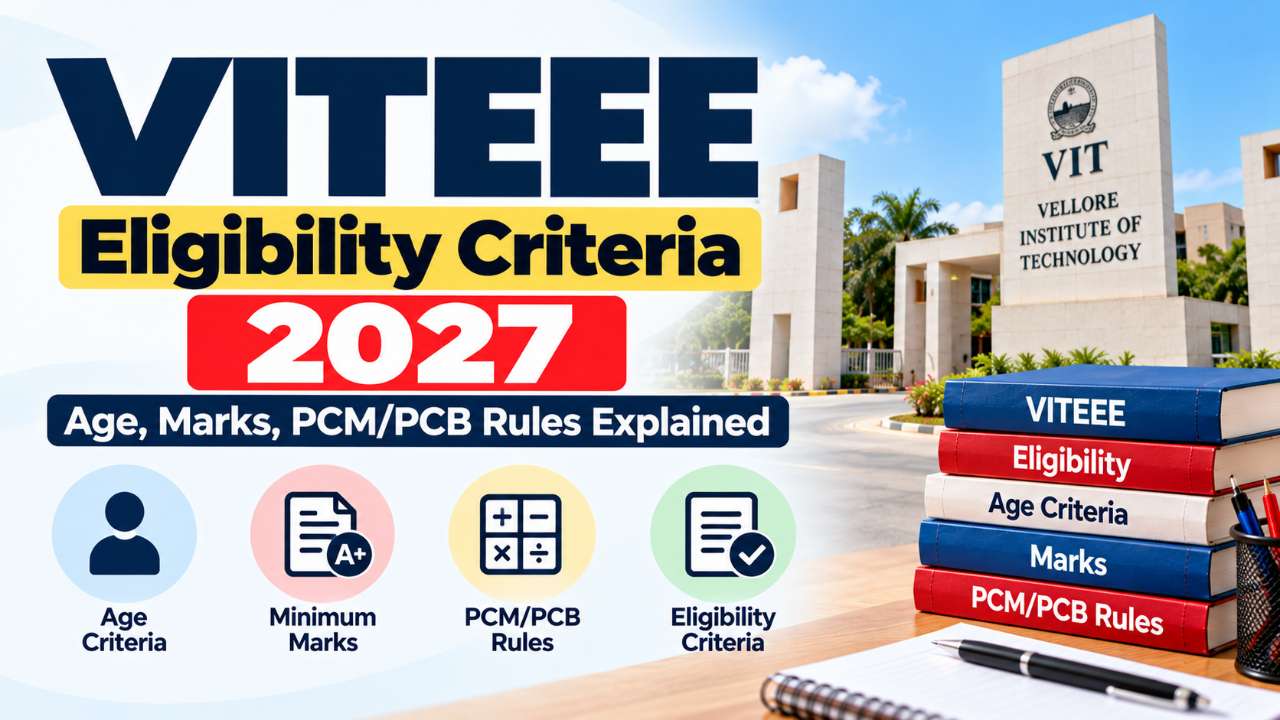
If you are planning to pursue B.Tech at the VIT group of institutions in 2027, the first checkpoint is not the syllabus or mock tests it is VITEEE eligibility criteria 2027. Vellore institute of Technology releases these rules with the official notification on viteee.vit.ac.in, and every line in your Class 12 profile must align with them before you pay the application fee. Registration for VITEEE began on 20 October 2026, and the exam is scheduled from 27 to 30 April 2027. Missing a single condition wrong board code, mixed subjects from two boards, or shortfall in Mathematics can cancel your candidature even after you score well.
This guide explains age, nationality, qualifying exam, marks, subject combinations, NRI and foreign rules, and counselling documents in plain language. It is written for Indian students, parents, and school counsellors who want a single, actionable reference aligned with VIT’s 2027 brochure. Always cross-check numbers on the official PDF before you submit the form. Keep a printed copy of the eligibility table in this article beside your mark sheet during registration week so you can answer form questions without guesswork.
VITEEE 2027 Eligibility at a Glance
VITEEE is mandatory for B.Tech admission at VIT campuses for resident Indians (except those applying under NRI or international channels). Your eligibility is judged on nationality or category of application, year of passing Class 12, board and mode of study, and aggregate marks in PCM or PCB with separate cut-offs in Mathematics or Biology.
| Parameter | General requirement (2027) |
|---|---|
| Class 12 year | Passed in 2025 or 2026, or appearing in 2027 |
| Not eligible | Passed Class 12 in 2024 or earlier |
| PCM / PCMB | 60% aggregate in P+C+M; minimum 50% in Mathematics |
| PCB / PCMB | 60% aggregate in P+C+B; minimum 50% in Biology |
| Relaxed aggregate | 50% in P+C+M or P+C+B for SC/ST and specified regions |
| Exam attempt | One attempt only; violation can cancel admission |
Who Can Apply: Nationality and Application Category
VIT separates applicants by how they hold nationality and where they studied. Getting this wrong means filling the wrong form and losing time during correction windows.
Resident Indian, NRI, and OCI applicants
The applicant should be a Resident Indian National, Non-Resident Indian (NRI), or OCI cardholder with a residential address in India. NRI candidates may apply under the dedicated NRI category through the NRI application route published on VIT’s international admissions pages. Resident Indians who qualify must appear for VITEEE-2027; the entrance rank drives seat allotment.
Foreign applicants
Foreign nationals who studied or are studying abroad apply through the International application form, not the standard domestic VITEEE route in most cases. Their school-leaving credentials (Cambridge A Level, IB Diploma, etc.) follow separate subject-level rules described later in this article.
Action tip: Before registration, decide whether you are domestic (VITEEE), NRI, or international. Do not register as a resident Indian if you intend to claim NRI fee structure without meeting NRI documentation norms.
Qualifying Examination and Year-of-Passing Rules
The qualifying exam rule is strict and catches many repeaters and gap-year students.
- You must have passed HSC/Class 12 in 2025 or 2026, or be appearing for Class 12 in 2027.
- Candidates who passed Class 12 in 2024 or earlier cannot appear for VITEEE-2027 or seek admission for this cycle.
- Education must be through regular, full-time, formal mode, with English as a subject.
- All required subjects must be completed from one recognized board in a single academic year.
- You cannot combine marks from different boards even in the same year to meet eligibility.
- Appearing for multiple board examinations in the same academic year makes you ineligible.
Example: A student who passed CBSE in 2024 and re-appears as a private candidate in 2027 may still be ineligible if the first passing year was 2024. Another student appearing for the first time in 2027 as a regular school candidate is eligible to apply while marks are pending, subject to final verification.
When filling the form, select the correct board code from the prospectus annexure. A mismatch can lead to rejection without notice.
Recognized Boards and Class 12 Equivalence
VIT accepts the final examination of the 10+2 system from recognized Central or State boards, including CBSE and CISCE, plus boards VIT lists as equivalent. Other accepted routes include:
- Two-year Pre-university/Intermediate from a recognized board or university (for example Tamil Nadu State Board, Maharashtra HSC, or Karnataka PUC)
- NIOS Senior Secondary with at least five recognized subjects
- Cambridge/Pearson Edexcel and IB Diploma pathways for international students
- Class 12 completed outside india, with an equivalence certificate and CGPA converted to percentage
NIOS students are eligible provided they meet subject and percentage rules on the final mark sheet. Open-school candidates should confirm that all five subjects appear on one NIOS result in one academic year. State-board students should use the mark sheet subject names exactly as printed when calculating PCM or PCB VIT does not recalculate using internal school assessment sheets unless they appear on the board document.
Minimum Marks: PCM, PCB, and PCMB Explained
VIT uses aggregate marks in three core subjects, not overall Class 12 percentage alone. You can pass every other subject and still fail eligibility if PCM or PCB aggregates fall short.
PCM and PCMB (Mathematics stream)
- Minimum 60% aggregate in Physics, Chemistry, and Mathematics
- At least 50% in Mathematics individually
Example: 65% in Physics, 58% in Chemistry, and 55% in Mathematics gives aggregate (65+58+55)/3 = 59.33% below 60%, so the candidate is not eligible even if total Class 12 score is 70%. VIT’s own FAQ uses a similar illustration: 62% overall with only 53.35% PCM aggregate is not eligible.
PCB and PCMB (Biology stream)
- Minimum 60% aggregate in Physics, Chemistry, and Biology
- At least 50% in Biology
Biology-stream eligibility opens only specific biotech and health-informatics programmes; it does not qualify you for mainstream Computer Science or Mechanical Engineering at every campus.
Relaxed criteria for SC/ST and select states
Candidates belonging to SC/ST, or nativity of Jammu & Kashmir, Ladakh, or North-Eastern states (Arunachal Pradesh, Assam, Manipur, Meghalaya, Mizoram, Nagaland, Sikkim, Tripura) need a minimum 50% aggregate in Physics, Chemistry, and Mathematics or Biology, instead of 60%. Community or nativity certificates must be submitted at counselling; without them, the concession may not apply and admission can be void from the beginning.
Important: VIT does not use the JEE Main 75% board percentile rule for VITEEE. Eligibility is governed by VIT’s PCM/PCB aggregates, not NTA’s JEE Main criteria.
Age Limit for VITEEE 2027
VIT’s official prospectus FAQ states there is no specific age limit for VITEEE when you satisfy the Class 12 year rule. Some third-party pages mention a birth date cut-off such as 1 July 2005; if you see conflicting information, trust the current brochure on viteee.vit.ac.in. Practically, eligibility is tied to passing or appearing in Class 12 in 2025–2027, which indirectly limits very old academic profiles.
Exam Subject Choice and B.Tech Programme Mapping
During VITEEE, you either take Mathematics or Biology in the test (not both). Your choice must match your Class 12 stream and the programmes you target.
MPCEA (Mathematics, Physics, Chemistry, English, Aptitude)
With PCM eligibility (60% aggregate, 50% in Maths), MPCEA qualifies you for all B.Tech programmes across VIT Vellore, VIT Chennai, VIT-AP, and VIT Bhopal University Sehore, subject to rank and counselling.
BPCEA (Biology, Physics, Chemistry, English, Aptitude)
With PCB eligibility, you may apply only to designated biostream programmes, including:
- B.Tech Biotechnology (Vellore, Chennai, AP)
- B.Tech CSE (Bioinformatics) at Vellore
- B.Tech Health Sciences and Technology at Vellore
- B.Tech Bioengineering at Bhopal
- B.Tech CSE (Health Informatics) and CSE (Education Technology) at Bhopal
Choosing Biology in the exam without PCB marks on the mark sheet leads to rejection at verification.
NRI Eligibility Criteria 2027
NRI applicants follow a slightly different academic threshold:
- Twelve years of schooling with English in the qualifying exam
- Physics, Chemistry, and Mathematics or Biology/Biotechnology as compulsory subjects
- Minimum 50% average in PCM or PCB in 10+2 or equivalent
NRI seats and fees differ from domestic categories; read the NRI prospectus before mixing categories between siblings in the same household.
Foreign Candidate Eligibility (Cambridge and IB)
Foreign applicants from English-medium schools may qualify through:
- Cambridge/Pearson Edexcel: PCM requires Physics & Mathematics at A Level, Chemistry at A/AS Level, English at A/AS Level; PCB requires Physics & Biology at A Level, Chemistry at A/AS Level, English at A/AS Level.
- IB Diploma: PCM requires Physics & Mathematics HL, Chemistry SL/HL; PCB requires Physics & Biology HL, Chemistry SL/HL.
Equivalence and grade conversion must be documented before admission is confirmed.
VITEEE Application Form 2027 and Eligibility Self-Check
VIT opened the application form on 20 October 2026. Only candidates who already meet or realistically expect to meet the academic rules should register. The process includes account creation, academic details, photograph and signature upload, and fee payment. Eligibility is not re-checked at every keystroke; you certify accuracy when you submit. That makes a manual self-audit essential.
Use this quick workflow before payment: (1) photograph your Class 12 mark sheet or school transcript; (2) highlight Physics, Chemistry, Mathematics or Biology marks; (3) compute the simple average; (4) compare against 60% or 50% thresholds; (5) save the calculation screenshot for family records. Appearing students should obtain a bonafide letter from school confirming 2027 board candidacy.
Documents Required to Prove Eligibility at Counselling
Eligibility becomes tangible only when documents match the data you entered online.
- Class 12 mark sheet and pass certificate (provisional certificate acceptable for 2027 appearers until final marks arrive)
- Transfer or migration certificate if requested by campus
- SC/ST certificate in prescribed format for reserved-category concession
- Nativity certificate for J&K, Ladakh, or North-Eastern state relaxation
- Equivalence certificate for foreign qualifications or boards outside India
- Photo ID and category proof as listed in the counselling brochure
VIT may treat admission as void if final marks fall short or certificates are missing. Plan a folder physical and digital before the April 2027 test so you are not scrambling during rank announcement season.
Understanding VITEEE Exam Pattern in Relation to Eligibility
Eligibility determines whether you may enter the test; the exam pattern determines how you prepare once cleared. VITEEE-2027 is a two-hour computer-based test with 100 multiple-choice questions: Mathematics or Biology (40), Physics (25), Chemistry (25), Aptitude (5), and English (5). Each correct answer earns four marks, each wrong answer loses one mark, and unanswered questions score zero. You may appear only once; a second attempt violates application terms.
Your eligibility stream must match the paper you receive. PCM-eligible students should lock Mathematics practice; PCB-eligible students should not waste months on advanced calculus if they target only biotechnology pathways. English and Aptitude sections still matter for tie-breaking and overall rank, but they never replace PCM or PCB mark-sheet requirements.
From Eligibility to Admission: Counselling and Rank
Meeting eligibility lets you sit for the exam; admission eligibility additionally requires a valid VITEEE rank, successful document verification, and seat acceptance during counselling. VIT does not offer management quota for B.Tech; rank and choice filling determine campus and branch. There is no lateral entry for diploma holders into B.Tech through this route.
During counselling, you rank campuses and programmes. Merit combines your VITEEE score with seat availability. Eligibility does not guarantee a seat; it only unlocks the examination hall and later verification stages.
Common Eligibility Mistakes to Avoid
- Using overall Class 12 percentage instead of PCM/PCB aggregate
- Ignoring the 50% minimum in Maths or Biology while clearing 60% aggregate
- Combining subjects from two boards to reach 60%
- Selecting the wrong board code in the application
- Registering for Biology in VITEEE without PCB on the mark sheet
- Assuming JEE Main scores replace VITEEE (they do not for standard domestic admission)
- Missing SC/ST or nativity certificates at counselling
- Applying under the wrong nationality category (domestic vs NRI vs international)
How VITEEE Eligibility Compares With Other Entrance Routes
VITEEE is campus-specific to the VIT group. National exams such as JEE Main follow different academic-year and percentile norms. After engineering, many graduates pivot to management exams for instance, the CAT pathway for MBA but those rules are unrelated to VITEEE PCM cut-offs. If you are exploring alternatives because your aggregates are borderline, compare each institution’s admission policy on CollegeDwar rather than assuming one exam’s rules apply everywhere. Profiles such as TERI School of Advanced Studies New Delhi or Team Lease Skills University illustrate how eligibility varies outside VIT; engineering-focused options like RITE Jaipur or Laxminarayan Innovation Technological Lit University publish their own criteria. Postgraduate arts pathways such as an MA programme are separate from B.Tech entry entirely. For Uttar Pradesh learners weighing multiple forms, reading a regional university page such as Mohammad Ali Jauhar University Rampur helps contrast state-level norms with VIT’s national entrance.
Expert Tips for School Counsellors and Parents
Counsellors should run a bulk eligibility audit in October–November when registration opens. Flag students with PCM between 58% and 60% for targeted improvement in board exams or for realistic branch planning at VIT-AP or Bhopal rather than assuming Category 1 CSE at Vellore. Parents should verify that English appears on the mark sheet even as an elective and that the student is not pursuing a dual-board improvement plan that VIT forbids.
Students with PCMB on the mark sheet must decide early whether they will optimize for Mathematics-heavy VITEEE prep or Biology-limited programmes. Switching streams after registration wastes preparation time because the exam paper differs in the 40-question Maths or Biology block.
Pre-Application Checklist for Students and Parents
- Download the official VITEEE 2027 eligibility PDF from viteee.vit.ac.in
- Calculate PCM or PCB aggregate from mark sheet use only core three subjects
- Confirm Class 12 passing year is 2025, 2026, or appearing 2027
- Match exam subject (Maths vs Biology) to intended B.Tech branches
- Arrange category or nativity certificates early if you claim relaxed marks
- Complete registration before the published last date with correct board code
Conclusion
VITEEE eligibility 2027 is precise: right year of Class 12, single-board formal study, English on the mark sheet, and subject-wise aggregates with 50% in Mathematics or Biology. Relaxed rules help SC/ST and candidates from J&K, Ladakh, and listed North-Eastern states, but only with valid certificates at counselling. NRI and international students must follow their respective mark thresholds and application channels. Use the official prospectus as the final authority, prepare documents before the April 2027 exam window, and align your test subject choice with the programmes at Vellore, Chennai, AP, and Bhopal. When in doubt, verify calculations with your school counsellor and the VITEEE resource hub on CollegeDwar before paying the application fee.