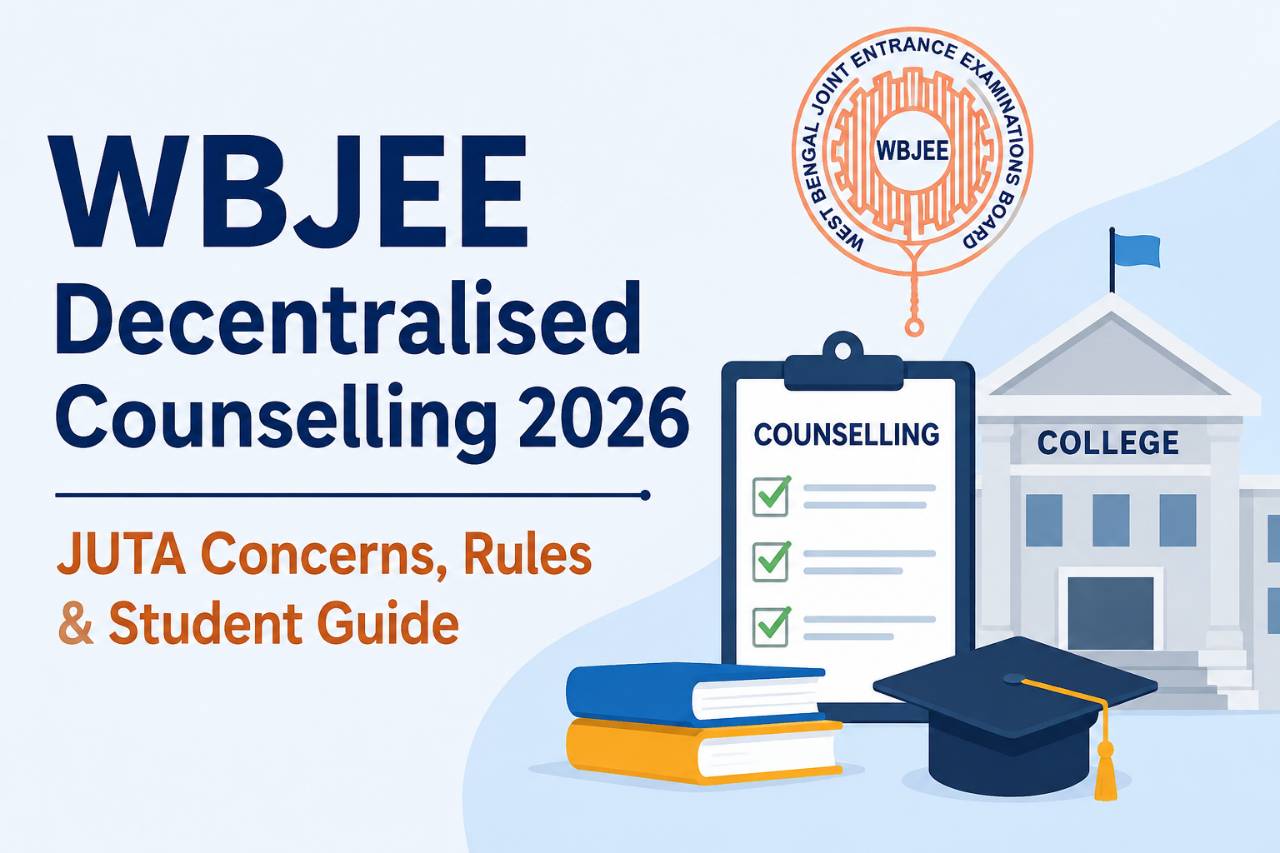
The West Bengal Joint Entrance Examinations Board (WBJEEB) has reversed a controversial eligibility rule for WBJEE 2026 decentralised counselling after widespread protests from students, teachers, and academic bodies. The board's original notification had barred candidates who had already secured admission through centralised online counselling from participating in the vacant-seat round—a move that sparked outrage across the state's engineering admission landscape. Following a corrigendum issued on August 30, 2026, all eligible rank-holders can now take part in the common online decentralised counselling process, including those seeking seat upgrades. This article explains what changed, why it mattered, and what BTech and BArch aspirants in West Bengal should do next.
What Is WBJEE Decentralised Counselling 2026?
Decentralised counselling is the final phase of engineering admissions in West Bengal, designed to fill residual vacant seats across participating institutions after the main centralised e-counselling rounds conclude. For the first time in 2026, WBJEEB is conducting this process through a unified online platform rather than leaving individual universities to manage leftover seats independently.
The common online decentralised counselling covers undergraduate programmes in Engineering, Technology, Architecture, and Pharmacy. It targets candidates who either did not secure a seat during the three rounds of centralised counselling or wish to explore better options among institutions that still have unfilled seats. Participating colleges include government engineering colleges, university -affiliated institutes, and private institutions across Kolkata, Howrah, North 24 Parganas, Darjeeling, and other districts.
How Decentralised Counselling Differs From Centralised Counselling
Centralised counselling is the primary admission pathway where WBJEEB allocates seats based on WBJEE rank or JEE Main rank through a state-wide merit list. Candidates register, fill choices, lock preferences, and receive seat allotments in multiple rounds with options to freeze, float, or withdraw.
Decentralised counselling, by contrast, focuses exclusively on vacant seats that remain after centralised rounds and institutional reporting. It operates as a mop-up mechanism to ensure no sanctioned seat goes unfilled while giving candidates another chance at admission or upgrade. The 2026 decentralised process is scheduled in two phases, with registration expected to open on September 2, 2026, subject to the revised brochure release.
The Controversial Rule That Triggered Backlash
On August 27, 2026, WBJEEB issued a notification for common online decentralised counselling that included a restrictive eligibility clause. Under the original provision, any candidate who had participated in the three rounds of WBJEE centralised e-counselling—including pharmacy counselling—and completed admission was declared ineligible for decentralised counselling.
The board justified this restriction as a measure to prevent multiple claims on seats, reduce unnecessary seat blocking, and stop seat migration by already-admitted candidates. Officials argued that allowing admitted students to re-enter counselling could disrupt the orderly allocation of vacant seats to candidates who had not yet secured any admission.
Why Students and Teachers Opposed the Restriction
The rule drew immediate and fierce criticism from multiple quarters. Student groups launched petitions—reportedly signed by over 2,500 aspirants—demanding that WBJEEB reconsider. Teachers' associations, parents, and university officials joined the chorus, calling the restriction a violation of natural justice.
The Jadavpur University Teachers' Association (JUTA) was among the most vocal critics. JUTA raised several concerns beyond the admission bar:
- No upgrade pathway: High-ranking candidates who had accepted lower-preference branches hoping to upgrade in later rounds found themselves permanently locked out.
- Class 12 marks-based eligibility: The original brochure allowed candidates who did not qualify through centralised counselling to participate based on higher secondary (10+2) marks—a provision JUTA labelled as merit dilution.
- Rank comparison confusion: Stakeholders questioned how WBJEE ranks and JEE Main ranks would be equated when both merit lists were involved in the same process.
- Merit inversion risk: Lower-ranked candidates could potentially gain better branches while higher-ranked admitted students were barred from upgrading.
Jadavpur University's Vice-Chancellor Chiranjib Bhattacharjee wrote to the state government regarding the matter. Speaking to media outlets, he stated that the earlier notice was highly objectionable and violated principles of natural justice, noting that lower-ranked candidates receiving better options would be an injustice to merit.
Government Response and Policy Reversal
West Bengal's Higher Education Minister Jagannath Chattopadhyay addressed student concerns on social media, assuring that the government would not compromise on merit while maintaining control over admissions for candidates not on the merit list. He confirmed that WBJEEB would soon issue a detailed notification with revised counselling provisions.
On August 30, 2026, WBJEEB issued a corrigendum officially rolling back the restrictive clause. The registrar's notice stated that pursuant to requests from various stakeholders, the board had decided to permit candidates who had already taken admission through the centralised online counselling process of WBJEE-2026 to participate in the common online decentralised counselling process.
What the Revised WBJEE Decentralised Counselling Rules Mean
With the controversial rule scrapped, the 2026 decentralised counselling landscape looks significantly different for engineering aspirants. Here is a breakdown of the key implications:
All Rank-Holders Can Now Participate
Whether you accepted a seat in Round 1, Round 2, or Round 3 of centralised counselling, you retain the right to register for decentralised counselling. This applies to candidates admitted to government colleges, self-financing institutes, and university-affiliated engineering programmes across West Bengal.
For example, a student admitted to mechanical engineering at a reputed Kolkata institute who was waiting to upgrade to computer science or electrical engineering can now re-enter the process. Similarly, candidates who accepted seats at institutions like Maulana Abul Kalam Azad University of Technology West Bengal or Techno India University West Bengal may explore vacant seats at other participating colleges.
Seat Upgrade Becomes Possible Again
The reversal restores what many stakeholders consider a fundamental admission principle: merit-based upgradation. Candidates with strong WBJEE or JEE Main ranks who settled for lower-preference branches during centralised rounds can now attempt to move to better branches or institutions during decentralised counselling.
This is particularly relevant for premier institutions where branch preferences vary dramatically in cut-off ranks. A candidate with WBJEE rank 200 waiting for computer science at a top government college may now compete for vacant seats rather than being permanently assigned to a lower-preference branch.
Revised Brochure and Schedule Expected
WBJEEB has confirmed that a revised decentralised counselling brochure and updated schedule will be published on the official portal at wbjeeb.nic.in/wbjee/. The corrigendum modifies the August 27 notification, and candidates should not rely on the original brochure for eligibility or procedural details.
Key documents to watch for include:
- Revised eligibility criteria for decentralised counselling
- Updated registration dates and fee structure
- Two-phase counselling schedule with choice filling and seat allotment timelines
- Clarifications on Class 12 marks-based participation rules
- Institution-wise vacant seat matrix
Understanding Eligibility for WBJEE 2026 Decentralised Counselling
While the admission bar has been lifted, decentralised counselling still operates under specific eligibility frameworks. Candidates should understand these categories before registering.
Primary Eligibility: WBJEE and JEE Main Rank-Holders
The core decentralised counselling process remains merit-driven, based on candidates' performance in WBJEE or JEE Main. Candidates who appeared in WBJEE 2026 and qualified, or who hold a valid JEE Main 2026 rank accepted by WBJEEB, form the primary applicant pool.
Candidates comparing their options should note that West Bengal accepts JEE Main ranks for admission to participating engineering colleges, making the exam a viable alternative pathway. Students who also appeared for JEE Advanced but did not secure IIT admission may still use their JEE Main rank for WBJEE decentralised counselling if eligible.
Class 12 Marks-Based Route: An Ongoing Debate
The original notification also permitted candidates who did not secure admission through centralised counselling to participate based on Class 12 (10+2) examination marks. This secondary eligibility route remains one of the most debated aspects of the 2026 decentralised process.
JUTA and other academic bodies argued that allowing Class 12 marks-based admissions alongside WBJEE rank-holders could:
- Dilute the merit basis established by the entrance examination
- Allow lower-ranked or non-WBJEE-qualified candidates to take seats that merit-list candidates could fill
- Create confusion about priority when two different merit criteria compete for the same vacant seats
Students should carefully review the revised brochure for final clarity on whether Class 12 marks-based eligibility has been modified, restricted, or retained alongside the rolled-back admission restriction.
Institutional Participation Across West Bengal
Decentralised counselling covers a wide network of institutions beyond Kolkata's premier colleges. Participating universities and their affiliated engineering colleges span multiple regions:
- Kolkata and adjoining areas: State universities and private institutes in the metropolitan region
- North 24 Parganas: Including institutions under West Bengal State University Barasat North 24 Parganas
- North Bengal: Colleges affiliated with North Bengal University Darjeeling
- Specialised universities: Health sciences, juridical sciences, and other university systems may have separate counselling processes for their programmes
Candidates interested in pharmacy programmes should note that B.Pharm counselling follows a separate notification and schedule on the WBJEEB portal, distinct from the engineering decentralised process.
Timeline: Key Dates for WBJEE 2026 Decentralised Counselling
Based on available notifications and expected revisions, here is the tentative timeline aspirants should monitor. All dates are subject to change upon release of the revised brochure.
| Event | Expected Date | Status |
|---|---|---|
| Original decentralised counselling notification | August 27, 2026 | Superseded by corrigendum |
| Corrigendum rolling back admission bar | August 30, 2026 | Active |
| Revised brochure and schedule publication | To be announced | Expected soon |
| Decentralised counselling registration opens | September 2, 2026 (tentative) | Pending confirmation |
| Phase 1 decentralised counselling | September 2026 | Pending schedule |
| Phase 2 decentralised counselling | September-October 2026 | Pending schedule |
Candidates must check wbjeeb.nic.in/wbjee/ daily for official updates. Do not rely on unofficial social media posts for registration deadlines or eligibility rules.
Why This Policy Reversal Matters for Engineering Aspirants
The WBJEE decentralised counselling controversy is more than a procedural adjustment—it reflects broader tensions in India's state-level engineering admission ecosystem. Understanding these dynamics helps students make informed decisions.
Merit Protection vs Seat Management
WBJEEB's original rationale—preventing seat blocking and multiple claims—addresses a real administrative challenge. When admitted candidates re-enter counselling, institutions face uncertainty about confirmed enrolments, fee collection, and classroom planning. However, stakeholders argued that administrative convenience cannot override a candidate's right to seek merit-based upgradation.
The policy reversal aligns with how other states handle mop-up rounds. Most centralised admission systems allow float options or subsequent rounds where admitted candidates can upgrade, balancing institutional stability with student choice.
Impact on Government College Seat Utilisation
Academic commentators warned that restrictive rules combined with Class 12 marks-based eligibility could lead to more vacant seats in government institutions. When high-ranking admitted students are barred from upgrading while lower-ranked candidates enter through alternative criteria, premier branches at top colleges may remain unfilled while lower-preference seats get occupied.
For government-funded institutions, every vacant seat represents underutilisation of public education resources—a concern the Higher Education Minister explicitly addressed when assuring that merit would not be compromised.
Lessons for Future Admission Cycles
The 2026 episode offers practical lessons for WBJEE aspirants in future years:
- Read every notification carefully: Eligibility rules can change between centralised and decentralised phases.
- Do not assume upgrade rights: Until the revised brochure confirms your eligibility, avoid making irreversible decisions based on expected upgradation.
- Engage through formal channels: The student petition and JUTA's representations demonstrate that organised stakeholder feedback can influence policy.
- Keep documents ready: Whether upgrading or seeking first-time admission, decentralised counselling moves quickly once registration opens.
- Monitor official sources only: WBJEEB's portal is the sole authoritative source for counselling rules and dates.
Actionable Tips for Candidates Preparing for Decentralised Counselling
Whether you are a first-time participant or an already-admitted candidate seeking an upgrade, strategic preparation improves your chances during decentralised counselling.
Research Vacant Seats and Cut-Off Trends
Before registration opens, study previous years' vacant seat patterns at your target institutions. Government engineering colleges in West Bengal often have branch-wise variation—computer science and electronics typically fill early, while civil, mechanical, and production engineering may have more vacancies.
Explore profiles of institutions you may not have considered during centralised counselling. Colleges under MAKAUT and other state universities offer accredited BTech programmes with strong regional placement records.
Prepare Your Choice List Strategically
Decentralised counselling typically allows limited choice revisions compared to centralised rounds. Prioritise institutions and branches realistically based on your rank and available vacancies. If upgrading, list only those options that genuinely improve your current admission—accepting a lateral move to a similar branch at a different college may not justify the administrative effort.
Financial and Logistical Planning
Seat upgrades may require additional fee payments, document re-verification, and physical reporting at the new institution. Budget for counselling fees, potential fee differences between colleges, and travel costs for document verification. Keep original copies of Class 10 certificate, Class 12 mark sheet, WBJEE admit card, rank card, category certificate (if applicable), and domicile proof readily accessible.
Understand the Float-Freeze-Withdraw Framework
Even in decentralised counselling, WBJEEB typically operates choice-locking mechanisms. Understand whether you can retain your current admission while exploring upgrades (float), permanently accept a new seat (freeze), or exit the process (withdraw). Misunderstanding these options can result in losing both your current seat and a potential upgrade.
Comparing WBJEE With Other State and National Admission Pathways
West Bengal engineering aspirants often evaluate multiple admission routes. Understanding how WBJEE decentralised counselling fits alongside other options provides context for decision-making.
WBJEE vs JEE Main for West Bengal Admissions
JEE Main opens doors to NITs, IIITs, and GFTIs nationwide, while WBJEE focuses on West Bengal's state quota seats. For decentralised counselling specifically, both WBJEE rank and JEE Main rank (as accepted by WBJEEB) serve as merit criteria. Candidates who performed better in JEE Main than WBJEE should verify how their JEE Main rank translates in the decentralised merit list.
Central Universities as Alternative Pathways
Students dissatisfied with WBJEE decentralised outcomes may also explore admissions at central universities outside West Bengal. Institutions like Central University of Jharkhand Ranchi, Central University of South Bihar, and Central Institute of Technology Kokrajhar conduct their own admission processes for engineering and technology programmes.
However, these pathways operate independently of WBJEE decentralised counselling and require separate applications, entrance scores, and eligibility checks.
What Stakeholders Are Saying: Expert Perspectives
The policy reversal has drawn reactions from across West Bengal's academic community, offering valuable context for students navigating the admission process.
Chiranjib Bhattacharjee, Vice-Chancellor of Jadavpur University, welcomed the rollback, emphasising that merit-based upgradation is essential for fairness. A senior official from Calcutta University noted that the original notice needed revision as many students would suffer from unprepared rule changes.
The All India Save Education Committee also raised concerns about sudden rule changes potentially leading to legal complications. Their position underscored that decentralised counselling should remain open to all qualified WBJEE candidates without arbitrary restrictions.
From the administrative side, a state higher education department official acknowledged that the original restriction aimed to prevent seat migration but conceded that student and teacher opposition necessitated the policy change.
Conclusion: Moving Forward With WBJEE 2026 Decentralised Counselling
The West Bengal government's decision to scrap the WBJEE decentralised counselling admission bar represents a significant win for engineering aspirants who advocated for merit-based fairness. By allowing already-admitted candidates to participate in the vacant-seat round, WBJEEB has restored the upgrade pathway that centralised counselling implicitly promised through float options.
However, the episode also highlights unresolved questions—particularly around Class 12 marks-based eligibility and rank equating between WBJEE and JEE Main merit lists—that the revised brochure must address transparently. Candidates should treat the corrigendum as confirmation of their right to participate while awaiting detailed procedural guidelines.
For thousands of BTech and BArch aspirants across West Bengal, the immediate priority is clear: monitor wbjeeb.nic.in/wbjee/ for the revised decentralised counselling brochure, prepare documents and choice lists, and register promptly when the window opens. Whether you are securing your first admission or upgrading to a dream branch at a premier institution, the decentralised counselling round may offer the opportunity you have been waiting for.
Stay informed, verify every detail against official notifications, and approach the process with a clear strategy. The 2026 admission cycle has already demonstrated that informed, organised student voices can shape policy—and that merit remains the guiding principle West Bengal's engineering admissions ultimately serve.