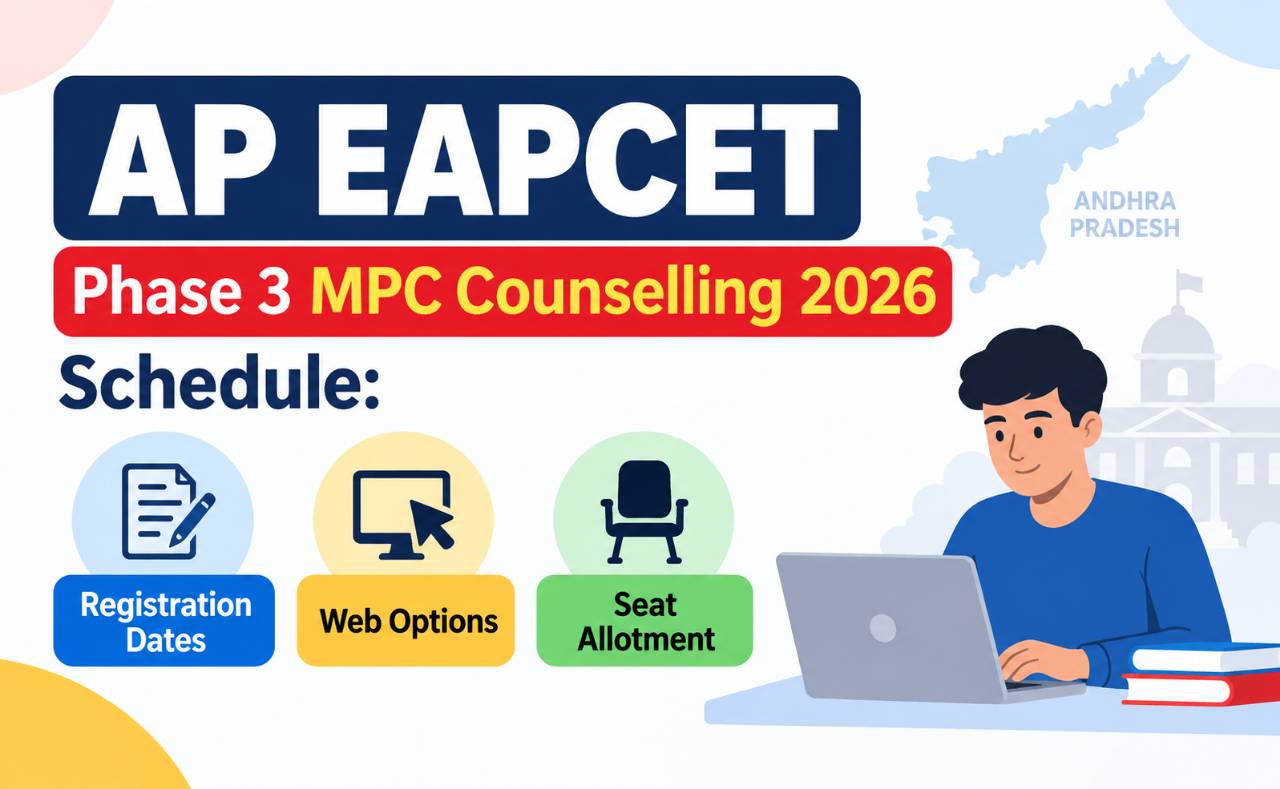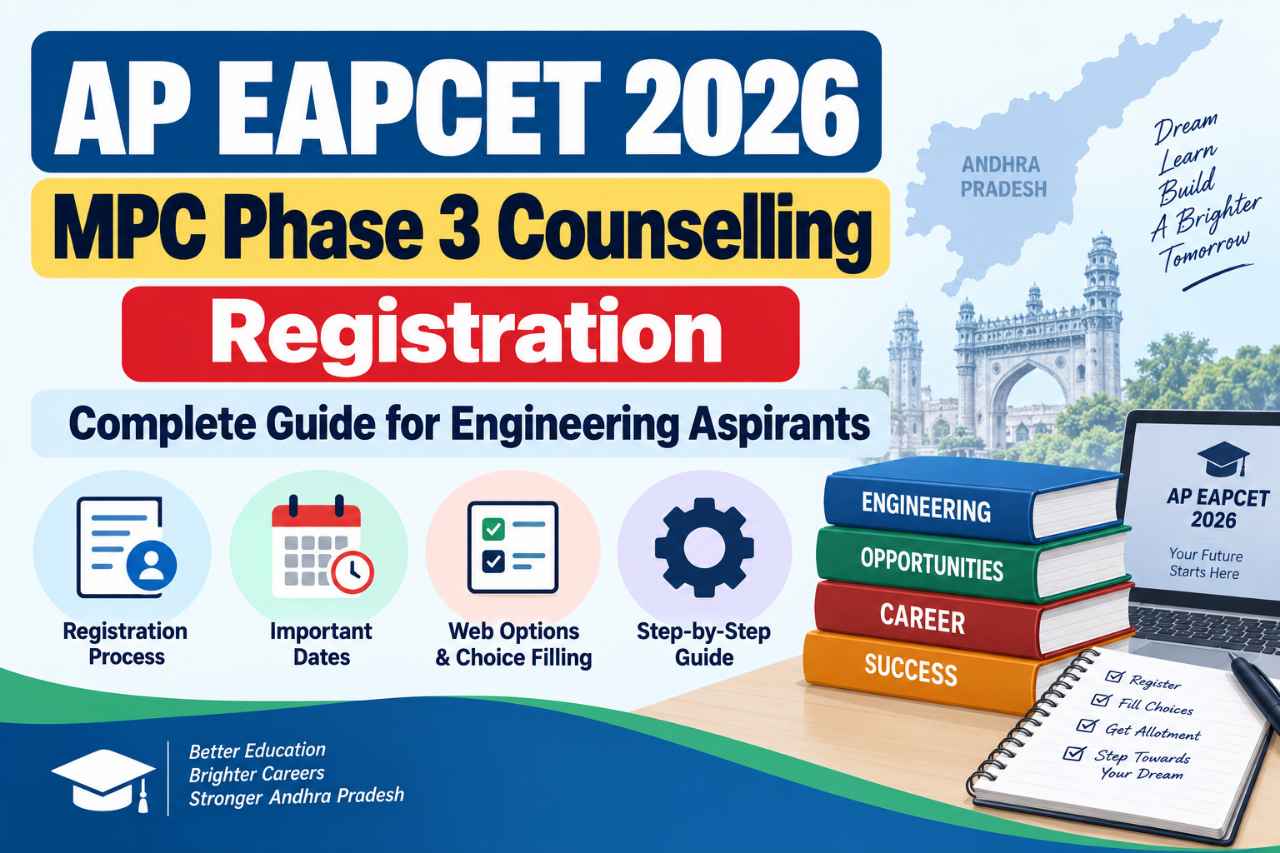
The Andhra Pradesh State Council of Higher Education (APSCHE) has officially begun AP EAPCET 2026 MPC Stream Phase 3 counselling registration, marking the third and final web-based admission round for engineering aspirants in the Mathematics, Physics, and Chemistry (MPC) stream. If you qualified AP EAPCET 2026 but missed a seat in earlier phases, did not report to your allotted college, or want to upgrade to a better institution, this phase is your last structured opportunity to join a government or private engineering College in Andhra Pradesh for the 2026–27 academic session.
Phase 3 counselling is conducted entirely through the official portal cap.apcfss.in. Candidates must complete registration, pay the processing fee, get certificates verified, and submit web options within the published deadlines. Missing even one step can disqualify you from seat allotment, so understanding the full timeline and procedure is essential. This guide explains who can apply, important dates, documents, fee structure, choice-filling strategy, and reporting rules in simple language designed to help students, parents, and counsellors navigate the process with confidence.
What Is AP EAPCET 2026 MPC Phase 3 Counselling?
AP EAPCET (Andhra Pradesh Engineering, Agriculture and Pharmacy Common Entrance Test), formerly known as AP EAMCET, is the state-level entrance exam for admission to B.Tech, B.Pharmacy, and related professional courses in Andhra Pradesh. After the exam and rank declaration, APSCHE conducts multiple counselling phases to allocate seats across participating colleges based on rank, reservation category, local area status, and candidate preferences.
Phase 3 is the final counselling round for the MPC (engineering) stream. It typically opens after Phase 1 and Phase 2 seat allotments are completed and vacant seats are released. Unlike the first two phases, which mainly serve fresh allotments, Phase 3 often includes candidates seeking seat upgrades (sliding), those who were allotted seats but did not join, candidates who cancelled admissions, and fresh registrants who did not participate earlier.
Because this is the last official round under the centralised admission process, competition can still be intense for popular branches such as Computer Science, Electronics and Communication Engineering (ECE), and Artificial Intelligence at top-tier colleges. However, many good institutions including regional government engineering colleges and reputed private universities may still have seats available across branches like Civil, Mechanical, Electrical, and Information Technology.
Why Phase 3 Matters for Engineering Aspirants
For thousands of students across Andhra Pradesh, Phase 3 counselling represents a second or even third chance at a quality engineering seat without waiting another year. Students who underestimated their rank in earlier rounds, filled choices too conservatively, or faced document verification delays often find better options in this phase once others vacate seats or upgrade.
Parents and students should treat Phase 3 with the same seriousness as Phase 1. Even if your rank is moderate, strategic web option entry can help you secure admission in a College that matches your career goals, location preference, and financial plan. Students exploring alternatives outside Andhra Pradesh may also compare state-level processes for instance, Maharashtra’s MHT CET or Delhi’s IPU CET but Phase 3 remains the primary route for AP domicile students targeting in-state B.Tech seats.
AP EAPCET 2026 MPC Phase 3 Counselling Schedule
APSCHE releases a detailed schedule for each counselling phase. For Phase 3, candidates should note every deadline carefully because the window for registration, verification, and choice entry is shorter than in earlier phases. Below is the official timeline as announced for the 2026 MPC stream Phase 3 round.
| Counselling Activity | Schedule / Dates |
|---|---|
| Candidate Registration (Fee Payment & Online Verification) | September 9 to 11, 2026 |
| Online Document Verification at Help Line Centres (HLCs) | September 9 to 12, 2026 |
| Submitting Web Options (Choice Selection) | September 9 to 12, 2026 |
| Modify / Change Web Options | September 13, 2026 |
| Seat Allotment Result Declaration | September 16, 2026 |
| Self-Reporting & Reporting at Allotted College | September 16 to 19, 2026 |
Key takeaway: The last date to register and pay the processing fee is September 11, 2026. Certificate verification and web option submission remain open until September 12, 2026, with a dedicated modification window on September 13. Seat allotment results are expected on September 16, followed by a short reporting period ending September 19, 2026.
What Happens If You Miss a Deadline?
APSCHE generally does not extend Phase 3 deadlines because the academic calendar must move forward. If you miss registration by September 11, you cannot participate in this round. If you register but fail to complete certificate verification or submit web options by September 12, your application may remain incomplete and you will not be considered for seat allotment on September 16.
Set phone reminders, bookmark the official portal, and complete all steps at least one day before each deadline. Use a stable internet connection and keep payment receipts and verification acknowledgements saved as screenshots or PDFs.
Who Is Eligible for AP EAPCET 2026 Phase 3 Counselling?
Not every AP EAPCET qualifier automatically qualifies for Phase 3. APSCHE defines eligibility based on participation in previous phases and current admission status. The following categories of candidates are generally eligible to register for MPC Phase 3 counselling:
- Candidates not allotted any seat in Phase 1 or Phase 2 despite having qualified AP EAPCET 2026.
- Candidates allotted a seat but who did not report to the allotted Collegewithin the prescribed reporting window in earlier phases.
- Candidates who cancelled their previous admission and wish to participate again in counselling.
- Candidates seeking seat upgradation (sliding) who joined a college in an earlier phase but want a better college or branch based on vacant seats and their rank.
- Fresh registrants who qualified the exam but did not register or complete procedures in Phase 1 or Phase 2.
Eligibility also depends on meeting basic admission criteria: passing Intermediate (or equivalent) with MPC subjects, securing a valid AP EAPCET rank, and satisfying local/non-local status rules where applicable. Candidates claiming reservation under SC, ST, BC, EWS, or other categories must hold valid certificates issued by competent authorities.
Local and Non-Local Status Rules
Andhra Pradesh engineering admissions follow local area reservation norms. Candidates are classified as local to specific university areas (such as SVU, AU, or OU regions) or as non-local. Your local status affects which college seats you can compete for and may influence cut-off ranks. Ensure your study certificate, residence certificate, and parental residence documents clearly support the local status you claim on the portal.
Candidates who migrated from Telangana to Andhra Pradesh after the bifurcation may need additional residence documentation. Always cross-check APSCHE’s latest notification on the official website before submitting claims, as rules are updated periodically.
Registration Fee and Payment Details
Phase 3 counselling requires payment of a non-refundable processing fee during online registration. The fee varies by social category:
- OC and BC categories: ₹1,200
- SC and ST categories: ₹600
Payment is made online through the counselling portal using net banking, debit card, credit card, or UPI-enabled gateways. After successful payment, save the transaction ID and fee receipt. First-time Phase 3 registrants must pay during September 9–11, 2026. Candidates who already paid in an earlier phase and whose verification status remains valid should log in and confirm their status before assuming payment is complete.
Common Payment Issues and How to Avoid Them
Payment failures often occur due to session timeouts, browser compatibility issues, or bank-side declines. Use an updated desktop browser, disable pop-up blockers temporarily, and avoid closing the window until the payment confirmation page appears. If money is debited but the portal does not reflect payment, note the transaction reference number and contact the helpline listed on cap.apcfss.in with proof of payment do not attempt multiple payments without checking status first.
Documents Required for AP EAPCET Phase 3 Counselling
Certificate verification is mandatory for new registrants and for candidates whose documents were not verified in earlier phases. Even if you verified documents in Phase 1 or 2, log in and confirm your verification status shows as complete before submitting web options. Keep both originals and clear scanned copies ready for upload or presentation at Help Line Centres (HLCs).
Standard documents required during AP EAPCET counselling include:
- AP EAPCET 2026 rank card
- AP EAPCET 2026 hall ticket
- Intermediate (10+2) marks memo / memorandum of marks
- SSC (10th) certificate or equivalent for date of birth proof
- Transfer Certificate (TC) from the last institution attended
- Study certificate from Class VI to Intermediate
- Integrated Community Certificate (for BC/SC/ST candidates, if applicable)
- Income certificate or valid white ration card (for fee reimbursement claims, if applicable)
- EWS certificate from MeeSeva (for OC candidates claiming EWS reservation, if applicable)
- Local status certificate and residence certificates as per APSCHE norms
- Andhra Pradesh residence certificate of parent (where required for local status)
Organise documents in a folder labelled with your hall ticket number. Name scanned files clearly (for example, RankCard_EAPCET2026.pdf) to avoid upload confusion. Any mismatch between portal entries and certificate details can delay verification or lead to rejection of reservation claims.
Step-by-Step AP EAPCET 2026 Phase 3 Registration Process
The registration process follows a fixed sequence on cap.apcfss.in. Completing steps out of order or skipping verification can block your access to web options. Below is a practical walkthrough for candidates and parents assisting with the process.
Step 1: Visit the Official Counselling Portal
Open cap.apcfss.in in a secure browser. Avoid third-party websites that mimic the official portal. Click on the AP EAPCET 2026 MPC Phase 3 counselling registration link displayed on the homepage during the active registration window.
Step 2: Log In With Hall Ticket Credentials
Enter your AP EAPCET 2026 hall ticket number and date of birth (or password, if already set from a previous phase). First-time users may need to create login credentials after initial authentication. Never share your password or OTP with unknown callers claiming to be from APSCHE.
Step 3: Pay the Processing Fee
Select the payment option, choose your category-appropriate fee (₹1,200 or ₹600), and complete online payment before September 11, 2026. Download and save the receipt immediately.
Step 4: Complete Certificate Verification
Upload required documents for online verification or visit a designated Help Line Centre (HLC) if instructed. Verification is open until September 12, 2026. Your profile should show “verified” status before you proceed to choice filling.
Step 5: Submit Web Options
After verification, access the web options module. Search colleges and branches, then arrange them in strict order of preference. Submit your choices before September 12, 2026. You may modify options on September 13, 2026, during the dedicated revision window.
Step 6: Download Seat Allotment and Report to College
Check allotment results on September 16, 2026. If allotted a seat, complete self-reporting on the portal and physically report to the college between September 16 and 19, 2026, with originals and photocopies of all verified documents.
Web Options Strategy: How to Fill Choices Smartly
Web option entry is the most decision-intensive part of AP EAPCET counselling. Your rank, category, local status, and the order of preferences directly determine allotment outcomes. A well-planned list balances ambition with realism.
Research Colleges Before You Log In
Before opening the choice-filling screen, prepare a spreadsheet listing target colleges, available branches, approximate cut-offs from previous years, annual fee structure, hostel availability, and distance from home. Prioritise NAAC-accredited institutions, colleges with strong placement records in your preferred branch, and campuses located in cities where you are willing to study for four years.
Students who miss AP seats sometimes explore private universities in other states institutions such as Plastindia International University represent the kind of specialised private options outside the AP centralised system but if your goal is an affordable government or state-quota seat, Phase 3 web options should remain your immediate focus.
Order Your Preferences Correctly
The counselling software allotts the highest preference you qualify for based on seat availability at your rank. Place your most desired college-branch combination at the top, followed by realistic backups, and include safe options at the bottom. Never leave the list empty or submit only ultra-competitive top choices unless you are comfortable risking no allotment.
A practical three-tier approach works well for many candidates:
- Aspirational choices (top 5–10): Branches/colleges slightly above your expected cut-off worth attempting if seats vacate.
- Realistic choices (middle 15–25): Colleges where your rank historically secured admission in your category.
- Safe choices (final 10–15): Institutions where admission is highly likely, ensuring you receive a seat if vacancies exist.
Use the September 13 Modification Window Wisely
After initial submission, analyse seat vacancy trends and peer discussions on verified forums. If APSCHE publishes any updated vacancy information before September 13, adjust your list accordingly. Avoid drastic last-minute changes without reason random reordering can cost you a stable backup seat.
Seat Allotment, Self-Reporting, and College Admission
On September 16, 2026, APSCHE releases Phase 3 seat allotment results on cap.apcfss.in. Log in with your credentials and download the allotment order. The allotment letter specifies college name, branch, reporting dates, and fee payment instructions.
Self-Reporting on the Portal
Self-reporting confirms that you accept the allotted seat. Failure to self-report within the given timeline may result in cancellation of allotment and forfeiture of future counselling rights in some cases. Read the fine print on the portal carefully before clicking confirm.
Physical Reporting at the Allotted College
Report to the allotted institution between September 16 and 19, 2026, with original documents, passport-size photographs, and applicable admission fees. Colleges verify documents again, collect tuition and other charges, and issue admission confirmation. Arrive early in the reporting window to avoid last-day rush and administrative delays.
Seat Upgradation and Sliding Rules
Candidates who joined a college in Phase 1 or 2 and participate in Phase 3 for upgradation should understand sliding rules published by APSCHE. If you receive a better allotment, you may need to surrender the previous seat and complete fresh reporting at the new college. Ignoring surrender procedures can lead to penalties or blocking of academic records.
Comparing AP EAPCET With Other Entrance Exams
Understanding how AP EAPCET counselling fits into India’s broader admission landscape helps students plan parallel options. AP EAPCET is a state-level exam focused on Andhra Pradesh institutions. By contrast, exams like MHT CET govern Maharashtra engineering admissions, while IPU CET facilitates entry into Guru Gobind Singh Indraprastha University and its affiliated colleges in Delhi NCR.
Students interested in design careers rather than mainstream B.Tech may simultaneously track exams such as NID DAT, which leads to National Institute of Design programmes. Each exam has distinct eligibility, counselling authority, and timeline AP EAPCET Phase 3 deadlines will not align with national or other state schedules, so maintain separate calendars if you are applying broadly.
Actionable Tips for Parents and Students
- Start early: Complete registration and payment on September 9 or 10 to leave buffer time for verification issues.
- Verify mobile number and email linked to your AP EAPCET application they receive OTPs and allotment alerts.
- Double-check category claims: Incorrect reservation claims can invalidate allotment even after results.
- Keep finances ready: College reporting requires tuition deposits; plan bank transfers or demand drafts in advance.
- Beware of fraud: APSCHE never asks for passwords or direct money transfers to personal accounts.
- Use official notifications only: Cross-check rumours on APSCHE or AP EAPCET official websites.
- Discuss branch vs college trade-offs: A lower-tier college in CSE may outweigh a top college in an less preferred branch depending on career goals.
What to Do After Phase 3 Ends
If you secure a seat in Phase 3, complete admission formalities promptly and prepare for academic orientation. If you remain unallotted, explore management quota seats (where legally available), private university admissions, lateral entry routes, or prepare for the next year’s AP EAPCET cycle. Some students also consider diploma-to-degree pathways or allied programmes while reattempting the exam.
Remember that Phase 3 is the final APSCHE centralised round for MPC stream counselling in 2026 treating it as your last structured chance within the state quota system motivates sharper planning and timely action.
Conclusion
AP EAPCET 2026 MPC Phase 3 counselling registration is now live at cap.apcfss.in, with the last date to register and pay fees on September 11, 2026. Eligible engineering aspirants including those seeking seat upgrades, fresh registrants, and candidates without previous allotments must complete certificate verification and web option entry by September 12, 2026, revise choices on September 13 if needed, and await seat allotment on September 16, 2026. Reporting to allotted colleges closes on September 19, 2026.
Success in this final phase depends on timely registration, accurate documents, and a carefully ranked web options list aligned with your rank and category. Whether you aim for a premier government engineering college or a solid regional institution, Phase 3 offers a genuine pathway to begin your B.Tech journey in Andhra Pradesh. Act early, stay on official channels, and make every deadline count.