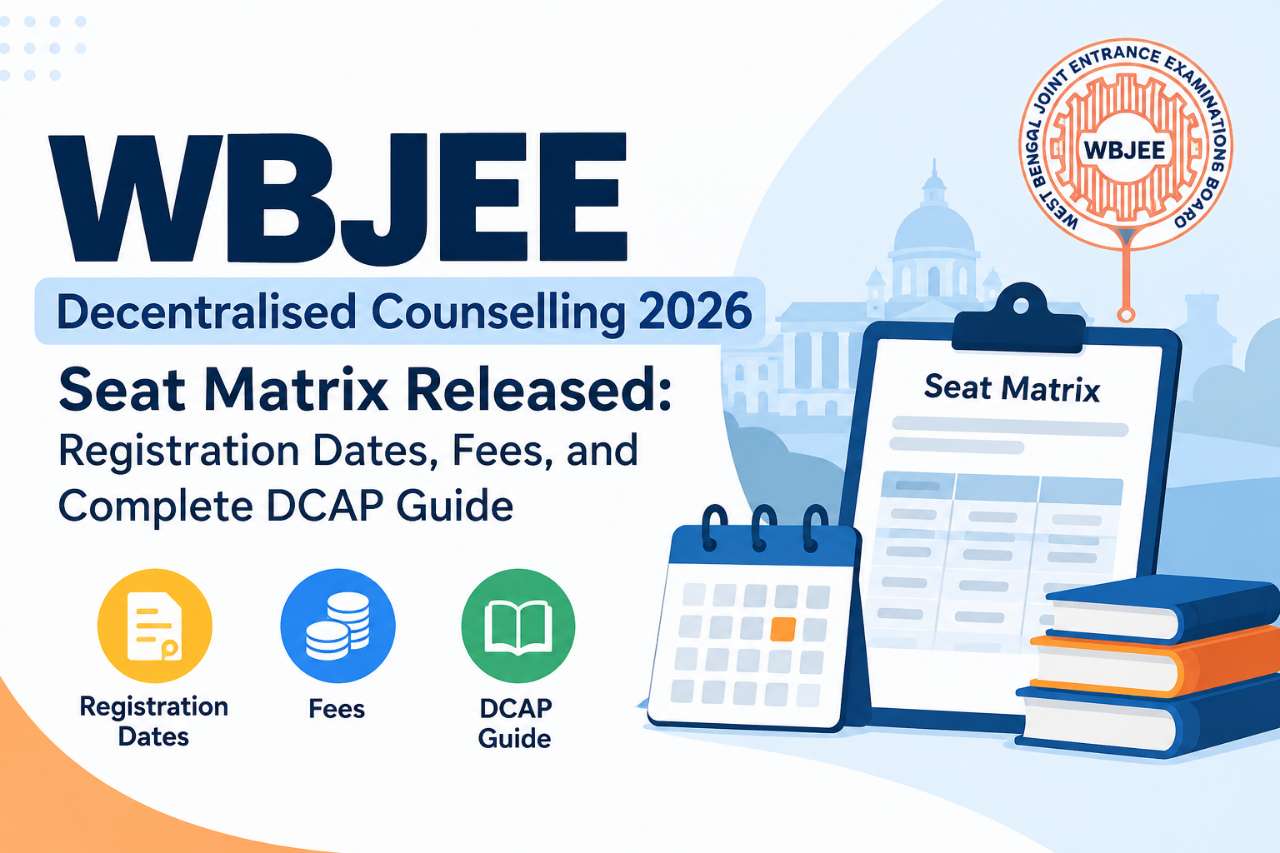
The West Bengal Joint Entrance Examinations Board (WBJEEB) has released the WBJEE Decentralised Counselling 2026 seat matrix for vacant undergraduate seats in Engineering, Technology, Architecture, and Pharmacy programmes across West Bengal. If you missed a seat in the main centralised counselling or want to upgrade to a better college, this common online decentralised e-counselling (DCAP-2026) is your structured second chance to secure admission before the academic session closes.
This guide explains what the seat matrix means, who can apply, the complete Phase 1 and Phase 2 schedule, registration fees, round-wise allotment rules, and practical tips to avoid common mistakes. All dates and rules mentioned here are based on the official revised schedule published by WBJEEB on its website wbjeeb.nic.in. For broader context on the entrance exam itself, refer to our detailed WBJEE guide on CollegeDwar.
What Is WBJEE Decentralised Counselling 2026?
WBJEE decentralised counselling is a residual seat allotment process conducted after the main WBJEE centralised admission programme (CAP). It covers seats that remain vacant in government, government-aided, and participating private engineering, architecture, and pharmacy colleges across West Bengal. Unlike the earlier centralised rounds where choices were locked in a fixed order, decentralised counselling allows eligible candidates to register afresh, pay a registration fee, fill choices against the published vacancy matrix, and compete for leftover seats institute-wise.
The board calls this process DCAP-2026 (Decentralised Counselling Admission Process). It is designed to ensure that no approved seat goes unfilled while giving candidates who did not participate earlier or those who withdrew from previous allotments a fair, transparent pathway to admission. The process runs in two phases, each with its own registration window, seat matrix publication, Round 1 allotment, physical verification at the Institute, Round 2 upgrade, and final confirmation deadlines.
How Decentralised Counselling Differs From Main WBJEE Counselling
In the main WBJEE counselling, seat allotment follows a central merit list and multi-round choice filling across the state. Decentralised counselling, by contrast, focuses only on vacant seats listed college-wise and stream-wise in the seat matrix. Eligibility is broader: apart from WBJEE rank holders, candidates with valid JEE Main 2026 ranks and eligible 10+2 merit-based qualifications can also participate in specific categories, subject to domicile and reservation rules.
Another key difference is the active registration window. You cannot simply log in and expect automatic consideration you must register, pay ₹250, complete profile creation, and submit choice selection within the notified dates. Missing the window means waiting for the next phase or exploring alternatives such as state-level exams, private universities, or central institutions like the Central University of Jharkhand Ranchi or the Central Institute of Technology Kokrajhar for non-WB pathways.
WBJEE Decentralised Counselling 2026 Seat Matrix: What Was Released?
On 6 September 2026 at 7:00 PM, WBJEEB published the Phase 1 vacant seat information across colleges and institutes, broken down by stream and discipline. This document commonly referred to as the seat matrix is the single most important reference for every candidate. It tells you exactly which B.Tech branches, B.Arch seats, and B.Pharm seats are still open, along with category-wise break-up where applicable.
The seat matrix for Phase 2 will be published on 16 September 2026 at 5:00 PM, after seats vacated through withdrawals and upgrades in Phase 1 are returned to the pool. WBJEEB also released a Visual Operational Summary on 6 September 2026 to help candidates understand eligibility categories, fee structure, round rules, and consequences of non-response.
How to Download the Seat Matrix From wbjeeb.nic.in
- Visit the official WBJEEB portal at wbjeeb.nic.in.
- Navigate to the EXAMINATIONS section and open the WBJEE 2026 page.
- Under Important Links, click on the link for vacant seat information or decentralised counselling seat matrix.
- Download the PDF or Excel file and filter by your preferred district, Institute, and branch.
- Cross-check category eligibility (General, SC, ST, OBC-A, OBC-B, PwD, etc.) before filling choices.
Actionable tip: Do not rely on screenshots circulated on social media. Always download the matrix from the official site on the day it is published, because seat counts change after each withdrawal deadline.
Who Is Eligible for DCAP-2026?
WBJEEB classifies decentralised counselling candidates into five broad categories. Your category determines which seats you can access in the vacancy matrix. Final eligibility always depends on programme-specific requirements, domicile conditions, seat type, reservation rules, and the published vacancy list.
| Category | Eligible Candidates |
|---|---|
| Category I | West Bengal-domiciled WBJEE 2026 rank holders eligible for reserved-category seats |
| Category II | West Bengal-domiciled candidates eligible on the basis of WBJEE 2026 rank (General/Open merit) |
| Category III | WBJEE 2026 rank holders who are not domiciled in West Bengal |
| Category IV | JEE (Main) 2026 rank holders (including candidates who also appeared for JEE Advanced but are seeking WB pharmacy/architecture/engineering seats through Main rank) |
| Category V | Eligible 10+2 merit-based candidates as per notified rules for specific seat types |
Candidates must hold valid academic qualifications for the programme applied Physics, Chemistry, and Mathematics for most engineering streams; Mathematics compulsory for Architecture; and PCB/PCM combinations as prescribed for Pharmacy. Domicile certificates, category certificates, and PwD certificates must be genuine and match the details entered during profile creation, as institutes verify originals during physical reporting.
WBJEE Decentralised Counselling 2026: Complete Schedule
The revised schedule below covers both Phase 1 and Phase 2. WBJEEB has noted that dates may change due to unavoidable circumstances, so check the official portal daily during the counselling period.
Phase 1 Schedule (September 2026)
| Date and Time | Event |
|---|---|
| 6 Sep 2026, 7:00 PM | Publication of vacant seat matrix (Phase 1) |
| 7 Sep 2026, 10:00 AM – 8 Sep 2026, 11:59 PM | Registration, ₹250 fee payment, profile creation, and choice selection |
| 10 Sep 2026, 10:00 AM | Round 1: Merit and allocation list publication |
| 10 Sep 2026, 10:00 AM – 11 Sep 2026, 11:59 PM | Seat acceptance fee (₹2,000) payment and provisional admission receipt download |
| 10 Sep 2026, 10:30 AM – 12 Sep 2026, 6:00 PM | Physical document verification and admission/withdrawal confirmation at Institute |
| 13 Sep 2026, 5:00 PM | Round 2: New allocation list after Round 1 |
| 13 Sep 2026, 5:00 PM – 14 Sep 2026, 11:59 PM | Round 2 seat acceptance fee payment |
| 14 Sep 2026, 10:00 AM – 15 Sep 2026, 4:00 PM | Round 2 physical verification at Institute |
| 15 Sep 2026, by 4:00 PM | Deadline to confirm admission cancellation in portal if withdrawing; seat returns to matrix |
Phase 2 Schedule (September 2026)
| Date and Time | Event |
|---|---|
| 16 Sep 2026, 5:00 PM | Publication of updated vacant seat matrix (Phase 2) |
| 16 Sep 2026, 5:00 PM – 18 Sep 2026, 11:59 PM | Registration, fee payment, profile creation, and choice selection |
| 20 Sep 2026, 10:00 AM | Round 1 allocation list publication |
| 20 Sep 2026, 10:00 AM – 21 Sep 2026, 11:59 PM | Seat acceptance fee payment and receipt download |
| 20 Sep 2026, 2:00 PM – 22 Sep 2026, 5:00 PM | Physical verification and admission/withdrawal at institute |
| 23 Sep 2026, 4:00 PM | Round 2 new allocation list |
| 23 Sep 2026, 4:00 PM – 24 Sep 2026, 11:59 PM | Round 2 seat acceptance fee payment |
| 24 Sep 2026, 10:00 AM – 25 Sep 2026, 6:00 PM | Final physical document verification and admission confirmation |
Last date to register for Phase 1: 8 September 2026, 11:59 PM. If you miss Phase 1, Phase 2 registration opens on 16 September 2026 at 5:00 PM and closes on 18 September 2026 at 11:59 PM provided you are not debarred for missing two consecutive non-response phases.
Registration Fee and Seat Acceptance Fee
Understanding the two-tier fee structure helps you plan finances and avoid incomplete registrations.
- Registration fee: ₹250 (one-time, non-refundable). Pay this during the active registration window after creating your DCAP profile. Without this payment, your choices will not be considered.
- Seat acceptance fee: ₹2,000. Pay only after you select and lock one allotted option from the allocation list within the notified deadline. This generates your system-generated Provisional Admission Receipt, which you must carry for institute-level verification.
The seat acceptance fee is separate from the institute's admission fee, tuition fee, and security deposit. Budget accordingly. WBJEEB accepts online payment through the counselling portal; keep transaction receipts and screenshots until admission is confirmed.
Step-by-Step Registration and Choice Filling Process
Decentralised counselling is entirely online until physical reporting. Follow these steps carefully during the active window.
Before You Register
- Confirm your eligibility category (WBJEE rank, JEE Main rank, or 10+2 merit).
- Keep your WBJEE 2026 roll number, JEE Main application number, Class 12 marksheet, domicile certificate, category certificate, and identity proof ready.
- Study the seat matrix and shortlist realistic options based on your rank and previous year cut-off trends.
- Ensure stable internet and a working mobile number linked to your profile for OTP verification.
During Registration (Active Window)
- Log in to the DCAP portal through wbjeeb.nic.in using your credentials.
- Complete Profile Creation with accurate personal, academic, and category details.
- Pay the non-refundable ₹250 registration fee.
- Proceed to Choice Selection and add institutes/branches in order of preference.
- Lock and submit choices before 11:59 PM on the last registration day do not wait until the final hour.
After Round 1 Allotment
- Check the merit and allocation list when published.
- If allotted a seat you accept, select and lock that option on the portal.
- Pay ₹2,000 seat acceptance fee within the deadline.
- Download the provisional admission receipt.
- Report to the allotted institute with original documents for verification between the notified dates.
- Complete admission confirmation or formal withdrawal at the institute within the specified window.
Important Round 2 rule: To be considered in Round 2, you must have completed Round 1 seat acceptance, physical reporting, document verification, and admission confirmation at the institute. Merely locking a Round 1 seat without reporting disqualifies you from Round 2 upgrade in that phase.
Choice Filling Strategy for Vacant Seats
Vacant seat counselling is competitive but also unpredictable many candidates withdraw late, opening better options in Round 2 or Phase 2. Use these strategies:
- Be realistic: Match your WBJEE or JEE Main rank with historical closing ranks for decentralised rounds, which are often higher (less competitive) than Round 1 CAP cut-offs.
- Mix ambition and safety: Place 2–3 aspirational choices at the top, followed by moderate options, and 3–4 safe seats you would genuinely attend.
- Check branch accreditation: Prefer AICTE-approved programmes and NBA-accredited departments where available.
- Consider location and fees: Government and government-aided seats have lower fees; private institutes may have higher tuition but more vacancy.
- Do not leave choices blank: An empty preference list wastes your registration fee entirely.
If engineering seats in West Bengal do not align with your rank or budget, explore parallel options early. National-level exams open doors to institutions such as the Central University of Karnataka Gulbarga, the Central University of Punjab Bathhinda, or specialised central institutes. Some students also consider management or design pathways through exams like MAT or NID DAT while keeping DCAP as a backup.
Documents Required for Physical Verification
When you report to the allotted institute, carry both originals and self-attested photocopies of the following:
- WBJEE 2026 admit card and rank card (or JEE Main 2026 scorecard for Category IV candidates)
- Class 10 certificate and marksheet (for age and name proof)
- Class 12 marksheet and pass certificate
- West Bengal domicile certificate (where applicable)
- Category certificate (SC/ST/OBC-A/OBC-B) issued by competent authority
- PwD certificate (if applicable)
- Photo identity proof (Aadhaar, voter ID, or passport)
- Provisional admission receipt downloaded from DCAP portal
- Seat acceptance fee payment proof
- Recent passport-size photographs
Institutes may ask for medical fitness certificates for pharmacy programmes or additional affidavits for gap-year candidates. Contact the institute's admission cell before travelling to avoid last-minute rejections.
Rules on Withdrawal, Upgrade, and Debarment
WBJEEB's visual operational summary outlines strict consequences for non-participation:
- If you are allotted a seat and fail to pay the acceptance fee or report to the institute within two consecutive non-response phases, you may be debarred from subsequent phases of decentralised counselling.
- If you withdraw from an allotted seat, you must confirm cancellation in the portal by 15 September 2026, 4:00 PM (Phase 1) so the seat re-enters the matrix for Phase 2.
- A consequential vacancy arises when an admitted candidate moves to another confirmed CAP or DCAP seat; such seats carry forward to the next phase's vacancy matrix.
- Round 2 allows upgrade within the locked choice set from Round 1 registration you cannot add entirely new institutes in Round 2 unless notified otherwise.
Think carefully before accepting a seat. Accepting and then abandoning without formal cancellation hurts both your record and fellow candidates waiting for that vacancy.
Phase 1 vs Phase 2: Which Should You Target?
Phase 1 is ideal if you are ready with documents, have researched the seat matrix published on 6 September, and can attend physical verification between 10 and 12 September. More seats are available in Phase 1, including those never offered in earlier CAP rounds.
Phase 2 suits candidates who missed Phase 1 registration, those whose documents were delayed, or candidates hoping to capture seats returned after Phase 1 withdrawals. The Phase 2 matrix published on 16 September may include premium branches that opened unexpectedly monitor it closely.
Candidates debarred for non-response in earlier phases cannot register again. If you are uncertain about reporting timelines, choose Phase 1 only if you can commit to institute visit within the verification window.
Common Mistakes to Avoid
- Waiting for the last hour on 8 September to register server overload can lock you out.
- Entering incorrect category or domicile details that fail institute verification.
- Ignoring the seat matrix category column and filling choices for seats you are ineligible for.
- Skipping physical reporting after paying the acceptance fee payment alone does not confirm admission.
- Trusting unofficial Telegram or WhatsApp cut-off claims instead of the official allocation list.
- Not reading the Visual Operational Summary before registering assumptions about JEE Main eligibility or 10+2 merit seats cause most rejections.
Alternatives If Decentralised Counselling Does Not Work Out
Not every candidate will secure a preferred seat through DCAP. If your rank is far from closing cut-offs or you prefer leaving West Bengal for higher studies, consider these parallel pathways:
- Reappear for WBJEE or improve your JEE Main score in the next attempt.
- Apply to central universities and institutes through CUET or institute-specific channels examples include the Central University of Tamil Nadu Tiruvarur and the Central University of Himachal Pradesh Dharmshala Kangra.
- Explore state private universities and deemed universities with direct admission or management quota (verify AICTE approval first).
- For hospitality aspirants, consider NCHMCT JEE; for arts and humanities, programmes such as MA at central universities remain strong options.
Institutions like the Central University of Gujarat, the Mahatma Gandhi Central University Motihari, and the Sindhu Central University SCU Ladakh illustrate the diversity of public-funded higher education beyond West Bengal's engineering pool. Planning a backup list reduces stress if DCAP allotment does not go your way.
Conclusion
The WBJEE Decentralised Counselling 2026 seat matrix marks the final structured admission window for thousands of engineering, architecture, and pharmacy seats in West Bengal. With Phase 1 registration open from 7 to 8 September 2026 and the seat matrix already published on 6 September, eligible WBJEE, JEE Main, and 10+2 merit candidates should act immediately download the official vacancy list, pay the ₹250 registration fee, fill choices wisely, and prepare for Round 1 allotment on 10 September.
Success in DCAP depends on timely action, accurate documentation, and realistic choice filling not just rank alone. Read the Visual Operational Summary on wbjeeb.nic.in, respect withdrawal and reporting deadlines, and treat Phase 2 as a genuine second opportunity rather than an afterthought. Whether you secure a government engineering seat in Kolkata or a pharmacy programme in a district college, decentralised counselling can still launch a solid academic career when approached with preparation and discipline.