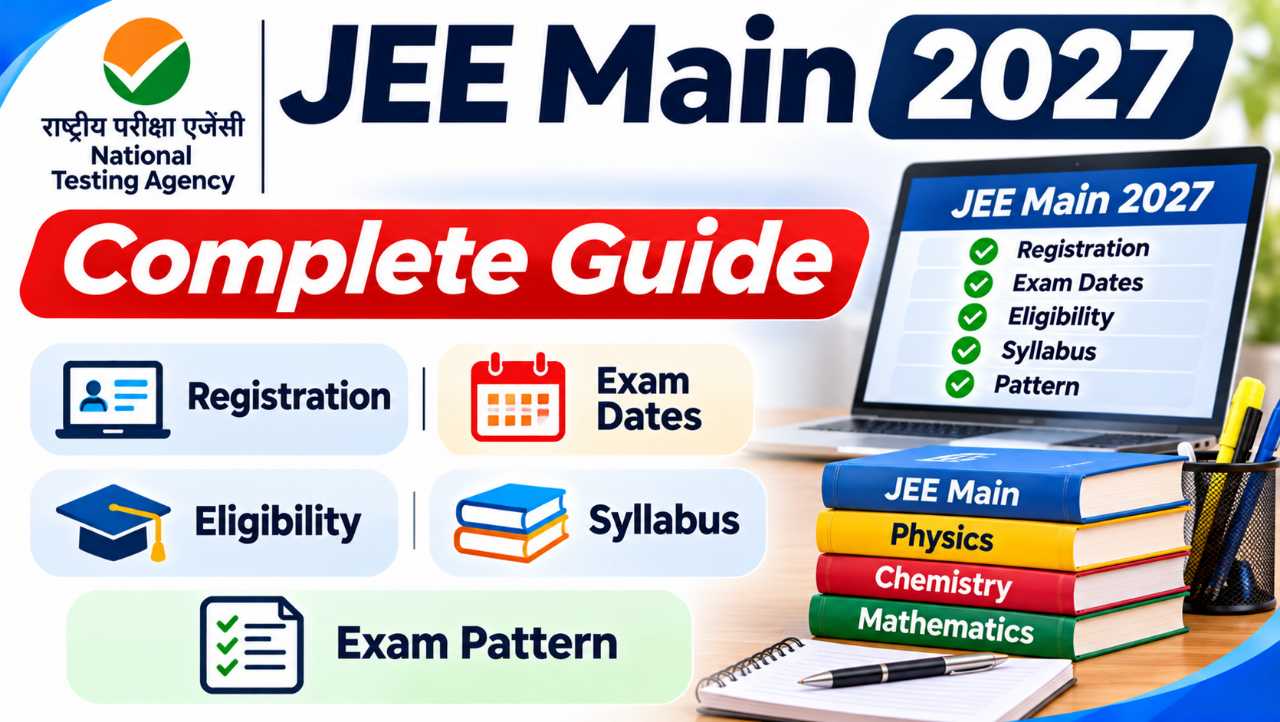
The JEE Main 2027 syllabus is the official topic list that defines what lakhs of engineering aspirants must master before appearing in India’s largest undergraduate engineering entrance test. The National Testing Agency (NTA) has published the syllabus on jeemain.nta.nic.in, aligned with the Class 11 and Class 12 science curriculum. Whether you are in Class 11, Class 12, or a dropper, understanding this document is the first step toward a structured score and a seat in a reputable B.Tech programme.
JEE Main 2027 Syllabus: Official Release and Where to Download
NTA typically releases the JEE Main 2027 syllabus PDF inside the Information Bulletin for the session. Candidates should always download the file from the official portal rather than unofficial mirrors, because only NTA’s document is binding for the examination.
- Official website: jeemain.nta.nic.in
- What the PDF contains: Unit-wise topics for Physics, Chemistry, and Mathematics (Paper 1), plus Paper 2 components for B.Arch and B.Planning where applicable
- Basis of syllabus: Prescribed Class 11 and 12 content, largely consistent with NCERT textbooks
Session 1 of JEE Main 2027 is scheduled on January 20, 21, 22, 23, 24, and 28, 2027 (as per the latest NTA calendar referenced in recent updates). Checking the bulletin when registration opens helps you confirm exact session dates, exam mode, and any procedural changes.
What’s New in JEE Mains 2027 Syllabus?
A common question every year is whether NTA has added or dropped chapters. For JEE Mains 2027, reports based on the official notification indicate:
- New topics added: None announced
- Topics removed: None announced
That means your NCERT-backed school preparation and standard JEE material remain relevant. Still, you must cross-check the PDF once registration begins, because NTA may revise wording or clarify experimental skills without changing the broad scope.
Why the Syllabus Stability Matters for Aspirants
When the syllabus stays steady, you can rely on previous years’ papers, mock tests, and coaching modules without worrying about sudden gaps. Stability also helps students in Kota, Jaipur, Delhi, and other hubs who follow two-year integrated programmes. Coaching centres in Rajasthan for example near Gurukul Institute of Engineering and Technology Kota or Vedant College of Engineering and Technology Kota often align mock difficulty with the unchanged scope.
JEE Main 2027 Exam Pattern at a Glance
Before diving into chapters, link the syllabus to how questions are asked. Paper 1 (B.E./B.Tech) is the focus for most readers.
- Subjects: Physics, Chemistry, Mathematics
- Typical section size: 25 questions per subject in the standard pattern (check the latest bulletin for exact numbers, numerical value questions, and internal choice)
- Mathematics share: Mathematics historically carries the highest proportion of the paper around 35% of total weight in syllabus discussions so balance your weekly hours accordingly
- Marking: Follow the official marking scheme in the bulletin (correct, incorrect, and unattempted rules)
Scoring well opens doors beyond metro NITs you may also target strong regional options such as Krishna institute of Engineering and Technology, Jagannath Institute of Engineering and Technology Cuttack, or Bhartiya Institute of Engineering and Technology Sikar.
Who Sets the JEE Main Syllabus and Why It Is Trustworthy
The National Testing Agency (NTA) conducts JEE Main on behalf of the Ministry of Education. The syllabus is not a coaching-centre guess list it is part of the statutory Information Bulletin. That is why educators, school teachers, and counsellors tell students to treat the PDF as the single source of truth. When social media posts claim “deleted chapters” or “new IIT-only topics,” verify them line by line against jeemain.nta.nic.in before changing your timetable.
JEE Main feeds both admission and eligibility: a strong percentile helps you secure B.Tech seats through JoSAA and state counselling, and top performers move on to JEE Advanced for IITs. Because the same syllabus spine supports both stages (with Advanced going deeper), mastering the Main list thoroughly builds a durable foundation rather than short-term cramming.
Balancing Board Exams and JEE Main 2027 Syllabus
Most syllabus units overlap with CBSE and state board Class 12 papers. Use that overlap strategically: read a NCERT chapter for school, then solve ten Main-level questions the same week. For boards, write structured answers; for JEE, practise speed and accurate rough work. Students eyeing Delhi universities often juggle multiple goals engineering via JEE and other programmes through separate entrances so a shared NCERT base reduces duplicate reading. Institutions like Fairfield Institute of Management and Technology illustrate how metro students weigh both professional degrees and alternate courses after Class 12.
Class 11 Foundation vs Class 12 Finish
Roughly half the JEE Main syllabus sits in Class 11 topics kinematics, thermodynamics, organic basics, coordinate geometry fundamentals. If you are in Class 12 and feel weak in rotation or complex numbers, schedule remedial weeks now instead of postponing to the “final revision.” Class 11 students should aim to finish new chapters monthly while allotting Sunday slots for cumulative mixed revision. Droppers should audit weak units from mock analytics first, then re-read only those NCERT portions before attempting fresh question banks.
NTA JEE Mains 2027 Physics Syllabus
The Physics section tests conceptual clarity and numerical ability across mechanics, electromagnetism, optics, modern physics, and electronics. Official units include:
- Units and Measurements; Kinematics; Laws of Motion
- Work, Energy and Power; Rotational Motion; Gravitation
- Properties of Solids and Liquids; Thermodynamics; Kinetic Theory of Gases
- Oscillations and Waves; Electrostatics; Current Electricity
- Magnetic Effects of Current and Magnetism; Electromagnetic Induction and AC
- Electromagnetic Waves; Optics
- Dual Nature of Matter and Radiation; Atoms and Nuclei; Electronic Devices
- Experimental Skills (practical familiarity as listed in the bulletin)
High-Weightage Physics Chapters (Trend-Based)
Analysis of past papers not a guarantee for 2027 suggests frequent emphasis on Optics, Electrostatics, Properties of Solids and Liquids, Current Electricity, Rotational Motion, and Electromagnetic Induction. Toppers still cover the full syllabus because NTA can rotate focus across units.
Actionable tip: Pair theory chapters with numerical drills. For instance, after Electrostatics, solve capacitor combination and Gauss’s law problems daily for two weeks. Use an error notebook for sign mistakes and unit conversions.
NTA JEE Mains 2027 Chemistry Syllabus
Chemistry is divided into Physical, Inorganic, and Organic sections. Each demands a different study style: calculations and graphs for Physical, periodic trends and coordination chemistry for Inorganic, and mechanism-based learning for Organic.
Physical Chemistry Units
- Some Basic Concepts in Chemistry; Atomic Structure
- Chemical Bonding and Molecular Structure; Chemical Thermodynamics
- Solutions; Equilibrium (including ionic equilibrium)
- Redox Reactions and Electrochemistry; Chemical Kinetics
Inorganic Chemistry Units
- Classification of Elements and Periodicity in Properties
- p-Block Elements (Groups 13–18)
- d- and f-Block Elements
- Coordination Compounds
Organic Chemistry Units
- Purification and Characterisation of Organic Compounds
- Some Basic Principles of Organic Chemistry; Hydrocarbons
- Organic Compounds Containing Halogens, Oxygen, and Nitrogen
- Biomolecules; Principles Related to Practical Chemistry
Past paper trends often highlight Coordination Compounds, Organic Compounds containing Oxygen, Hydrocarbons, Chemical Kinetics, and Atomic Structure. Organic rewards consistent daily practice aim for named reactions and distinction tests every week.
Chemistry rewards spaced repetition: Physical chapters need formula recall, Inorganic needs trend tables, and Organic needs reaction maps. A practical weekly split is three Physical numerical days, two Organic mechanism days, and two Inorganic revision days, with Friday reserved for previous-year mixed chemistry sets.
NTA JEE Mains 2027 Mathematics Syllabus
Mathematics carries substantial weight and ties directly to engineering coursework. Official units include:
- Sets, Relations and Functions; Complex Numbers and Quadratic Equations
- Matrices and Determinants; Permutations and Combinations; Binomial Theorem
- Sequence and Series; Limit, Continuity and Differentiability
- Integral Calculus; Differential Equations
- Coordinate Geometry; Three-Dimensional Geometry; Vector Algebra
- Statistics and Probability; Trigonometry
Mathematics Chapters That Need Extra Time
Historical weightage points to Coordinate Geometry, Integral Calculus, Complex Numbers, Matrices and Determinants, Limits and Differentiability, and Vector Algebra. Coordinate geometry alone has often accounted for a large share of mathematics questions in cumulative analyses.
Actionable tip: Maintain a formula sheet but prioritise problem types parametric forms of conics, definite integrals as areas, and 3D geometry distance problems. Timed sets of 15 questions build exam stamina.
JEE Main Syllabus 2027 for Paper 2 (B.Arch / B.Planning)
Candidates for architecture or planning follow Paper 2, which still leans on the core mathematics list plus aptitude and drawing or planning sections.
- Mathematics: Same broad topics as Paper 1 mathematics (sets through probability, as listed in the bulletin)
- General Aptitude: Awareness of buildings, materials, 3D visualization, analytical reasoning, scale and proportion, design and drawing of patterns
- B.Arch Drawing: Sketching urban and rural scenes from memory
- B.Planning: General awareness, social sciences themes, and thinking skills including maps, charts, and comprehension
If your goal is design rather than core B.Tech, explore allied institutions such as Arch College of Design and Business Jaipur while keeping JEE Main as a parallel option.
Subject-Wise Weightage for JEE Main 2027 (Previous Year Insight)
NTA does not publish fixed chapter quotas for future papers. Coaching analysts use multi-year data to guide priority. The table below summarises illustrative cumulative weightage patterns discussed for recent cycles treat it as a planning aid, not a promise of 2027 papers.
| Subject | Frequently High-Share Chapters | Planning Note |
|---|---|---|
| Physics | Optics, Electrostatics, Current Electricity, Rotational Motion | Revise optics ray and wave topics together monthly |
| Chemistry | Coordination Compounds, Organic Oxygen compounds, Hydrocarbons | Alternate Physical theory days with Organic mechanisms |
| Mathematics | Coordinate Geometry, Integral Calculus, Complex Numbers | Allocate extra weekly hours to calculus and coordinate |
Students should not skip low-frequency chapters entirely easy questions from gravitation or biomolecules can boost ranks.
Detailed multi-year tabulations show Physics chapters such as Optics and Electrostatics leading cumulative counts, Mathematics chapters such as Coordinate Geometry and Integral Calculus dominating maths share, and Chemistry seeing strong presence from Coordination Compounds and Oxygen-containing Organic topics. Use such statistics to order your revision queue in the last ninety days, not to delete chapters from your first pass.
Session 1, Session 2, and Syllabus Coverage
JEE Main is usually held in multiple sessions each year. The syllabus remains identical across sessions; only the question paper changes. If Session 1 in January 2027 does not go as planned, Session 2 offers another attempt with the same topic list. Plan your first full syllabus completion at least six weeks before Session 1 so Session 2 can focus on mocks and weak areas. NTA may also publish official mock tests on the portal align those with units you have already studied to measure readiness without guessing missing topics.
Important Chapters in JEE Main 2027 Syllabus
“Important” here means historically frequent, not officially tagged by NTA. A balanced hit list for revision bootcamps:
- Physics: Electronic Devices, Electromagnetic Waves, Dual Nature, Electrostatics, Current Electricity, Rotational Motion
- Chemistry: Some Basic Concepts, Atomic Structure, Coordination Compounds, Basic Principles of Organic Chemistry, d- and f-Block Elements, Purification and Characterisation
- Mathematics: Vector Algebra, Differential Equations, Integral Calculus, Permutations and Combinations, Statistics and Probability, Sets and Relations
How to Complete JEE Main 2027 Syllabus on Time
- Map the PDF to your calendar: Count weeks until Session 1 and divide units across months.
- Concept first, speed second: Rushing through formulas without understanding hurts both Main and Advanced.
- Use previous years’ papers: After finishing a unit, solve relevant past questions from the last decade.
- Mock tests and error analysis: Simulate exam duration; log mistakes by topic.
- Revision cycles: Short weekly revision plus a full syllabus revision six weeks before the exam.
Delhi NCR students often combine school boards with coaching; exploring local ecosystems from Jamia Millia Islamia New Delhi aspirations to private B.Tech routes helps set realistic rank targets early.
Best Books to Cover the JEE Main 2027 Syllabus
Stick to one primary book per segment plus NCERT. Recommended references commonly used by aspirants:
Physics
- Concepts of Physics (Vol. 1 & 2) – H.C. Verma
- Understanding Physics – D.C. Pandey
- Fundamentals of Physics – Halliday, Resnick & Walker
Chemistry
- Physical Chemistry – P Bahadur; Modern Approach to Chemical Calculations – R.C. Mukherjee
- Organic Chemistry – O.P. Tandon; Morrison & Boyd for deeper reading
- Concise Inorganic Chemistry – J.D. Lee
Mathematics
- Objective Mathematics – R.D. Sharma
- Coordinate and trigonometry classics – S.L. Loney
- Calculus practice – Amit M. Agarwal (Arihant)
JEE Main 2027 Syllabus PDF Download: Quick Checklist
- Visit jeemain.nta.nic.in and open the latest Information Bulletin
- Download the syllabus appendix or integrated PDF section
- Save a printed copy and highlight units you have not started
- Match each unit with NCERT chapter numbers for Physics, Chemistry, and Mathematics
- Revisit the site monthly for sample papers or practice questions NTA may upload
Conclusion
The JEE Mains 2027 syllabus reaffirms the Class 11–12 science foundation with no broad additions or deletions reported for this cycle. Download the official PDF from NTA, study Physics, Chemistry, and Mathematics unit by unit, respect Mathematics’ higher share of effort, and use past weightage only as a prioritization tool not an excuse to skip chapters. Combine NCERT clarity with timed practice, mock tests, and a college list that matches your expected rank, using resources such as the JEE Main page and institute profiles on CollegeDwar. Starting early, revising often, and tracking errors will keep you on course for Session 1 in January 2027 and beyond.