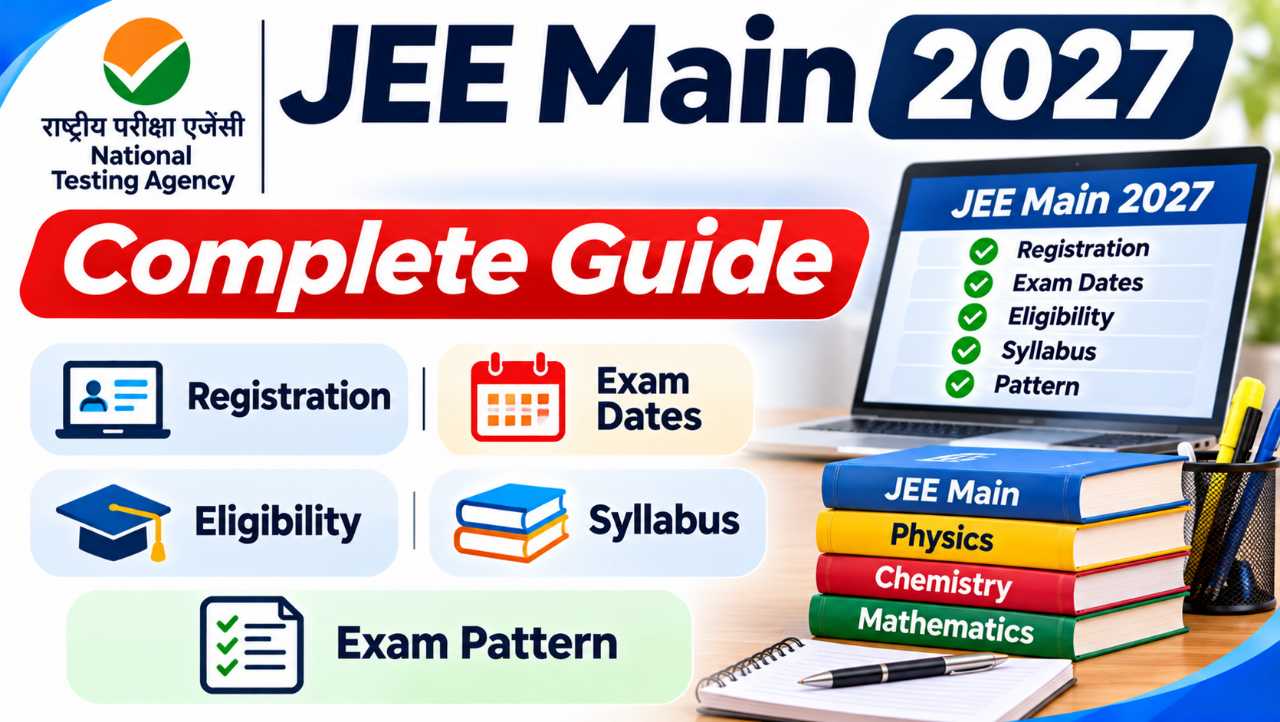
JEE Main 2027 is the gateway exam for lakhs of Indian students who dream of studying B.Tech, B.Arch, or B.Planning at NITs, IIITs, GFTIs, and other centrally funded institutes. The National Testing Agency (NTA) conducts this computer-based test twice a year, and the first session is already shaping up as one of the largest undergraduate registrations in the country. Whether you are a Class 12 student appearing in 2027, a repeater polishing your rank, or a parent planning the admission calendar, this guide covers everything you need: key dates, eligibility, syllabus, exam pattern, registration steps, and what happens after the result.
What Is JEE Main 2027 and Why Does It Matter?
The Joint Entrance Examination (Main), commonly called JEE Main, is India’s national-level screening test for engineering and architecture admissions. A strong percentile opens doors to 48,000+ seats across NITs, IIITs, and GFTIs through JoSAA counselling. Separately, only the top 2.5 lakh eligible rank holders from both sessions combined can sit for JEE Advanced, which is mandatory for IIT admission.
JEE Main is not limited to traditional engineering. Paper 1 targets B.E./B.Tech aspirants, while Paper 2A and 2B serve B.Arch and B.Planning candidates respectively. Students who are also exploring design or hospitality pathways may parallel-track exams such as the NIFT entrance exam or NCHMCT JEE, but for core B.Tech planning, JEE Main remains the central milestone.
Who Conducts JEE Main?
NTA publishes the official notification, application forms, admit cards, answer keys, and results on jeemain.nta.nic.in. Always verify dates on this portal rather than unverified social media posts.
JEE Main 2027 Latest Updates
As of late November 2026, Session 1 registration is active, including a late-fee window for candidates who missed the regular deadline. NTA has reported that over 15 lakh application forms were submitted for Session 1, with more than 13 lakh candidates completing fee payment underscoring intense competition.
- Registration: Session 1 began on 24 October 2026; late registration with ₹500 extra fee was extended in the live update cycle.
- Aadhaar advisory: Candidates who obtained Aadhaar before age 15 are urged to update biometrics for smoother verification at centres.
- DigiLocker users: Re-KYC is advised if documents are pulled via DigiLocker.
- Final form: Only the last successfully submitted application is treated as valid.
- Syllabus: Aligned with NCERT Class 11 and 12; high-weight chapters include coordinate geometry, mechanics, organic chemistry, and electrostatics.
JEE Main 2027 Exam Dates: Session 1 and Session 2
NTA holds two sessions each year. Your best percentile across Session 1 (January) and Session 2 (April) is used for ranking and counselling. Missing Session 1 does not bar you from Session 2, though serious aspirants usually attempt both.
Session 1 Schedule (January 2027)
| Event | Date |
|---|---|
| Online application (regular) | 24 Oct – 22 Nov 2026 |
| Fee payment last date (regular) | 22 Nov 2026 |
| Late application with ₹500 fee | 23 – 26 Nov 2026 (check portal) |
| Application correction | 27 – 29 Nov 2026 |
| City intimation slip | 30 Dec 2026 |
| Admit card | 13 Jan 2027 |
| Exam days | 20, 21, 22, 23, 24 and 28 Jan 2027 |
| Answer key | On NTA website post-exam |
| Result | By Feb 2027 |
Session 2 Schedule (April 2027)
| Event | Date |
|---|---|
| Application opens | 5 Jan 2027 |
| Fee payment last date | 3 Feb 2027 |
| Late fee window | 4 – 7 Feb 2027 |
| Application correction | 8 – 10 Feb 2027 |
| City intimation | 12 Mar 2027 |
| Admit card | 25 Mar 2027 |
| Exam days | 2, 3, 4, 5, 6, 7 Apr 2027 |
| Result | By Apr 2027 |
Action tip: Mark city intimation and admit card dates immediately after registration. NTA assigns exam city and shift; you cannot choose the exact slot.
JEE Main 2027 Eligibility Criteria
Understanding eligibility before paying fees saves time and money. For 2027, the qualifying examination rule is straightforward.
- Year of passing: You must have passed Class 12 (or equivalent) in 2025 or 2026, or be appearing in the 2027 board exams.
- Age limit: There is no upper age limit for JEE Main 2027.
- Subjects: For B.Tech (Paper 1), you typically need Physics, Mathematics, and Chemistry/Biology/Biotechnology/Technical Vocational in 10+2 (per NTA brochure rules verify your category of admission).
- Recognised boards: CBSE, state boards, NIOS, vocational higher secondary certificates, AICTE-recognised 3-year diplomas, defence academy routes, and foreign boards with AIU equivalence are among accepted pathways.
- NRI candidates: Those without Aadhaar may register using a valid Indian passport, per the latest advisory.
Eligibility for JEE Advanced is stricter (rank cut-off, number of attempts, and IIT-specific rules). Treat JEE Main as stage one and read Advanced criteria only after you are realistically in contention for the top 2.5 lakh ranks.
JEE Main 2027 Registration and Application Fee
Registration is entirely online. The process includes account creation, academic details, photograph and signature upload, exam city preference, and fee payment. Keep scanned documents ready in the prescribed format to avoid session timeout.
After submission, download the confirmation page. If you used DigiLocker, ensure details match your board certificates before the correction window closes.
JEE Main 2027 Syllabus
The JEE Main 2027 syllabus follows NCERT themes from Class 11 and 12 Physics, Chemistry, and Mathematics. NTA releases the detailed topic list in the information brochure on the official site. Rather than chasing every line, strategic preparation focuses on chapters that historically carry higher weight.
Physics: High-Priority Topics
- Units and measurements, motion in a plane, laws of motion
- Work, energy, power; rotational motion; gravitation
- Mechanical properties of solids and fluids
- Thermodynamics; kinetic theory; oscillations and waves
- Electrostatics: charges, fields, potential, capacitance
- Current electricity; moving charges and magnetism
- Electromagnetic induction and alternating current
- Optics and modern physics fundamentals
Mathematics: High-Priority Topics
- Sets, relations, functions; complex numbers; quadratic equations
- Matrices and determinants
- Limits, continuity, differentiability; application of derivatives
- Integrals; differential equations
- Coordinate geometry; 3D geometry
- Probability and statistics
- Trigonometry and inverse trigonometric functions
Chemistry: High-Priority Topics
- Atomic structure; chemical bonding; states of matter
- Thermodynamics and equilibrium; redox and electrochemistry
- Organic chemistry: GOC, hydrocarbons, functional groups, biomolecules
- Inorganic chemistry: periodic trends, coordination compounds, p-block and d-block elements
Preparation tip: Complete NCERT line by line especially Chemistry then graduate to PYQs and timed mocks. High-weight areas like coordinate geometry in Maths, mechanics in Physics, and organic pathways in Chemistry repay disproportionate effort.
JEE Main 2027 Exam Pattern and Marking Scheme
All papers are conducted in computer-based test (CBT) mode unless NTA specifies otherwise in the brochure. Understanding section-wise questions helps you plan accuracy versus speed.
Paper 1: B.E. / B.Tech
| Subject | Questions | Marks |
|---|---|---|
| Mathematics | 20 MCQ + 5 numerical | 100 |
| Physics | 20 MCQ + 5 numerical | 100 |
| Chemistry | 20 MCQ + 5 numerical | 100 |
| Total | 75 | 300 |
Marking: +4 for correct MCQs and numerical answers; −1 for incorrect MCQs and numericals (verify current brochure for any update on numerical negative marking).
Paper 2A: B.Arch
Mathematics (100 marks) + Aptitude Test (50 questions, 200 marks) + Drawing (2 questions, 100 marks). Total 400 marks, 77 questions plus drawing component.
Paper 2B: B.Planning
Mathematics (100) + Aptitude (200) + Planning-based questions (25 questions, 100 marks). Total 400 marks.
Exam Duration and Shifts
- Paper 1, 2A, and 2B: 3 hours each
- Both B.Arch and B.Planning in one go: 3 hours 30 minutes
- Typical shifts: 9:00 AM – 12:00 noon and 3:00 PM – 6:00 PM (IST); extended timing for 3.5-hour papers
How to Prepare for JEE Main 2027
Success blends syllabus coverage, retention, and exam temperament. Use this phased approach from now until your session date.
- Foundation (months 1–4): NCERT completion + chapter-wise exercises.
- Consolidation (months 5–8): Standard reference books, short notes, formula sheets.
- Exam readiness (final 8–12 weeks): Full-length mocks, error log, speed drills on numericals.
After each mock, tag mistakes as concept gap, calculation error, or time mismanagement. Fix the dominant category first. For college research alongside prep, explore institutes such as Laxminarayan Innovation Technological University and compare cut-off trends on CollegeDwar once you have a realistic mock percentile band.
Students undecided between pure engineering and humanities may also review alternate pathways for example postgraduate routes via a Master of Arts (MA) after a bachelor’s degree but if B.Tech is the goal, keep JEE Main mocks non-negotiable in your weekly schedule.
Admit Card, Exam Day Guidelines, and Dress Code
Session 1 admit cards are expected around 13 January 2027. Download from the NTA portal using application number and password or date of birth. Cross-check name spelling, photograph, exam date, shift, and centre address.
Carry a printed admit card, valid photo ID, and follow centre frisking rules. Avoid metal accessories, heavy footwear, electronic gadgets, and bags. Male candidates should prefer light clothing without metal buttons or zips; female candidates should wear simple attire (e.g., leggings or salwar) without scarves or jewellery, as per past NTA advisories.
Visit your centre a day earlier if possible, and reach at least 60 minutes before reporting time. PwD candidates must carry prescribed certificates.
Answer Key, Result, and What Happens Next
NTA releases a provisional answer key and candidate response sheet. You may challenge specific keys within the announced window by paying the required fee per question. The final key feeds into percentile calculation.
Results are declared in percentile score, not raw marks alone. Session-wise percentiles are announced after each session; a consolidated rank considering the best of two sessions is used for JoSAA and state counselling participation where applicable.
The JoSAA seat matrix covers NITs, IIITs, and GFTIs. Indicative totals from the previous cycle included roughly 25,000+ NIT seats, 11,000+ IIIT seats, and 11,000+ GFTI seats about 48,000 engineering seats combined. Actual 2027 numbers will appear in the official seat matrix notification.
Application Form Correction and Common Mistakes
Session 1 correction is scheduled for 27–29 November 2026. Editable fields are limited to what NTA enables in the portal each year typically personal details, academic information, and photograph in some cases, but not always exam city after a cutoff.
- Mismatch between board name on certificate and application
- Wrong category or PwD status
- Blurry photograph or signature not meeting pixel requirements
- Selecting wrong paper (B.Tech vs B.Arch)
Counselling and College Choice Strategy
After results, register on JoSAA (for NIT+/IIIT/GFTI), and parallel state counselling portals if domicile rules benefit you. Fill choices in descending order of preference, mixing ambitious, realistic, and safe options based on opening–closing ranks from prior years.
Use CollegeDwar’s JEE Main hub to track participating colleges, branch-wise trends, and exam updates without juggling dozens of bookmarked tabs.
Documents and Details Needed Before You Register
Most registration delays happen because students start without a document checklist. Prepare these before you open the form:
- Identity: Aadhaar number (updated biometrics if issued before age 15), or valid Indian passport for eligible NRI applicants.
- Academic records: Class 10 certificate for date of birth proof, and Class 12 marks sheet or registration details if you are an appearing candidate.
- Category certificate: SC/ST/OBC (NCL)/EWS/PwD certificates in the format NTA accepts, if applicable.
- Photograph and signature: Recent colour photo and clear signature scan as per pixel and file-size rules in the brochure.
- Contact details: Active mobile number and email not shared with multiple candidates OTP verification fails when inboxes are cluttered.
When pulling marksheets through DigiLocker, complete re-KYC if prompted. Mismatched names between DigiLocker and your board certificate are among the most frequent correction-window issues counsellors report each year.
Late Fee, Correction Window, and Why Timing Matters
NTA offers a short late-registration period with an additional ₹500 fee for candidates who miss the regular closing date. Session 1 late registration was live around 23–26 November 2026 in official updates never assume an extension beyond what the portal displays. Session 2 late registration is scheduled for 4–7 February 2027 with the same late-fee logic.
The correction window is not unlimited editing. Session 1 corrections run 27–29 November 2026; Session 2 corrections run 8–10 February 2027. Log in with application number, password, and date of birth. Fix spelling errors in the candidate or parent name, board details, and category flags before the window closes counselling and certificate verification later depend on exact matches.
Understanding JEE Main Percentile Scores
Many families still expect a single “out of 300” rank in the same way school unit tests work. JEE Main reports NTA scores in percentile. Your percentile tells you how you performed relative to other candidates in your session, not your absolute marks alone. After both sessions, NTA applies the best of two sessions principle for the consolidated rank used in JoSAA.
Why this matters for preparation: two students with similar raw marks can earn different percentiles if the paper difficulty shifts between shifts or sessions. That is why full-length mocks calibrated to current patterns matter more than solving only easy chapter tests.
Quick Facts on Ranking
- Session 1 result: expected by February 2027.
- Session 2 result: expected by April 2027.
- Final consolidated ranking: after Session 2, incorporating the better percentile.
- JEE Advanced cutoff: published with results; only top eligible ranks move to the next stage.
Official Mock Tests and Sample Papers
NTA activates free mock tests on the official portal that mirror CBT navigation, timer behaviour, and question palette tools. Treat your first mock as a lab session: learn how to mark questions for review, skip numericals temporarily, and return within the three-hour cap.
Combine official mocks with previous-year JEE Main papers. Solve at least the last five years per subject after concept revision. Note recurring traps especially in Chemistry conceptual MCQs and Calculus-based Maths. Accuracy strategy: attempt questions you are sure of before chasing speed on lengthy numericals.
Exam-Day Document Checklist
Beyond the admit card, carry a government photo ID (Aadhaar, passport, school ID with photograph, etc., as listed in the brochure). Reach early for frisking; centres disallow bags, watches, calculators, mobile phones, Bluetooth devices, and most metal accessories.
On the answer sheet workflow, follow invigilator instructions for photograph, thumb impression, and attendance signature. Any deviation can delay your entry when queues are long on peak exam days in metro cities.
Beyond JoSAA: State Counselling and Backup Options
Many states admit students to government and private engineering colleges through their own counselling based on JEE Main scores rules vary by domicile, reservation, and participating institutes. JoSAA remains the channel for NITs, IIITs, and GFTIs, but a smart applicant watches both calendars.
If engineering is not your only interest, build a balanced plan. Design-focused students may prepare for the NIFT entrance exam; hospitality aspirants may track the NCHMCT JEE. Your core JEE Main effort still anchors the widest B.Tech landscape.
When Was the JEE Main 2027 Notification Released?
NTA released the JEE Main 2027 notification and information brochure on 24 October 2026, alongside the start of Session 1 registration. The brochure is the authoritative document for fee structure by category, PwD provisions, city list updates, and any last-minute pattern clarifications. Download it from jeemain.nta.nic.in and keep a dated copy on your phone for quick reference during preparation and form filling.
Conclusion
JEE Main 2027 rewards disciplined NCERT study, honest mock-test analysis, and careful attention to NTA timelines. Session 1 is already underway with lakhs of registered candidates; Session 2 gives a second shot at improving your best percentile. Register only after confirming eligibility, double-check your application during the correction window, and align your study plan with the official syllabus and CBT pattern. Whether your destination is an NIT, an IIIT, a GFTI, or the JEE Advanced route to IITs, the same fundamentals apply: clarity on dates, depth on core chapters, and calm execution on exam day. For the latest official alerts, keep jeemain.nta.nic.in as your primary source and use trusted companions like CollegeDwar to explore colleges and courses once your score card is in hand.