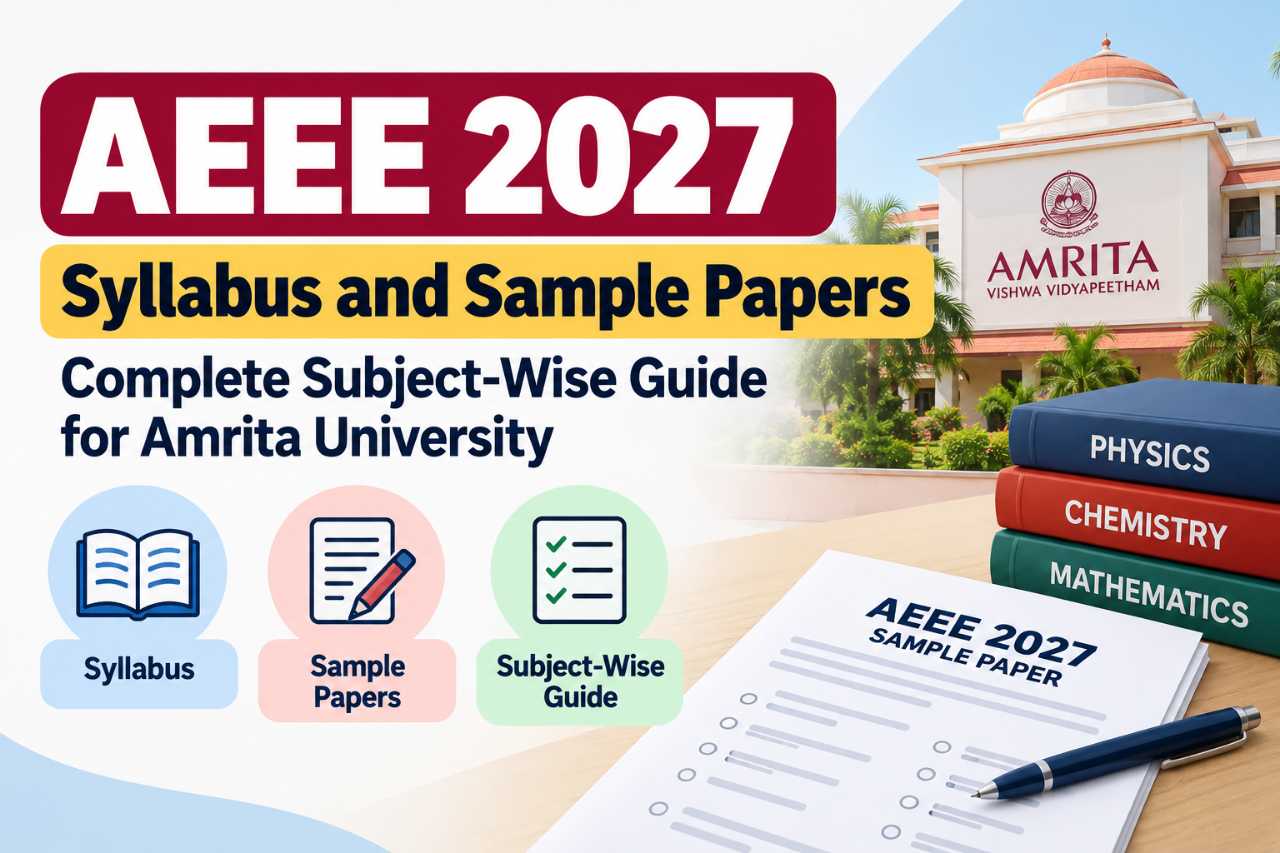
The AEEE exam pattern 2027 defines how Amrita Vishwa Vidyapeetham shortlists students for its B.Tech programmes across campuses such as Coimbatore, Amritapuri, Bengaluru, Chennai, Kochi, and others. Amrita is expected to publish the final pattern on aeee.amrita.edu; until then, the structure mirrors the revised pattern announced in recent brochures. Understanding sections, duration, marking, and negative marking is the first step before you compare Amrita with other private and deemed universities you may also be applying to, such as SRM University Engineering or Amity University Noida.
According to the latest schedule, AEEE 2027 will be held in two phases, with testing expected between 15 April and 7 May 2027. The paper is a computer-based test (CBT) in English, lasting 2 hours 30 minutes, with 100 multiple-choice questions and a maximum score of 300 marks. This article explains the full Amrita university paper pattern, subject-wise marks, how the test differs from older AEEE formats, and how to turn the pattern into a realistic study planwithout treating the brochure as a substitute for your own mock-test practice.
What Is AEEE and Who Should Read This Pattern?
Amrita Engineering Entrance Examination (AEEE) is the university-level test for undergraduate engineering admission at Amrita Vishwa Vidyapeetham. If you are a Class 12 student (or equivalent) with Physics, Chemistry, and Mathematics, AEEE is usually one of several options alongside state CETs, JEE Main, and exams conducted by institutions like Lovely Professional University Engineering or Galgotias University Greater Noida.
The pattern matters because Amrita has updated its paper over the years. The current design gives more weight to Mathematics, adds Quantitative Aptitude and English, and keeps core PCM at the centre. Treating AEEE as “only PCM at JEE level” can leave you underprepared for aptitude and language items that still affect rank.
AEEE 2027 Exam Pattern at a Glance
The following summary is based on the pattern communicated for AEEE 2027 and the revised structure used in the preceding admission cycle. If Amrita updates the brochure, check the official portal and adjust your plan.
- Mode: Online computer-based test (CBT)
- Language: English
- Duration: 2 hours 30 minutes (150 minutes)
- Question type: Multiple Choice Questions (MCQs) with four options
- Total questions: 100
- Total marks: 300
- Marking: +3 for every correct answer
- Negative marking: −1 for every incorrect answer
- Unattempted questions: No mark added or deducted
- Phases: Two phases; candidates may attempt as per slot booking rules in the official notification
Why the Pattern Favours Strategic Attempts
With one-third negative marking (you lose one mark for a wrong answer against three marks gained for a correct one), blind guessing hurts your normalized score. A practical rule many toppers use is to attempt questions you can solve or eliminate options for, and to skip doubtful items unless you can narrow choices to two. Across 100 questions in 150 minutes, you have roughly 90 seconds per question on averagefaster for English and aptitude, slower for lengthy Mathematics problems.
Subject-Wise Questions and Marks Distribution
The AEEE paper pattern 2027 splits the paper into five sections. Each question carries 3 marks, so the number of questions in a section equals one-third of that section’s marks.
Section-wise break-up
- Mathematics: 40 questions | 120 marks
- Physics: 25 questions | 75 marks
- Chemistry: 20 questions | 60 marks
- Quantitative Aptitude: 10 questions | 30 marks
- English: 5 questions | 15 marks
Mathematics alone is 40% of the paper by question count and marks. If you are targeting a strong branch at a competitive campus, Mathematics accuracy often separates ranks. Physics and Chemistry together are 45 questionsstill substantial, and largely aligned with Class 11 and 12 NCERT-style preparation similar to what you would use for JEE Main or state engineering exams.
Quantitative Aptitude and English are smaller but not “free marks.” Aptitude items may cover percentages, ratios, time and work, simple interest, data interpretation, and logical patterns. English may test vocabulary, grammar, and short comprehension. Students who only drill PCM sometimes lose easy marks here; a 15–20 minute daily aptitude and English routine for six to eight weeks is usually enough to cover the expected difficulty.
Marks distribution table (AEEE 2027)
For quick reference, here is how marks add up to 300:
- Maths 120
- Physics 75
- Chemistry 60
- Quantitative Aptitude 30
- English 15
- Total 300
AEEE 2027 Mode of Examination and Two-Phase Schedule
Amrita conducts AEEE as an online CBT. You will use a computer at the allotted test centre, navigate questions on screen, and mark answers by clicking options. There is no pen-and-paper OMR sheet. Familiarity with on-screen rough work (centre-provided scribble pads) and the review/mark-for-review features reduces anxiety on exam day.
The two-phase structure gives flexibility: Phase 1 and Phase 2 windows allow students to choose a slot that fits board exams and other entrance tests. The announced testing period runs from 15 April to 7 May 2027 across phases (exact slot dates are published with the application brochure). Many candidates also sit JEE Main, VITEEE, or university tests such as those required by Chitkara University Engineering or Shiv Nadar University Engineering, so plan overlapping dates early.
CBT skills that improve scores
- Take official or website-listed mock tests in full-screen timed mode.
- Practice switching between subjects mentallyAEEE is one composite paper, not separate subject papers.
- Build a review pass in the last 15 minutes for flagged questions.
- Read all options before confirming; CBT makes changing answers easy, but time lost on indecision is costly.
Marking Scheme and Rank Implications
Amrita’s marking scheme for AEEE 2027 is straightforward: +3 / −1 / 0 for correct, wrong, and unattempted respectively. There is typically no sectional cut-off in the pattern document itself; overall rank drives counselling. However, branch cut-offs at popular campuses (for example Computer Science, Electronics, or dual-degree options) vary sharply by year and quota.
Past counselling discussions often mention that scores around 200+ out of 300 improve chances for many branches, while top branches at flagship campuses may need higher marks depending on applicant volume. Treat these as planning benchmarks, not guaranteesalways compare with the current year’s cut-off and seat matrix.
When evaluating return on effort, compare Amrita’s scholarship and fee structure with other engineering destinations. Families exploring North India may simultaneously track BML Munjal University, The Northcap University Engineering, or state institutions like Delhi Technological University (DTU) and Netaji Subhas University of Technology (NSUT) Delhi for a balanced shortlist.
AEEE Syllabus 2027 and Its Link to the Pattern
The AEEE syllabus is built on Class 11 and 12 topics in Physics, Chemistry, and Mathematics, plus aptitude and English skills. The pattern document does not replace the syllabus PDFboth together define what to study and how it will be tested.
Physics (indicative units)
Units and dimensions, kinematics, mechanics, solids and fluids, oscillations and waves, electrostatics, current electricity, magnetostatics, electromagnetic induction, electromagnetic waves, optics, thermodynamics, modern physics, and related numerical problem types.
Chemistry (indicative units)
Basic calculations, atomic structure, periodicity, chemical bonding, solutions, p-block and d/f elements, coordination compounds, solid state, electrochemistry, thermodynamics, organic functional groups, hydrocarbons, polymers, chemical kinetics, biomolecules, and environmental chemistry.
Mathematics (indicative units)
Sets, relations, functions, complex numbers, permutations and combinations, binomial theorem, sequences and series, trigonometry, coordinate geometry, circles, conics, quadratic equations, limits, continuity, differentiation, integration, differential equations, probability, matrices, determinants, vectors, and 3-D geometry.
If you are also applying to specialised schools such as University of Petroleum and Energy Studies, you may notice syllabus overlap with JEE Mainuse one strong PCM base for multiple exams, then add aptitude and English only where the pattern demands it.
How AEEE Pattern Differs From Older Amrita Papers
Candidates who relied on outdated resources should note: earlier AEEE papers were sometimes perceived as PCM-only with different weightage. The revised pattern explicitly includes 40 Mathematics questions and dedicated Quantitative Aptitude and English sections. Coaching modules labelled “old AEEE” may omit these. Always cross-check the latest brochure before buying books or subscribing to test series.
Preparation Strategy Aligned With the 2027 Pattern
Month-by-month approach for Class 12 students
Months 6–4 before exam: Complete syllabus once for PCM with NCERT + one reference book per subject. Start 20 minutes daily for aptitude (school-level quantitative reasoning is enough initially).
Months 3–2 before exam: Shift to topic-wise tests under time limits. After each test, classify errors as concept, calculation, or misread question. Maintain an error logthis is high-ROI for CBT exams.
Last month: Full-length mock tests twice per week simulating 150 minutes. Analyse section-wise time spent. If Mathematics consumes 70+ minutes, drill shortcuts and skip strategies for lengthy problems.
Books and resources (pattern-aware)
- Physics/Chemistry/Maths: NCERT + previous years’ AEEE papers + one standard JEE Main practice book for numerical depth.
- Aptitude: Any SSC/ bank PO-level quantitative aptitude primer for basics; focus on speed.
- English: Grammar essentials (tenses, articles, prepositions) and vocabulary from past entrance papers.
- Mocks: Official Amrita mock tests when released; supplementary CBT mocks from reputable platforms.
Time management inside the 150-minute paper
A workable order for many students is: secure English and Aptitude first (15 questions, relatively quick), then Chemistry (20 questions), then Physics (25), and dedicate the remaining block to Mathematics (40). Adjust based on your strengthsstrong math students may start with Mathematics while energy is high. The best order is the one that maximizes attempted questions with high accuracy, not the one used by toppers online.
Admission Path After AEEE: Pattern Score to Seat
Your AEEE score feeds into rank, counselling, and campus-branch allotment. Amrita also offers pathways through JEE Main and other criteria in some years; the official admission brochure lists eligibility and merit rules. When counselling opens, keep choice filling flexible across campusesyou may prefer flagship locations for certain branches but accept another campus for the same branch if cut-offs differ.
Students from Rajasthan or nearby states sometimes maintain a dual list: Amrita campuses plus local options such as Poornima University Jaipur, Jecrc University Jaipur, or Jaipur National University (JNU Jaipur) for backup planning. Use the pattern to estimate realistic score targets before you pay multiple application fees.
Key Takeaways for AEEE 2027 Aspirants
- Prepare for 100 MCQs in 150 minutes with +3/−1 marking.
- Prioritize Mathematics (120 marks) while not ignoring aptitude and English.
- Train on CBT mocks because the exam is online only.
- Track official updates on aeee.amrita.edu for any pattern tweak in the final brochure.
- Combine board exams, JEE Main, and phase dates in one calendar to avoid clash stress.
Conclusion
The AEEE exam pattern 2027 rewards disciplined PCM preparation, quick aptitude, and careful CBT exam habits. With 300 marks on the line and negative marking in play, your goal is not to attempt every question but to maximize net score through accuracy and smart section timing. Download the latest syllabus alongside the pattern, attempt full mocks under real conditions, and compare Amrita with other engineering entrances on your listwhether that includes Integral University Engineering, DIT University Engineering, or government institutes you are eyeing elsewhere. A clear pattern today becomes a measurable rank tomorrow.