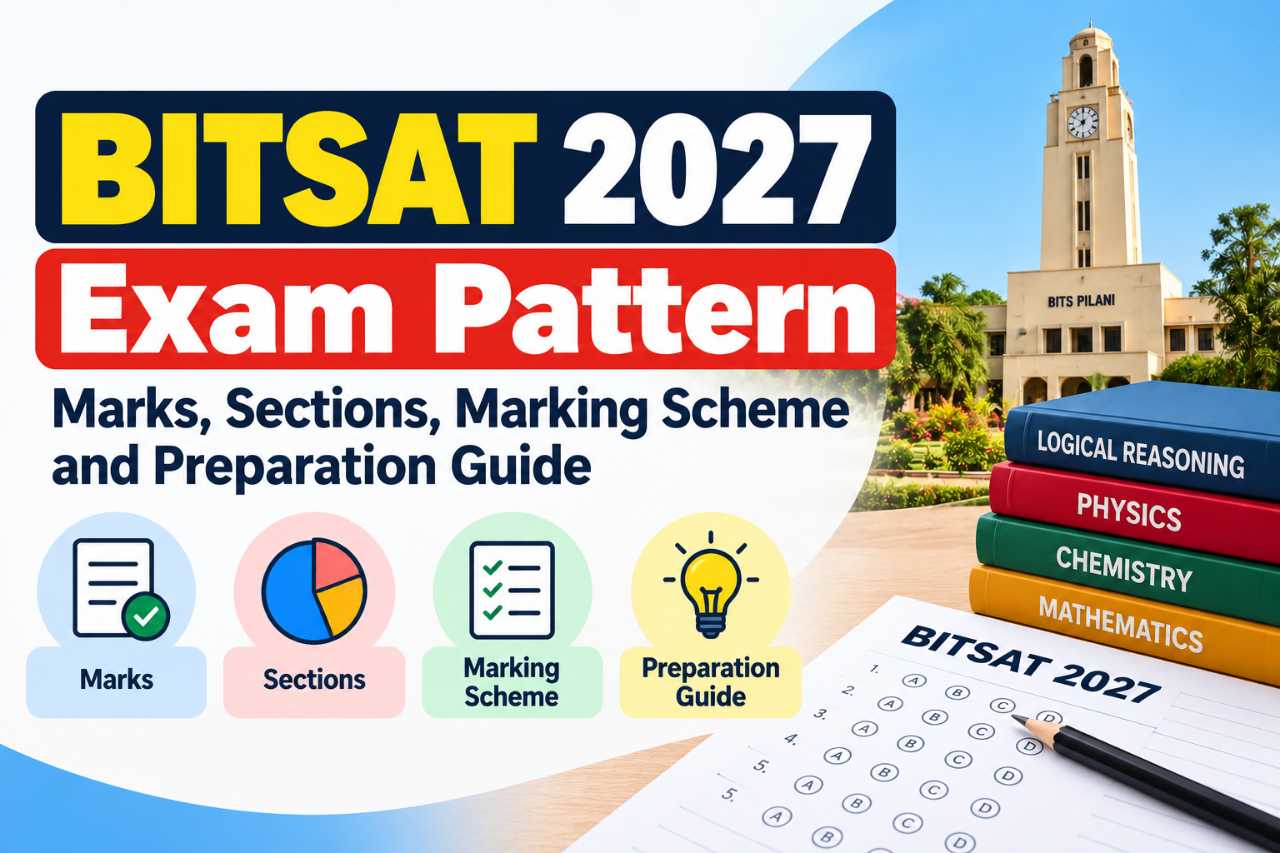
The Birla Institute of Technology and Science Admission Test (BITSAT) is one of India's most competitive engineering entrance exams, opening doors to BE programmes at BITS Pilani, Goa, and Hyderabad campuses. For aspirants targeting the May 2027 cycle, understanding the BITSAT exam pattern 2027 is not optional it is the foundation of every study plan, mock-test strategy, and time-management decision you will make over the next months.
BITS Pilani releases the official pattern, brochure, and syllabus on bitsadmission.com. Until then, the structure has remained stable for recent editions: a single online paper, four parts, objective questions only, and a clear marking scheme with negative marking. This article breaks down total marks, section-wise question counts, the unique “extra questions” feature, who should choose Mathematics versus Biology in Part IV, and how the pattern differs from other national-level tests so you can prepare with clarity rather than guesswork.
BITSAT 2027 at a Glance: Mode, Duration, and Language
BITSAT is conducted as a Computer-Based Test (CBT). You answer on a computer at an assigned test centre; there is no pen-and-paper option. The total duration is 3 hours (180 minutes), and the entire paper is in English. Unlike some exams that lock you into a section for a fixed time, BITSAT typically allows you to move freely across all 130 main questions within the overall three-hour window you can revisit and change answers among those 130 until you submit or time runs out.
The authority usually conducts BITSAT in two sessions (Session 1 and Session 2), both generally scheduled around May. Candidates may apply for one or both sessions depending on that year’s notification; attempting both can give a second shot at improving your score for counselling. Always confirm session dates, registration windows, and fees in the official brochure when it is published.
Quick Facts Table: BITSAT Exam Pattern 2027
| Particular | Detail |
|---|---|
| Exam mode | Online (CBT) |
| Duration | 3 hours |
| Medium | English |
| Question type | Multiple Choice Questions (MCQ), 4 options each |
| Total questions (main paper) | 130 |
| Maximum marks (main paper) | 390 |
| Marks per correct answer | +3 |
| Negative marking | −1 per wrong answer |
| Unattempted questions | 0 marks (no penalty) |
Section-Wise Paper Pattern: Four Parts Explained
The BITSAT question paper is divided into four parts. Parts I, II, and III are common to almost all candidates. Part IV depends on your programme choice: most BE aspirants attempt Mathematics, while candidates for BE Environmental and Sustainability Engineering and the BPharm programme attempt Biology instead of Mathematics.
Part I: Physics (30 Questions)
Physics carries 30 questions, each worth 3 marks if answered correctly. Topics align with the NCERT-plus standard expected at Class 11 and 12 level: mechanics, thermodynamics, electromagnetism, optics, modern physics, and related numerical problem-solving. Because Physics and Chemistry together form 60 of 130 questions, strong fundamentals in these two subjects often decide whether you finish the paper with time left for accuracy checks or rush through Part IV.
Actionable tip: In mock tests, aim to average roughly 45–50 minutes for Physics and Chemistry combined initially, then refine based on your strengths. BITSAT rewards speed with accuracy; blind guessing hurts because of −1 per wrong answer.
Part II: Chemistry (30 Questions)
Chemistry also has 30 MCQs. Physical, organic, and inorganic chemistry all appear, often mixing conceptual questions with calculation-based items. The equal weightage with Physics (30 each) means neglecting Chemistry while over-investing in Mathematics alone is a common mistake.
In past papers, organic reaction mechanisms and physical chemistry numerics often consume more time per question than factual inorganic items. During revision, tag questions as "fast factual" or "slow numerical" so your exam-day order within Part II matches your strengths some toppers answer quick inorganic and factual organic first, then return to lengthier physical chemistry problems after securing net marks elsewhere.
Part III: English Proficiency and Logical Reasoning
Part III is split into two sub-sections:
- English Proficiency: 10 questions testing vocabulary, grammar, reading comprehension, and usage.
- Logical Reasoning: 20 questions covering patterns, series, syllogisms, analogies, and analytical puzzles.
Together, these 30 questions are often the fastest-scoring segment for students who practise regularly. Many engineering aspirants underestimate English and LR until mock scores stagnate; dedicating 20–30 minutes daily to this section can improve your net score without deep new syllabus learning.
Part IV: Mathematics or Biology (40 Questions)
Part IV is the heaviest single block: 40 questions. BE candidates (except the environmental engineering stream noted above) take Mathematics. BPharm and BE Environmental and Sustainability Engineering candidates take Biology.
Mathematics covers algebra, trigonometry, coordinate geometry, calculus, probability, and vectors again at a Class 11–12 competitive level. Biology covers botany, zoology, genetics, biotechnology basics, and related NCERT-aligned topics for pharmacy-oriented applicants.
Section-Wise Question Distribution
| Part | Subject / Area | Questions |
|---|---|---|
| Part I | Physics | 30 |
| Part II | Chemistry | 30 |
| Part III (a) | English Proficiency | 10 |
| Part III (b) | Logical Reasoning | 20 |
| Part IV | Mathematics or Biology | 40 |
| Total (main paper) | 130 | |
Total Marks and Marking Scheme 2027
Every question in the main BITSAT paper carries equal weight: 3 marks for each correct answer. With 130 questions, the maximum score on the core paper is 390 marks. There is negative marking: each incorrect response costs 1 mark. Questions left blank earn zero they neither add nor subtract.
The computer interface allows only one option to be selected per question. You may skip questions and return later among the 130; this flexibility is central to exam strategy. A useful rule of thumb: if you can eliminate two options confidently, the expected value of attempting often beats leaving the question blank; if you are entirely guessing among four options, skipping is usually safer.
Worked Example: How Negative Marking Affects Net Score
Suppose in a practice set you attempt 120 questions: 90 correct, 20 wrong, 10 unattempted.
- Marks from correct: 90 × 3 = 270
- Penalty from wrong: 20 × 1 = −20
- Net score: 250 (unattempted contribute 0)
Compare with attempting all 130 with 95 correct and 35 wrong: 285 − 35 = 250 the same net score with higher risk. This illustrates why accuracy and selective attempts matter as much as speed in BITSAT.
Extra Questions in BITSAT: What They Are and When to Use Them
One distinctive feature of the BITSAT pattern is the optional 12 extra questions. You become eligible only if you answer all 130 main questions without leaving any unattempted and still have time remaining within the 3-hour limit.
These 12 additional questions are drawn from Physics, Chemistry, Mathematics/Biology, and Logical Reasoning only three questions from each of these four areas. English Proficiency is not included in the extra set. Critically, once you choose to attempt the extra questions, you cannot go back to edit any of your answers to the original 130. The system treats that as a one-way decision.
Should You Opt for Extra Questions?
Extra questions suit candidates who finish the main paper early with high confidence and want to push their score beyond 390. They are not recommended if you rushed through the 130 with many doubtful answers you lose the chance to fix those responses. High scorers sometimes gain up to 36 additional marks (12 × 3) if all extras are correct, but wrong extras still attract −1 each.
BITS Pilani designs the main paper so that a well-prepared student can reasonably complete 130 questions in 180 minutes; the extras reward exceptional speed and accuracy rather than random guessing.
How BITSAT Pattern Compares With Other Entrance Exams
Understanding how BITSAT differs from tests like JEE Main, VITEEE, or MHT CET helps you avoid preparing with the wrong mock format. BITSAT uniquely combines PCM (or PCB for some programmes) with English and Logical Reasoning in one sitting. It is fully CBT, has no section-wise time lock for the main 130 questions, and offers optional bonus questions features rarely combined elsewhere.
Students exploring creative or design careers may parallel-track exams such as the NIFT entrance exam, which evaluates aptitude for fashion and design rather than PCM speed. Engineering-focused aspirants, meanwhile, should align mocks strictly with the four-part BITSAT structure.
Within the BITS ecosystem, undergraduate engineering admission is primarily through BITSAT scores and merit lists; management programmes at institutions like BITS Management College follow separate admission routes and are not substitutes for the BE entrance path knowing this distinction prevents confusion about which exam to prepare for.
Programme Choices Linked to the Paper Pattern
Your Part IV selection must match your applied programme:
- BE (most branches): Mathematics in Part IV.
- BE Environmental and Sustainability Engineering: Biology in Part IV.
- BPharm: Biology in Part IV.
Pharmacy and medical-oriented students sometimes compare PCB pathways with university-level health sciences options elsewhere for instance, institutions such as King George Medical University represent a different admission universe (medical degrees via NEET and state rules), while BITSAT Biology targets BITS pharmacy and the specified BE stream not MBBS seats.
If your long-term plan shifts toward postgraduate humanities rather than engineering, routes like pursuing an MA programme after an appropriate bachelor’s degree are separate from BITSAT; still, scoring well on BITSAT keeps premium BE options open while you decide.
Important Pattern Rules Every Candidate Should Remember
- There is no separate time limit per section for the main 130 questions manage the full 180 minutes globally.
- You can revise answers among the 130 until submission (unless you proceed to extra questions).
- Guessing blindly across the paper tends to lower scores because of negative marking.
- BITSAT admissions are primarily merit-based on test performance; check the official brochure for any special provisions (such as board topper schemes) each year.
- Always cross-check the latest pattern on bitsadmission.com when the 2027 brochure releases minor procedural updates can occur even when the core 130-question structure stays the same.
Preparation Strategy Aligned With the Exam Pattern
Effective preparation mirrors the paper’s weightage. Allocate weekly hours roughly in proportion to question counts: substantial time for Mathematics (40 questions), balanced blocks for Physics and Chemistry (30 each), and consistent daily practice for English and Logical Reasoning (30 combined).
Phase 1: Syllabus Coverage (Months 1–4)
Complete NCERT for Physics, Chemistry, and Mathematics/Biology first, then layer reference books and chapter-wise exercises. Build an LR and English habit early short daily drills outperform cramming in the last week.
Phase 2: Speed and Accuracy (Months 5–7)
Shift to timed sectional tests, then full 130-question mocks in 180 minutes. Track attempted count, accuracy rate, and net score separately. Many toppers attempt 120–130 questions with high accuracy rather than forcing every question with guesses.
Phase 3: Exam Simulation (Final 4–6 Weeks)
Take computer-based mocks in exam-like conditions. Practise the decision flow: complete 130 → review flagged questions → only then consider extras if policy and timing allow. If you plan to skip extras, use remaining minutes to verify uncertain main-paper answers instead.
Session 1 and Session 2: Planning Your Attempt
When BITS Pilani announces two sessions for 2027, treat Session 1 as your primary target and Session 2 as an optional improvement window if you register for both. The exam pattern within each session remains the same; what changes is your preparation runway and stress level. After Session 1, analyse section-wise time spent and error types before Session 2 not just overall score.
Computer-Based Test Interface: What to Expect on Exam Day
Because BITSAT is fully online, your familiarity with the CBT screen matters almost as much as syllabus coverage. The interface typically shows a question palette, options to mark for review, and navigation across parts. You select one answer per MCQ; the system prevents marking two options simultaneously. Use "mark for review" for questions you may revisit, but avoid over-flagging so many items that you run out of review time in the final ten minutes.
Practise scrolling, option selection, and moving between questions with a mouse or trackpad the same input device you will use at the centre. Carry approved ID and admit card as per the notification, reach early for biometric and seating formalities, and treat the full 180 minutes as active solving time after the demo screen instructions end.
Linking Exam Pattern With the Official Syllabus
The exam pattern tells you how many questions appear and how they are scored; the BITSAT syllabus tells you what can be asked. Always read both documents together on bitsadmission.com. Physics and Chemistry syllabi generally track competitive Class 11–12 boards; Mathematics or Biology in Part IV lists chapter-wise topics that justify the 40-question block. English Proficiency and Logical Reasoning syllabi are shorter but explicit grammar, vocabulary, reading skills, and standard LR puzzle types.
When you finish a syllabus chapter, solve at least a handful of MCQs in exam style (+3/−1 mindset) before moving on. That habit connects content revision to the pattern you will face in May 2027 rather than leaving pattern awareness until the last month.
Common Mistakes Candidates Make Despite Knowing the Pattern
- Starting with Part IV first every time: Some students open with Mathematics because it has the most questions, then run out of stamina for Physics and Chemistry. Experiment in mocks many find a PCM–LR–English rotation that balances energy and accuracy.
- Ignoring English and LR until April: Thirty questions at three marks each can swing merit lists; daily short practice prevents a last-minute scramble.
- Attempting all 130 with low accuracy: Negative marking punishes over-attempting. Building a personal "minimum confidence" threshold before marking an option often raises net scores.
- Entering extra questions without a plan: Triggering the 12-question mode locks your main-paper edits. Only proceed when every main answer is intentional, not rushed.
- Using JEE-only mocks: JEE-style papers omit English, LR, and the BITSAT-specific navigation and bonus-question flow supplement with BITSAT-formatted tests.
From Raw Score to Admission: Why Pattern Knowledge Shapes Cutoffs
Campus and branch cutoffs fluctuate yearly, but they always reflect net BITSAT scores derived from this fixed pattern. A single careless guess (−1) costs as much as one-third of a correct answer (+3). That is why two candidates with similar knowledge can land different percentiles one manages attempt quality under time pressure, the other does not. Integrated MSc and BE programmes at various BITS campuses all reference the same test structure even when cutoffs diverge by campus and programme.
Board marks and eligibility criteria determine whether you can sit for the test; the pattern determines how your performance is measured once you are in the hall. Keeping both lenses clear avoids last-minute surprises about Biology versus Mathematics or about whether your target programme requires attempting every main question before considering extras.
Conclusion
The BITSAT exam pattern 2027 centres on a 3-hour online test with 130 MCQs worth 390 marks, divided into Physics, Chemistry, English and Logical Reasoning, and Mathematics or Biology. Correct answers earn +3 marks, wrong answers lose 1 mark, and optional 12 extra questions reward only those who complete the full main paper with time to spare without the ability to revisit earlier answers. Master this structure first, then build syllabus depth, mock-test discipline, and smart attempt strategy. Download the official brochure from BITS Pilani when available, align your mocks with the four-part layout, and treat English and Logical Reasoning as score multipliers rather than afterthoughts. That approach turns the exam pattern from a brochure detail into a practical roadmap for admission to one of India top private engineering institutes.