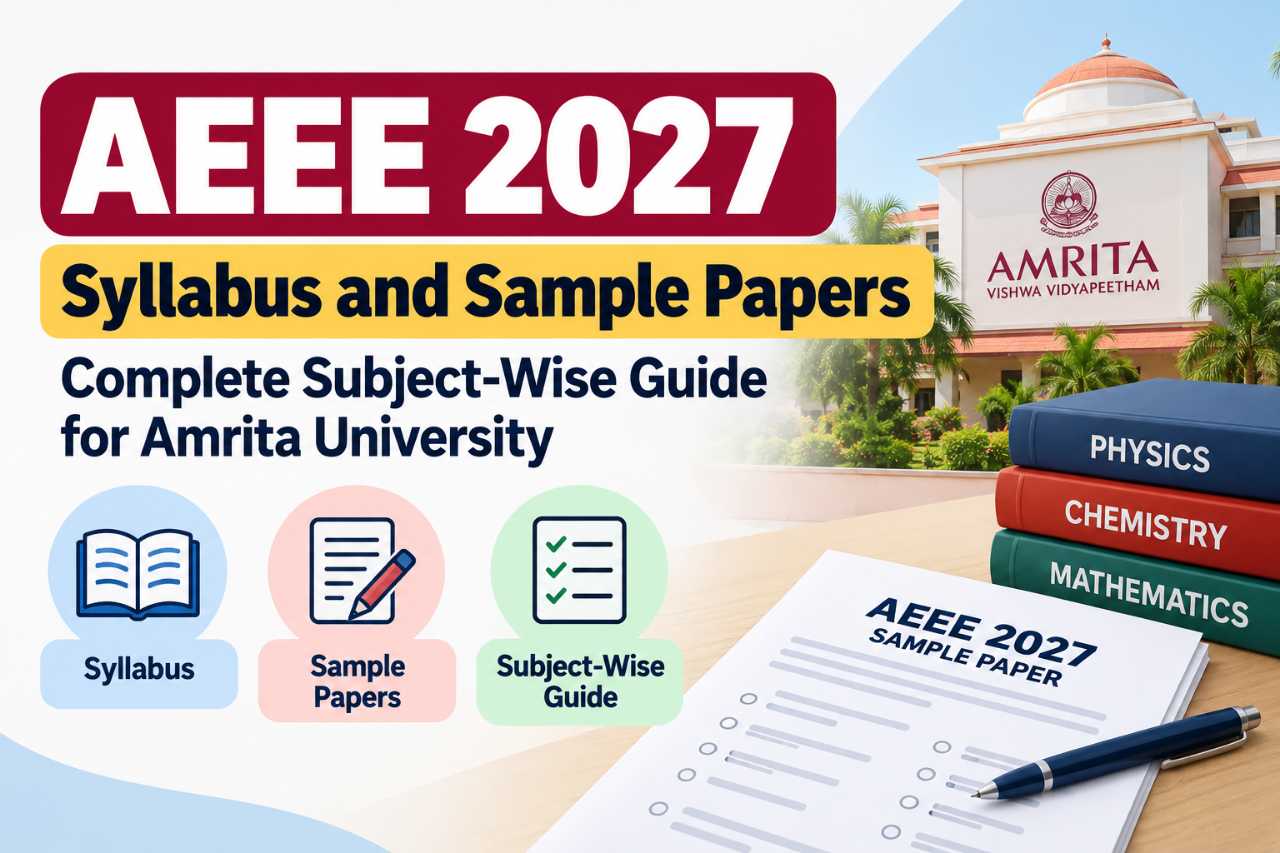
If you are targeting B.Tech admission at Amrita Vishwa Vidyapeetham, the Amrita Engineering Entrance Examination (AEEE) is the gateway most aspirants focus on. For AEEE 2027, Amrita University is expected to release the official syllabus and sample paper links around November 2026 on the portal aeee.amrita.edu. Until then, planning around the established five-subject structure Physics, Chemistry, Mathematics, English, and Quantitative Aptitude keeps your preparation aligned with how the exam is actually designed.
This CollegeDwar guide explains the AEEE 2027 syllabus subject by subject, how sample papers fit into your study plan, and the exam pattern (including negative marking). Whether you are in Class 12 or a drop-year student comparing options alongside exams like VITEEE or state CETs, a clear syllabus map helps you study high-yield chapters first and avoid last-minute surprises.
We also cover English and Quantitative Aptitude preparation, a month-wise roadmap, Phase 1 versus Phase 2 strategy, and FAQs aligned with what students ask voice assistants and search engines before registration opens.
What Is AEEE and Who Should Take It?
AEEE is the university-level entrance test for undergraduate engineering programmes at Amrita campuses, including Coimbatore, Amritapuri, Bengaluru, Chennai, and other centres. Roughly 50,000 candidates appear each year, which makes rank and branch choice competitive especially for Computer Science and core branches at the Coimbatore campus.
The exam is conducted in two phases, giving you a second chance to improve your score if Phase 1 does not go as planned. Questions are drawn from the Class 11 and 12 science stream curriculum for the core sciences, with additional sections testing language and basic numerical aptitude. Amrita does not publish a separate “minimum percentile” for the exam itself; admission is driven by your AEEE performance and counselling, though board marks in PCM still matter for eligibility.
AEEE 2027 Syllabus Overview
The AEEE syllabus 2027 will mirror prior years: five sections, 100 multiple-choice questions, and a total of 300 marks. Physics, Chemistry, and Mathematics carry the bulk of the weight. English and Quantitative Aptitude are shorter but can decide ranks when PCM scores cluster together.
Once the PDF is live, download it from the official site and tick off topics against your NCERT and reference books. Treat the syllabus as a contract anything not listed is lower priority unless it supports a listed concept (for example, basic algebra for physics problems).
How the Five Subjects Map to Questions
- Physics: 25 questions
- Chemistry: 20 questions
- Mathematics: 40 questions (highest section weight)
- English: 5 questions
- Quantitative Aptitude: 10 questions
Mathematics alone is 40% of the question count, so engineering aspirants who neglect Calculus or Coordinate Geometry often lose rank despite strong Physics. Balance your weekly timetable accordingly.
AEEE 2027 Physics Syllabus (Subject-Wise Topics)
Physics in AEEE blends conceptual understanding with standard JEE Main–level numericals. Focus on units, mechanics, and electromagnetism they recur frequently across years.
- Units and dimensions
- Kinematics
- Mechanics
- Solids and fluids
- Oscillations and waves
- Heat and thermodynamics
- Kinetic theory of gases
- Electrostatics, current electricity, and magnetostatics
- Electromagnetic induction and electromagnetic waves
- Ray and wave optics
- Modern physics
Actionable tip: Maintain a formula sheet with dimensional checks. AEEE penalises wrong answers, so blind substitution without unit sense costs marks. Pair each chapter with 15–20 timed MCQs after theory revision.
AEEE 2027 Chemistry Syllabus (Subject-Wise Topics)
Chemistry spans physical, inorganic, and organic blocks. Organic functional groups and physical chemistry calculations often appear as quick-scoring items if your fundamentals are clear.
- Basic chemical calculations
- Atomic structure and periodicity
- Chemical bonding
- Solutions and colligative properties
- Gaseous state and surface chemistry
- Solid state
- Thermodynamics
- Electrochemistry
- Chemical kinetics
- P-block elements
- D- and f-block elements
- Coordination compounds
- Basic organic chemistry and hydrocarbons
- Organic functional groups (hydroxyl, carbonyl, ethers)
- Organic halogen compounds
- Biomolecules and environmental chemistry
Actionable tip: For organic reactions, use reaction maps rather than rote lists. Connect biomolecules and environmental chemistry to NCERT end-of-chapter exercises they are easy marks if revised once a week.
AEEE 2027 Mathematics Syllabus (Subject-Wise Topics)
With 40 questions, Mathematics is the rank-maker. The syllabus aligns closely with standard PCM board plus entrance prep topics.
- Sets, relations, and functions
- Complex numbers
- Permutations and combinations
- Binomial theorem
- Sequences and series
- Trigonometry
- Quadratic equations
- Matrices and determinants
- Limit, continuity, and differentiability
- Differential calculus
- Integral calculus
- Differential equations
- Probability
- Coordinate geometry (straight line, pair of straight lines, circles, family of circles, conic sections)
- Vector algebra
- Three-dimensional geometry
Actionable tip: Allocate at least 45% of your daily AEEE study time to Mathematics until mock scores stabilise. Integrate previous-year-style problems from conic sections and 3D geometry they are time-consuming under exam pressure.
English and Quantitative Aptitude in AEEE 2027
Although the official subject-wise PDF emphasises PCM, the exam also includes English (5 questions) and Quantitative Aptitude (10 questions). These sections reward consistent practice more than deep theory.
English (typical focus areas)
- Reading comprehension and inference
- Grammar, sentence correction, and vocabulary in context
- Synonyms, antonyms, and idiomatic usage at moderate difficulty
Quantitative Aptitude (typical focus areas)
- Number systems, percentages, ratio and proportion
- Time, speed, distance; time and work
- Simple and compound interest, profit and loss
- Basic data interpretation and logical arithmetic
Do not skip these because the question count is small: with negative marking, guessing in English or QA hurts as much as in Physics. Ten minutes of daily aptitude drills for eight weeks adds measurable rank safety.
AEEE 2027 Exam Pattern at a Glance
Understanding the pattern helps you use syllabus knowledge and sample papers effectively. The following reflects the structure Amrita has used in recent cycles; confirm any updates when the 2027 brochure is released.
- Mode: Computer-based test (online)
- Medium: English
- Duration: 2 hours 30 minutes (150 minutes)
- Question type: Multiple choice (four options each)
- Total questions: 100
- Marks per correct answer: +3
- Negative marking: −1 per incorrect answer
- Maximum marks: 300
Strategic takeaway: accuracy beats attempt volume. Attempting all 100 questions with low accuracy can pull your score below a candidate who attempts 85 questions with strong precision.
AEEE 2027 Sample Papers: Why They Matter
AEEE sample papers 2027 (and official model papers) are built to reflect the live exam’s pattern and syllabus coverage. They are not a substitute for concept study, but they close the gap between “knowing topics” and “performing under time limits.”
- Exam familiarity: You learn navigation, section sequencing, and stamina for 150 minutes on screen.
- Strength–weakness audit: Error logs from sample papers show whether gaps are in Mechanics, Organic Chemistry, or Calculus.
- Time management: Simulating real conditions trains you to leave lengthy 3D geometry problems for a second pass.
- Confidence: Scoring trends on multiple mocks reduce anxiety in Phase 1 and Phase 2.
When Amrita releases sample papers with solutions, solve them without looking at answers first, then review every wrong attempt with syllabus tags (e.g., “Electrochemistry – Nernst equation”). Repeat papers after 3–4 weeks to check retention.
How to Align Board Exams and AEEE Preparation
Because the AEEE syllabus is rooted in Class 11 and 12 science, your board preparation and entrance prep can overlap if you plan deliberately.
- Finish NCERT Physics, Chemistry, and Mathematics once for boards, marking overlapping AEEE chapters.
- Shift to MCQ-dominant practice at least four months before Phase 1.
- Keep one day per week for English and Quantitative Aptitude only.
- Use Phase 1 as a diagnostic if you sit both phases; refine weak units before Phase 2 registration deadlines.
Students eyeing multiple entrances often compare private university tests with state exams. Exploring other technology-focused institutions such as JSS Science And Technology University, Kerala University Of Digital Sciences Innovation And Technology, or JC Bose University Of Science And Technology YMCA Faridabad helps you build a balanced college list beyond Amrita alone.
Eligibility and Academic Benchmarks (AEEE 2027)
Before diving into sample papers, confirm you meet eligibility norms (always verify the latest notification):
- Nationality: Indian citizens (as per standard AEEE criteria).
- Age: Candidates are typically required to be born on or after 1 July 2006 for the 2027 cycle (check the official brochure for any revision).
- Qualifying exam: Passed or appearing in Class 12 or equivalent with Physics, Chemistry, and Mathematics.
- Academic performance: Recent guidance often cites at least 60% aggregate in PCM in Class 12 and minimum subject-wise performance expectations for counselling; read the 2027 information bulletin for exact wording.
There is no universally advertised “minimum percentile” cut-off for sitting AEEE itself, but your rank determines campus and branch. Strong board marks plus a solid AEEE score remain the practical combination for preferred branches.
Difficulty Level and Rank Strategy
AEEE is widely described as moderate to challenging, with emphasis on PCM accuracy rather than exotic out-of-syllabus tricks. Ranks in the low hundreds open premium branches at major campuses; mid-tier ranks may still yield programmes at Amritapuri, Bengaluru, Chennai, or newer centres depending on counselling slabs and quotas.
If you are comparing engineering pathways across regions, institutions like Centurion University Of Technology And Management, MIT Art Design And Technology University Pune, and Odisha University Of Technology And Research illustrate how diverse admission routes coexist with national private exams such as AEEE.
Amrita Campuses Accepting AEEE Scores
AEEE scores feed admission across Amrita School of Engineering and related campuses, including:
- Amrita School of Engineering, Coimbatore
- Amrita School of Engineering, Amritapuri
- Amrita School of Engineering, Bengaluru
- Amrita Vishwa Vidyapeetham campuses at Chennai and other locations as listed in the current brochure
Campus choice affects branch availability, fees, and placement ecosystems. Use official counselling data and rank trends rather than rumours when deciding between a branch at one campus versus another.
Common Preparation Mistakes to Avoid
- Ignoring Mathematics weight: Under-practising Calculus and Coordinate Geometry despite 40 questions.
- Skipping mock analysis: Solving sample papers without error logs repeats the same mistakes.
- Random guessing: −1 marking makes speculative attempts expensive.
- Late English/QA prep: Five and ten questions still influence total score and tie-break scenarios.
- Outdated materials: Always cross-check chapter lists when the 2027 syllabus PDF drops.
AEEE 2027 Syllabus PDF: When and How to Use It
Amrita typically uploads the AEEE syllabus PDF download link alongside registration details. Save a copy on your phone and laptop, then split it into three colour-coded tracks: green for chapters you have mastered, amber for in-progress topics, and red for untouched units. Update colours after every sample paper so your revision stays honest.
Cross-link each red topic to at least one resource: NCERT for theory, a standard MCQ bank for practice, and one video explanation if you are stuck for more than two days. This prevents syllabus overwhelm especially in Mathematics, where the chapter list is long but many topics share methods (for example, Coordinate Geometry and Vector Algebra).
Sample Paper vs Previous Year Paper: What Is the Difference?
Official sample papers are model tests Amrita releases to show format and difficulty intent. Previous year question papers (when officially shared or reliably reconstructed) show what actually appeared in past phases. Use sample papers to learn pacing; use previous papers to spot recurring concept patterns in Physics and Chemistry. Never treat either as a guarantee of 2027 questions, but together they train exam temperament better than chapter tests alone.
After each paper, calculate three metrics: accuracy (correct ÷ attempted), speed (minutes per question), and net score (3 × correct − 1 × wrong). Track these on a simple spreadsheet. Rising accuracy with stable speed is the sign your syllabus coverage is working.
Month-Wise Preparation Roadmap (Suggested)
Timelines vary by starting level, but this framework helps Class 12 students balance boards and AEEE:
- June–August: Complete syllabus once for PCM using NCERT; note AEEE chapter overlap.
- September–November: Shift to MCQs; start English and QA drills; download the official 2027 syllabus when released.
- December–January: One full sample paper every 10–14 days; deep revision on red-list topics.
- February–March (Phase 1 window): Alternate-day mocks; light board overlap only where needed.
- Before Phase 2: Targeted fixes from Phase 1 analysis; avoid learning brand-new chapters unless critical.
If you are a drop-year candidate, front-load Mathematics and mock tests you already know board theory, so sample papers should dominate the last eight weeks.
Phase 1 and Phase 2: How to Plan Both Attempts
Because AEEE runs in two phases, treat Phase 1 as a scored rehearsal unless you are already hitting target net scores in mocks. Register for Phase 2 if your Phase 1 result leaves room for improvement in Mathematics or Chemistry sections where focused drills often yield quick gains.
Avoid radically changing your question attempt order between phases unless mocks prove a better sequence. Consistency reduces silly errors under stress. Also confirm registration deadlines for Phase 2 on the official portal; missing dates closes the improvement window entirely.
Quick Reference: AEEE Exam Pattern Summary
Use this snapshot while revising syllabus chapters or checking sample paper solutions:
- Online CBT, English medium, 150 minutes total duration
- 100 MCQs carrying 300 maximum marks with +3/−1 scoring
- Section question counts: Physics 25, Chemistry 20, Mathematics 40, English 5, Quantitative Aptitude 10
- Syllabus base: Class 11 and 12 for PCM; aptitude and language sections need separate daily practice
Study Resources That Match the AEEE Syllabus
You do not need dozens of books. A focused stack works better:
- NCERT Class 11 and 12 for Physics, Chemistry, and Mathematics fundamentals.
- One MCQ practice book or platform aligned with JEE Main–level PCM (not exclusively Advanced-only topics).
- Official Amrita sample papers once published, plus timed sectional tests for English and QA.
- Formula and reaction sheets you build yourself not photocopied summaries so recall improves.
Engineering aspirants comparing campuses often research faculty, labs, and placements at multiple universities. Alongside Amrita, reading about Mody University Of Science And Technology or Shoolini University Of Bio Technology And Management Sciences can clarify backup options if rank outcomes differ from expectations.
Counselling, Rank, and Branch Choice: Syllabus Links to Outcomes
Strong syllabus coverage alone does not pick your campus rank and counselling rules do. High-demand branches such as Computer Science at Coimbatore require competitive AEEE ranks. Chemical, Civil, or newer-campus programmes may be accessible at higher rank bands or in later counselling rounds depending on year and quota.
Use your sample paper net score trend to set realistic branch targets before counselling stress begins. Discuss campus preferences with family using official placement reports rather than anecdotal comparisons alone. Your AEEE preparation quality shows up most clearly in Mathematics and Physics accuracy exactly the sections that separate close ranks.
Conclusion
The AEEE 2027 syllabus and sample papers are your official compass for Amrita B.Tech admissions. Master the Class 11–12 PCM topics listed under Physics, Chemistry, and Mathematics, add steady English and Quantitative Aptitude practice, and rehearse with model papers under the 150-minute CBT format. Watch aeee.amrita.edu from November 2026 onward for PDF updates, and pair syllabus ticks with timed mocks to convert knowledge into rank. For broader college planning, explore profiles such as Gandhi Institute Of Engineering And Technology University Odisha (GIET) and Bharatiya Engineering Science And Technology Innovation University alongside your Amrita target so you enter counselling with strong alternatives.