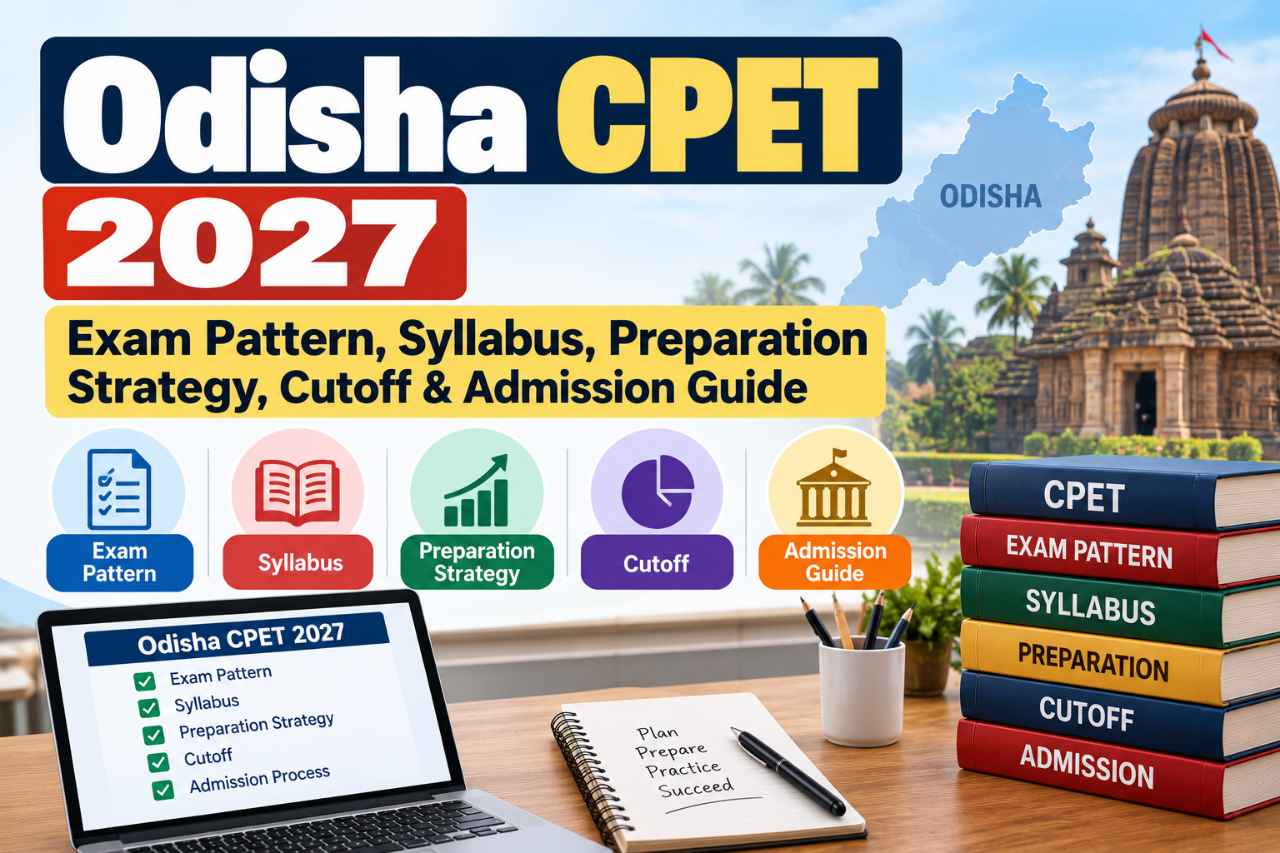

If you have finished your undergraduate degree in Odisha or you plan to pursue a master's at a state public university here the Odisha Common PG Entrance Test (CPET) 2027 is likely on your radar. Conducted under the Students Academic Management System (SAMS), CPET is the gateway to a wide range of PG courses across science, arts, commerce, and professional streams at participating higher education institutions.
Unlike a single-university entrance, CPET centralises admission so you fill one application, appear for one subject-specific test, and then participate in choice filling and seat allotment based on merit. For CPET 2027, applications are expected from the last week of February 2027, with the exam tentatively in the first week of May 2027. Hall tickets usually follow in the last week of April. Always confirm dates on the official portal at samsodisha.gov.in.
This article explains what CPET is, who can apply, how the paper is structured, how to prepare subject-wise, how merit and cutoffs work, and what to do after results written in plain language for students and parents planning ahead for 2027.
What Is Odisha CPET and Who Conducts It?
CPET (Common PG Entrance Test), also referred to as SAMS Odisha PG, is a state-level entrance examination for postgraduate admissions. The Odisha State Higher Education Council (OSHEC) oversees the process, while SAMS handles online application, merit lists, and seat allotment.
The exam's purpose is straightforward: it offers a fair, uniform screening mechanism for PG seats at state public universities and affiliated colleges. Reports suggest roughly 121 institutes participate in the CPET admission cycle, though the exact list may be updated each year on the official website.
Admissions are largely online registration, choice filling, fee payment, and checking allotment while the entrance test itself is conducted in offline (pen-and-paper) mode. After allotment, you report physically to the allotted college for document verification and admission fee payment.
CPET 2027 at a Glance
- Exam name: Common PG Entrance Test (CPET)
- Level: State-level PG entrance
- Frequency: Once a year
- Language: English
- Mode of exam: Offline
- Duration: 90 minutes
- Total questions: 70 MCQs
- Marking: +1 for correct answer; no negative marking
- Application mode: Online via SAMS
- General application fee: Rs 500 (concessions for reserved categories)
Institutions such as Odisha University of Technology and Research, CV Raman Global University Odisha, and GIET University, Gunupur are among the names students often target; always verify whether your chosen PG programme falls under CPET for the admission year you apply.
CPET 2027 Important Dates (Tentative)
Official notifications can shift by a few days, but historical cycles help you plan. Use this timeline as a planning reference and cross-check when the Higher Education Department, Odisha publishes the CPET 2027 brochure.
| Event | Expected window (2027) |
|---|---|
| Online application (CAF) opens | Last week of February 2027 |
| Last date to apply / correction window | Last week of March 2027 |
| CPET admit card | Last week of April 2027 |
| CPET exam date | First week of May 2027 |
| Provisional answer key | Third week of May 2027 |
| Subject-wise / state merit list | First week of July 2027 |
| Final merit list | Last week of July 2027 |
| First round seat allotment | Second week of August 2027 |
| Second / final allotment & spot/waitlist phases | August–September 2027 |
Action tip: Mark February and April on your calendar one for completing the form without rush, one for downloading the hall ticket and revising lightly rather than cramming new topics.
CPET Eligibility Criteria 2027
Eligibility is programme-specific. You must hold a relevant undergraduate degree with the minimum percentage prescribed for that PG course, and you must appear for the CPET paper mapped to your subject.
General Rules Most Aspirants Should Know
- You typically need a UG degree in a related discipline (for example, Economics UG for MA Economics CPET).
- Many programmes require at least 45% aggregate in the qualifying degree; some professional or competitive courses may specify higher cutoffs at the university level after CPET.
- Reservation and relaxation norms follow Odisha state policy; read the official eligibility annex for your category.
- Final-year UG students may be allowed to apply in some cycles if they can produce marksheets by document verification confirm in the 2027 notification.
Examples of Programme–Subject Mapping
The official brochure lists dozens of combinations. Below are illustrative examples (always verify against the latest PDF):
- MA Anthropology & Tribal Studies: UG in Science or Arts; CPET papers in Anthropology (Science/Arts variants as notified).
- MSc Applied Chemistry: UG with Chemistry; minimum marks as per table (often 45%).
- MA Applied Psychology: UG from Arts, Commerce, or Science streams as specified.
- MSc Biochemistry: Often linked to Biotechnology or related UG backgrounds per the eligibility matrix.
If your goal is a health-allied or specialised PG track, also explore institutional pages such as Odisha University of Health Sciences to see which entrances apply some health programmes may use separate tests in addition to or instead of CPET depending on the year.
CPET Application Form 2027: Documents and Fees
The Common Application Form (CAF) on SAMS is mandatory. Incomplete or incorrect forms are a common reason for rejection at verification, so treat the application as seriously as the exam itself.
Application Fee Structure
- General category: Rs 500
- SC/ST: Rs 300
- PwD and Transgender candidates: Nil fee (as per recent cycles)
Payment is online debit/credit card, net banking, or UPI (including BHIM UPI).
Documents and Specifications
- Valid email ID and mobile number (OTP-based registration)
- Class 12 marksheet
- UG marksheets / provisional certificate
- Aadhaar number
- Scanned photograph and signature in JPEG/JPG format
- Thumb impression scan where required
After submission, save multiple copies of the confirmation page. You will need login credentials later for admit card, merit list, and seat allotment on portals such as pg.samsodisha.gov.in.
CPET 2027 Exam Pattern Explained
Understanding the pattern helps you allocate time in the 90-minute window and choose what to revise first.
Structure of the Question Paper
- Total questions: 70 multiple-choice questions (MCQs)
- Breakdown: Approximately 40 questions from the core subject and 30 from the elective paper of the same subject (as per official pattern)
- Marks: One mark per question; maximum raw score 70
- Negative marking: None an important strategic point (see preparation section)
- Mode: Offline OMR or similar sheet (carry allowed stationery as per instructions on admit card)
What the Pattern Means for Your Preparation
Because there is no penalty for wrong answers, you should attempt all questions, but blind guessing without elimination wastes mental energy. A better approach: solve confidently first, mark uncertain ones, then use elimination on the rest.
The split between core and elective reflects your UG curriculum. If your elective paper was weaker, dedicate extra weeks to that portion it carries substantial weight (30 of 70 questions).
CPET Syllabus and Subject-Wise Preparation Strategy
Odisha CPET does not always publish one single slim syllabus booklet for every subject; instead, syllabi are often aligned with UG honours/core and elective curricula under Odisha universities. Treat your degree course outlines as the primary syllabus source, supplemented by previous years' papers.
Step 1: Build a Master Topic List
Collect:
- Your university's UG syllabus for core + elective papers in the subject.
- Any subject-specific CPET syllabus PDF released on SAMS.
- Two to three previous years' question papers (if available officially or through coaching libraries).
Merge these into one checklist and mark topics as High / Medium / Low priority based on frequency in past papers.
Step 2: Science vs Arts vs Commerce Focus
Science programmes (MSc Chemistry, Geology, Microbiology, etc.): Revise numerical problems, diagrams, and standard definitions. Practice short conceptual MCQs many questions test whether you recognise exceptions (for example, periodic trends, reaction mechanisms, or geological classifications).
Arts and social science programmes (History, Economics, Psychology): Use timelines, thinkers' names, theories, and map-based facts for History; graphs and basic econometrics intuition for Economics; schools of psychology and research basics for Psychology.
Commerce and interdisciplinary courses: Balance theory with application-style MCQs case-based questions on policy or data interpretation appear in some subjects.
Step 3: Monthly Study Plan Template (6 Months)
Adjust duration if you start earlier or later:
- Months 6–5 before exam: Complete first reading of all core topics; make one-page notes per unit.
- Months 4–3: Elective-focused revision; weekly mixed MCQ tests (70 questions, 90 minutes).
- Months 2–1: Previous papers under timed conditions; error notebook for repeated mistakes.
- Last 2 weeks: Light revision only; sleep regular hours; mock OMR filling practice.
Step 4: Resources That Actually Help
- Standard UG textbooks prescribed by your university
- Subject gateways: university department websites for sample questions
- Peer study groups for oral quizzing (excellent for arts subjects)
- Online MCQ banks verify answers against textbooks, not random forums
Students balancing open-distance UG degrees should plan early; if you studied through Odisha State Open University, align elective topics with the CPET subject code you select during application.
Sample Papers and Previous-Year Practice
Official or coaching-provided CPET sample papers help you see how questions are framed not always as long theory answers, but as precise MCQs testing definitions, dates, formulas, and application. After each mock, classify errors into concept gap, silly mistake, or time pressure. Concept gaps go back to textbook reading; silly mistakes mean you need slower reading of question stems; time pressure means more full-length drills. Aim for at least eight to ten full papers in the final two months if your subject is competitive.
CPET 2027 Preparation Tips That Improve Scores
- Respect the exam pattern: Practise 70 questions in 90 minutes until your pacing is automatic roughly 75 seconds per question with buffer for review.
- Use no-negative-marking wisely: Attempt every question, but learn quick elimination tricks to raise accuracy on guesses.
- Revise in cycles: Short, spaced revision beats one long read before the exam.
- Track weak electives: Many rank drops come from neglecting the 30 elective-based questions.
- Stay official: Application and admit card only through SAMS domains; avoid third-party “guaranteed rank” claims.
- Health and routine: Regular sleep especially in May when the exam is held in often-warm weather hydration and travel planning to the centre matter.
If you are also exploring national entrances (for comparison or backup), note that design or law paths use different tests for example, law schools may require CLAT or state law entrances rather than CPET; institutions like National University of Study and Research in Law, Ranchi illustrate that PG law admissions are a separate track from Odisha CPET arts/science PG listings.
Admit Card, Answer Key, and Result
CPET Admit Card 2027
Registered candidates download the hall ticket from the SAMS admission portal using login ID and password. The admit card shows your name, programme, exam date, time, and centre address. Carry a printed copy and valid photo ID. Without the hall ticket, you are typically not allowed to sit for the test.
Answer Key and Objections
A provisional answer key is usually released in the third week of May, with a short window to submit objections through the prescribed channel. Read objection rules carefully only supported challenges with references are considered.
Result and Merit Lists
Results and subject-wise merit lists follow in July. You will check scores using hall ticket or login details. A final merit list after resolving objections determines counselling rank.
How CPET Merit Rank Is Calculated
Your admission rank is not based on the entrance alone. Odisha CPET uses a weighted combination of career marks and entrance score:
- Career marks (30% weight): Class 10 (5 marks component scale), Class 12 (10 marks component scale), UG degree marks (15 marks component scale) total career component normalised to 30% of the formula.
- CPET marks (70% weight): Your performance in the 70-mark entrance test contributes 70% of the composite.
Final composite = Career (30%) + CPET (70%)
This means a strong UG percentage can cushion a moderate CPET score, but high CPET marks remain the dominant lever because of the 70% weight. If your UG marks are modest, aim for the upper band of CPET scores (see below).
CPET Cutoff 2027: What to Expect
Cutoffs are the minimum composite or entrance thresholds needed for a particular course + college combination in a given year. SAMS publishes cutoffs and allotment details on official portals; individual universities may also display spot-round merit PDFs.
Factors That Move Cutoffs Up or Down
- Number of applicants for that subject
- Difficulty level of the CPET paper
- Seats available in each HEI
- Reservation category-wise seat distribution
- Popularity of campus location and department reputation
Illustrative “Good Score” Bands on the 70-Mark CPET Paper
These bands are indicative, not guarantees always compare with the latest merit list for your subject:
| Performance band | Approximate CPET raw score (out of 70) |
|---|---|
| Exceptional | 60–70 |
| Good | 45–59 |
| Average | 30–44 |
| Below average | Below 30 |
For competitive subjects like History at major universities, past indicative cutoffs have sometimes clustered in the low 50s on the entrance component at well-known universities names and numbers change every year, so use them only as motivation benchmarks, not promises.
Large applicant volumes (recent cycles saw tens of thousands of test-takers statewide) mean small score gains can move your rank significantly especially in subjects with fewer seats.
Seat Allotment, Freeze, Float, and Slide-Up
After merit publication, eligible candidates participate in online choice filling for colleges and courses, then seat allotment rounds.
Understanding Options After Allotment
- Freeze: Accept the allotted seat and stop further rounds you are confirming admission there.
- Float: Accept the seat for now but stay eligible for a better preference in a later round if seats open.
- Slide-up: Used when you want an upgrade within preferences while managing existing allotment rules read the SAMS user manual each year for exact definitions.
Pay admission fees within deadlines through the SAMS student portal. Then report to the allotted institution with original documents for verification.
Spot Admission and Waitlist
After main rounds, vacant seats may lead to spot or waitlist-based admission. Non-admitted but CPET-qualified candidates should monitor notices on university websites and SAMS. Physical reporting may be required for waitlist candidates when seats open.
Who Should Consider CPET 2027?
CPET suits students who want a cost-effective, state-supported PG education in Odisha across traditional and applied disciplines. It is less relevant if your target is a national PG entrance outside the SAMS list (for example, certain national design tests such as the NIFT entrance exam for fashion and design programmes).
Before you apply, list your top five college–course pairs, check last year's merit trends if available, and match them with realistic CPET score targets given your career marks weight.
Conclusion
Odisha CPET 2027 is the main route to postgraduate seats at participating public universities and colleges under SAMS. Success combines disciplined subject revision aligned with core and elective UG syllabi, timed MCQ practice for a 70-question, 90-minute offline paper, and smart application and choice filling. Remember that 70% of your merit depends on CPET, so the entrance remains your biggest score lever even though Class 10, Class 12, and UG marks matter.
Start early: register when the CAF opens in late February 2027, download your admit card on time, attempt all questions using the no-negative-marking rule wisely, and follow official merit and allotment timelines through July and August. For the latest notification, cutoffs, and participating institutes, rely on samsodisha.gov.in and the PG SAMS portal and use college profiles on CollegeDwar to compare campuses before you lock your choices.