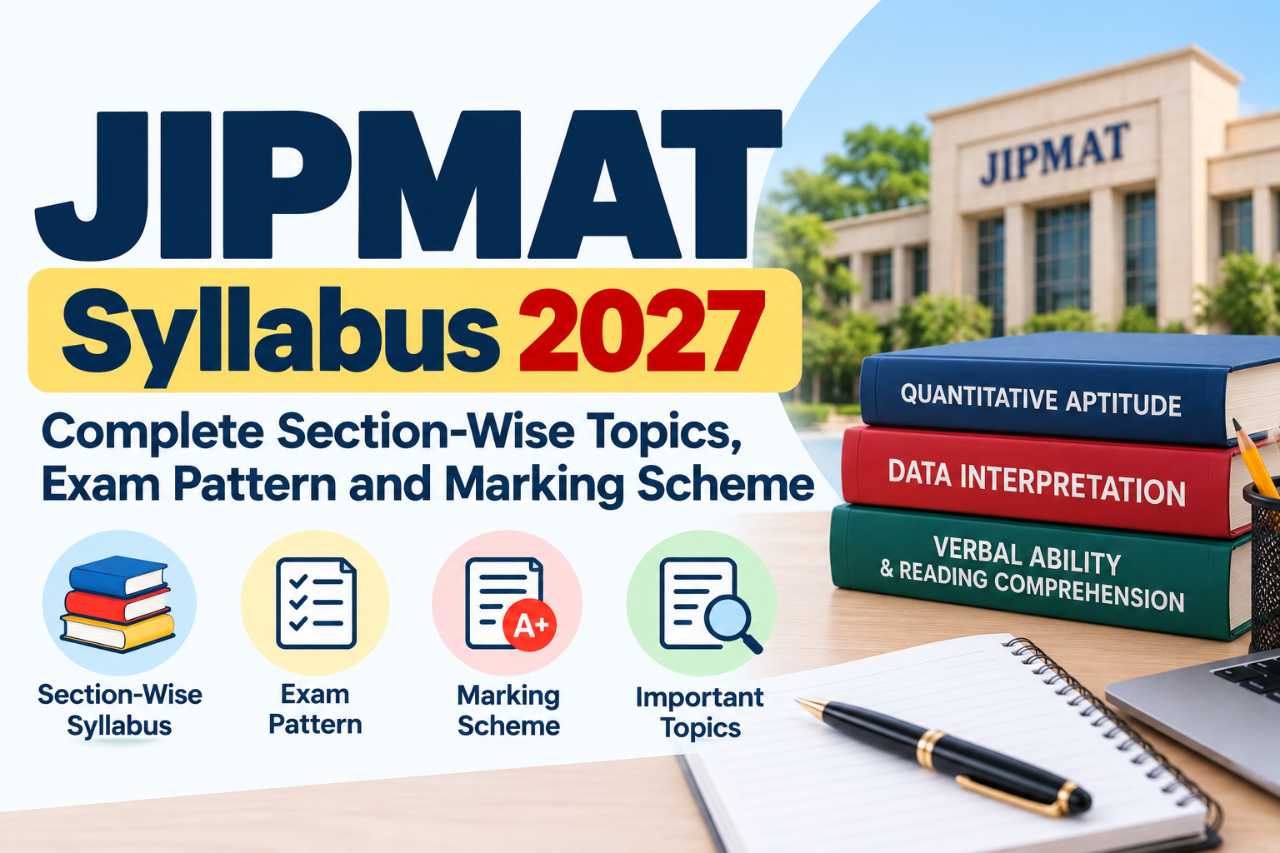

If you have finished Class 12 and want a management degree from an Indian institute of Management without waiting for graduation, the Joint Integrated Programme in Management Admission Test (JIPMAT) is one of the most focused routes available today. Conducted by the national Testing Agency (NTA), JIPMAT shortlists candidates for the five-year Integrated Programme in Management (IPM) at IIM Jammu and IIM Bodh Gaya. Unlike generic aptitude tests, JIPMAT is built specifically for young learners who are comfortable with school-level maths, logical puzzles, and English comprehension.
Understanding the JIPMAT syllabus 2027 early helps you avoid random coaching modules and study only what the paper actually measures. The exam has three sections Quantitative Aptitude, Data Interpretation & Logical Reasoning, and Verbal Ability & Reading Comprehension delivered as 100 multiple-choice questions in English on a computer. Based on recent exam cycles, the JIPMAT 2027 notification is expected around the third week of April 2027, with the test likely in the second week of June 2027 for the 2027–32 IPM batch. Timelines can shift, so always cross-check the official NTA bulletin once it is published.
This CollegeDwar guide explains the section-wise syllabus, expected exam pattern, marking scheme, preparation priorities, and mistakes to avoid written for students, parents, and school counsellors who need clear, actionable information aligned with Google’s helpful content and E-E-A-T expectations: accurate facts, transparent sourcing, and practical study advice rather than hype.
What Is JIPMAT and Who Should Appear?
JIPMAT is a national-level entrance exam for integrated management admission. Successful candidates enter a structured five-year programme that blends undergraduate foundations with management coursework, internships, and campus activities at participating IIMs. The test does not replace Class 12 board exams; boards remain important for eligibility and overall academic profile.
JIPMAT suits students who:
- Enjoy problem-solving in maths and logic and read English regularly (newspapers, novels, or quality non-fiction).
- Want an early start in business, analytics, finance, or entrepreneurship through an IIM-branded IPM.
- Can commit to a disciplined preparation plan alongside board or post-board schedules.
Many students simultaneously explore other national entrances after Class 12 for example, design aspirants look at the NIFT Entrance Exam, while management enthusiasts may also prepare for tests like MAT later in their academic journey. JIPMAT is unique because it targets integrated admission right after school, not a standalone two-year MBA.
JIPMAT Syllabus 2027: Overview at a Glance
NTA publishes the broad syllabus through the official information bulletin. No secret “extra syllabus” exists beyond the competencies described below. Treat every topic as school-level or slightly above, with emphasis on speed and accuracy under time pressure.
| Particular | Details |
|---|---|
| Exam name | JIPMAT (Joint Integrated Programme in Management Admission Test) |
| Conducting body | National Testing Agency (NTA) |
| Programmes | Five-year IPM at IIM Jammu and IIM Bodh Gaya |
| Mode | Computer-Based Test (CBT) |
| Medium | English |
| Total questions | 100 MCQs |
| Total marks | 400 |
| Duration | 150 minutes (2 hours 30 minutes) |
| Expected timing | Afternoon slot (historically around 3:00 PM–5:30 PM; confirm in admit card) |
| Marking | +4 correct, −1 incorrect, 0 for unattempted |
JIPMAT Exam Pattern 2027: Section-Wise Breakup
Before memorising formulas, internalise how marks are distributed. Equal weight across sections means neglecting English or logic can hurt your total even if maths is strong.
| Section | Questions | Marks per question | Section marks |
|---|---|---|---|
| Quantitative Aptitude (QA) | 33 | 4 | 132 |
| Data Interpretation & Logical Reasoning (DILR) | 33 | 4 | 132 |
| Verbal Ability & Reading Comprehension (VARC) | 34 | 4 | 136 |
| Total | 100 | 400 |
Marking scheme and attempt strategy
JIPMAT uses standard MCQ scoring with negative marking:
- Correct answer: +4 marks
- Wrong answer: −1 mark
- Unattempted: no penalty
Actionable tip: aim for calculated attempts. If you can eliminate two options in DILR or VARC, the expected value of guessing often beats leaving the question blank. If you are clueless, skip four careless negatives can wipe out one correct QA question.
Time benchmark: 150 minutes for 100 questions is roughly 1.5 minutes per question on average, but VARC passages and DILR sets consume blocks of 8–12 minutes. Practice sectional time caps: QA 45–50 minutes, DILR 45–50 minutes, VARC 50–55 minutes, plus a 5-minute buffer for review.
Section 1: JIPMAT Syllabus for Quantitative Aptitude (QA)
The QA section tests mathematics typically covered up to Class 10. Questions are computationally light but conceptually tricky; they reward clarity on fundamentals rather than advanced calculus or higher secondary-only tricks.
Core QA topics to master
- Numbers: divisibility, remainders, unit digits, LCM-HCF applications
- Arithmetic: percentages, profit and loss, simple and compound interest, averages, mixtures and alligations
- Algebra: linear equations, quadratic basics, identities where applicable
- Geometry: triangles, circles, mensuration, coordinate basics if referenced
- Modern applications: time and work, time, speed and distance, pipes and cisterns style problems
- Roots and powers: square roots, cube roots, simplification
- Data interpretation (within QA): small tables or charts embedded in quant contexts
How to prepare QA for JIPMAT
- Revise NCERT Class 8–10 concepts before touching mock papers.
- Maintain a formula notebook with when to use notes, not just lists.
- Solve 15–20 timed QA questions daily; analyse errors by topic tag.
- Once accuracy crosses 80% in practice, increase speed with mixed drills.
Example focus area: percentage change chained with profit and loss appears often. Practice converting multi-step word problems into one-line equations.
Section 2: JIPMAT Syllabus for Data Interpretation and Logical Reasoning (DILR)
DILR blends logical reasoning puzzles with data interpretation from charts and tables. This section rewards systematic notation students who scribble clear grids usually outperform those who try to solve entirely in their heads.
Logical reasoning topics
- Seating arrangements (linear, circular, dual rows)
- Blood relations and family trees
- Direction sense and routes
- Coding-decoding and series
- Syllogisms, statements, assumptions, and propositions
- Binary logic and constraints-based puzzles
- Clocks and calendars
- Venn diagrams and set theory applications
Data interpretation topics
- Tables and caselets
- Bar graphs and line graphs
- Pie charts
- Data sufficiency (whether given data is enough to answer)
- Comparisons, ratios, and percentage growth read from visuals
Preparation tips for DILR
Pick one puzzle type each week and go deep. For seating arrangement, write symbols for fixed positions first, then fill flexible slots. For DI, read the question before the graph know whether you need absolute values or ratios. Avoid starting mock tests without revising basic arithmetic used in DI (percentages and averages).
Section 3: JIPMAT Syllabus for Verbal Ability and Reading Comprehension (VARC)
VARC carries 34 questions, slightly more than the other sections. It includes reading passages plus grammar and vocabulary items. Strong English improves both accuracy and speed; unlike QA, you cannot always “derive” an answer if vocabulary is weak.
VARC topic list
- Reading comprehension passages (fact, inference, tone, title)
- Para jumbles and logical flow of sentences
- Fill in the blanks with contextual vocabulary
- Sentence correction and error spotting
- Synonyms and antonyms
- Articles, prepositions, and proper word usage
- Grammar rules applied in exam-style sentences
Actionable VARC routine
Read one editorial daily and summarise it in five sentences. Weekly, attempt two RC passages under a 12-minute timer. Maintain a vocabulary journal with example sentences not isolated word lists. For grammar, revise subject-verb agreement, modifiers, and parallel structure; JIPMAT often tests subtle errors in otherwise fluent sentences.
JIPMAT Syllabus 2027 PDF: How to Use Official Documents
Students often search for a “JIPMAT syllabus 2027 PDF.” The authoritative version is the NTA JIPMAT information bulletin, released with the application window on the official NTA website. PDF downloads from third-party sites may be outdated or incomplete.
- Download the bulletin only from NTA’s official portal when the notification is live.
- Print the syllabus section and tick topics weekly as you complete them.
- Map each topic to 10–15 practice questions before marking it “done.”
CollegeDwar recommends pairing the bulletin with previous-year memory-based papers and official sample materials when NTA releases them.
Important Topics: High-Yield Checklist for JIPMAT 2027
While the syllabus is wide, certain clusters recur frequently across IPM-style exams:
- QA: percentage, ratio, averages, time-speed-distance, time and work, simple/compound interest, basic geometry
- DILR: seating arrangement, blood relations, coding-decoding, syllogism, tables and bar-line DI sets
- VARC: RC inference questions, para jumbles, error spotting, collocations in fill-in-the-blanks
Use this checklist during the last 30 days before the exam to prioritise revision over learning brand-new advanced topics.
JIPMAT vs Other Entrance Paths After Class 12
Career planning is broader than one exam. Some students weigh medicine, humanities, design, and management simultaneously. A student interested in clinical sciences might research institutions such as King George Medical University, while another may commit fully to IPM via JIPMAT. Others pursue postgraduate routes after a bachelor’s degree, exams like MAT open MBA doors, and arts graduates may explore a MA before specialising further.
JIPMAT’s advantage is early entry into an IIM ecosystem with a curriculum designed for integrated learners. Its challenge is narrow eligibility (specific IIMs) and a syllabus that demands balanced skills, not extreme depth in a single subject.
Month-Wise Preparation Plan (Template)
Adjust durations based on your starting month, but keep the sequence: fundamentals → sectional drills → full mocks → revision.
- Months 1–2: NCERT maths revision; daily RC; two DILR puzzle types per week
- Months 3–4: sectional tests; error log; vocabulary consolidation
- Months 5–6: full-length mocks twice weekly; analyse time traps; refine attempt policy with negative marking
- Final 3 weeks: syllabus checklist revision; light new topics; sleep and exam-day logistics
Common Mistakes JIPMAT Aspirants Should Avoid
- Starting mocks before concepts are in place mock scores demoralise without learning value.
- Ignoring VARC because “English feels easy” passage inference questions are often the deciders.
- Random guessing without elimination negative marking punishes pride-based attempts.
- Chasing coaching material for unrelated exams (CAT-level quant) instead of school-level mastery.
- Missing official updates on dates, city choices, and admit card instructions.
Exam Day and CBT Familiarity
JIPMAT is conducted in CBT mode in English. Practice reading questions on screen; use on-screen rough work discipline. Carry permitted ID and follow centre guidelines listed on the admit card. Reach early to reduce stress NTA centres may have verification queues.
Eligibility and Application: What Syllabus Prep Assumes
JIPMAT eligibility rules are defined in the official NTA notification each year. Typically, candidates who have passed or are appearing in Class 12 (or equivalent) from a recognised board may apply, subject to age and minimum marks criteria stated in the bulletin. The syllabus assumes fluency in English because the entire paper is English-medium; there is no regional-language question booklet.
When registration opens, keep scanned photographs, signatures, and board details ready. Choose exam cities carefully travel on exam day should be minimised. Pay the application fee within the deadline and save confirmation pages. Syllabus preparation is wasted effort if administrative steps are missed, so treat the notification PDF as a twin document alongside your study planner.
What Question Styles Look Like in Each Section
Knowing topic names is not enough; you should recognise how NTA frames skills into MCQs.
Quantitative Aptitude examples
A single QA item might combine ratio and percentage: “If the price of an article increases by 20% and then decreases by 10%, find the net percentage change.” Another may test time and work with alternate days of work. Geometry questions often involve area/perimeter of combined shapes rather than proof-based mathematics.
DILR examples
A compact DI set may show a bar graph of five companies’ revenues over four years, followed by four questions on growth rates and rankings. A logic puzzle may place six people in a row with constraints about who sits next to whom. Writing a grid prevents contradictions when you test hypothetical placements.
VARC examples
RC passages are usually 400–600 words on general topics education, environment, business ethics, or science for lay readers. Questions ask for main idea, supporting evidence, or vocabulary in context. Grammar items may present a sentence with one underlined segment and four alternatives.
Recommended Study Resources (Without Overloading)
Quality beats quantity. For QA, NCERT Mathematics Classes 8–10 plus a standard school-level aptitude workbook is sufficient for most aspirants. For DILR, puzzle modules aimed at IPM or foundational MBA entrances (not advanced CAT-only sets) align better with JIPMAT difficulty. For VARC, daily reading of a national daily, plus grammar revision from any trusted Class 10 English guide, builds endurance.
Previous-year JIPMAT papers when shared officially or reliably by educators help calibrate difficulty. After each mock, tag every wrong answer as concept gap, careless error, or time pressure; your weekly plan should react to those tags.
After the Exam: Scores, Cutoffs, and IPM Admission Context
JIPMAT is an entrance shortlisting stage, not the final admission order by itself. Participating IIMs announce cutoffs, may conduct further selection components (such as personal interviews or written ability tests depending on the year’s policy), and publish final merit lists on their official websites. Always read IIM Jammu and IIM Bodh Gaya admission handbooks for the batch you target.
Cutoffs fluctuate with paper difficulty and applicant volume. Instead of chasing last year’s number alone, aim for balanced sectional performance extremely low VARC with high QA may still miss holistic cutoffs if institutes use composite scoring or sectional thresholds.
Parent and Counsellor Quick Guide
Guardians can support JIPMAT preparation without micromanaging every mock score. Provide a quiet study routine, ensure nutrition and sleep, and help students access official notifications. Encourage balanced career conversations: management via IPM is one strong path; clinical, design, humanities, and later MBA routes remain valid. Comparing exams like JIPMAT, NIFT Entrance Exam, or future MAT attempts should be informational, not stressful ranking of “better” careers.
Weekly Study Schedule Sample (6–8 Weeks Before Exam)
Use this template if you already completed basics and need exam-season structure. Adjust hours to your school or coaching load.
| Day | Focus | Target output |
|---|---|---|
| Monday | QA arithmetic drill | 25 timed questions + error log |
| Tuesday | DILR puzzles | 2 seating or blood-relation sets |
| Wednesday | VARC | 1 RC passage + 15 grammar items |
| Thursday | QA geometry & algebra | 20 questions revising weak tags |
| Friday | DI sets | 1 table and 1 bar/line graph set |
| Saturday | Full sectional mock rotation | One section under strict time |
| Sunday | Full mock or active revision | 150-minute test or syllabus checklist |
On revision days, revisit questions you marked “almost correct” those sit closest to quick score gains. Sleep at least seven hours during this phase; fatigue shows up first in DILR accuracy.
Conclusion
The JIPMAT syllabus 2027 revolves around three balanced pillars: Class 10–oriented Quantitative Aptitude, reasoning-heavy Data Interpretation & Logical Reasoning, and English-focused Verbal Ability & Reading Comprehension. With 100 MCQs, 400 marks, and a +4/−1 marking scheme over 150 minutes, your success depends on structured preparation, smart guessing rules, and consistent reading habits not last-minute cramming.
Keep a single notebook for formulas, vocabulary, and puzzle templates so revision in the final week stays organised. Reattempt only marked questions instead of rereading entire modules that habit saves hours while improving retention.
Download the official NTA bulletin when JIPMAT 2027 registration opens, align your study plan with the section-wise breakup, and track progress with mocks and error logs. Whether JIPMAT is your primary goal or part of a wider plan that includes other national exams, clarity on syllabus and pattern is the first step toward a confident exam day.