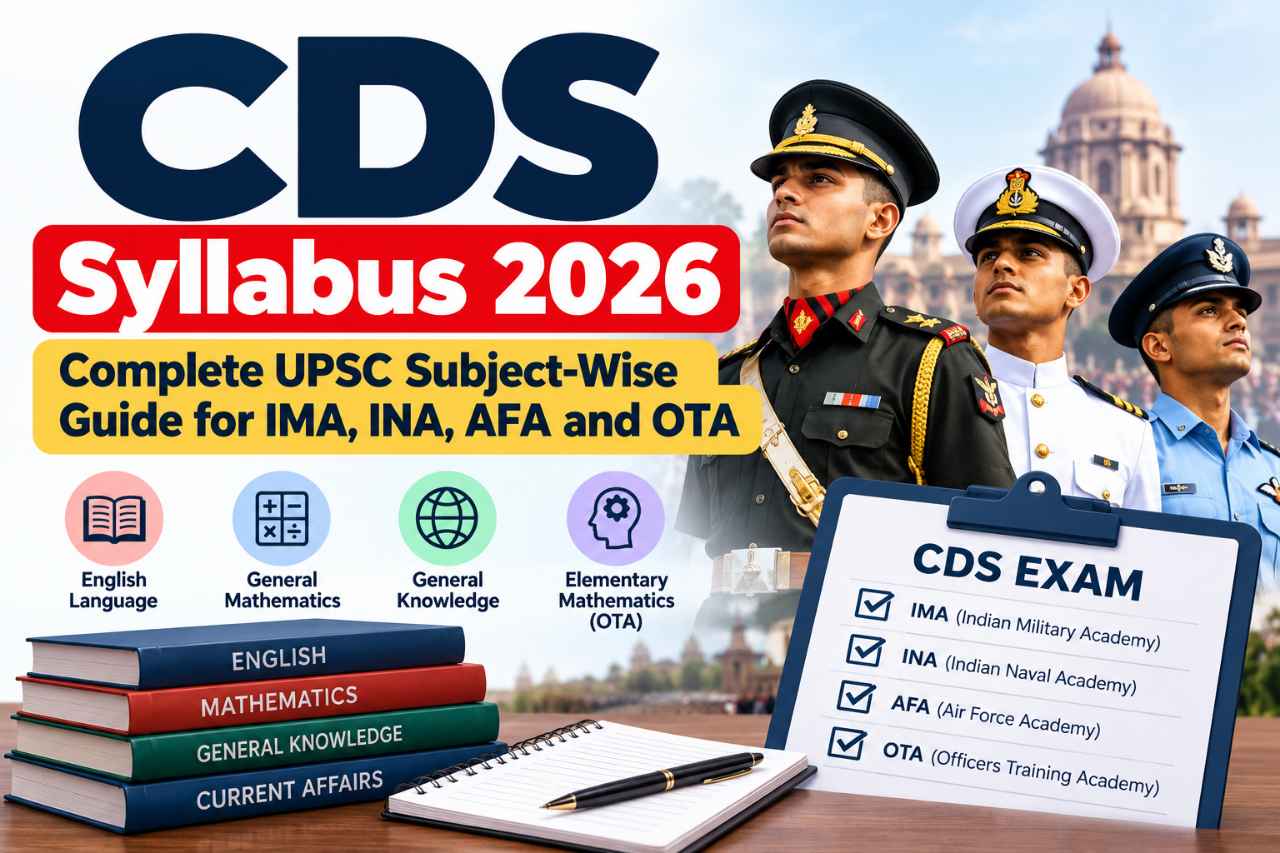

The Combined Defence Services (CDS) examination is one of India's most respected routes into the Indian Military Academy (IMA), Indian Naval Academy (INA), Air Force Academy (AFA), and Officers Training Academy (OTA). For CDS syllabus 2026, the Union Public Service Commission (UPSC) publishes the official topic list in the notification and syllabus PDF. Knowing that syllabus inside out is not optional it decides whether you study the right chapters, attempt the right mock tests, and enter the SSB interview with confidence.
This article explains the UPSC CDS exam syllabus subject by subject, how it differs for OTA versus IMA/INA/AFA, the written exam pattern, negative marking, and practical tips to build a six-month or twelve-month plan. Whether you are a final-year graduate or already working, use this as your single reference for syllabus-driven preparation. You will also find a subject-wise topic checklist, a sample 16-week coverage map, official PDF download steps, and answers to the most searched CDS syllabus questions useful for both search engines and voice-style “People Also Ask” results.
Defence aspirants often ask whether they should begin with books or with the notification PDF. The answer is simple: start with the PDF, then choose books that map chapter-by-chapter to that outline. That order saves money, reduces overwhelm, and keeps your revision measurable when exam day approaches.
What Is the CDS Exam and Why Does the Syllabus Matter?
CDS is a national-level recruitment exam conducted twice a year typically CDS (I) and CDS (II). Successful candidates proceed to the Service Selection Board (SSB) interview and medical tests before joining training academies. The written stage is entirely objective (multiple choice), but the breadth of General Knowledge and, for most entries, Mathematics makes syllabus discipline essential.
The official syllabus describes English and General Knowledge (GK) for all entries. Candidates for IMA, INA, and AFA also face Elementary Mathematics. OTA applicants both men and women for Short Service Commission take only English and GK. Questions are broadly at Class 10 and Class 12 standard for maths and science-linked GK, which is why school-level revision plus current affairs pays off.
CDS Syllabus 2026 at a Glance
Before diving into chapters, map your entry to the correct papers. Use the table below as a quick featured-snippet-friendly summary.
| Academy / Entry | Written Papers | Total Marks (Written) | Maths Required? |
|---|---|---|---|
| IMA, INA, AFA | GK, English, Elementary Mathematics | 300 | Yes |
| OTA (SSC) | GK, English | 200 | No |
Each paper carries 100 marks and two hours. Wrong answers attract negative marking (one-third of the marks assigned to that question in the standard UPSC scheme for CDS). Accuracy therefore matters as much as speed.
CDS Exam Pattern 2026 (Written Examination)
Pattern for IMA, INA, and AFA
- Paper 1: English 100 marks, 2 hours
- Paper 2: General Knowledge 100 marks, 2 hours
- Paper 3: Elementary Mathematics 100 marks, 2 hours
Pattern for OTA
- Paper 1: General Knowledge 100 marks, 2 hours
- Paper 2: English 100 marks, 2 hours
After clearing the written cutoff (which varies by academy and category), candidates receive call letters for SSB, spanning Stage I screening and Stage II psychological tests, group tasks, and personal interview over several days. Personality assessment is holistic; no single sub-test carries fixed isolated weight in the way written papers do.
CDS English Syllabus 2026
The UPSC states that the English paper is designed to test your understanding of the language and workmanlike use of words. In practice, that translates into vocabulary, grammar, comprehension, and sentence improvement not obscure literary criticism.
Topics You Should Cover
- Reading comprehension passages (fact, opinion, and inference-based)
- Spotting errors in grammar and usage
- Sentence completion and cloze tests
- Synonyms, antonyms, and idioms
- Ordering of words and sentences (para jumbles)
- Fill in the blanks (grammar and vocabulary)
- Direct and indirect speech, active and passive voice (where tested)
Actionable Tips
Read one editorial daily from a standard newspaper and summarise it in five sentences this builds comprehension speed. Maintain a vocabulary notebook with example sentences. Attempt at least two full English sections per week under timed conditions. Because English appears for every CDS entry including OTA, neglecting it while over-focusing on GK is a common mistake.
CDS General Knowledge Syllabus 2026
GK is described as knowledge of current events and matters of everyday observation and experience in their scientific aspects, as expected of an educated person without specialisation in science. The paper also includes History of India and Geography answerable without deep optional-subject study.
Major GK Areas
- Current affairs: national and international events, defence exercises, appointments, schemes, sports, awards (last 12–18 months heavily weighted)
- Indian history: ancient, medieval, and modern freedom struggle highlights
- Geography: physical, economic, and human geography of India and the world; maps and locations
- Indian polity and constitution: fundamental rights, Parliament, judiciary, constitutional bodies
- Economy: basic concepts, budget terminology, banking, important indices
- General science: physics, chemistry, biology at school level applications in daily life
- Defence awareness: ranks, organisation, recent indigenous projects (from reliable news sources)
Actionable Tips
Split GK into static (history, polity, geography notes) and dynamic (monthly current affairs). Use mnemonics for chronology and map-based drilling for geography. Cross-check facts with official government portals when preparing notes accuracy supports trust and E-E-A-T. GK is common to all academies; it often decides rank when English scores cluster.
CDS Elementary Mathematics Syllabus 2026
Mathematics applies only to IMA, INA, and AFA aspirants. The UPSC-defined blocks are as follows.
Arithmetic (Number System and Related Topics)
- Number System: natural numbers, integers, rational and real numbers; division algorithm; prime and composite numbers; tests of divisibility; factorisation; logarithms (laws only); use of logarithmic tables
- Elementary Number Theory: division algorithm; prime and composite; factorisation; HCF and LCM; Euclidean algorithm; logarithms to base 10 and laws
Algebra
- Basic operations, simple factors, remainder theorem, HCF and LCM, theory of polynomials, quadratic equations, linear equations in two variables and their graphs
- Simultaneous linear inequations, practical problems on linear equations
- Set language and notation; rational expressions and conditional identities
- Laws of indices, surds, and indices
Trigonometry
- Sine, cosine, tangent values; simple trigonometric identities; use of trigonometric tables
- Simple cases of heights and distances
Geometry
- Lines and angles, plane and plane figures, theorems on properties of angles at a point, parallel lines, sides and angles of a triangle, congruency of triangles, similar triangles
- Concurrence of medians and altitudes, circles and their properties including tangents, parallelograms, rectangles, and square
Mensuration
- Areas of squares, rectangles, parallelograms, triangles, and circles
- Surface area and volume of cuboids, lateral surface and volume of right circular cones and cylinders, surface area and volume of spheres
Statistics
- Collection and tabulation of statistical data
- Graphical representation: histograms, bar charts, pie charts
- Measures of central tendency: mean, median, and mode
Actionable Tips for Maths
Revisit NCERT Classes 8–10 for concept clarity, then graduate to CDS-specific MCQ practice. Maintain a formula sheet and an error log for repeated mistakes. Aim for accuracy first; speed follows. OTA candidates can skip this section entirely and reallocate time to GK and English depth.
CDS OTA Syllabus Versus IMA, INA, and AFA
The CDS OTA syllabus is strictly English plus General Knowledge. There is no mathematics paper, which makes OTA attractive to humanities and commerce graduates. However, competition remains intense, and SSB standards are identical in rigour. Women candidates commonly target OTA; eligibility age bands differ from other entries, so always read the latest notification for exact dates.
Candidates eyeing the Navy or Air Force through INA or AFA must qualify Mathematics even if their graduation is in non-science streams plan extra months for maths if your school foundation is weak.
Eligibility, Graduation, and Planning Your Timeline
CDS requires a bachelor’s degree from a recognised university. Final-year students may apply if they can produce proof by the prescribed date. Your degree can be from any discipline; engineering, arts, or commerce all qualify if the institution is recognised.
If you are still choosing where to complete graduation, compare accredited institutions and their exam support culture. For example, students at universities in the Northeast may explore options such as Assam Down Town University while mapping long-term goals defence via CDS, or creative fields via exams like the NIFT entrance exam. The lesson is the same: pick a recognised degree path first, then layer competitive exam preparation on a stable academic base.
How to Download the Official CDS Syllabus PDF
UPSC hosts the notification and syllabus on upsc.gov.in. When the CDS 2026 notification releases, download the PDF and highlight subject headings. Cross-verify any third-party syllabus chart against that document official text wins if there is a mismatch.
- Visit the UPSC official website and open the Examinations section.
- Select Active Examinations or Archive for Combined Defence Services.
- Download the notification PDF; syllabus is embedded in the document.
- Print or annotate the English, GK, and Maths sections relevant to your academy choice.
Best Books and Resources (Syllabus-Aligned)
Choose materials that mirror the official outline rather than generic “defence exam” bundles.
- English: high-quality grammar reference plus previous years’ CDS English papers
- GK: standard Indian polity and history texts, atlas for geography, monthly current affairs magazine or curated notes
- Mathematics: NCERT foundation plus objective practice book covering arithmetic through statistics
- Revision: last 10–15 years’ CDS question papers and timed mock tests
Previous year papers reveal how UPSC translates broad syllabus lines into actual MCQs essential for AI-overview-friendly “what to study” queries and for your own benchmarking.
SSB After the Written Exam: What the Syllabus Does Not Cover
SSB assesses officer-like qualities: leadership, communication, reasoning, and social adaptability. Stage I includes Officer Intelligence Rating (OIR) and Picture Perception & Description Test (PP&DT). Stage II spans psychology tests, group testing officer tasks, interview, and conference. No PDF syllabus replaces daily practice in group discussions, current affairs articulation, and physical fitness. Treat written syllabus mastery as the gate; treat SSB as the differentiator.
Common Mistakes When Following the CDS Syllabus
- Studying engineering-level maths when elementary syllabus suffices
- Ignoring English because it feels “easy”
- GK notes without revision cycles current affairs fade quickly
- Skipping negative-marking strategy and over-attempting
- Using outdated syllabus charts from old notifications
Month-Wise Syllabus Coverage Framework (Example)
Adjust duration to your baseline; this 16-week sketch suits many working professionals.
- Weeks 1–4: English grammar revision + GK static (polity, history) + Maths number system and algebra
- Weeks 5–8: Daily comprehension + GK geography and science + Trigonometry and geometry
- Weeks 9–12: Full-length sectional tests + current affairs consolidation + Mensuration and statistics
- Weeks 13–16: Full mock papers, error log review, weak-topic drills, exam-day strategy
CDS Selection Process Beyond the Syllabus
Understanding where the syllabus fits in the full pipeline helps you allocate effort. The CDS selection process typically includes the written examination, SSB interview, medical examination, and final merit list based on combined performance as per rules in force for that year.
Written Stage
The written exam is conducted in offline pen-and-paper mode with OMR sheets. You mark answers for each MCQ within the two-hour window per paper. Because papers may be scheduled on the same day or across consecutive sessions depending on the cycle, check your admit card for exact timing and reach the centre early with valid ID.
SSB Stage
SSB is not a content syllabus in the textbook sense, yet it rewards the same habits good syllabus prep builds: clarity of thought, awareness of national issues, and calm under pressure. Stage I filters through OIR and PP&DT; those who clear it stay for Stage II tasks spread over multiple days. Assessors the interviewing officer, group testing officer, and psychologist evaluate you holistically rather than through a single numbered test.
Medical and Merit
Medical standards follow service-specific requirements. Even a strong written score cannot compensate for unmet medical criteria, so review basic fitness early. Merit lists combine written and SSB performance according to official weightage; cutoffs shift with vacancies and candidate performance each cycle.
Topic-Wise Preparation Examples for Featured Clarity
Abstract syllabus lines become easier when you attach sample question styles.
English example focus: A passage on economic policy might ask for the author’s tone, the meaning of a phrase in context, or the best title skills improved by daily reading, not cramming word lists alone.
GK example focus: A question might link a new defence partnership to a map location, or ask which constitutional article relates to a recent judgment linking static polity with current news.
Mathematics example focus: Mensuration problems often combine a cylinder and a cone; algebra may test forming equations from word problems about speed or work. Practise setting up equations quickly without skipping the read step.
CDS Syllabus 2026 and Exam Mode: Practical Exam-Day Tips
- Carry admit card, photo ID, and black ball-point pens as instructed; avoid prohibited items in the exam hall.
- Fill OMR bubbles completely and align question numbers carefully misalignment causes lost marks despite knowing answers.
- Allocate rough time per section: for three-paper candidates, fatigue management across the day matters; hydrate and rest between sessions if applicable.
- Leave questions blank when guessing would likely hurt your score under negative marking; attempt only when you can eliminate options.
- After the exam, shift focus to SSB-oriented reading and physical training rather than endlessly re-reading every GK note.
How CDS Compares to Other Graduate-Level Entrances
CDS sits alongside other post-graduation pathways. Unlike design entrances such as the NIFT entrance exam, which stress creativity, aptitude tests, and portfolio-oriented skills, CDS emphasises general academic breadth, officer suitability, and service commitment. Neither path is “easier” they serve different careers. Many students complete a solid bachelor’s programme whether at a central university, state institution, or private campus such as Assam Down Town University and then choose CDS if defence leadership is the goal.
Compared with single-subject post-graduate entrance tests, CDS rewards consistency across English, GK, and optional maths. That multidiscipline demand is exactly why the official syllabus PDF should be your anchor document rather than random social-media topic lists.
Staying Updated When UPSC Revises Notifications
Syllabus frameworks for CDS have been stable for years, but exam dates, age limits, and vacancy numbers change each notification. Subscribe to official UPSC alerts, verify any “CDS syllabus 2026 download” link against upsc.gov.in, and update your study plan when a new notification confirms exam centres and application windows. Third-party articles including curated guides like this one should always be cross-checked with primary sources for dates and eligibility numbers.
Conclusion
The CDS syllabus 2026 is structured but broad: English and General Knowledge for everyone; Elementary Mathematics for IMA, INA, and AFA. Anchor your preparation in the UPSC notification PDF, divide GK into static and current components, and practice maths only if your entry demands it. Pair syllabus coverage with previous year papers, disciplined negative-marking strategy, and early SSB orientation. With a recognised graduation in hand and a syllabus-first study plan, you maximise both written marks and interview readiness for a career as an officer in the Indian Armed Forces.