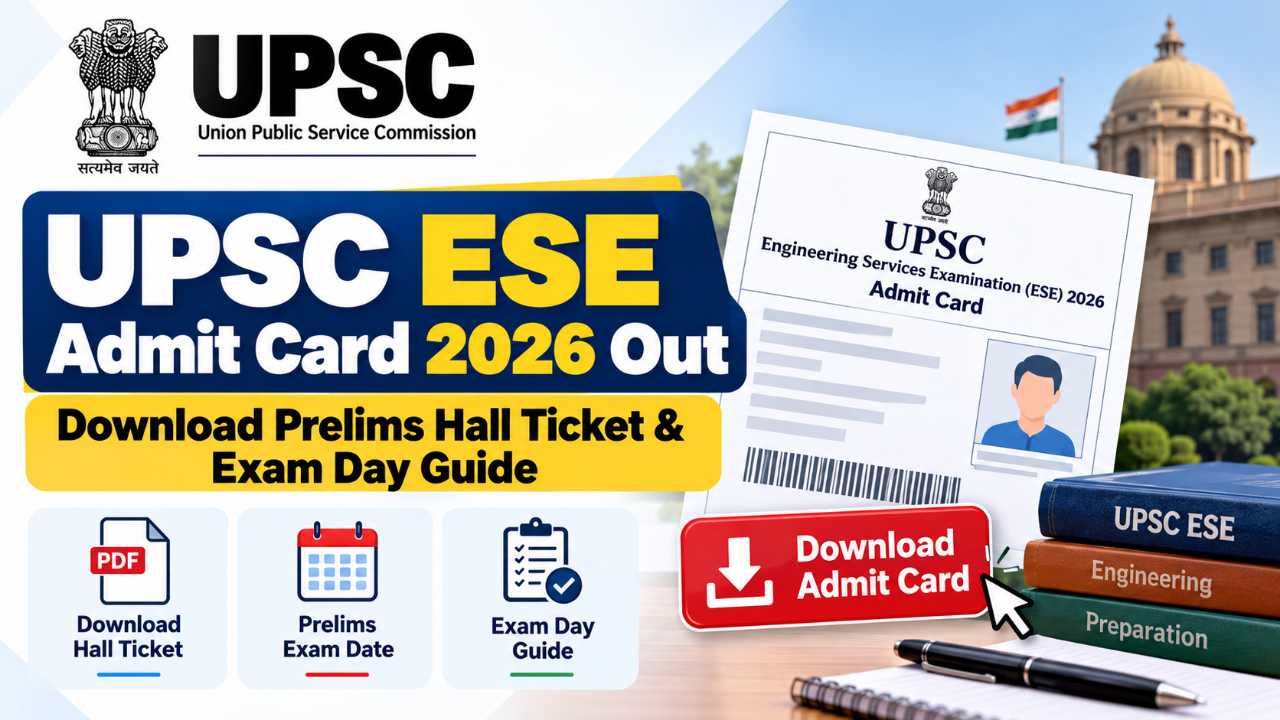

The UPSC Engineering Services Examination (ESE), widely known as IES, is one of India’s most respected recruitment exams for engineers who want to serve in central government departments such as Railways, CPWD, Defence, and Telecommunications. For the 2026 cycle, the Union Public Service Commission released the UPSC ESE admit card 2026 for the preliminary stage ahead of the exam held on 8 February 2026. Whether you are a final-year B.Tech student from an institution like MIT Anna University Chennai or a working professional revisiting competitive exams, your hall ticket is the single document that confirms your exam centre, timing, and identity on test day.
This guide explains what the ESE admit card is, important dates for 2026, step-by-step download instructions, details printed on the ticket, documents to carry, exam-day rules, and what to do if you spot errors. It is written for Indian engineering graduates and aspirants who follow official UPSC updates and want clear, actionable information aligned with current exam practice.
What Is the UPSC ESE Admit Card and Why It Matters
The ESE admit card also called an e-admit card or hall ticket is an official PDF issued by UPSC only through its website. It is not sent by post or email as a default practice. Without a valid printout (or as instructed in the latest notice) and matching photo ID, candidates are generally not permitted to enter the examination venue.
The preliminary exam is the first filter in a three-stage process. Qualifiers move to the engineering mains written papers and then to the personality test (interview). Separate admit cards or call letters are typically released for each stage, so saving your registration credentials after applying is essential for every download window.
Who Needs This Document?
Only candidates whose applications were accepted and who appear in the commission’s admitted list can download the active link. If the portal shows “not found” or invalid credentials, verify that you completed both parts of the application, paid fees on time, and are using the same registration ID or roll number mentioned in your confirmation email or application printout.
UPSC ESE Admit Card 2026: Key Dates and Exam Overview
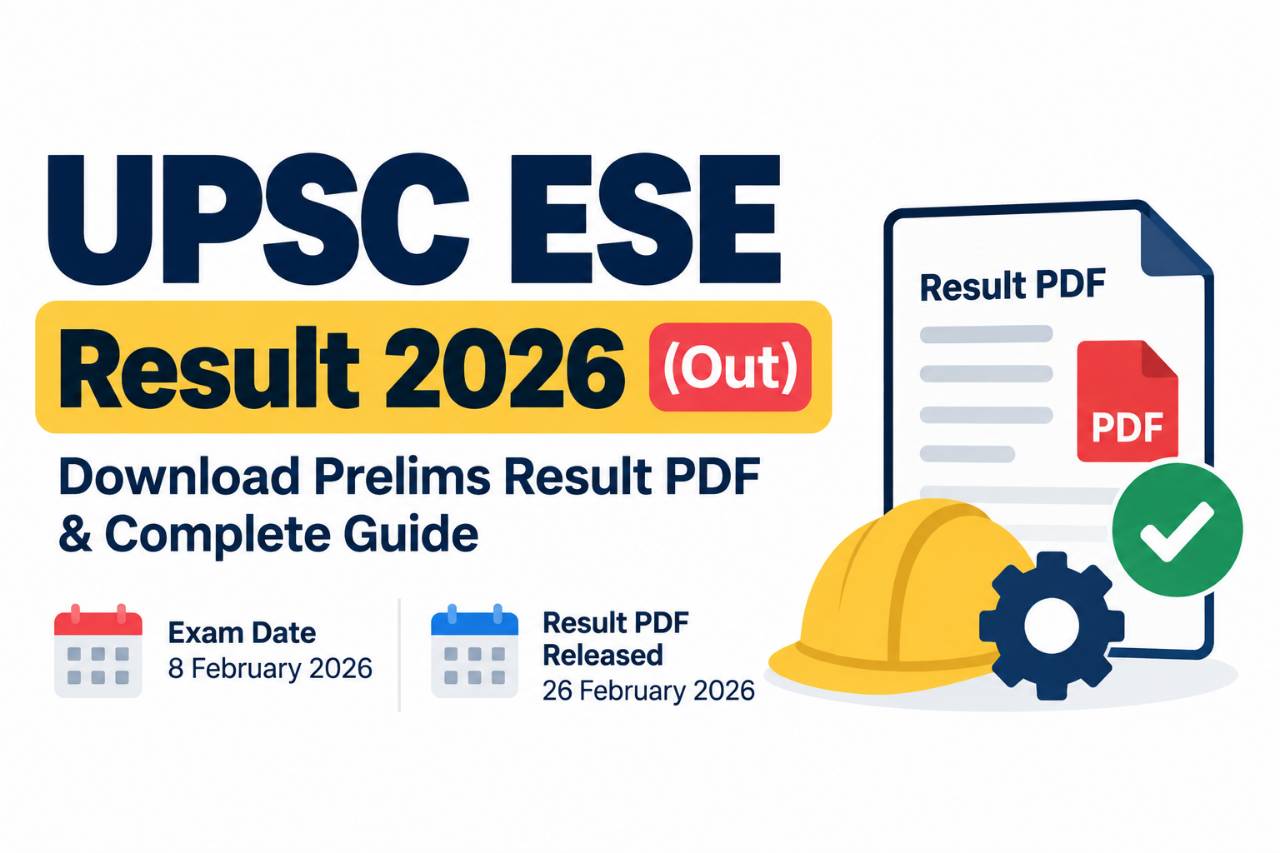
For the Engineering Services (Preliminary) Examination, 2026, UPSC notified the exam on 26 September 2025. The preliminary test was conducted on 8 February 2026 (Sunday) as a one-day offline (pen-and-paper) examination across centres in India. According to the official examination page and press note, the e-admit card was uploaded on 30 January 2026.
Understanding this timeline helps future aspirants plan travel, leave from college or office, and document checks. Students balancing campus placements with exams similar to those preparing for design entrances such as the NIFT Entrance Exam often underestimate how early admit cards appear; UPSC usually releases them roughly one to two weeks before the prelims.
Quick Reference: ESE 2026 Preliminary Cycle
- Notification: 26 September 2025
- Last date to apply: 16 October 2025 (6:00 PM)
- Preliminary exam date: 8 February 2026
- E-admit card availability: 30 January 2026
- Official portals: upsc.gov.in and upsconline.nic.in
Exam Pattern on Prelims Day (2026)
The preliminary stage has two papers on the same day. Paper I (General Studies and Engineering Aptitude) is common to all streams. Paper II is discipline-specific: Civil, Mechanical, Electrical, or Electronics & Telecommunication Engineering. Session timings are published in the official time table; candidates must follow the reporting time on their individual admit card, not generic social media posts.
Negative marking applies in the objective-type preliminary papers. This makes accuracy as important as speed an approach many engineers refine while studying alongside degrees from colleges such as DMI College of Engineering Chennai or IMS Engineering College.
Stages When UPSC Releases ESE Admit Cards
Unlike a single university semester hall ticket, ESE uses stage-wise e-admit cards:
- Preliminary admit card: For Paper I and Paper II at allotted centres in your chosen city.
- Mains admit card: Issued only to candidates who clear the preliminary written result; mains papers are descriptive.
- Personality test call letter: For candidates shortlisted after mains; the interview is commonly held at UPSC Bhawan, New Delhi.
Each release is announced under “Active Examinations” or “What’s New” on the UPSC site. Bookmark the Engineering Services examination page for your year so you do not rely on outdated third-party links.
How to Download UPSC ESE Admit Card 2026 Online
UPSC activates a dedicated e-admit card module before each stage. While exact button labels may change slightly year to year, the flow below reflects the standard process used for the 2026 preliminary hall ticket.
- Open the official website upsc.gov.in or the online portal upsconline.nic.in.
- Navigate to the section for E-Admit Cards or Active Examinations.
- Select Engineering Services (Preliminary) Examination, 2026 (or the current year’s listing).
- Read the instructions on the disclaimer page and proceed by clicking Yes where prompted.
- Enter your Registration ID or Roll Number, along with Date of Birth and the Captcha shown on screen.
- Click Submit to view your hall ticket.
- Download the PDF and print it on clean A4 paper. Keep at least two copies until final results are declared.
Tip: Use a desktop browser with pop-ups allowed for PDF download. Avoid last-minute downloads on exam morning when server load is high. If you forgot credentials, retrieve your registration ID from the application printout or email before the release date.
Candidates from North-Eastern states who studied at universities such as Assam Down Town University should confirm that the name on the admit card matches their ID proofs, especially if they have recently updated Aadhaar or passport details.
Details Mentioned on the ESE Hall Ticket
After downloading, verify every field carefully. Errors are rare but must be corrected before exam day through UPSC channels.
- Candidate’s name, photograph, and signature (as uploaded during application)
- Roll number and registration ID
- Date of birth, gender, and category (where applicable)
- Father’s name (as per application record)
- Exam date and session/shift timings
- Test city and complete address of the examination venue
- General instructions and items prohibited inside the hall
Cross-check the discipline code for Paper II so you receive the correct question booklet Civil, Mechanical, Electrical, or E&T. A mismatch between your applied branch and the admit card is a serious issue; contact the commission immediately.
Documents to Carry Along With the Admit Card
UPSC mandates identity verification at the venue. For the preliminary examination, carry:
- A clear printout of the e-admit card
- The same photo ID whose number you entered or that is referenced on the admit card commonly Aadhaar, Voter ID, PAN, driving licence, or passport
- A black ballpoint pen for marking responses on the OMR sheet (as per instructions for that year)
For later stages, UPSC may also ask for additional passport-size photographs identical to the one submitted in the application. Read the “Important Instructions” PDF appended to each e-admit card release.
Do not carry: mobile phones, smartwatches, Bluetooth devices, calculators (unless explicitly allowed in a specific paper notice), study material, or loose sheets. Violations can lead to disqualification and legal action.
UPSC ESE 2026 Vacancies and Engineering Disciplines
The Engineering Services Examination recruits officers for technical posts under the Government of India. The 2026 notification advertised hundreds of vacancies across core branches Civil, Mechanical, Electrical, and Electronics & Telecommunication Engineering allocated to services such as Indian Railway Service of Engineers, Central Engineering Service, and allied cadres. Exact vacancy numbers and community-wise break-up appear in the official PDF on upsc.gov.in; treat social media summaries as secondary until you match them with the notification.
Your admit card discipline must align with the branch you selected while filling Part II of the form. Switching branches after submission is not possible without a fresh cycle. Final-year students should ensure degree completion certificates are available before mains or document verification stages, as UPSC may ask for proof of eligibility beyond the preliminary admit card check.
Choosing and Reaching Your ESE Exam Centre
During application, candidates select a preferred examination city from the list in the notification. UPSC allots a specific venue within or near that city. The full address appears only on the individual hall ticket not on a generic city list so download your own card rather than following a friend’s centre address.
Plan logistics early: book train or bus tickets for overnight travel if your centre is outside your home town, identify parking or metro routes, and save the centre contact number if provided. On 8 February 2026, winter fog in North India sometimes delayed morning trains; building a one-day buffer for outstation travel is wise for future February prelims.
Sample Checklist Before Leaving Home
- Two printed copies of e-admit card
- Original photo ID and a photocopy if instructed
- Black ballpoint pens (carry spares)
- Transparent water bottle if allowed
- Simple wristwatch without smart features, only if permitted in that year’s instructions
- Snack for after the session not for consumption inside the hall
Exam Day Guidelines for ESE Aspirants
Discipline on exam day protects your candidature and helps you stay calm under pressure.
- Reach the centre at least 30–60 minutes before reporting time to complete frisking and seat allocation.
- Carry a transparent water bottle only if permitted in that year’s instructions.
- Plan local travel in advance; metro cities may have multiple centres with similar names.
- Wear modest clothing without large metal accessories to speed up security checks.
- Follow health advisories if UPSC publishes any for that session.
Engineering graduates often compare ESE with other career paths some peers pursue MBBS via institutes like All india institute of Medical Sciences New Delhi, while others target technical services through ESE. The admit card rules are stricter than most university exams because of national-level standardisation.
Understanding ESE Versus Other Engineering Career Exams
Indian engineers often choose among GATE (for M.Tech and PSU recruitment), state PSC exams, and UPSC ESE. ESE uniquely leads to Group A/Group B technical services with administrative responsibility. The admit card process mirrors other UPSC exams: online release, captcha login, and strict ID checks at the gate.
Students at multidisciplinary campuses such as IMS Unison University or Dr Vishwanath Karad MIT World Peace University should decide early whether their degree stream maps to the four ESE papers. Those whose programmes emphasise design or management may still qualify if the underlying degree is a recognised B.Tech in an eligible branch; read the fine print in the notification rather than assuming eligibility from college brochures alone.
Common Problems and How to Fix Them
Admit Card Link Not Opening
Try an alternate official domain (upsc.gov.in versus upsconline.nic.in), clear browser cache, or switch networks. If the release date has not been announced, no link will work wait for the press note.
Wrong Photo or Spelling on the Ticket
Contact UPSC promptly. Use the helpline or facilitation counter details published in the notification. Keep your application PDF and payment receipt ready.
Lost Registration ID
Check email/SMS from UPSC application system or Part-I registration printout. Without it, download may be delayed until you recover credentials.
UPSC Contact Details (Reference)
Address: Union Public Service Commission, Dholpur House, Shahjahan Road, New Delhi – 110069
Helpline: 011-24041001 / 011-40303444
Email: upscsoap@nic.in
Security, Fairness, and Instructions on the E-Admit Card PDF
Each UPSC e-admit card embeds “Important Instructions” covering frisking, barred items, and conduct rules. Candidates must read this annexure as carefully as they read technical syllabus topics. Mis-bubbling of roll numbers on OMR sheets, leaving the hall without permission, or carrying prohibited devices has led to cancellations in past cycles across various UPSC examinations.
UPSC also emphasises preserving the admit card until final results are declared because roll numbers on the ticket are used for score retrieval, objections against answer keys, and correspondence. Store digital backups in encrypted cloud folders in addition to physical printouts.
Accessibility and Special Requirements
Candidates with disabilities who requested scribes or compensatory time during application should verify that such concessions appear on the admit card or in a separate UPSC corrigendum. If approved facilities are missing, email the commission with proof of approval before the exam date. PwBD guidelines evolve; rely on the latest notification appendix for ESE 2026 rather than older forum posts.
Eligibility Reminder: Who Can Apply for ESE?
The admit card discussion assumes you already meet eligibility. ESE requires an engineering degree (B.E./B.Tech) in an eligible discipline from a recognised university. Integrated programmes recognised by UPSC may qualify if they meet notification wording. Pure B.Sc Engineering without the notified degree nomenclature generally does not qualify always read the current Engineering Services Examination Rules PDF.
Computer Science and other branches may be eligible depending on the year’s notification and service allocation. If you are unsure while still in college, align your electives and stream with the four conventional papers offered in prelims Paper II.
Institutions focused on management alongside technology such as IMS Management College produce graduates who sometimes pivot to technical services; your degree title on the final certificate must still match UPSC’s accepted list.
After Prelims: Results, Mains Admit Card, and Preparation
For ESE 2026 prelims, UPSC published written results on its official site after the February examination. Shortlisted candidates should monitor the same examination page for mains e-admit cards and revised time tables. Mains tests in-depth engineering knowledge through conventional papers; personality tests assess leadership, ethics, and communication.
While waiting for scores, avoid discarding your preliminary admit card. It contains roll numbers needed for answer-key objections and result lookups. Maintain a folder of UPSC correspondence similar to how medical aspirants track counselling documents for institutes such as All india institute of Medical Sciences Bhopal organisation reduces stress across multi-stage exams.
Preparation and College Life: Balancing ESE With Academics
Many Indian engineering students start ESE preparation in the third or fourth year. Time management matters more than brute study hours. Use standard textbooks for your discipline, previous years’ papers, and a structured plan for Paper I (current affairs, ethics, and basic sciences at engineering aptitude level).
Campus resources vary. Some universities host GATE or ESE discussion groups; others rely entirely on self-study. Wherever you study whether at MIT Art Design and Technology University Pune, MIT Vishwaprayag University, or regional engineering colleges sync mock tests with your academic calendar so project deadlines and lab exams do not clash with UPSC prelims in February.
Conclusion
The UPSC ESE admit card 2026 for prelims was released on 30 January 2026, enabling lakhs of engineering aspirants to confirm centres for the 8 February 2026 examination. Treat the hall ticket as a legal entry pass: download it only from UPSC, verify every detail, carry approved ID, and follow exam-day instructions printed on the PDF. For mains and personality test stages, repeat the same careful process when new e-admit cards go live.
If you are beginning your engineering journey, choose a recognised B.Tech programme, track official notifications early, and keep registration credentials secure. Whether your goal is Indian Engineering Services or another competitive path, disciplined document management starting with the admit card is a small habit that prevents large setbacks on exam day.